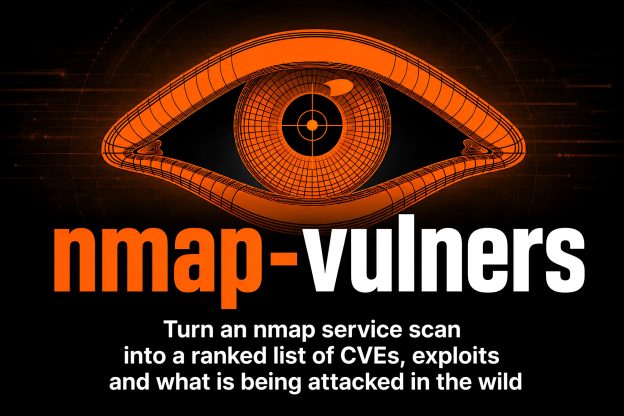
The Vulners team has released nmap-vulners 2.0. This plugin (an NSE script) turns the popular Nmap port scanner into a black-box vulnerability scanner. Simply run $ nmap -sV --script vulners <target> to get a prioritized report on vulnerabilities and exploits. And all of this is available for free with no limitations. 🆓😉
How exactly does this plugin work?
To find vulnerabilities, the software is identified first:
🔹 The service's CPE identifier may be provided by Nmap itself (using the -sV option).
🔹 If Nmap fails to identify the service, the plugin attempts to determine the CPE identifier from the raw banner using rules for FTP, SMTP, SSH, MySQL, DNS, NTP, LDAP, and other services. Starting with version 2.0, the fingerprint catalog is updated weekly based on Recog, Wappalyzer, WhatWeb, FingerprintHub, and nuclei-templates. The latest catalog is automatically fetched when the plugin runs.
🔹 If an HTTP service is detected, nmap-vulners also attempts to identify the web stack, including the framework, CMS, or PHP version behind a reverse proxy. It analyzes Server and X-Powered-By headers, cookies, the page title, meta tags, filenames in script src, and page content. The plugin includes more than 700 rules. In version 2.0, the number of HTTP path fingerprints increased from 125 to 939, while parallelization kept the processing time at around 6 seconds per port.
🔹 If a product is identified but its version is unknown, the plugin makes a single request to a known file that contains version information, such as /CHANGELOG.txt for Drupal or /administrator/manifests/files/joomla.xml for Joomla. This works with Concrete5, Drupal, Jira, Joomla, Apache Tomcat, and WordPress.
🔹 Finally, if a service cannot be identified, Smart Audit can be used. The raw banner is sent to the Vulners server, which identifies the software and its version and then looks for related vulnerabilities. This is the only paid feature! Each unique request costs 1 credit, and results are cached. The number of requests is limited by the vulners.max_items parameter, which defaults to 32. Smart Audit can be disabled entirely with --script-args vulners.max_items=0.
The service data is then sent to the Vulners server, which returns a prioritized vulnerability report. For each vulnerability or exploit, the report includes its ID, SEVERITY level, CVSS and EPSS scores, Vulners AI score, KEV and EXP flags, and a link to its page on the Vulners website.
So, is an API key actually required?
🔹 The plugin can work without an API key. However, detection will use the legacy endpoint, and some vulnerability and exploit data will not be available.
🔹 Adding an API key, even without credits, enables the "EXP" flag for vulnerabilities and the "KEV" flag for both vulnerabilities and exploits. It also adds an EPSS score column, providing more complete prioritization: KEV → CISA SSVC Exploitation Active → exploits → EPSS → CVSS. So, an API key is recommended. 😉
🔹 If your API key has credits, the Smart Audit feature is also available (see above).
Installation
To install the plugin, simply run the one-line script. The installer automatically finds Nmap and its NSE script directory, installs the latest vulners.nse version, and removes old 1.x files. It then runs nmap --script-updatedb and verifies the installation. The --user and --prefix options let you specify the installation directory, while --uninstall removes the plugin. If needed, the installer prompts for a Vulners API key, validates it, and saves it to ~/.nmap/vulners.key with permissions set to 600.