

Tag Archives: DNS

May Microsoft Patch Tuesday

May Microsoft Patch Tuesday

May Microsoft Patch Tuesday. A total of 119 vulnerabilities, approximately 1.5 times fewer than in April. There are currently no vulnerabilities marked as actively exploited in the wild. However, there is one vulnerability with a public exploit:

🔸 EoP - Windows Kernel (CVE-2026-40369). A detailed write-up and exploit for this vulnerability were published on May 14, two days after the May MSPT. The researcher describes exploitation of the vulnerability as follows: "A single syscall from any unprivileged process — including inside Chrome's renderer sandbox — can increment arbitrary kernel memory addresses. No race conditions. No heap spray. No special tokens. 100% deterministic privilege escalation to SYSTEM."

Among the remaining ones, the following stand out:

🔹 RCE - Windows DNS Client (CVE-2026-41096). A ZDI analyst commented on this vulnerability as follows: "This patch fixes a heap-based buffer overflow in the DNS Client triggered by a malicious DNS response. No authentication or user interaction needed, and since the DNS Client runs on virtually every Windows machine, the attack surface is enormous. An attacker with a position to influence DNS responses (MitM, rogue server) could achieve unauthenticated RCE across your enterprise."

🔹 RCE - Windows Netlogon (CVE-2026-41089). The vulnerability allows an unauthenticated remote attacker to execute arbitrary code on a domain controller by sending a specially crafted network request. Exploitation does not require credentials or user interaction, which classifies this vulnerability as wormable. Compromise of a domain controller means full compromise of the organization's entire domain. A Rapid7 analyst added in their commentary: "No privileges or user interaction are required, and attack complexity is low, which suggests that creation of a reliable exploit might not be especially difficult for anyone with knowledge of the specific mechanism. Microsoft assesses exploitation as less likely, but since those exploitability assessments are provided without an accompanying explanation, it's not clear how much reassurance defenders should take. Anyone who remembers the much-discussed CVE-2020-1472 (aka ZeroLogon) back in 2020 will note that CVE-2026-41089 offers an attacker more immediate control of a domain controller. Patches are available for all versions of Windows Server from 2012 onwards."

🔹 RCE - Windows TCP/IP (CVE-2026-40415). Commentary from a ZDI analyst: "This bug in the TCP/IP stack results from a use-after-free (UAF) and could allow a remote, unauthenticated threat actor to execute code without user interaction. That makes this another wormable bug. However, this one is much less likely to be exploited. The target needs to be under sustained low-memory (memory pressure) conditions, which is pretty rare."

🔹 RCE - Microsoft Word (CVE-2026-40361, CVE-2026-40364, CVE-2026-40366, CVE-2026-40367). An attacker can exploit these vulnerabilities through social engineering by sending a malicious file to a targeted victim. Successful exploitation would grant the attacker arbitrary code execution. Microsoft researchers note that the Preview Pane is an attack vector for each of these vulnerabilities.

🔹 RCE - Microsoft Office (CVE-2026-40363, CVE-2026-42831). A heap-based buffer overflow vulnerability in Microsoft Office may allow an unauthorized attacker to remotely execute arbitrary code.

🔹 RCE - Windows GDI (CVE-2026-35421). A heap-based buffer overflow vulnerability in the Windows GDI component may allow an unauthorized attacker to remotely execute arbitrary code.

🔹 RCE - Microsoft Dynamics 365 On-Premises (CVE-2026-42898). Commentary from a ZDI analyst: "It allows any authenticated user to execute code with a scope change, meaning exploitation can break out and affect resources beyond the vulnerable component itself. Scope changes are pretty rare, so if you're running Dynamics 365 On-Prem, definitely test and deploy this patch quickly."

🔹 EoP - Windows Kernel (CVE-2026-33841, CVE-2026-35420, CVE-2026-40369). CVE-2026-33841 and CVE-2026-40369 are rated "Exploitation More Likely". A local attacker can use these vulnerabilities to elevate privileges to SYSTEM level. In the case of CVE-2026-33841, the attacker can elevate privileges to Medium/High integrity level.

🗒 Full Vulristics report

About Denial of Service - PAN-OS (CVE-2024-3393) vulnerability

About Denial of Service - PAN-OS (CVE-2024-3393) vulnerability

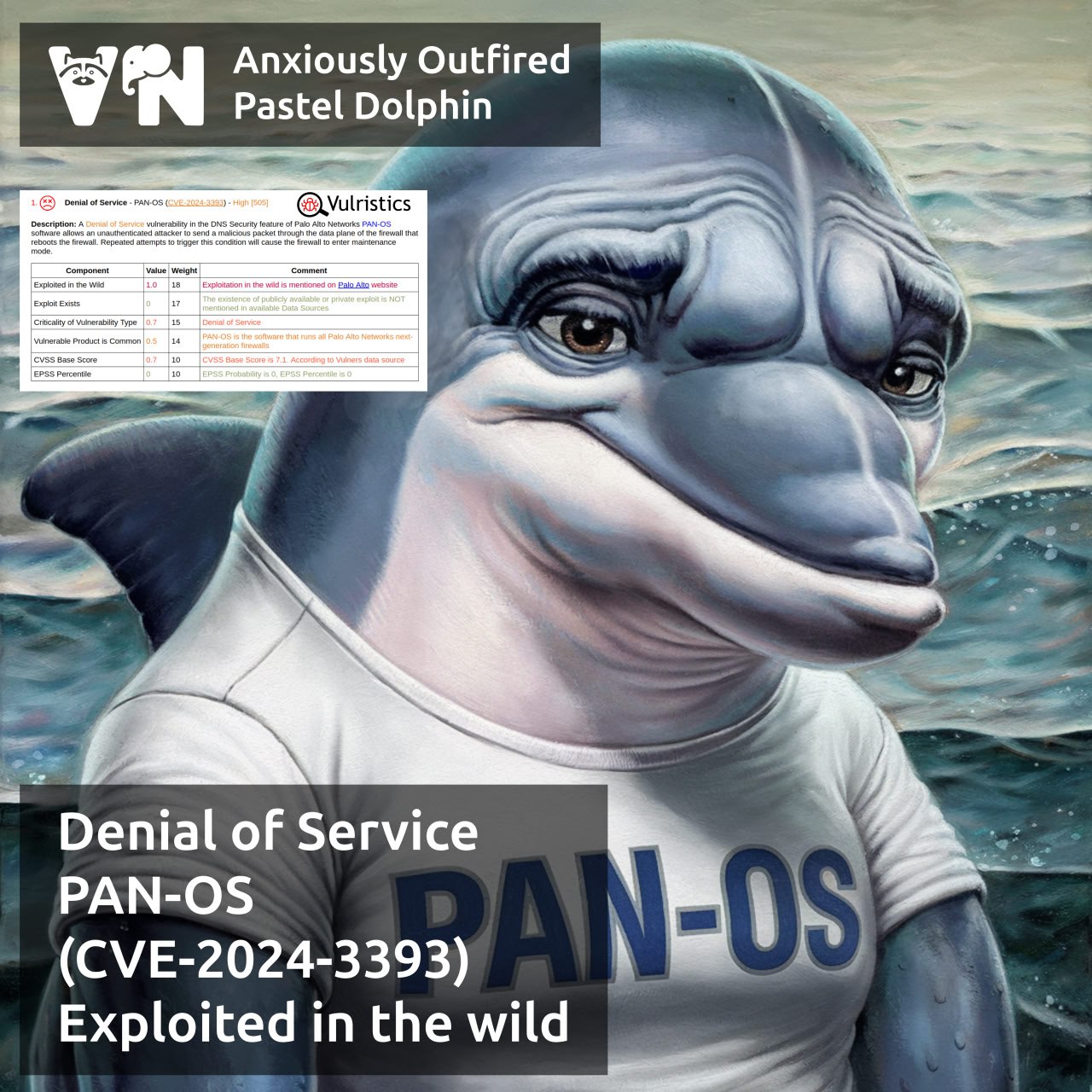
About Denial of Service - PAN-OS (CVE-2024-3393) vulnerability. PAN-OS is the operating system that runs all Palo Alto Network NGFWs. The vendor's advisory was released on December 27. Аn unauthenticated attacker can send a malicious packet through the data plane of the firewall, causing it to reboot. Repeated attempts to trigger this condition will cause the firewall to enter maintenance mode. For exploitation the logging option of the "DNS Security" feature must be enabled.

👾 Palo Alto has already detected attacks that exploit this vulnerability. There are no public exploits yet.

👀 CyberOK detects more than 500 PAN-OS installations in RuNet, of which 32 are potentially vulnerable. Additionally, 218 hosts are running PAN-OS version 11.0.x, which is no longer supported by the vendor since November 17.

🔧 To fix the vulnerability, you need to update your device or, as a workaround, disable the logging option of the "DNS Security" function.

На русском

First impressions of the April Microsoft Patch Tuesday

First impressions of the April Microsoft Patch Tuesday
First impressions of the April Microsoft Patch TuesdayFirst impressions of the April Microsoft Patch TuesdayFirst impressions of the April Microsoft Patch TuesdayFirst impressions of the April Microsoft Patch TuesdayFirst impressions of the April Microsoft Patch TuesdayFirst impressions of the April Microsoft Patch TuesdayFirst impressions of the April Microsoft Patch TuesdayFirst impressions of the April Microsoft Patch TuesdayFirst impressions of the April Microsoft Patch Tuesday

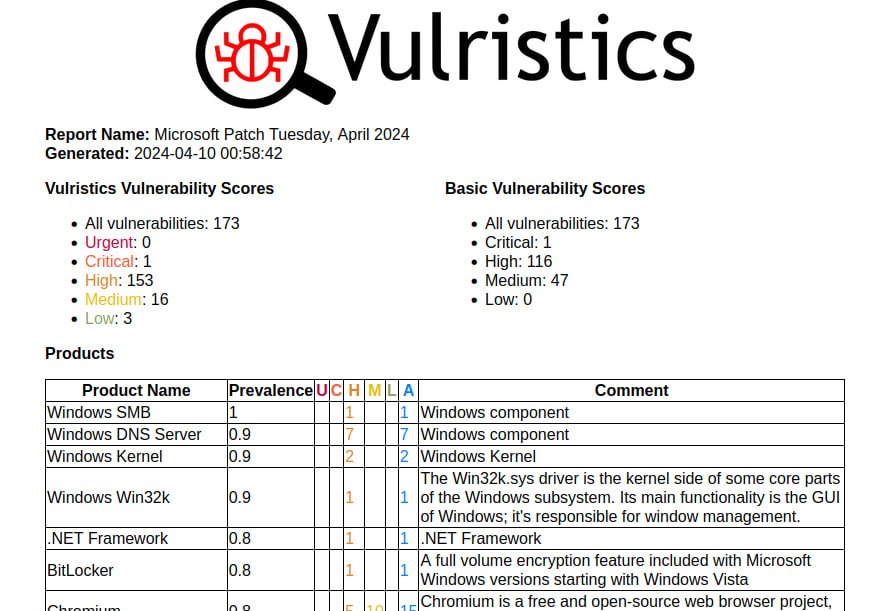
First impressions of the April Microsoft Patch Tuesday. I don't even know what to write. 🤪 Very strange! 173 vulnerabilities, of which 23 were added since the last Patch Tuesday.

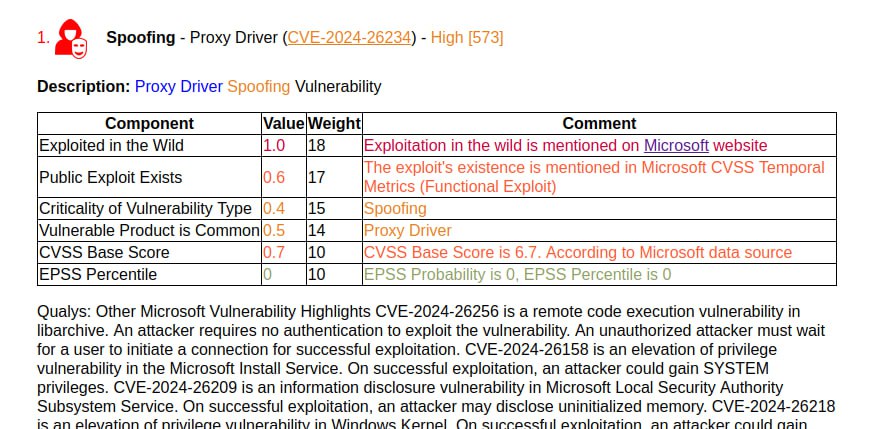
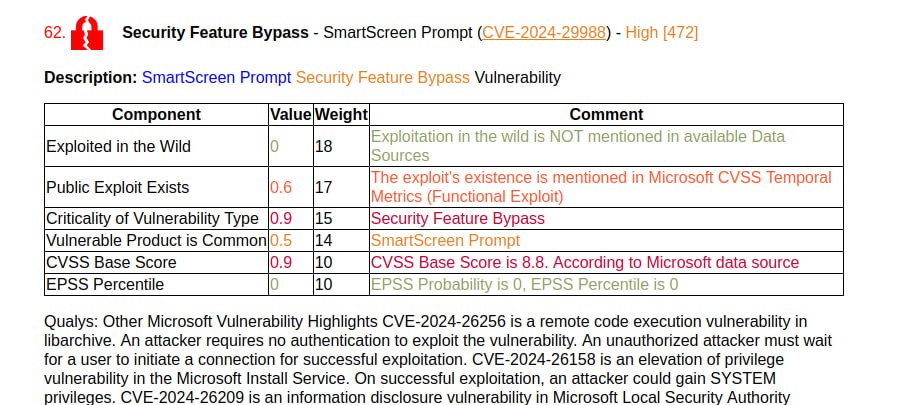
Microsoft flags one vulnerability as being exploited in the wild: Spoofing - Proxy Driver (CVE-2024-26234). And only Qualys briefly mentions it. Literally like this: "Microsoft has not disclosed any information about the vulnerability". 😅 ZDI also claims that Security Feature Bypass - SmartScreen Prompt (CVE-2024-29988) is being exploited in the wild, which is a Mark of the Web (MotW) bypass.

There are no exploits for anything yet. The following vulnerabilities can be highlighted:

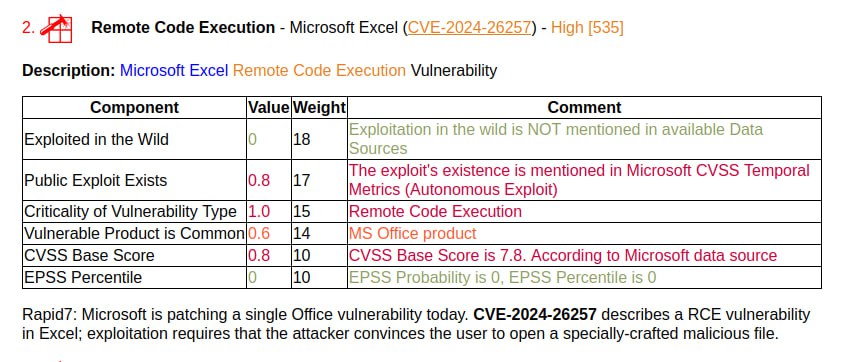
🔸 Remote Code Execution - Microsoft Excel (CVE-2024-26257). Can be exploited by an attacker when the victim opens a specially crafted file.
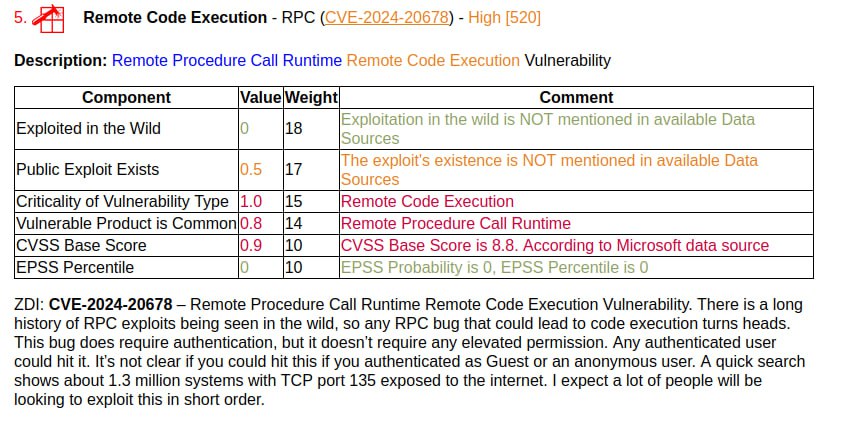
🔸 Remote Code Execution - RPC (CVE-2024-20678). It is highlighted by ZDI, which also claims 1.3 million exposed TCP 135 ports.
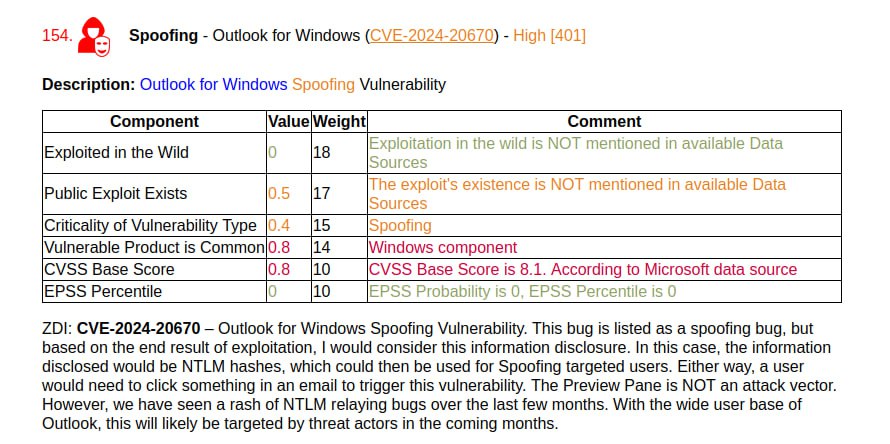
🔸 Spoofing - Outlook for Windows (CVE-2024-20670). ZDI writes that this is an Information Disclosure vulnerability that can be used in NTLM relay attacks.
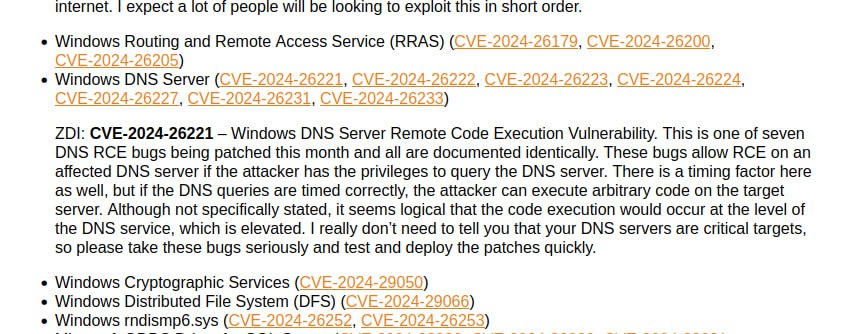
🔸 Remote Code Execution - Windows DNS Server (CVE-2024-26221, CVE-2024-26222, CVE-2024-26223, CVE-2024-26224, CVE-2024-26227, CVE-2024-26231, CVE-2024-26233). Maybe some of this will be exploited in the wild, ZDI particularly highlights CVE-2024-26221.
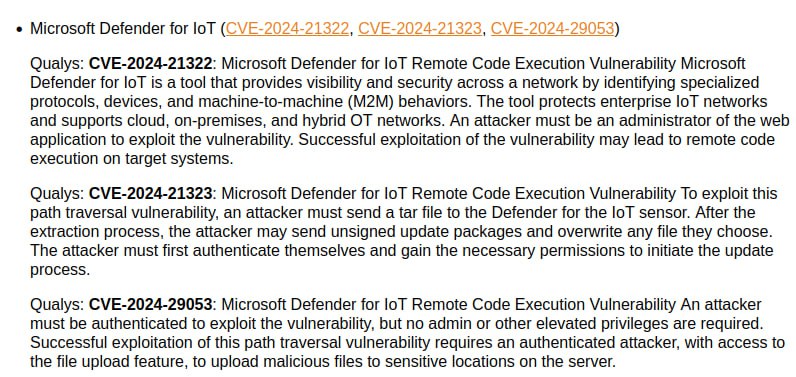
🔸 Remote Code Execution - Microsoft Defender for IoT (CVE-2024-21322, CVE-2024-21323, CVE-2024-29053). It is an IoT and ICS/OT security solution that can be deployed on-prem.

There are simply indecently massive fixes:

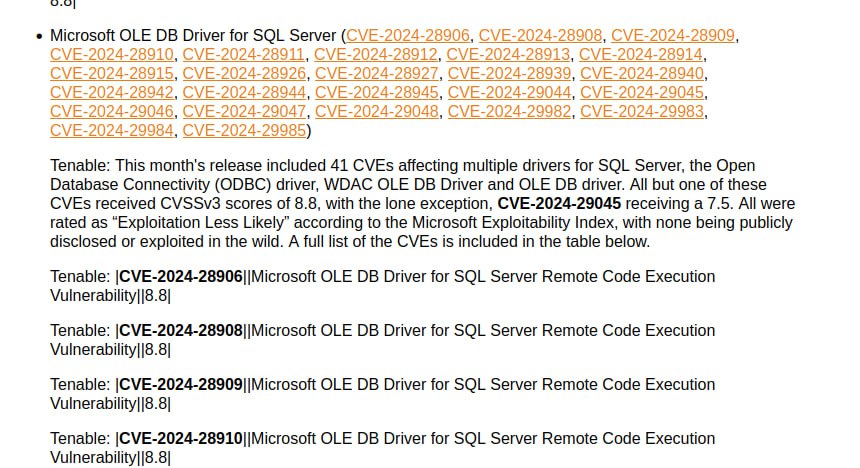
🔹 Remote Code Execution - Microsoft OLE DB Driver for SQL Server / Microsoft WDAC OLE DB Provider for SQL Server / Microsoft WDAC SQL Server ODBC Driver. 28 CVEs! I won’t even list everything here. 😨
🔹 Security Feature Bypass - Secure Boot. 23 CVEs!

🗒 Vulristics report

На русском

Upd. 10.04 I slightly tweaked the vulnerability type detection to increase the priority of the detection based on the Microsoft generated description compared to the detection based on CWE. In particular, the type of vulnerability for Spoofing - Proxy Driver (CVE-2024-26234) and Spoofing - Outlook for Windows (CVE-2024-20670) has changed.

Microsoft Patch Tuesday April 2023: CLFS EoP, Word RCE, MSMQ QueueJumper RCE, PCL6, DNS, DHCP

Microsoft Patch Tuesday April 2023: CLFS EoP, Word RCE, MSMQ QueueJumper RCE, PCL6, DNS, DHCP. Hello everyone! This episode will be about Microsoft Patch Tuesday for April 2023, including vulnerabilities that were added between March and April Patch Tuesdays.

Alternative video link (for Russia): https://vk.com/video-149273431_456239123

As usual, I use my open source Vulristics project to analyse and prioritize vulnerabilities. I took the comments about the vulnerabilities from the Qualys, Tenable, Rapid7, ZDI Patch Tuesday reviews. And this is the first Patch Tuesday report since I added EPSS support to Vulristics. 😉

Compared to March, Microsoft Patch Tuesday for April 2023 is kind of weak. 🙄

Continue reading

Microsoft Patch Tuesday September 2022: CLFS Driver EoP, IP packet causes RCE, Windows DNS Server DoS, Spectre-BHB

Microsoft Patch Tuesday September 2022: CLFS Driver EoP, IP packet causes RCE, Windows DNS Server DoS, Spectre-BHB. Hello everyone! Let’s take a look at Microsoft’s September Patch Tuesday. This time it is quite compact. There were 63 CVEs released on Patch Tuesday day. If we add the vulnerabilities released between August and September Patch Tuesdays (as usual, they were in Microsoft Edge), the final number is 90. Much less than usual.

Alternative video link (for Russia): https://vk.com/video-149273431_456239101

Continue reading

Microsoft Patch Tuesday April 2022 and custom CVE comments sources in Vulristics

Microsoft Patch Tuesday April 2022 and custom CVE comments sources in Vulristics. Hello everyone! This episode will be about Microsoft Patch Tuesday for April 2022 and new improvements in my Vulristics project. I decided to add more comment sources. Because it’s not just Tenable, Qualys, Rapid7 and ZDI make Microsoft Patch Tuesday reviews, but also other security companies and bloggers.

Alternative video link (for Russia): https://vk.com/video-149273431_456239085

You can see them in my automated security news telegram channel avleonovnews after every second Tuesday of the month. So, now you can add any links with CVE comments to Vulristics.

Continue reading

Microsoft Patch Tuesday February 2022

Microsoft Patch Tuesday February 2022. Hello everyone! This episode will be about Microsoft Patch Tuesday for February 2022. I release it pretty late, because of the my previous big episode about the blindspots in the Knowledge Bases of Vulnerability Scanners. Please take a look if you haven’t seen it. Well, if you are even slightly interested in the world news, you can imagine that the end of February 2022 in Eastern Europe is not the best time to create new content on Vulnerability Management. Let’s hope that peace and tranquility will be restored soon. And also that geopolitical confrontation between the largest nuclear powers will de-escalate somehow.

But let’s get back to information security. While working on Microsoft Patch Tuesday report for February 2022, I made a lot of improvements to my open source project for vulnerability prioritization Vulristics. I want to start with them.

Continue reading