

Tag Archives: Kerberos

September Linux Patch Wednesday

September Linux Patch Wednesday

September Linux Patch Wednesday. There are 2,653 vulnerabilities in total. For comparison, in August, there were 3,060 - 13% more. This time, the Linux Kernel has 812 vulnerabilities, and Chromium has 644. There are signs of exploitation in the wild for 6 vulnerabilities:

🔻 RCE - Gitea (CVE-2026-60004). Gitea is a popular platform for hosting Git repositories on your own servers. An attacker with basic write access to a repository can run arbitrary shell commands as the Gitea OS user. With open registration enabled by default, even an unauthenticated attacker can get the required access by creating an account and a repository. The vulnerability was added to CISA KEV on August 25. A campaign exploiting the vulnerability to install the XMRig cryptominer has been observed. Public exploits have been available on GitHub since July 29. The vulnerability was fixed in ALT Linux packages on August 27.

🔻 AuthBypass - Gitea (CVE-2026-20896). The vulnerability allows a remote attacker to bypass authentication and log in to Gitea as another user, including an administrator. The vulnerability was added to VulnCheck KEV on July 6. Public exploits have been available on GitHub since July 2. The vulnerability was fixed in ALT Linux packages on August 27.

🔻 AuthBypass - Keycloak (CVE-2026-18963). Keycloak is a popular platform for identity and access management (IAM/SSO). A vulnerability in the password reset mechanism allows an unauthenticated remote attacker to reset any user's password and take over their account without email confirmation. The vulnerability was added to VulnCheck KEV on August 25. Public exploits have been available on GitHub since August 20. The vulnerability was fixed in ALT Linux packages on August 20.

🔻 RCE - Chromium (CVE-2026-85046, CVE-2026-87491). Chromium is a web browser project that forms the basis of Google Chrome and other browsers. Vulnerabilities in the V8 JavaScript engine allow a remote attacker to execute arbitrary code within the browser sandbox if a user opens a malicious HTML page. Both vulnerabilities are exploited in the wild and were added to the CISA KEV on September 4 and September 9. Public exploits have been available on GitHub since September 4. The vulnerabilities have been fixed in ALT Linux and Debian packages since September 5.

🔻 RCE - SPIP (CVE-2026-77806). SPIP is an open-source CMS for creating and collaboratively editing websites. The critical vulnerability allows an unauthenticated remote attacker to execute arbitrary code on the server. The vulnerability was added to VulnCheck KEV on August 21. A Metasploit module is available. The vulnerability has been fixed in Debian packages since August 21.

For another 205 vulnerabilities, there are currently no signs of exploitation in the wild, but public exploits are available. Among them, the following stand out:

🔸 AuthBypass - FreeIPA (CVE-2026-76578). FreeIPA is a solution for centralized identity and access management in Linux infrastructures (LDAP/Kerberos). A remote, unauthenticated attacker can obtain membership in the FreeIPA administrator group and perform administrative operations against the directory and, on SID-enabled deployments, other IdM services. A public exploit has been available on GitHub since September 9. The vulnerability was fixed in ALT Linux packages on September 7.

🔸 RCE - PHP/Adminer (CVE-2026-56705). Adminer is a popular web-based tool for database administration, often deployed alongside PHP applications. The vulnerability allows an unauthenticated remote attacker to write PHP code to the web server's document root and execute it, thereby achieving RCE. A public exploit has been available on GitHub since August 25. The vulnerability has been fixed in Debian packages since September 16.

🗒 Full Vulristics report

September Microsoft Patch Tuesday

September Microsoft Patch Tuesday

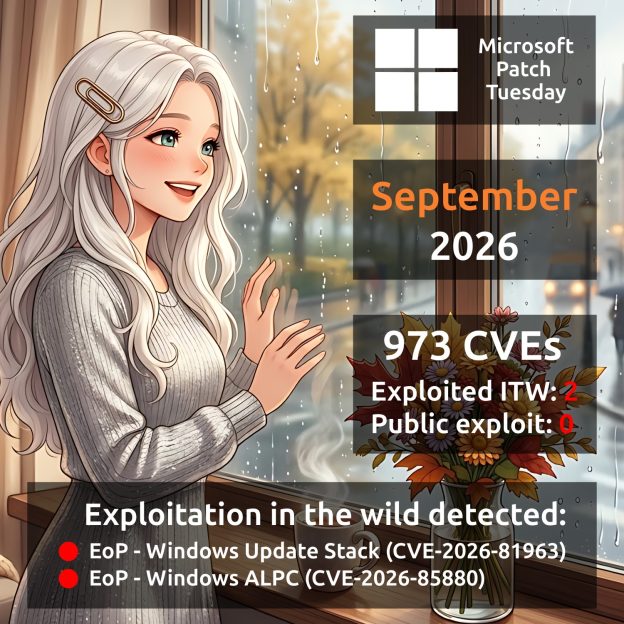
September Microsoft Patch Tuesday. A total of 973 vulnerabilities were addressed - more than twice as many as in August. Seven products had 20 or more vulnerabilities fixed: Windows Biometric Service (64), Microsoft SQL Server (54), Windows DHCP Server (36), Microsoft Office Word (35), Windows NTFS (29), Microsoft Excel (28), and Windows Win32k (24). Vulnerabilities affecting these products account for just under one-third of the total. Two vulnerabilities are known to have been exploited in the wild:

🔻 EoP - Windows Update Stack (CVE-2026-81963). A link following flaw in the Windows Update Stack (CWE-59) may allow an authenticated attacker to elevate privileges locally. An attacker who successfully exploited this vulnerability could gain SYSTEM privileges.

🔻 EoP - Windows Advanced Local Procedure Call (ALPC) (CVE-2026-85880). A heap-based buffer overflow flaw in Windows ALPC (CWE-122) may allow an authenticated attacker to elevate privileges locally. An attacker who successfully exploited this vulnerability could gain SYSTEM privileges.

There are no vulnerabilities with public exploits yet. Of the remaining vulnerabilities, the following can be highlighted:

🔹 RCE - Microsoft Exchange (CVE-2026-55007). A remote, unauthenticated attacker could achieve code execution on a vulnerable Exchange server by sending an email containing a malicious Visio attachment. The code is executed when the server processes the message, without requiring the victim to open it or use the Preview Pane.

🔹 RCE - Remote Desktop Services (CVE-2026-69525). Successful exploitation of this flaw would allow an unauthenticated attacker to execute arbitrary code by exploiting a use-after-free flaw.

🔹 RCE - Windows DNS Server (CVE-2026-69730). According to the advisory, an unauthenticated, remote attacker could send a crafted packet to exploit a use-after-free flaw in Windows DNS in order to achieve remote code execution.

🔹 RCE - Windows USB Mass Storage Class Driver (CVE-2026-68839). Successful exploitation of this vulnerability could allow an attacker the ability to gain remote code execution via an in-network attacker calling arbitrary endpoints.

🔹 RCE - Windows Kerberos (CVE-2026-69676). An authentication-bypass flaw via capture-replay in Windows Kerberos may allow an authenticated attacker to execute code over a network.

🔹 RCE - Windows Key Distribution Center (CVE-2026-69712). A use-after-free flaw in the Windows Key Distribution Center may allow an authenticated attacker to execute code over a network.

🔹 EoP - Microsoft Exchange (CVE-2026-69380). An authenticated attacker with access to a mailbox through a low-privileged user account could exploit this vulnerability to gain access to other mailboxes. Successful exploitation would allow the attacker to send and receive emails on behalf of other Exchange users as well as access attachments.

🗒 Full Vulristics report

July "In the Trend of VM" (#17): vulnerabilities in Microsoft Windows and Roundcube

July In the Trend of VM (#17): vulnerabilities in Microsoft Windows and Roundcube

July "In the Trend of VM" (#17): vulnerabilities in Microsoft Windows and Roundcube. A traditional monthly roundup. This time, it's a very short one. 🙂

🗞 Post on Habr (rus)
🗒 Digest on the PT website (rus)

Only three trending vulnerabilities:

🔻 Remote Code Execution - Internet Shortcut Files (CVE-2025-33053)
🔻 Elevation of Privilege - Windows SMB Client (CVE-2025-33073)
🔻 Remote Code Execution - Roundcube (CVE-2025-49113)

На русском

About Elevation of Privilege - Windows SMB Client (CVE-2025-33073) vulnerability

About Elevation of Privilege - Windows SMB Client (CVE-2025-33073) vulnerability

About Elevation of Privilege - Windows SMB Client (CVE-2025-33073) vulnerability. A vulnerability from the June Microsoft Patch Tuesday allows an attacker to execute a malicious script, forcing the victim's host to connect to the attacker's SMB server and authenticate, resulting in gaining SYSTEM privileges.

🔹 Details on how to exploit the vulnerability were published on June 11 (the day after MSPT) on the websites of RedTeam Pentesting and Synacktiv companies.

🔹 Exploits for the vulnerability have been available on GitHub since June 15.

🔹 The PT ESC research team confirmed the exploitability of the vulnerability and, on June 24, published an explainer, exploitation methods, and information on detection techniques.

Install the update and enforce SMB signing on domain controllers and workstations.

No in-the-wild exploitation has been reported yet.

На русском

Microsoft Patch Tuesday November 2022: Exchange ProxyNotShell RCE, JScript9, MoTW, OpenSSL, Edge, CNG, Print Spooler

Microsoft Patch Tuesday November 2022: Exchange ProxyNotShell RCE, JScript9, MoTW, OpenSSL, Edge, CNG, Print Spooler. Hello everyone! This episode will be about Microsoft Patch Tuesday for November 2022, including vulnerabilities that were added between October and November Patch Tuesdays. As usual, I use my open source Vulristics project to create the report.

Alternative video link (for Russia): https://vk.com/video-149273431_456239107

The most important news of this Patch Tuesday was a release of patches for ProxyNotShell Remote Code Execution – Microsoft Exchange (CVE-2022-41040, CVE-2022-41082) mentioned in the previous episode. These vulnerabilities became public on September 28, and updates for this vulnerability did not appear until November 8. Microsoft could have acted more quickly. But it’s good that the problem with these actively exploited vulnerabilities is finally solved.

But besides ProxyNotShell, this November Patch Tuesday had a lot of interesting vulnerabilities. Let’s take a look.

Continue reading →

Microsoft Patch Tuesday September 2022: CLFS Driver EoP, IP packet causes RCE, Windows DNS Server DoS, Spectre-BHB

Microsoft Patch Tuesday September 2022: CLFS Driver EoP, IP packet causes RCE, Windows DNS Server DoS, Spectre-BHB. Hello everyone! Let’s take a look at Microsoft’s September Patch Tuesday. This time it is quite compact. There were 63 CVEs released on Patch Tuesday day. If we add the vulnerabilities released between August and September Patch Tuesdays (as usual, they were in Microsoft Edge), the final number is 90. Much less than usual.

Alternative video link (for Russia): https://vk.com/video-149273431_456239101

Continue reading →

Vulristics Vulnerability Score, Automated Data Collection and Microsoft Patch Tuesdays Q4 2020

Vulristics Vulnerability Score, Automated Data Collection and Microsoft Patch Tuesdays Q4 2020. In this episode I would like to make a status update of my Vulristics project. For those who don’t know, in this project I retrieve publicly available vulnerability data and analyze it to better understand the severity of these vulnerabilities and better prioritize them. Currently, it is mainly about Microsoft Patch Tuesday vulnerabilities, but I have plans to go further. Also in this episode I want to demonstrate the new Vulristics features on Microsoft Patch Tuesday reports for October, November and December 2020.

Vulristics Vulnerability Scores, automated data collection and Microsoft Patch Tuesday Q4 2020

Patch Tuesdays Automated Data Collection

First of all, I dealt with the annoying collecting of the data for Microsoft Patch Tuesdays reports. Previously it took pretty long time. I had to go to Microsoft website and search for CVE IDs. After that, I had to get the comments from various Vulnerability Management vendors and researchers blogs (Tenable, Qualys, Rapid7, ZDI). I wanted this to be as much automated as possible. I have added some code to make CVE search requests on the Microsoft website for a date range (including the second Tuesday of the month). I also figured out how to make searches on the Vulnerability Management vendors blogs. So, now to get a Microsoft Patch Tuesday report it’s only necessary to set the year and month.

Continue reading →