Tag Archives: CVSS

The Vulners team has released nmap-vulners 2.0

The Vulners team has released nmap-vulners 2.0

The Vulners team has released nmap-vulners 2.0. This plugin (an NSE script) turns the popular Nmap port scanner into a black-box vulnerability scanner. Simply run $ nmap -sV --script vulners <target> to get a prioritized report on vulnerabilities and exploits. And all of this is available for free with no limitations. 🆓😉

How exactly does this plugin work?

To find vulnerabilities, the software is identified first:

🔹 The service's CPE identifier may be provided by Nmap itself (using the -sV option).

🔹 If Nmap fails to identify the service, the plugin attempts to determine the CPE identifier from the raw banner using rules for FTP, SMTP, SSH, MySQL, DNS, NTP, LDAP, and other services. Starting with version 2.0, the fingerprint catalog is updated weekly based on Recog, Wappalyzer, WhatWeb, FingerprintHub, and nuclei-templates. The latest catalog is automatically fetched when the plugin runs.

🔹 If an HTTP service is detected, nmap-vulners also attempts to identify the web stack, including the framework, CMS, or PHP version behind a reverse proxy. It analyzes Server and X-Powered-By headers, cookies, the page title, meta tags, filenames in script src, and page content. The plugin includes more than 700 rules. In version 2.0, the number of HTTP path fingerprints increased from 125 to 939, while parallelization kept the processing time at around 6 seconds per port.

🔹 If a product is identified but its version is unknown, the plugin makes a single request to a known file that contains version information, such as /CHANGELOG.txt for Drupal or /administrator/manifests/files/joomla.xml for Joomla. This works with Concrete5, Drupal, Jira, Joomla, Apache Tomcat, and WordPress.

🔹 Finally, if a service cannot be identified, Smart Audit can be used. The raw banner is sent to the Vulners server, which identifies the software and its version and then looks for related vulnerabilities. This is the only paid feature! Each unique request costs 1 credit, and results are cached. The number of requests is limited by the vulners.max_items parameter, which defaults to 32. Smart Audit can be disabled entirely with --script-args vulners.max_items=0.

The service data is then sent to the Vulners server, which returns a prioritized vulnerability report. For each vulnerability or exploit, the report includes its ID, SEVERITY level, CVSS and EPSS scores, Vulners AI score, KEV and EXP flags, and a link to its page on the Vulners website.

So, is an API key actually required?

🔹 The plugin can work without an API key. However, detection will use the legacy endpoint, and some vulnerability and exploit data will not be available.

🔹 Adding an API key, even without credits, enables the "EXP" flag for vulnerabilities and the "KEV" flag for both vulnerabilities and exploits. It also adds an EPSS score column, providing more complete prioritization: KEV → CISA SSVC Exploitation Active → exploits → EPSS → CVSS. So, an API key is recommended. 😉

🔹 If your API key has credits, the Smart Audit feature is also available (see above).

Installation

To install the plugin, simply run the one-line script. The installer automatically finds Nmap and its NSE script directory, installs the latest vulners.nse version, and removes old 1.x files. It then runs nmap --script-updatedb and verifies the installation. The --user and --prefix options let you specify the installation directory, while --uninstall removes the plugin. If needed, the installer prompts for a Vulners API key, validates it, and saves it to ~/.nmap/vulners.key with permissions set to 600.


August "In the Trend of VM" (#30): vulnerabilities in ViPNet Client, the Microsoft Windows kernel, and Microsoft SharePoint

August In the Trend of VM (#30): vulnerabilities in ViPNet Client, the Microsoft Windows kernel, and Microsoft SharePoint

August "In the Trend of VM" (#30): vulnerabilities in ViPNet Client, the Microsoft Windows kernel, and Microsoft SharePoint. I present the traditional monthly roundup of trending vulnerabilities according to Positive Technologies. In the previous July edition, there was just one vulnerability. This time, there are four.

🗞 Post on Habr (rus)
🗒 Digest on the PT website (rus)

🔻 RCE - ViPNet Client (BDU:2026-09885). The first trending vulnerability in a Russian-made product since the beginning of 2026. Its exploitation was discovered by Positive Technologies experts.

🔻 EoP - NT OS Kernel (CVE-2026-42980). The vulnerability allows an attacker to escalate privileges to NT AUTHORITY\SYSTEM level.

🔻 EoP - Microsoft SharePoint (CVE-2026-56164) and RCE - Microsoft SharePoint (CVE-2026-58644). Two actively exploited vulnerabilities in a popular platform for building corporate websites, managing documents, and collaborating.

🟥 The full list of trending vulnerabilities is available on the portal

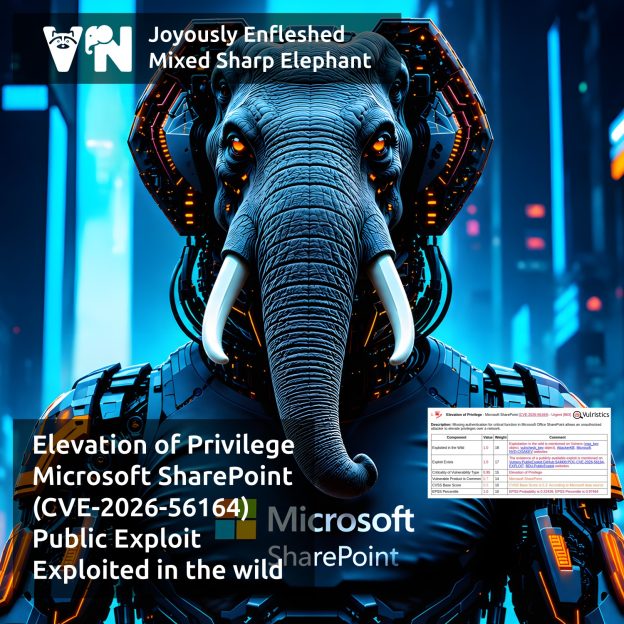
About Elevation of Privilege - Microsoft SharePoint (CVE-2026-56164) vulnerability.

About Elevation of Privilege - Microsoft SharePoint (CVE-2026-56164) vulnerability.

About Elevation of Privilege - Microsoft SharePoint (CVE-2026-56164) vulnerability. The vulnerability was disclosed in the July Microsoft Patch Tuesday release on July 14. The vulnerability, related to missing authentication for a critical function (CWE-306), allows an unauthenticated attacker to remotely elevate their privileges.

It is quite interesting that the CVSS scores for the vulnerability differ significantly between Microsoft's website and the NVD.

🔹 Microsoft: CVSS:3.1/AV:N/AC:L/PR:N/UI:N/S:U/C:N/I:L/A:N (5.3 MEDIUM)

🔹 NVD: CVSS:3.1/AV:N/AC:L/PR:N/UI:N/S:U/C:H/I:H/A:H (9.8 CRITICAL)

As can be seen, the difference is that Microsof's experts consider the impact of successful exploitation on integrity to be low, while the NVD rates the impact on confidentiality, integrity, and availability as high. This once again highlights the subjective nature of CVSS as a vulnerability prioritization tool. 😉

👾 Microsoft experts flagged this vulnerability as being exploited in the wild on the day of Patch Tuesday. The vulnerability was also added to the CISA KEV catalog on the same day. Microsoft credited Mandiant Incident Response for reporting this vulnerability, which suggests that Mandiant may have been involved in identifying the exploitation activity. There are currently no publicly available details regarding the attacks. However, according to Bleeping Computer, this vulnerability may have been exploited in an attack against the Swiss Federal Office of Information Technology, Systems and Telecommunication (BIT) reported on July 28. During the incident, credentials for around 200 user and technical accounts were compromised on Internet-facing SharePoint servers. The investigation did not reveal any other data breaches. According to BIT, SharePoint vulnerabilities from the July Microsoft Patch Tuesday were exploited on the servers, although the specific CVEs were not disclosed.

🛠 An exploit for the vulnerability has been available on GitHub since August 6. According to the exploit author's description, the vulnerability allows a remote unauthenticated attacker to elevate privileges to the level of Farm Administrator. By abusing request processing and routing mechanisms, an attacker can force a vulnerable server to fall back to an elevated security context instead of rejecting an unauthenticated request. This enables the attacker to access information about site collections, users, and server configuration, add administrators, and execute commands.

⚙️ Updates are available for Microsoft SharePoint Server 2016, 2019, and Subscription Edition. In addition to installing the updates, Microsoft experts recommend enabling the AMSI antimalware scanning interface on the server and setting the Request Body Scan mode to Full to reduce the risk of exploitation.

Microsoft Patch Tuesday March 2023: Outlook EoP, MOTW Bypass, Excel DoS, HTTP/3 RCE, ICMP RCE, RPC RCE

Microsoft Patch Tuesday March 2023: Outlook EoP, MOTW Bypass, Excel DoS, HTTP/3 RCE, ICMP RCE, RPC RCE. Hello everyone! This episode will be about Microsoft Patch Tuesday for March 2023, including vulnerabilities that were added between February and March Patch Tuesdays.

Alternative video link (for Russia): https://vk.com/video-149273431_456239119

As usual, I use my open source Vulristics project to analyse and prioritize vulnerabilities. I took the comments about the vulnerabilities from the Qualys, Tenable, Rapid7, ZDI Patch Tuesday reviews.

Microsoft Patch Tuesday for March 2023 was quite refreshing. 😈

Continue reading

Microsoft Patch Tuesday December 2022: SPNEGO RCE, Mark of the Web Bypass, Edge Memory Corruptions

Microsoft Patch Tuesday December 2022: SPNEGO RCE, Mark of the Web Bypass, Edge Memory Corruptions. Hello everyone! This episode will be about Microsoft Patch Tuesday for December 2022, including vulnerabilities that were added between November and December Patch Tuesdays. As usual, I use my open source Vulristics project to analyse and prioritize vulnerabilities.

Alternative video link (for Russia): https://vk.com/video-149273431_456239112

But let’s start with an older vulnerability. This will be another example why vulnerability prioritization is a tricky thing and you should patch everything. In the September Microsoft Patch Tuesday there was a vulnerability Information Disclosure – SPNEGO Extended Negotiation (NEGOEX) Security Mechanism (CVE-2022-37958), which was completely unnoticed by everyone. Not a single VM vendor paid attention to it in their reviews. I didn’t pay attention either.

Continue reading

Microsoft Patch Tuesday October 2022: Exchange ProxyNotShell RCE, Windows COM+ EoP, AD EoP, Azure Arc Kubernetes EoP

Microsoft Patch Tuesday October 2022: Exchange ProxyNotShell RCE, Windows COM+ EoP, AD EoP, Azure Arc Kubernetes EoP. Hello everyone! This episode will be about Microsoft Patch Tuesday for October 2022, including vulnerabilities that were added between September and October Patch Tuesdays. As usual, I use my open source Vulristics project to create the report.

Alternative video link (for Russia): https://vk.com/video-149273431_456239106

Continue reading

Joint Advisory AA22-279A and Vulristics

Joint Advisory AA22-279A and Vulristics. Hello everyone! This episode will be about the new hot twenty vulnerabilities from CISA, NSA and FBI, Joint cybersecurity advisory (CSA) AA22-279A, and how I analyzed these vulnerabilities using my open source project Vulristics.

Alternative video link (for Russia): https://vk.com/video-149273431_456239105

Americans can’t just release a list of “20 vulnerabilities most commonly exploited in attacks on American organizations.” They like to add geopolitics and point the finger at some country. Therefore, I leave the attack attribution mentioned in the advisory title without comment.

Continue reading