Tag Archives: Outlook

July "In the Trend of VM" (#29): Microsoft Exchange Server vulnerability

July In the Trend of VM (#29): Microsoft Exchange Server vulnerability

July "In the Trend of VM" (#29): Microsoft Exchange Server vulnerability. Here is my traditional monthly roundup of trending vulnerabilities, according to Positive Technologies. The previous June edition featured four vulnerabilities. This time, there's only one.

🗞 Post on Habr (rus)
🗒 Digest on the PT website (rus)

🔻 XSS - Microsoft Exchange (CVE-2026-42897). The vulnerability allows attackers to execute arbitrary JavaScript in a user's browser when the user opens a malicious email in Outlook Web Access (OWA). A public proof-of-concept exploit is available, and the vulnerability has already been exploited in the wild.

🟥 The full list of trending vulnerabilities is available on the portal

About Cross Site Scripting - Microsoft Exchange (CVE-2026-42897) vulnerability

About Cross Site Scripting - Microsoft Exchange (CVE-2026-42897) vulnerability

About Cross Site Scripting - Microsoft Exchange (CVE-2026-42897) vulnerability. The vulnerability was fixed on May 14 outside the regular Microsoft Patch Tuesday cycle. Improper neutralization of input during web page generation (CWE-79, XSS) in Microsoft Exchange Server allows an unauthorized attacker to perform spoofing over a network. In practical terms, this means that a remote attacker could exploit this vulnerability by sending a specially crafted email to a user. If the user opens the email in Outlook Web Access and certain interaction conditions are met, arbitrary JavaScript can be executed in the browser context. As a result, the attacker may gain control of the user's mailbox by using an active user session.

👾 Microsoft experts immediately reported signs of active exploitation in the wild for this vulnerability. The vulnerability was added to the CISA KEV on May 15.

⚒️ A public exploit for the vulnerability was published on GitHub on May 15 as well.

⚙️ Initially, mitigation measures were recommended to address the vulnerability, delivered via the Exchange Emergency Mitigation (EM) service or by using the Exchange on-premises Mitigation Tool (EOMT) script. Security updates that fix the vulnerability in Microsoft Exchange Server Subscription Edition RTM, Exchange Server 2016, and Exchange Server 2019 were released almost a month later, on June 9. Microsoft experts recommended keeping the mitigations enabled even after applying the patch, as they provide an additional layer of protection. However, applying these mitigations may cause issues (for example, errors when printing calendars and displaying images in OWA).

⚠️ Please note that Exchange Server 2016 and 2019, which are out of support, are also affected by this vulnerability. Only customers enrolled in the Period 2 Extended Security Update (ESU) program are eligible to receive Exchange Server 2016 and 2019 security updates released between May and October 2026.


February Microsoft Patch Tuesday

February Microsoft Patch Tuesday

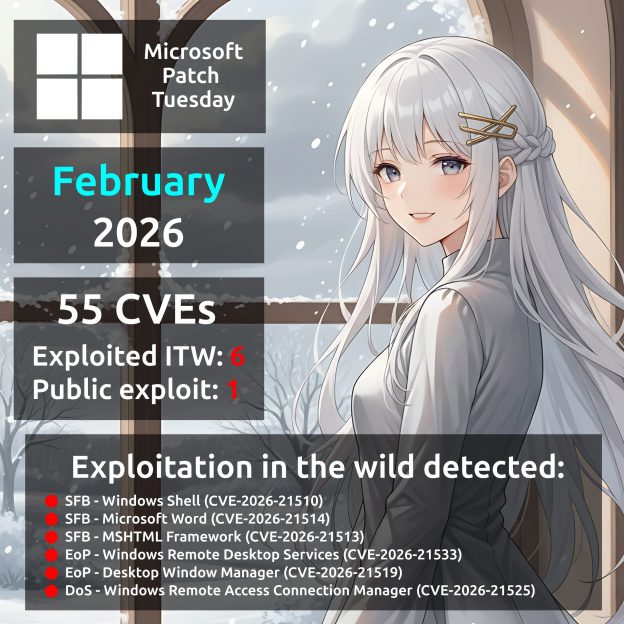
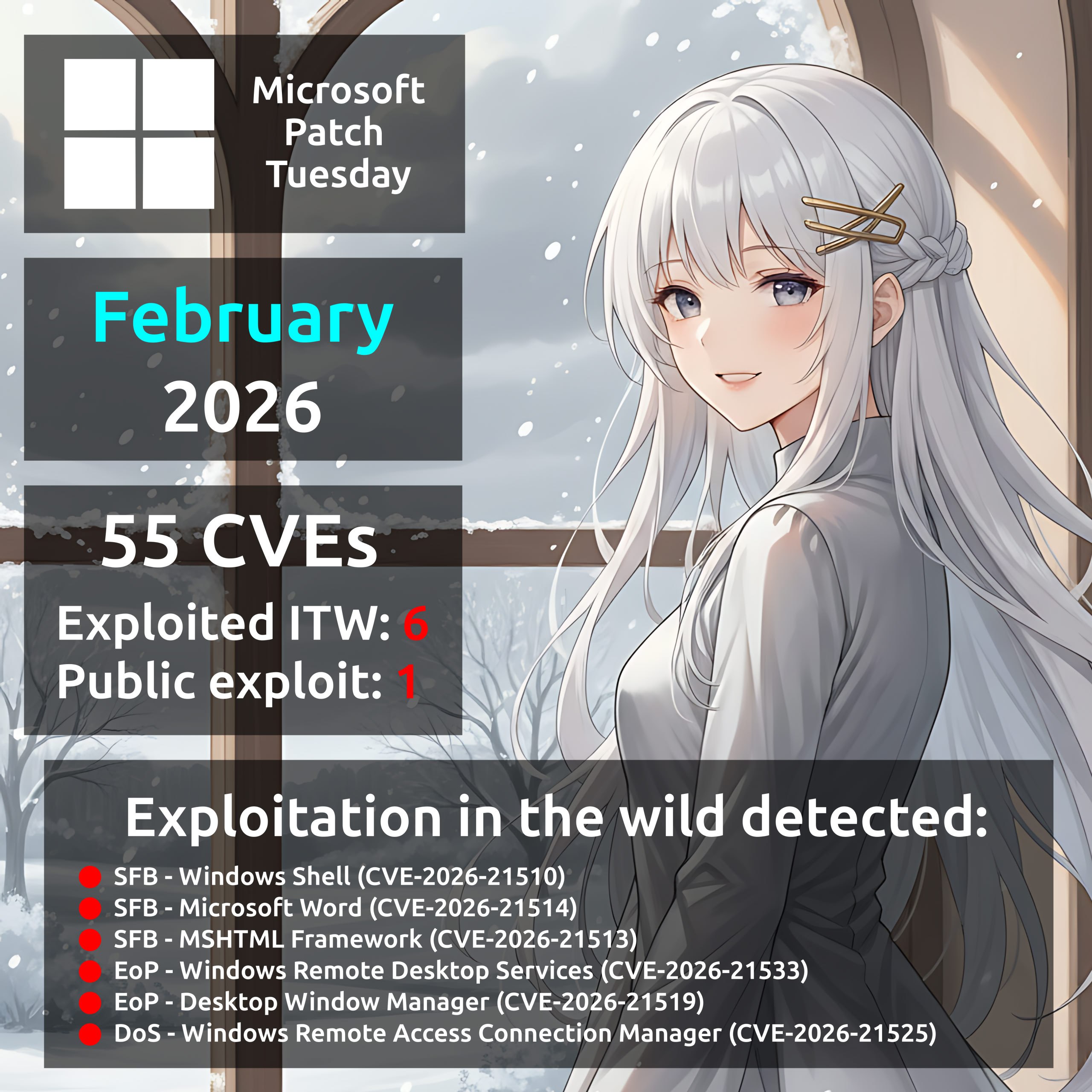
February Microsoft Patch Tuesday. A total of 55 vulnerabilities, half as many as in January. There are as many as six (❗️) vulnerabilities being exploited in the wild:

🔻 SFB/RCE - Windows Shell (CVE-2026-21510)
🔻 SFB/RCE - Microsoft Word (CVE-2026-21514)
🔻 SFB - MSHTML Framework (CVE-2026-21513)
🔻 EoP - Windows Remote Desktop Services (CVE-2026-21533)
🔻 EoP - Desktop Window Manager (CVE-2026-21519)
🔻 DoS - Windows Remote Access Connection Manager (CVE-2026-21525)

There is also one vulnerability with a public exploit:

🔸 DoS - libjpeg (CVE-2023-2804)

Notable remaining vulnerabilities:

🔹 RCE - Windows Notepad (CVE-2026-20841)
🔹 Spoofing - Outlook (CVE-2026-21511)
🔹 EoP - Windows Kernel (CVE-2026-21231, CVE-2026-21239, CVE-2026-21245), Windows AFD.sys (CVE-2026-21236, CVE-2026-21238, CVE-2026-21241)

🗒 Full Vulristics report

На русском

December Microsoft Patch Tuesday

December Microsoft Patch Tuesday

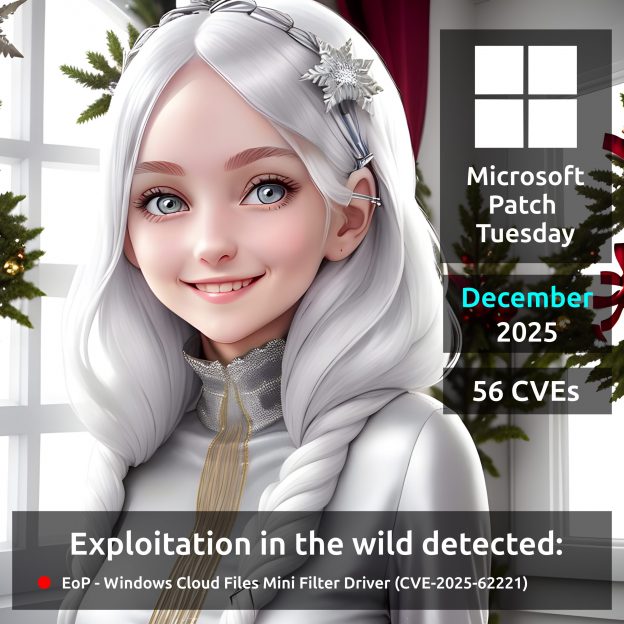
December Microsoft Patch Tuesday. A total of 56 vulnerabilities were fixed - 9 fewer than in November. There is one vulnerability with confirmed in-the-wild exploitation:

🔻 EoP - Windows Cloud Files Mini Filter Driver (CVE-2025-62221)

There are currently no vulnerabilities with publicly available exploits. Among the remaining vulnerabilities, the following stand out:

🔹 RCE - Microsoft Office (CVE-2025-62554, CVE-2025-62557), Microsoft PowerShell (CVE-2025-54100), Microsoft Outlook (CVE-2025-62562), GitHub Copilot for JetBrains (CVE-2025-64671)
🔹 EoP - Windows Win32k (CVE-2025-62458), Windows Cloud Files Mini Filter Driver (CVE-2025-62454, CVE-2025-62457), Windows Common Log File System Driver (CVE-2025-62470), Windows Remote Access Connection Manager (CVE-2025-62472), Windows Storage (CVE-2025-59516)

🗒 Full Vulristics report

На русском

Vulnerabilities of Western logistics

Vulnerabilities of Western logistics

Vulnerabilities of Western logistics. On May 21, Western intelligence agencies released joint advisory AA25-141A about attacks targeting infrastructure of Western logistics and tech companies. Alongside the usual Five Eyes, intelligence services from Germany, Czech Republic, Poland, Denmark, Estonia, France, and the Netherlands also contributed.

The document mentions the exploitation of vulnerabilities:

🔻 Remote Code Execution - WinRAR (CVE-2023-38831)
🔻 Elevation of Privilege - Microsoft Outlook (CVE-2023-23397)
🔻 Remote Code Execution - Roundcube (CVE-2020-12641)
🔻 Code Injection - Roundcube (CVE-2021-44026)
🔻 Cross Site Scripting - Roundcube (CVE-2020-35730)

Patches, exploits, and signs of in-the-wild exploitation have been available for years for these vulnerabilities. 🤦‍♂️🤷‍♂️

🗒 Vulristics Report

На русском

New episode "In the Trend of VM" (#12): 8 February CVEs & Why the Darknet Matters for VM Specialists

New episode "In the Trend of VM" (#12): 8 February CVEs & Why the Darknet Matters for VM Specialists. Now with a new design and new video editing. 😉

📹 Video on YouTube and LinkedIn
🗞 Post on Habr (rus)
🗒 Digest on the PT website

Content:

🔻 00:00 Greetings
🔻 00:23 Remote Code Execution - Windows Lightweight Directory Access Protocol (LDAP) (CVE-2024-49112)
🔻 01:35 Remote Code Execution - Microsoft Configuration Manager (CVE-2024-43468)
🔻 02:38 Remote Code Execution - Windows OLE (CVE-2025-21298)
🔻 03:55 Elevation of Privilege - Windows Hyper-V NT Kernel Integration VSP (CVE-2025-21333, CVE-2025-21334, CVE-2025-21335)
🔻 05:02 Authentication Bypass – FortiOS/FortiProxy (CVE-2024-55591)
🔻 06:16 Remote Code Execution - 7-Zip (CVE-2025-0411)
🔻 07:27 Should a VM specialist be aware of what is happening in the Darknet?
🔻 08:48 About the digest of trending vulnerabilities

На русском

About Remote Code Execution - Windows OLE (CVE-2025-21298) vulnerability

About Remote Code Execution - Windows OLE (CVE-2025-21298) vulnerability

About Remote Code Execution - Windows OLE (CVE-2025-21298) vulnerability. The vulnerability is from the January Microsoft Patch Tuesday. OLE (Object Linking and Embedding) is a technology for linking and embedding objects into other documents and objects, developed by Microsoft. A common use of this technology is embedding an Excel table in a Word document.

What is this vulnerability about? The attacker’s code executes when a specially crafted RTF document is opened or when a malicious email is opened or previewed in Microsoft Outlook. In the second case, no action is required from the victim other than clicking on the message. 🤷‍♂️ Microsoft recommends viewing messages in Outlook only in plain text.

On January 20, an exploit PoC appeared on GitHub that demonstrates Memory Corruption when opening an RTF document. Now we are waiting for an RCE exploit for Outlook. 😉

There have been no reports of attacks yet.

Fix this vulnerability ASAP!

На русском