Tag Archives: DHCP

August Microsoft Patch Tuesday

August Microsoft Patch Tuesday

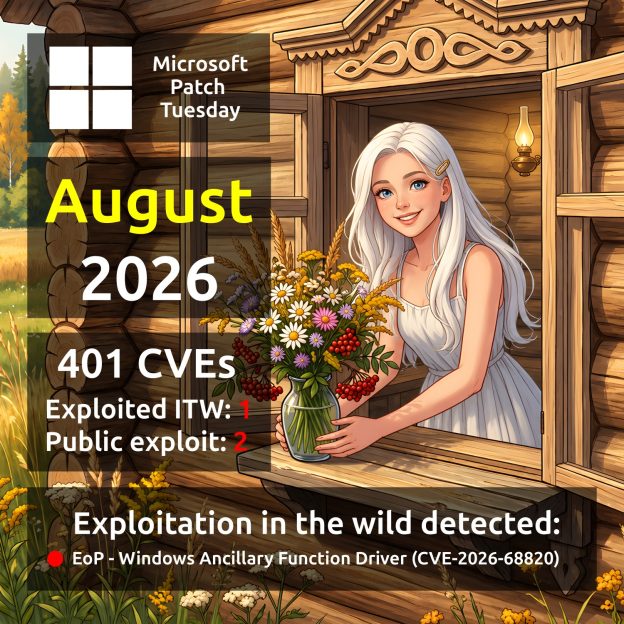
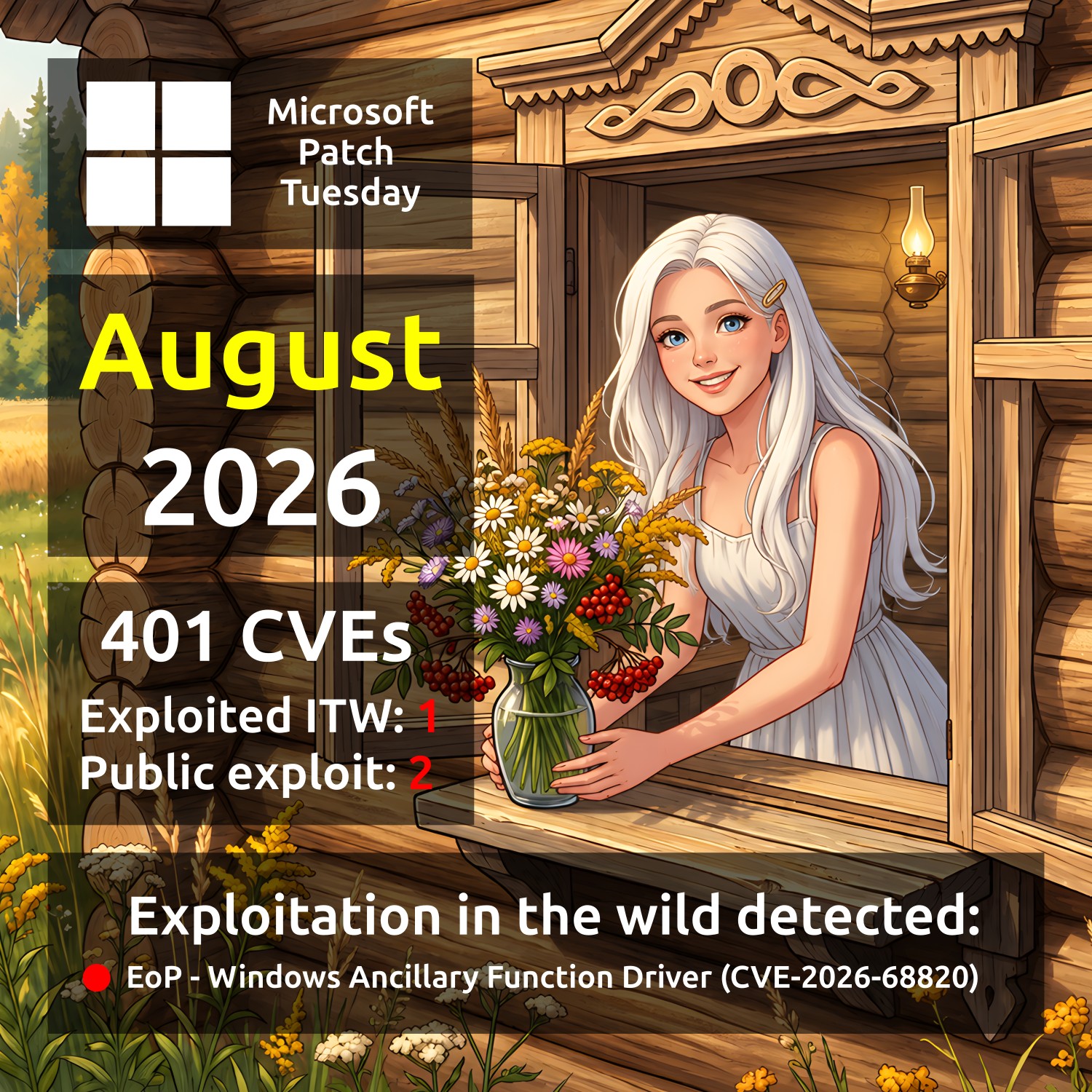
August Microsoft Patch Tuesday. A total of 401 vulnerabilities were addressed - 170 fewer than in July. One of the vulnerabilities is known to be actively exploited in the wild:

🔻 EoP - Windows Ancillary Function Driver for WinSock (CVE-2026-68820). A local attacker can exploit this vulnerability to gain SYSTEM-level privileges. There is a contradiction in Microsoft's description: the Exploit Code Maturity in CVSS is marked as "Unproven", while at the same time Microsoft states that the vulnerability is being exploited in the wild. 🤷‍♂️

Public exploits are available for two other vulnerabilities:

🔸 EoP - Windows User Profile Service (CVE-2026-62832). This vulnerability allows an authenticated attacker to elevate privileges to ADMINISTRATOR level. Rapid7 believes this vulnerability is related to the LegacyHive exploit, which was published on July 14.

🔸 EoP - Windows Kernel (CVE-2026-62737). This vulnerability allows an authenticated attacker to elevate privileges to SYSTEM level. An exploit has been publicly available since August 11.

Among the remaining vulnerabilities, the following stand out:

🔹 RCE - Windows DNS Server (CVE-2026-62878). This wormable vulnerability allows a remote unauthenticated attacker to execute code on a vulnerable server with elevated privileges. It is recommended to test and install the update as soon as possible, especially on Internet-facing DNS servers.

🔹 RCE - Windows Deployment Services TFTP Server (CVE-2026-62893). This vulnerability, discovered as part of the ZDI (Zero Day Initiative) program, allows an attacker to execute code without authentication or user interaction. TFTP has no authentication mechanism and is available remotely via UDP port 69. Any WDS server serving Windows Imaging Format (WIM) files via TFTP, which is the standard PXE boot scenario, is vulnerable. The issue results from the lack of validation of the existence of an object before performing operations on it. UDP port 69 should be blocked at the perimeter, but attackers could easily use this vulnerability for lateral movement within an organization. If you're using WDS for deployments, test and install this update quickly.

🔹 RCE - Windows DHCP Server (CVE-2026-62823). Successful exploitation of this vulnerability allows a remote unauthenticated attacker to execute arbitrary code from an adjacent network by sending a specially crafted packet that triggers a heap-based buffer overflow.

🔹 EoP - Microsoft Exchange (CVE-2026-62911). This vulnerability allows a remote authenticated attacker (with Privileges Required: Low according to CVSS) to gain control over the mailboxes of all Exchange users, send and read emails, and download attachments. This vulnerability was demonstrated at Pwn2Own Berlin. ZDI researchers provided Microsoft with working exploits.

🔹 RCE - Microsoft QUIC (CVE-2026-62815). This use-after-free vulnerability allows an unauthenticated attacker to execute arbitrary code on a target system by sending a specially crafted network packet. QUIC is an IETF-standardized transport protocol that runs over UDP instead of TCP and serves as the foundation for HTTP/3. The protocol is used by approximately 13.5 million websites.

🔹 Tampering - Windows Container Isolation FS Filter Driver (unionfs.sys) (CVE-2026-72971). This vulnerability reportedly allows an attacker to overwrite certain files. As a result, an attacker could perform an action within a container that could impact the host system.

🗒 Full Vulristics report

June Microsoft Patch Tuesday

June Microsoft Patch Tuesday

June Microsoft Patch Tuesday. Last week I was on vacation in Veliky Novgorod, so I'm publishing this overview only now. A total of 202 vulnerabilities were addressed, approximately twice as many as in May. There are currently no vulnerabilities marked as exploited in the wild. However, there are two vulnerabilities with publicly available exploits:

🔸 RCE - HTTP.sys (CVE-2026-47291). This critical vulnerability allows remote, unauthenticated attackers to execute arbitrary code on affected systems without user interaction. However, systems using the default MaxRequestBytes registry value in the Windows HTTP stack are not affected. If needed, you can change this registry setting to protect systems while testing and deploying the patch. Microsoft's security bulletin includes instructions and a PowerShell script for this workaround.

🔸 DoS - HTTP.sys (CVE-2026-49160). The same exploit is used as for the previous RCE vulnerability.

It is also worth paying attention to vulnerabilities that Microsoft has flagged as having a publicly available exploit:

🔹 SFB - Windows BitLocker (CVE-2026-50507). A successful attacker could bypass the BitLocker Device Encryption feature on the system storage device. An attacker with physical access to the target could exploit this vulnerability to gain access to encrypted data. According to Tenable, this is the "Bitskrieg" vulnerability discovered by the researcher known as Chaotic Eclipse/Nightmare Eclipse.

🔹 SFB - Secure Boot (CVE-2026-48570). An attacker who successfully exploited this vulnerability could bypass Secure Boot. This vulnerability was reported by Alon Leviev (STORM), who is known for previous research related to BootKitty and BlackLotus.

Among the remaining vulnerabilities, the following are worth highlighting:

🔹 RCE - Windows Kernel (CVE-2026-45657). This vulnerability allows remote, unauthenticated attackers to run code with SYSTEM privileges without any user interaction. In other words, it could be used to spread automatically between systems. The issue is caused by how the Windows kernel processes TCP/IP traffic. Microsoft rated this as "Exploitation Less Likely", but security researchers and exploit developers are already analyzing the patch and trying to build an exploit. Test and deploy this patch as soon as possible.

🔹 EoP - Windows Collaborative Translation Framework (CTFMON) (CVE-2026-45586). This vulnerability affects a component used for voice and handwriting recognition. If exploited, an attacker could gain SYSTEM privileges. Microsoft rates this vulnerability as "Exploitation More Likely".

🔹 RCE - Windows Remote Desktop Client (CVE-2026-42909, CVE-2026-42913, CVE-2026-42985, CVE-2026-42992, CVE-2026-42993, CVE-2026-44799, CVE-2026-44801, CVE-2026-47289, CVE-2026-47653, CVE-2026-47654, CVE-2026-48563). Successful exploitation would require a victim to connect to an attacker-controlled server using an affected version of the Remote Desktop Client. This action could trigger a heap-based buffer overflow, resulting in remote code execution.

🔹 RCE - DHCP Client Service (CVE-2026-44815). This vulnerability allows remote, unauthenticated attackers to execute code on affected systems without user interaction. Because the DHCP client is widely enabled across Windows systems, this vulnerability presents a broad attack surface. Organizations should prioritize testing and deploying the patch for this vulnerability as soon as possible.

🗒 Full Vulristics report

Microsoft Patch Tuesday April 2023: CLFS EoP, Word RCE, MSMQ QueueJumper RCE, PCL6, DNS, DHCP

Microsoft Patch Tuesday April 2023: CLFS EoP, Word RCE, MSMQ QueueJumper RCE, PCL6, DNS, DHCP. Hello everyone! This episode will be about Microsoft Patch Tuesday for April 2023, including vulnerabilities that were added between March and April Patch Tuesdays.

Alternative video link (for Russia): https://vk.com/video-149273431_456239123

As usual, I use my open source Vulristics project to analyse and prioritize vulnerabilities. I took the comments about the vulnerabilities from the Qualys, Tenable, Rapid7, ZDI Patch Tuesday reviews. And this is the first Patch Tuesday report since I added EPSS support to Vulristics. 😉

Compared to March, Microsoft Patch Tuesday for April 2023 is kind of weak. 🙄

Continue reading

Rapid7 Nexpose in 2017

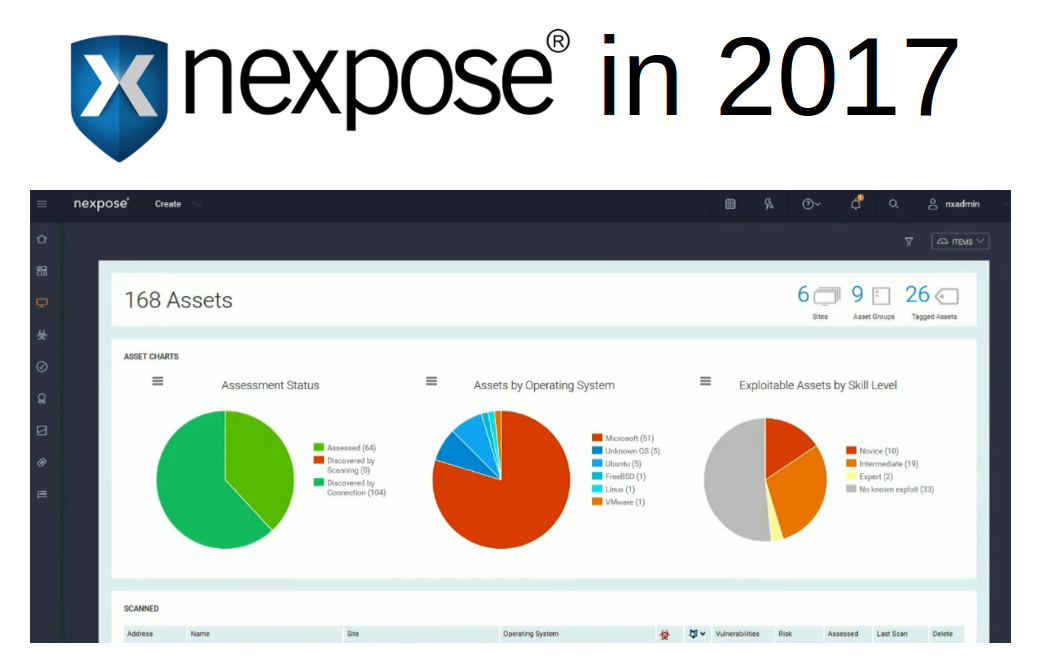
Rapid7 Nexpose in 2017. Last year I tested Rapid7 Nexpose and wrote two posts about installation and use of Nexpose Community Edition and Nexpose API. I didn’t follow news of this vendor for a about year. Today I watched live demo of Nexpose latest version. It has some new interesting features, improvements and ideas, that I would like to mention.

Rapid7 Nexpose in 2017

And of course, things that sales people say to you should be always taken with some skepticism. Only concrete implementation tested in your environment matters. But they usually mention some useful ideas that can be perceived independently from the products they promote.
Continue reading