Tag Archives: SecureBoot

June Microsoft Patch Tuesday

June Microsoft Patch Tuesday

June Microsoft Patch Tuesday. Last week I was on vacation in Veliky Novgorod, so I'm publishing this overview only now. A total of 202 vulnerabilities were addressed, approximately twice as many as in May. There are currently no vulnerabilities marked as exploited in the wild. However, there are two vulnerabilities with publicly available exploits:

🔸 RCE - HTTP.sys (CVE-2026-47291). This critical vulnerability allows remote, unauthenticated attackers to execute arbitrary code on affected systems without user interaction. However, systems using the default MaxRequestBytes registry value in the Windows HTTP stack are not affected. If needed, you can change this registry setting to protect systems while testing and deploying the patch. Microsoft's security bulletin includes instructions and a PowerShell script for this workaround.

🔸 DoS - HTTP.sys (CVE-2026-49160). The same exploit is used as for the previous RCE vulnerability.

It is also worth paying attention to vulnerabilities that Microsoft has flagged as having a publicly available exploit:

🔹 SFB - Windows BitLocker (CVE-2026-50507). A successful attacker could bypass the BitLocker Device Encryption feature on the system storage device. An attacker with physical access to the target could exploit this vulnerability to gain access to encrypted data. According to Tenable, this is the "Bitskrieg" vulnerability discovered by the researcher known as Chaotic Eclipse/Nightmare Eclipse.

🔹 SFB - Secure Boot (CVE-2026-48570). An attacker who successfully exploited this vulnerability could bypass Secure Boot. This vulnerability was reported by Alon Leviev (STORM), who is known for previous research related to BootKitty and BlackLotus.

Among the remaining vulnerabilities, the following are worth highlighting:

🔹 RCE - Windows Kernel (CVE-2026-45657). This vulnerability allows remote, unauthenticated attackers to run code with SYSTEM privileges without any user interaction. In other words, it could be used to spread automatically between systems. The issue is caused by how the Windows kernel processes TCP/IP traffic. Microsoft rated this as "Exploitation Less Likely", but security researchers and exploit developers are already analyzing the patch and trying to build an exploit. Test and deploy this patch as soon as possible.

🔹 EoP - Windows Collaborative Translation Framework (CTFMON) (CVE-2026-45586). This vulnerability affects a component used for voice and handwriting recognition. If exploited, an attacker could gain SYSTEM privileges. Microsoft rates this vulnerability as "Exploitation More Likely".

🔹 RCE - Windows Remote Desktop Client (CVE-2026-42909, CVE-2026-42913, CVE-2026-42985, CVE-2026-42992, CVE-2026-42993, CVE-2026-44799, CVE-2026-44801, CVE-2026-47289, CVE-2026-47653, CVE-2026-47654, CVE-2026-48563). Successful exploitation would require a victim to connect to an attacker-controlled server using an affected version of the Remote Desktop Client. This action could trigger a heap-based buffer overflow, resulting in remote code execution.

🔹 RCE - DHCP Client Service (CVE-2026-44815). This vulnerability allows remote, unauthenticated attackers to execute code on affected systems without user interaction. Because the DHCP client is widely enabled across Windows systems, this vulnerability presents a broad attack surface. Organizations should prioritize testing and deploying the patch for this vulnerability as soon as possible.
🗒 Full Vulristics report

January Microsoft Patch Tuesday

January Microsoft Patch Tuesday

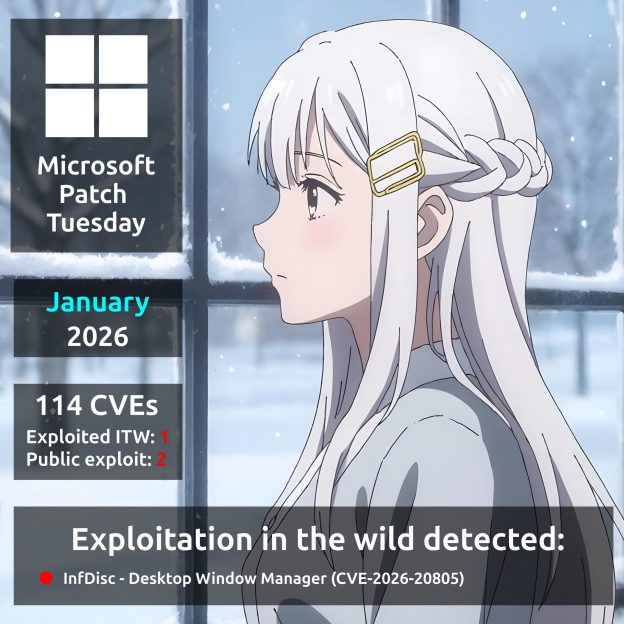
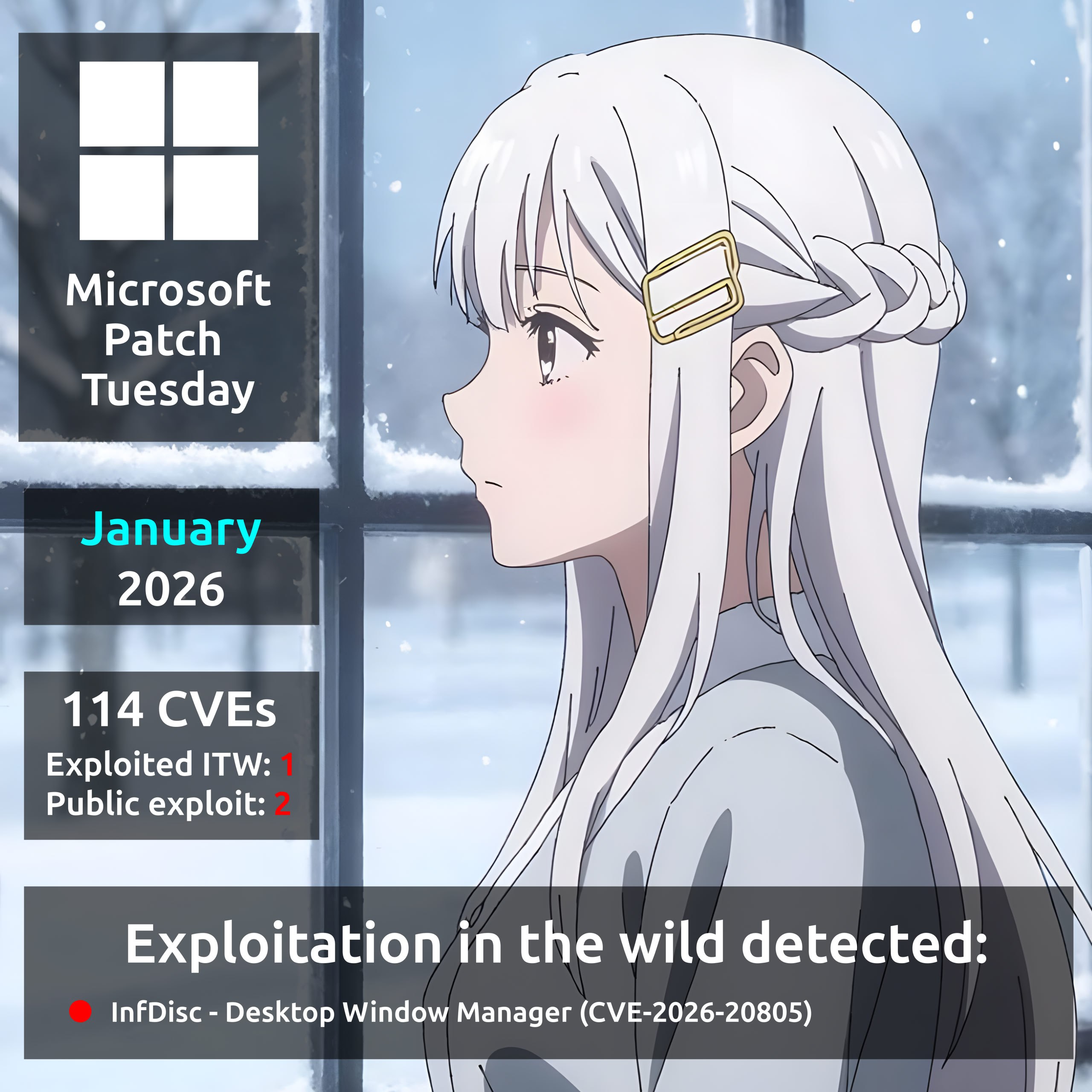
January Microsoft Patch Tuesday. A total of 114 vulnerabilities, twice as many as in December. There is one vulnerability with evidence of in-the-wild exploitation:

🔻 InfDisc - Desktop Window Manager (CVE-2026-20805)

There are also two vulnerabilities with public exploits:

🔸 RCE - Windows Deployment Services (CVE-2026-0386)
🔸 EoP - Windows Agere Soft Modem Driver (CVE-2023-31096)

Other notable vulnerabilities include:

🔹 RCE - Microsoft Office (CVE-2026-20952, CVE-2026-20953), Windows NTFS (CVE-2026-20840, CVE-2026-20922)
🔹 EoP - Desktop Windows Manager (CVE-2026-20871), Windows Virtualization-Based Security (VBS) Enclave (CVE-2026-20876)
🔹 SFB - Secure Boot Certificate Expiration (CVE-2026-21265)

Also noteworthy, reported by Positive Technologies:

🟥 EoP - Windows Telephony Service (CVE-2026-20931)

🗒 Full Vulristics report

На русском

First impressions of the April Microsoft Patch Tuesday

First impressions of the April Microsoft Patch Tuesday
First impressions of the April Microsoft Patch TuesdayFirst impressions of the April Microsoft Patch TuesdayFirst impressions of the April Microsoft Patch TuesdayFirst impressions of the April Microsoft Patch TuesdayFirst impressions of the April Microsoft Patch TuesdayFirst impressions of the April Microsoft Patch TuesdayFirst impressions of the April Microsoft Patch TuesdayFirst impressions of the April Microsoft Patch TuesdayFirst impressions of the April Microsoft Patch Tuesday

First impressions of the April Microsoft Patch Tuesday. I don't even know what to write. 🤪 Very strange! 173 vulnerabilities, of which 23 were added since the last Patch Tuesday.

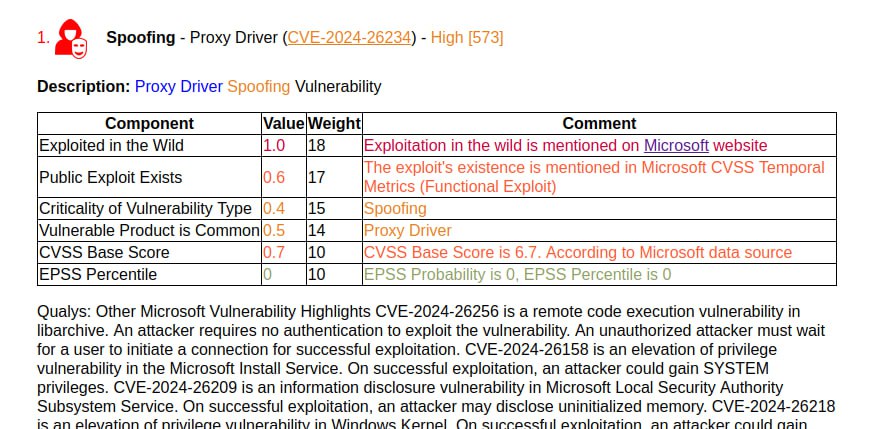
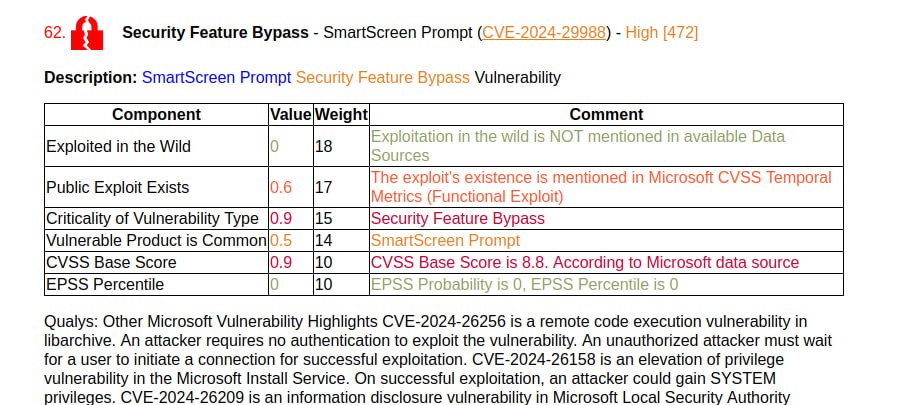
Microsoft flags one vulnerability as being exploited in the wild: Spoofing - Proxy Driver (CVE-2024-26234). And only Qualys briefly mentions it. Literally like this: "Microsoft has not disclosed any information about the vulnerability". 😅 ZDI also claims that Security Feature Bypass - SmartScreen Prompt (CVE-2024-29988) is being exploited in the wild, which is a Mark of the Web (MotW) bypass.

There are no exploits for anything yet. The following vulnerabilities can be highlighted:

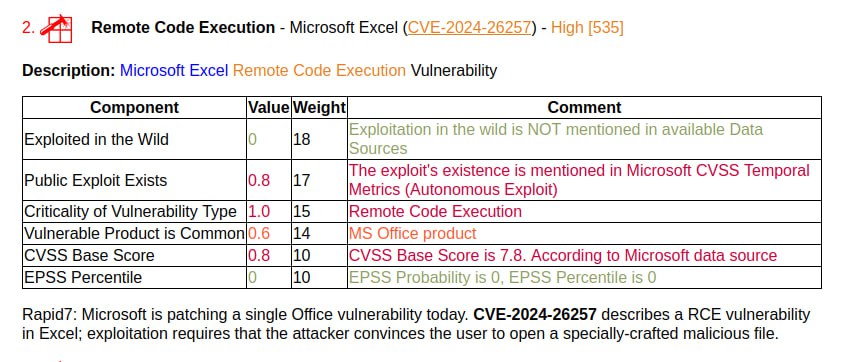
🔸 Remote Code Execution - Microsoft Excel (CVE-2024-26257). Can be exploited by an attacker when the victim opens a specially crafted file.
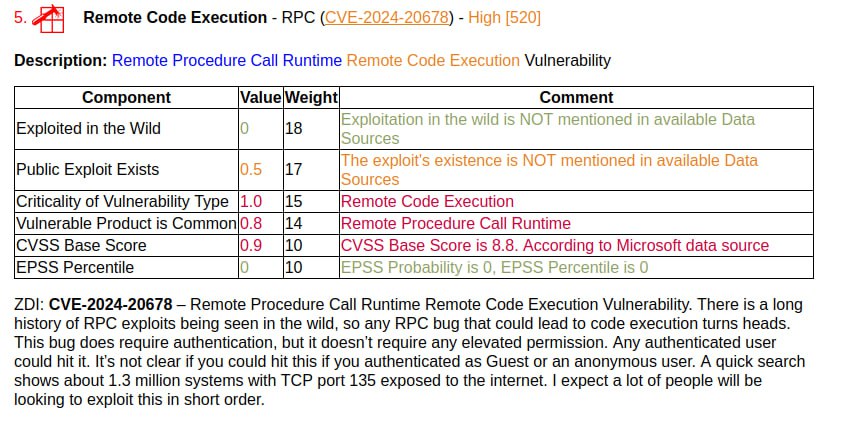
🔸 Remote Code Execution - RPC (CVE-2024-20678). It is highlighted by ZDI, which also claims 1.3 million exposed TCP 135 ports.
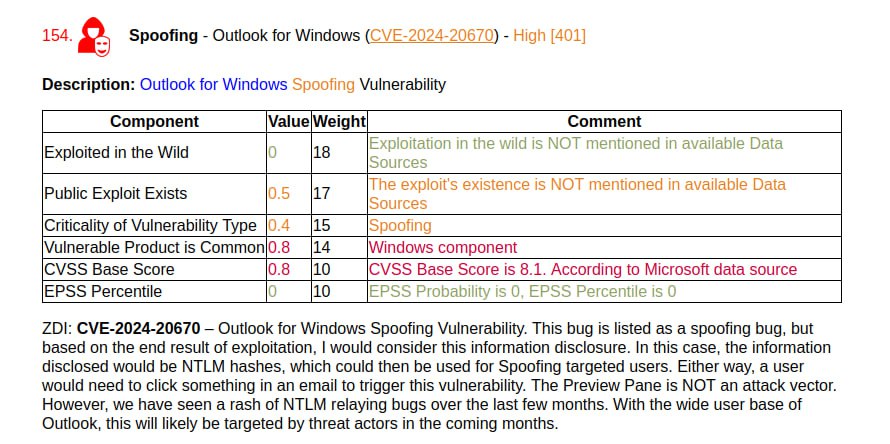
🔸 Spoofing - Outlook for Windows (CVE-2024-20670). ZDI writes that this is an Information Disclosure vulnerability that can be used in NTLM relay attacks.
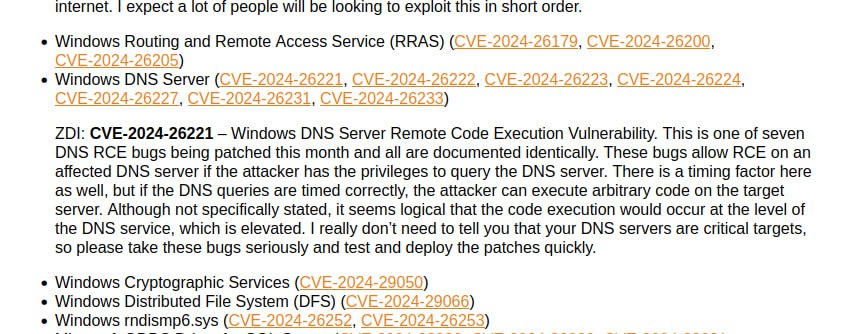
🔸 Remote Code Execution - Windows DNS Server (CVE-2024-26221, CVE-2024-26222, CVE-2024-26223, CVE-2024-26224, CVE-2024-26227, CVE-2024-26231, CVE-2024-26233). Maybe some of this will be exploited in the wild, ZDI particularly highlights CVE-2024-26221.
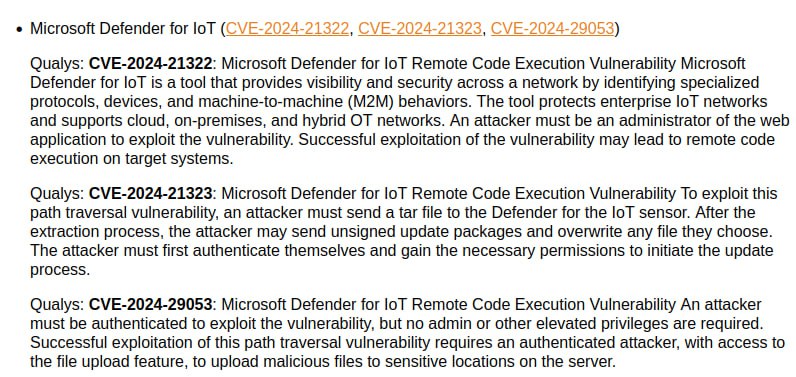
🔸 Remote Code Execution - Microsoft Defender for IoT (CVE-2024-21322, CVE-2024-21323, CVE-2024-29053). It is an IoT and ICS/OT security solution that can be deployed on-prem.

There are simply indecently massive fixes:

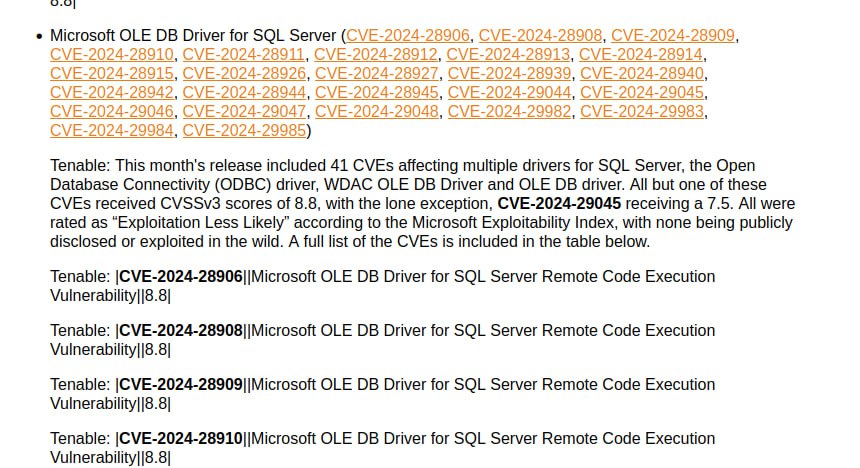
🔹 Remote Code Execution - Microsoft OLE DB Driver for SQL Server / Microsoft WDAC OLE DB Provider for SQL Server / Microsoft WDAC SQL Server ODBC Driver. 28 CVEs! I won’t even list everything here. 😨
🔹 Security Feature Bypass - Secure Boot. 23 CVEs!

🗒 Vulristics report

На русском

Upd. 10.04 I slightly tweaked the vulnerability type detection to increase the priority of the detection based on the Microsoft generated description compared to the detection based on CWE. In particular, the type of vulnerability for Spoofing - Proxy Driver (CVE-2024-26234) and Spoofing - Outlook for Windows (CVE-2024-20670) has changed.