Tag Archives: AFDsys

August Microsoft Patch Tuesday

August Microsoft Patch Tuesday

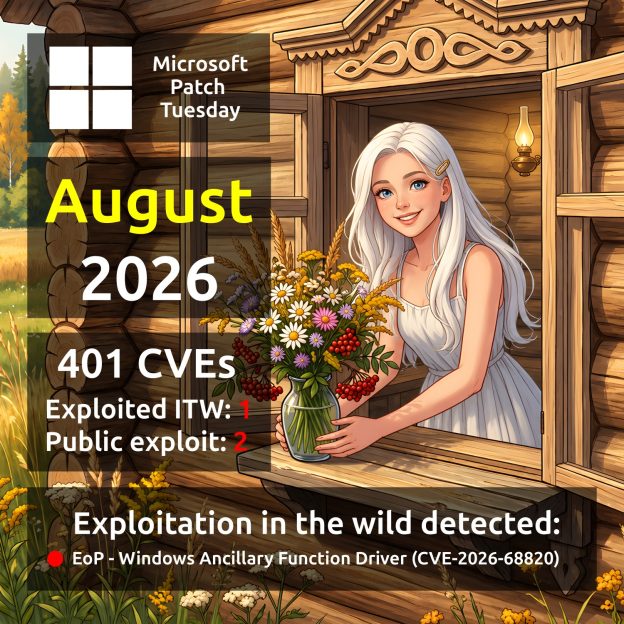
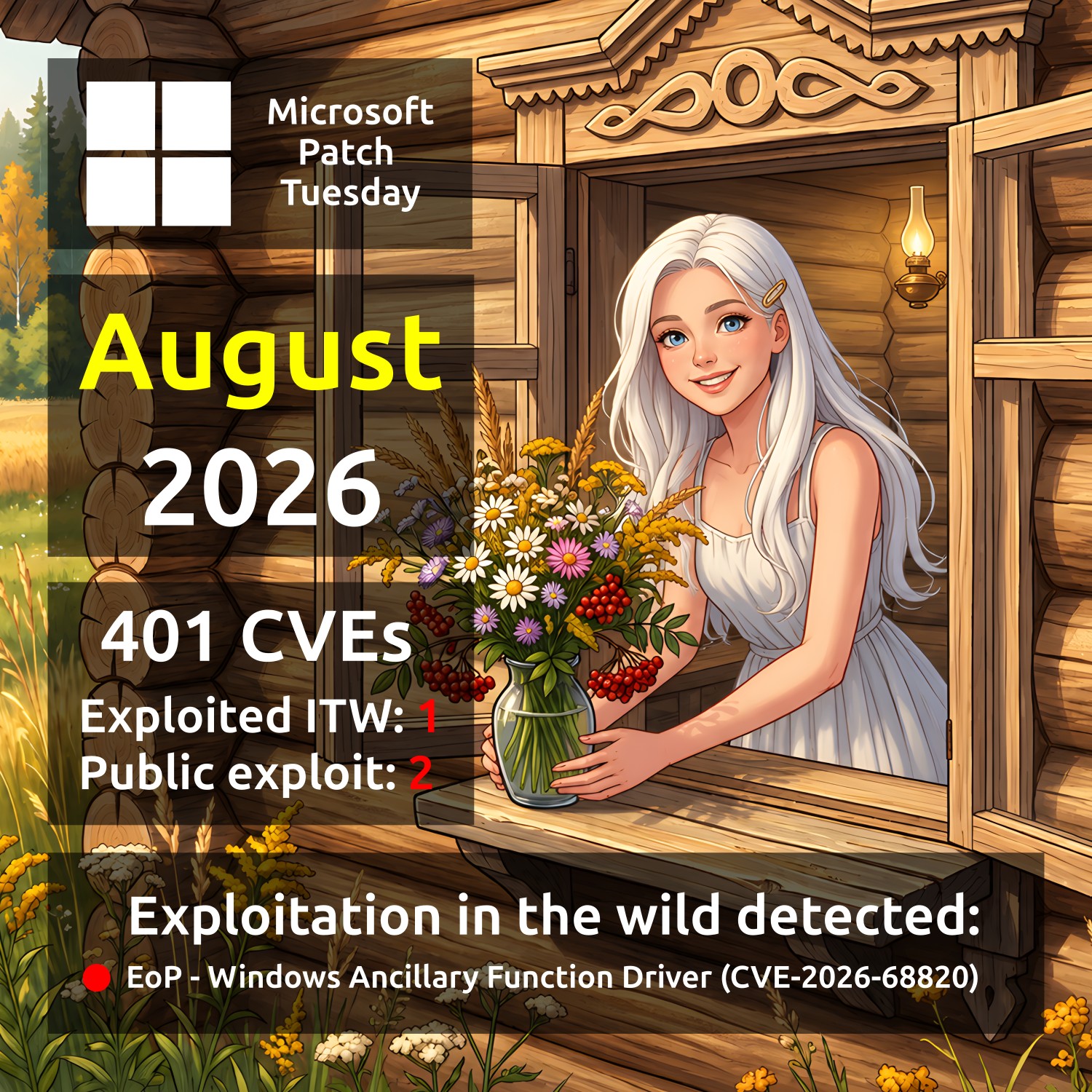
August Microsoft Patch Tuesday. A total of 401 vulnerabilities were addressed - 170 fewer than in July. One of the vulnerabilities is known to be actively exploited in the wild:

🔻 EoP - Windows Ancillary Function Driver for WinSock (CVE-2026-68820). A local attacker can exploit this vulnerability to gain SYSTEM-level privileges. There is a contradiction in Microsoft's description: the Exploit Code Maturity in CVSS is marked as "Unproven", while at the same time Microsoft states that the vulnerability is being exploited in the wild. 🤷‍♂️

Public exploits are available for two other vulnerabilities:

🔸 EoP - Windows User Profile Service (CVE-2026-62832). This vulnerability allows an authenticated attacker to elevate privileges to ADMINISTRATOR level. Rapid7 believes this vulnerability is related to the LegacyHive exploit, which was published on July 14.

🔸 EoP - Windows Kernel (CVE-2026-62737). This vulnerability allows an authenticated attacker to elevate privileges to SYSTEM level. An exploit has been publicly available since August 11.

Among the remaining vulnerabilities, the following stand out:

🔹 RCE - Windows DNS Server (CVE-2026-62878). This wormable vulnerability allows a remote unauthenticated attacker to execute code on a vulnerable server with elevated privileges. It is recommended to test and install the update as soon as possible, especially on Internet-facing DNS servers.

🔹 RCE - Windows Deployment Services TFTP Server (CVE-2026-62893). This vulnerability, discovered as part of the ZDI (Zero Day Initiative) program, allows an attacker to execute code without authentication or user interaction. TFTP has no authentication mechanism and is available remotely via UDP port 69. Any WDS server serving Windows Imaging Format (WIM) files via TFTP, which is the standard PXE boot scenario, is vulnerable. The issue results from the lack of validation of the existence of an object before performing operations on it. UDP port 69 should be blocked at the perimeter, but attackers could easily use this vulnerability for lateral movement within an organization. If you're using WDS for deployments, test and install this update quickly.

🔹 RCE - Windows DHCP Server (CVE-2026-62823). Successful exploitation of this vulnerability allows a remote unauthenticated attacker to execute arbitrary code from an adjacent network by sending a specially crafted packet that triggers a heap-based buffer overflow.

🔹 EoP - Microsoft Exchange (CVE-2026-62911). This vulnerability allows a remote authenticated attacker (with Privileges Required: Low according to CVSS) to gain control over the mailboxes of all Exchange users, send and read emails, and download attachments. This vulnerability was demonstrated at Pwn2Own Berlin. ZDI researchers provided Microsoft with working exploits.

🔹 RCE - Microsoft QUIC (CVE-2026-62815). This use-after-free vulnerability allows an unauthenticated attacker to execute arbitrary code on a target system by sending a specially crafted network packet. QUIC is an IETF-standardized transport protocol that runs over UDP instead of TCP and serves as the foundation for HTTP/3. The protocol is used by approximately 13.5 million websites.

🔹 Tampering - Windows Container Isolation FS Filter Driver (unionfs.sys) (CVE-2026-72971). This vulnerability reportedly allows an attacker to overwrite certain files. As a result, an attacker could perform an action within a container that could impact the host system.

🗒 Full Vulristics report

February Microsoft Patch Tuesday

February Microsoft Patch Tuesday

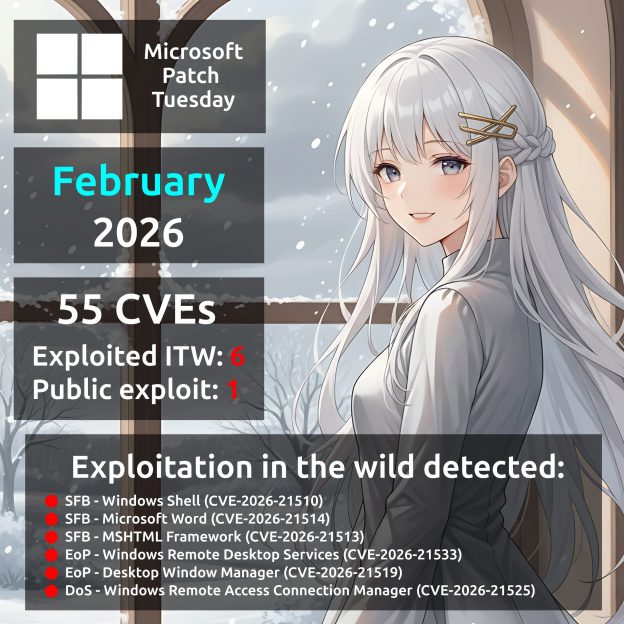
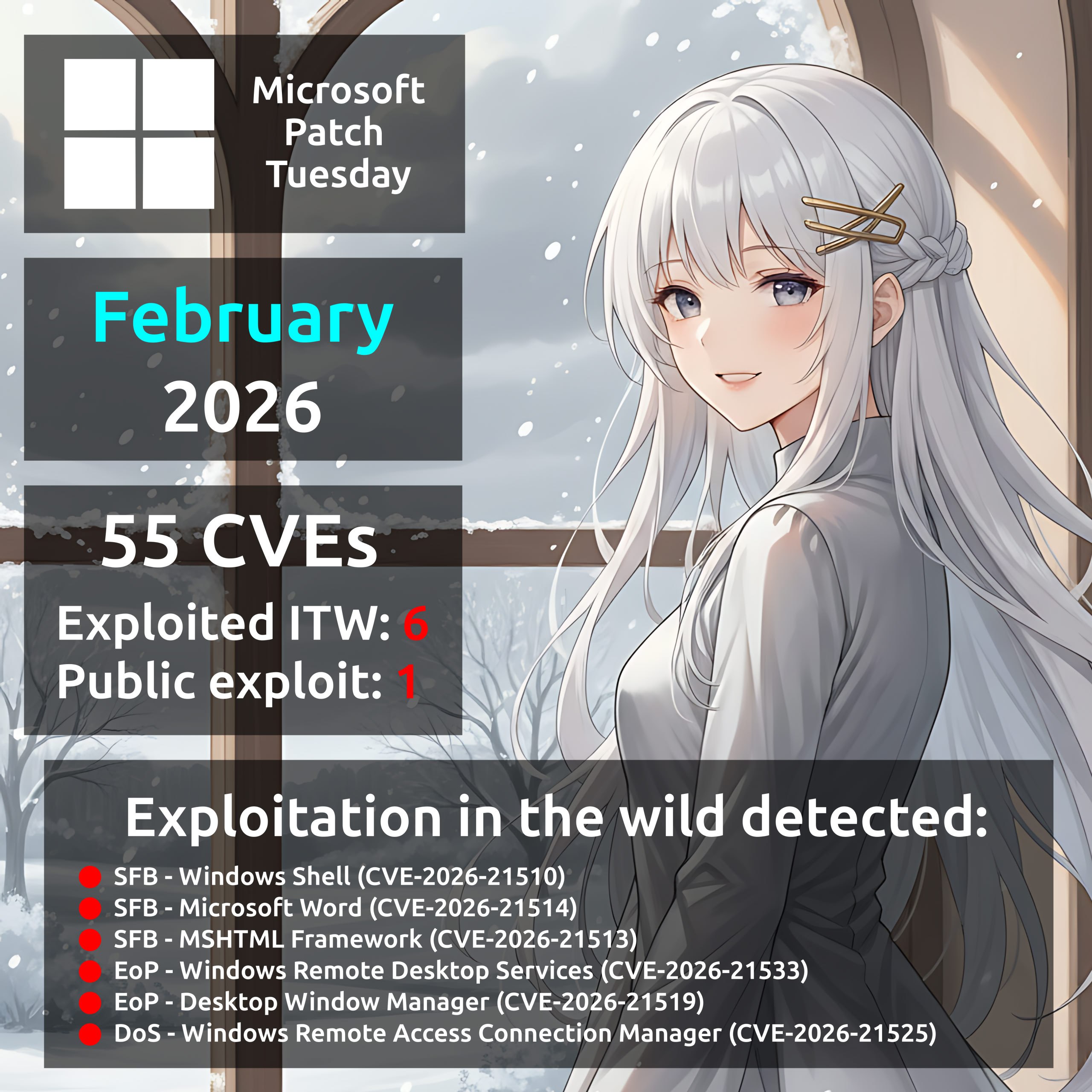
February Microsoft Patch Tuesday. A total of 55 vulnerabilities, half as many as in January. There are as many as six (❗️) vulnerabilities being exploited in the wild:

🔻 SFB/RCE - Windows Shell (CVE-2026-21510)
🔻 SFB/RCE - Microsoft Word (CVE-2026-21514)
🔻 SFB - MSHTML Framework (CVE-2026-21513)
🔻 EoP - Windows Remote Desktop Services (CVE-2026-21533)
🔻 EoP - Desktop Window Manager (CVE-2026-21519)
🔻 DoS - Windows Remote Access Connection Manager (CVE-2026-21525)

There is also one vulnerability with a public exploit:

🔸 DoS - libjpeg (CVE-2023-2804)

Notable remaining vulnerabilities:

🔹 RCE - Windows Notepad (CVE-2026-20841)
🔹 Spoofing - Outlook (CVE-2026-21511)
🔹 EoP - Windows Kernel (CVE-2026-21231, CVE-2026-21239, CVE-2026-21245), Windows AFD.sys (CVE-2026-21236, CVE-2026-21238, CVE-2026-21241)

🗒 Full Vulristics report

На русском

March episode "In the Trend of VM" (#13): vulnerabilities of Microsoft, PAN-OS, СommuniGate and who should patch hosts with deployed application

March episode "In the Trend of VM" (#13): vulnerabilities of Microsoft, PAN-OS, СommuniGate and who should patch hosts with deployed application. I'm posting the translated video with a big delay, but it's better than never. 😉

📹 Video on YouTube and LinkedIn
🗞 Post on Habr (rus)
🗒 Digest on the PT website

Content:

🔻 00:00 Greetings
🔻 00:31 Elevation of Privilege - Windows Ancillary Function Driver for WinSock (CVE-2025-21418)
🔻 01:12 Elevation of Privilege - Windows Storage (CVE-2025-21391)
🔻 01:53 Authentication Bypass - PAN-OS (CVE-2025-0108)
🔻 03:09 Remote Code Execution - CommuniGate Pro (BDU:2025-01331)
🔻 04:27 The VM riddle: who should patch hosts with a deployed application?
🔻 07:11 About the digest of trending vulnerabilities

На русском

August episode of "In The Trend of VM": 5 vulnerabilities in Microsoft Windows and one in WordPress

August episode of "In The Trend of VM": 5 vulnerabilities in Microsoft Windows and one in WordPress. We have branched off from Seclab news videos and started releasing separate episodes. Hooray! 🥳😎 If we get enough views, we will continue to release them in the future. It's up to you, please follow the link to the video platform and click "Like" button and/or leave a comment. 🥺

📹 Video "In The Trend of VM" on YouTube
🗞 A post on Habr (rus) a slightly expanded script of the video
🗒 A compact digest (rus) on the official PT website

List of vulnerabilities:

🔻 00:48 Remote Code Execution - Windows Remote Desktop Licensing Service "MadLicense" (CVE-2024-38077)
🔻 02:22 Security Feature Bypass - Windows Mark of the Web "Copy2Pwn" (CVE-2024-38213)
🔻 03:23 Elevation of Privilege - Windows Ancillary Function Driver for WinSock (CVE-2024-38193), Windows Kernel (CVE-2024-38106), Windows Power Dependency Coordinator (CVE-2024-38107)
🔻 04:50 Unauthenticated Elevation of Privilege - WordPress LiteSpeed Cache Plugin (CVE-2024-28000)

English voice over was generated by my open source utility subtivo (subtitles to voice over)

06:39 Check out the final jingle I generated using AI services 😉 (ToolBaz for lyrics and Suno for music)

На русском

About Elevation of Privilege - Windows Ancillary Function Driver for WinSock (CVE-2024-38193) and other Windows EoP vulnerabilities from August Patch Tuesday

About Elevation of Privilege - Windows Ancillary Function Driver for WinSock (CVE-2024-38193) and other Windows EoP vulnerabilities from August Patch Tuesday

About Elevation of Privilege - Windows Ancillary Function Driver for WinSock (CVE-2024-38193) and other Windows EoP vulnerabilities from August Patch Tuesday. In total, in the August MSPT there were 3 EoPs with signs of exploitation in the wild. They have identical descriptions: an attacker can elevate privileges on the host to SYSTEM level. The vulnerability in Windows Kernel is more difficult to exploit, because it is necessary to win a race condition.

We only know the names of the attackers who exploited the EoP vulnerability in the Windows Ancillary Functions Driver (AFD.sys). It is exploited by the well-known group Lazarus. This was reported in a press release from Gen Digital, the company that owns Avira and Avast antiviruses. To neutralize information security products during an attack, Lazarus attackers use the Fudmodule rootkit. So, even if EDR is installed on the host, the host should be updated. 😏

На русском