Tag Archives: LPE

About Elevation of Privilege - Windows Ancillary Function Driver for WinSock (CVE-2026-68820) vulnerability

About Elevation of Privilege - Windows Ancillary Function Driver for WinSock (CVE-2026-68820) vulnerability

About Elevation of Privilege - Windows Ancillary Function Driver for WinSock (CVE-2026-68820) vulnerability. The Ancillary Function Driver (AFD) is a Windows component that supports Windows Sockets applications and is contained in the afd.sys file. The afd.sys driver runs in kernel mode and manages the Winsock TCP/IP communications protocol. This vulnerability is from the August Microsoft Patch Tuesday. Use-after-free (CWE-416) in the Windows Ancillary Function Driver for WinSock allows an authorized attacker to elevate privileges locally to SYSTEM level. Successful exploitation requires an attacker to win the race condition. As a result, the attacker can gain full control over the Windows host, execute commands with SYSTEM-level privileges, disable security protections, install malware, and access other users' data.

👾 The vulnerability was already being exploited in the wild when it was disclosed as part of Microsoft's August Patch Tuesday on August 11. That same day, it was added to the CISA KEV catalog. Notably, Microsoft listed the Exploit Code Maturity in the CVSS as "Unproven". 🤷‍♂️ Microsoft credited researchers from Check Point for reporting the vulnerability.

Details on how the vulnerability was exploited in attacks were published in a Check Point blog post on August 11. The vulnerability was exploited as part of the "Operation Dream Job" campaign, which targeted organizations worldwide, with a particular focus on the defense sector in Europe and India. The campaign is linked to the Lazarus Group. The campaign begins with targeted phishing messages offering victims attractive job opportunities at well-known companies in the defense, aerospace, and aviation industries. Victims are lured into opening a PDF decoy masquerading as a Lockheed Martin job description. This triggers the execution of a lightweight in-memory loader - MISTPEN. The loader uses the Microsoft Graph API to access OneDrive, from which it retrieves additional modules and runs them in memory. During the initial stages of the infection, the attacker deploys several reconnaissance modules that gather information about the system and running processes. Once the target is deemed of interest, MISTPEN retrieves an additional persistence module, which installs the malware on disk and ensures that MISTPEN is automatically launched after a system reboot. After establishing persistence, MISTPEN loads an in-memory module designed to exploit the CVE-2026-68820 vulnerability. Check Point researchers believe that this vulnerability was already being exploited in the "Operation Dream Job" campaign in early July 2026. Successful exploitation enables the malware to launch FudModule, a Lazarus kernel-level rootkit, with SYSTEM privileges. The final backdoor delivered by MISTPEN - ForestTiger - provides attackers with remote access to the compromised system, allowing them to execute commands, collect host information, and download additional malicious components.

🛠 No public exploits have been observed so far. Some people are offering exploits for sale, but they don't look reliable.

⚙️ Security updates are available for Windows 10, Windows 11, and Windows Server 2019.

June "In the Trend of VM" (#28): Linux kernel, Microsoft Defender, and Palo Alto Networks device vulnerabilities

June In the Trend of VM (#28): Linux kernel, Microsoft Defender, and Palo Alto Networks device vulnerabilities

June "In the Trend of VM" (#28): Linux kernel, Microsoft Defender, and Palo Alto Networks device vulnerabilities. Presenting the traditional monthly roundup of trending vulnerabilities according to Positive Technologies. In the previous May edition, we covered four vulnerabilities. This time, there are also four vulnerabilities associated with five CVE identifiers.

🗞 Post on Habr (rus)
🗒 Digest on the PT website (rus)

🔻 EoP - Linux Kernel "Dirty Frag" (CVE-2026-43284, CVE-2026-43500). A chain of vulnerabilities with a public exploit to obtain root access. There are signs of in-the-wild exploitation.

🔻 EoP - Linux Kernel "Fragnesia" (CVE-2026-46300). Another vulnerability for gaining root access with a public exploit.

🔻 EoP - Microsoft Defender "RedSun" (CVE-2026-41091). A privilege escalation vulnerability leading to SYSTEM-level access, with a public exploit available and indications of in-the-wild exploitation. Pay special attention to Windows server and desktop environments where Microsoft Defender is enabled but there is no Internet access for regular updates.

🔻 RCE - PAN-OS (CVE-2026-0300). An unauthenticated RCE with root privileges affecting PA-Series and VM-Series firewalls. A public exploit exists, and there are indications of in-the-wild exploitation.

🟥 The full list of trending vulnerabilities is available on the portal

About Elevation of Privilege - Linux Kernel "Fragnesia" (CVE-2026-46300) vulnerability

About Elevation of Privilege - Linux Kernel Fragnesia (CVE-2026-46300) vulnerability

About Elevation of Privilege - Linux Kernel "Fragnesia" (CVE-2026-46300) vulnerability. The vulnerability was discovered by researcher William Bowling together with the V12 team. Fragnesia belongs to the class of Dirty Frag vulnerabilities. It is an error in the ESP/XFRM subsystem, distinct from Dirty Frag, which was addressed with a separate patch. It allows achieving arbitrary byte writes into the kernel page cache of read-only files, without requiring any race condition.

🛠 Technical details and exploit code were published on May 15. The public exploit modifies the contents of /usr/bin/su in the kernel page cache, and then executes /usr/bin/su, resulting in the user obtaining a root shell. The on-disk binary is never modified. A reboot or cache flush restores normal system behavior.

⚙️ Fragnesia affects the same kernel versions as Dirty Frag. Any distribution shipping a kernel without the May 13 patch is vulnerable. The vulnerability was confirmed on Ubuntu 6.8.0-111-generic (April 11, 2026 build). Monitor kernel package updates for your Linux distribution(s).

For systems where a kernel update is not possible, the same workaround as for Dirty Frag is effective (blacklisting modules). Systems where the Dirty Frag workaround has already been applied are already protected against Fragnesia. Systems that only received Dirty Frag updates without applying the workaround remain vulnerable and require new updates addressing Fragnesia.

Trending vulnerabilities for June according to Positive Technologies

Trending vulnerabilities for June according to Positive Technologies. Traditionally, in 3 formats (in Russian):

📹 The section "Trending VM" in the SecLab news video (starts at 15:03)
🗞 Post on the Habr website, in fact this is a slightly expanded scenario for the "Trending VM" section
🗒 Compact digest with technical details on the official PT website

List of vulnerabilities:

🔻 EoP in Microsoft Windows CSC (CVE-2024-26229)
🔻 EoP in Microsoft Windows Error Reporting (CVE-2024-26169)
🔻 EoP in Microsoft Windows Kernel (CVE-2024-30088)
🔻 RCE in PHP (CVE-2024-4577)
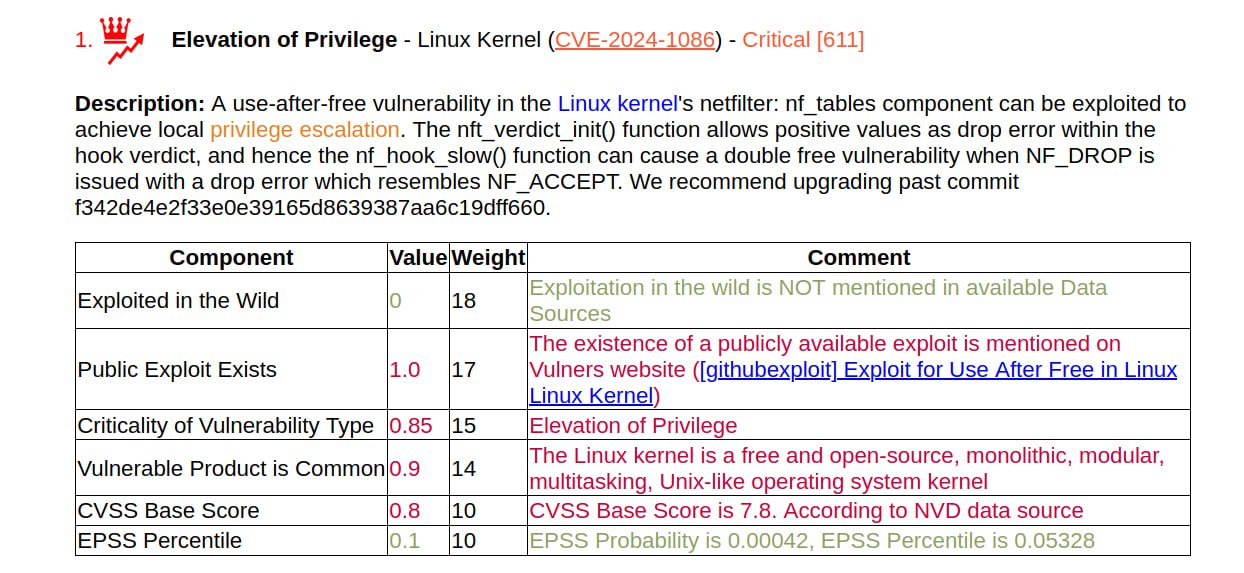
🔻 EoP in Linux Kernel (CVE-2024-1086)
🔻 InfDisclosure in Check Point Security Gateways (CVE-2024-24919)
🔻 RCE in VMware vCenter (CVE-2024-37079, CVE-2024-37080)
🔻 AuthBypass in Veeam Backup & Replication (CVE-2024-29849)

На русском

Elevation of Privilege (Local Privilege Escalation) - Linux Kernel (CVE-2024-1086) has been added to CISA KEV

Elevation of Privilege (Local Privilege Escalation) - Linux Kernel (CVE-2024-1086) has been added to CISA KEV

Elevation of Privilege (Local Privilege Escalation) - Linux Kernel (CVE-2024-1086) has been added to CISA KEV. The vulnerability itself is relatively old, from January. I already wrote about it in March, when the write-up and public exploit were released.

Despite the fact that the exploitation of this vulnerability is trivial (the attacker launches a local utility and gains root privileges), until recently there were no signs of exploitation in the wild. This is quite strange: such a useful exploit should immediately be included in the attackers’ toolkit. So either the practical exploitation of this vulnerability is somehow complicated, or the attackers did not leave any traces. 🤔

In any case, on May 30, the vulnerability was added to CISA KEV, and this means the fact of its exploitation in attacks has been proven. But there are no details yet. Please be aware of this vulnerability when upgrading Linux hosts.

На русском

For the January Elevation of Privilege (Local Privilege Escalation) - Linux Kernel (CVE-2024-1086), the write-up and PoC were released on March 26

For the January Elevation of Privilege (Local Privilege Escalation) - Linux Kernel (CVE-2024-1086), the write-up and PoC were released on March 26

For the January Elevation of Privilege (Local Privilege Escalation) - Linux Kernel (CVE-2024-1086), the write-up and PoC were released on March 26. The video demo for the script looks impressive: they run the script as a regular user and after a couple of seconds they get a root shell. According to the author, the exploit works with most Linux kernels between versions 5.14 and 6.6, including Debian, Ubuntu and KernelCTF.

🔻 The exploit requires kconfig CONFIG_USER_NS=y; sh command sysctl kernel.unprivileged_userns_clone = 1; kconfig CONFIG_NF_TABLES=y. The author writes that this is the default for Debian, Ubuntu, and KernelCTF, and for other distributions it is necessary to test it.
🔹 The exploit does not work with kernels v6.4> with kconfig CONFIG_INIT_ON_ALLOC_DEFAULT_ON=y (including Ubuntu v6.5)

NSFOCUS writes that Redhat is also vulnerable. 🤷‍♂️

На русском