Tag Archives: CheckPoint

About Elevation of Privilege - Windows Ancillary Function Driver for WinSock (CVE-2026-68820) vulnerability

About Elevation of Privilege - Windows Ancillary Function Driver for WinSock (CVE-2026-68820) vulnerability

About Elevation of Privilege - Windows Ancillary Function Driver for WinSock (CVE-2026-68820) vulnerability. The Ancillary Function Driver (AFD) is a Windows component that supports Windows Sockets applications and is contained in the afd.sys file. The afd.sys driver runs in kernel mode and manages the Winsock TCP/IP communications protocol. This vulnerability is from the August Microsoft Patch Tuesday. Use-after-free (CWE-416) in the Windows Ancillary Function Driver for WinSock allows an authorized attacker to elevate privileges locally to SYSTEM level. Successful exploitation requires an attacker to win the race condition. As a result, the attacker can gain full control over the Windows host, execute commands with SYSTEM-level privileges, disable security protections, install malware, and access other users' data.

👾 The vulnerability was already being exploited in the wild when it was disclosed as part of Microsoft's August Patch Tuesday on August 11. That same day, it was added to the CISA KEV catalog. Notably, Microsoft listed the Exploit Code Maturity in the CVSS as "Unproven". 🤷‍♂️ Microsoft credited researchers from Check Point for reporting the vulnerability.

Details on how the vulnerability was exploited in attacks were published in a Check Point blog post on August 11. The vulnerability was exploited as part of the "Operation Dream Job" campaign, which targeted organizations worldwide, with a particular focus on the defense sector in Europe and India. The campaign is linked to the Lazarus Group. The campaign begins with targeted phishing messages offering victims attractive job opportunities at well-known companies in the defense, aerospace, and aviation industries. Victims are lured into opening a PDF decoy masquerading as a Lockheed Martin job description. This triggers the execution of a lightweight in-memory loader - MISTPEN. The loader uses the Microsoft Graph API to access OneDrive, from which it retrieves additional modules and runs them in memory. During the initial stages of the infection, the attacker deploys several reconnaissance modules that gather information about the system and running processes. Once the target is deemed of interest, MISTPEN retrieves an additional persistence module, which installs the malware on disk and ensures that MISTPEN is automatically launched after a system reboot. After establishing persistence, MISTPEN loads an in-memory module designed to exploit the CVE-2026-68820 vulnerability. Check Point researchers believe that this vulnerability was already being exploited in the "Operation Dream Job" campaign in early July 2026. Successful exploitation enables the malware to launch FudModule, a Lazarus kernel-level rootkit, with SYSTEM privileges. The final backdoor delivered by MISTPEN - ForestTiger - provides attackers with remote access to the compromised system, allowing them to execute commands, collect host information, and download additional malicious components.

🛠 No public exploits have been observed so far. Some people are offering exploits for sale, but they don't look reliable.

⚙️ Security updates are available for Windows 10, Windows 11, and Windows Server 2019.

July "In the Trend of VM" (#17): vulnerabilities in Microsoft Windows and Roundcube

July In the Trend of VM (#17): vulnerabilities in Microsoft Windows and Roundcube

July "In the Trend of VM" (#17): vulnerabilities in Microsoft Windows and Roundcube. A traditional monthly roundup. This time, it's a very short one. 🙂

🗞 Post on Habr (rus)
🗒 Digest on the PT website (rus)

Only three trending vulnerabilities:

🔻 Remote Code Execution - Internet Shortcut Files (CVE-2025-33053)
🔻 Elevation of Privilege - Windows SMB Client (CVE-2025-33073)
🔻 Remote Code Execution - Roundcube (CVE-2025-49113)

На русском

About Remote Code Execution - Internet Shortcut Files (CVE-2025-33053) vulnerability

About Remote Code Execution - Internet Shortcut Files (CVE-2025-33053) vulnerability

About Remote Code Execution - Internet Shortcut Files (CVE-2025-33053) vulnerability. A vulnerability from the June Microsoft Patch Tuesday. This vulnerability immediately showed signs of exploitation in the wild. This flaw allows a remote attacker to execute arbitrary code when a victim opens a specially crafted .url file, delivered, for example, through a phishing attack.

🔹 The vulnerability was reported by Check Point researchers. On June 10, the day of Microsoft’s June Patch Tuesday, they published technical details on their website. The vulnerability had been exploited by the APT group Stealth Falcon since at least March 2025. The exploitation led to the download and execution of malware (Horus Agent) from the attacker’s WebDAV server.

🔹 Exploits for this vulnerability have been available on GitHub since June 12.

На русском

May "In the Trend of VM" (#15): vulnerabilities in Microsoft Windows and the Erlang/OTP framework

May In the Trend of VM (#15): vulnerabilities in Microsoft Windows and the Erlang/OTP framework

May "In the Trend of VM" (#15): vulnerabilities in Microsoft Windows and the Erlang/OTP framework. A traditional monthly vulnerability roundup. 🙂

🗞 Post on Habr (rus)
🗒 Digest on the PT website (rus)

A total of 4 trending vulnerabilities:

🔻 Elevation of Privilege - Windows Common Log File System Driver (CVE-2025-29824)
🔻 Elevation of Privilege - Windows Process Activation (CVE-2025-21204)
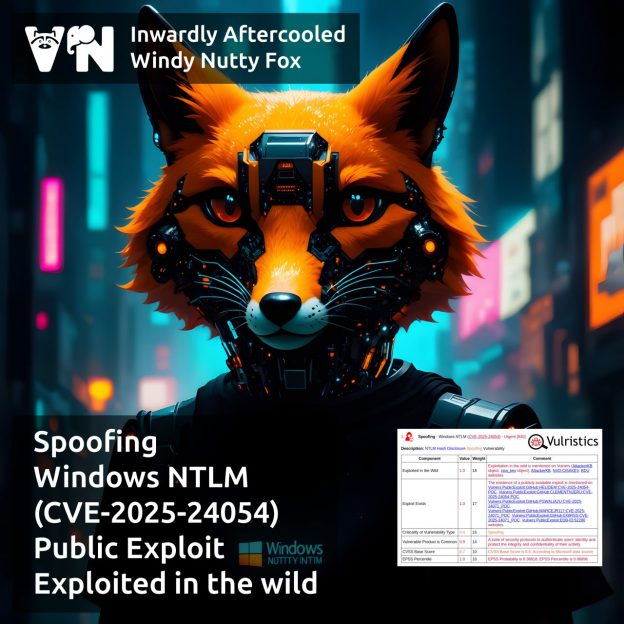
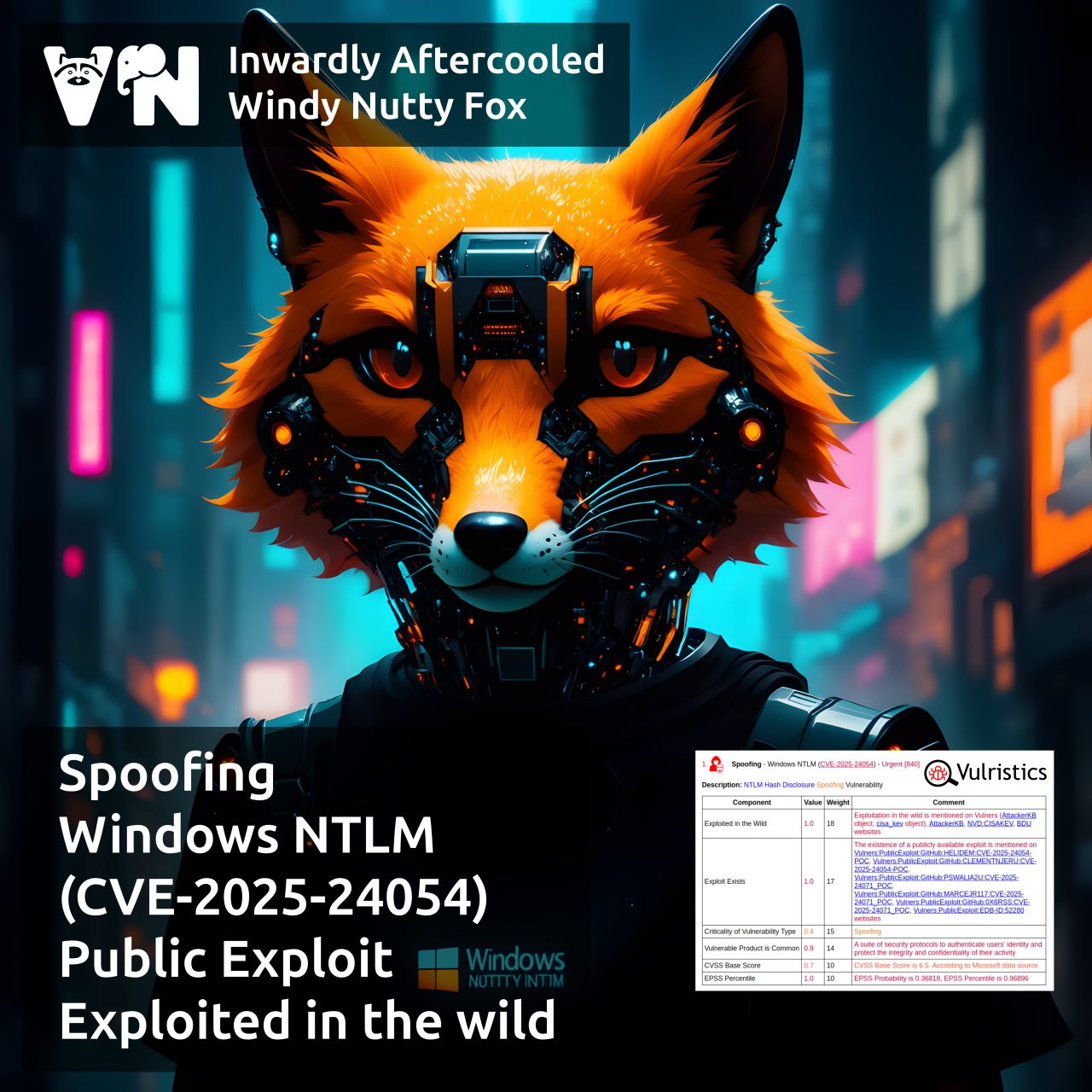
🔻 Spoofing - Windows NTLM (CVE-2025-24054)
🔻 Remote Code Execution - Erlang/OTP (CVE-2025-32433)

На русском

About Spoofing - Windows NTLM (CVE-2025-24054) vulnerability

About Spoofing - Windows NTLM (CVE-2025-24054) vulnerability

About Spoofing - Windows NTLM (CVE-2025-24054) vulnerability. It was patched in the March Microsoft Patch Tuesday. VM vendors didn't mention this vulnerability in their reviews; it was only known to be exploited via user interaction with a malicious file.

A month later, on April 16, Check Point published a blog post with technical details, revealing that the vulnerability is exploited using specially crafted files...

✋ Wait a minute — there was a trending vulnerability in March MSPT: CVE-2025-24071, related to the same files. 🤔 Turns out, it’s THE SAME vulnerability. 🤪 Check Point reports: "Microsoft had initially assigned the vulnerability the CVE identifier CVE-2025-24071, but it has since been updated to CVE-2025-24054". What a mess. 🤷‍♂️ Technical details in the previous post.

👾 Since March 19, Check Point has tracked about 11 campaigns exploiting this vulnerability to collect NTLMv2-SSP hashes.

На русском

I have finalized the list of trending vulnerabilities for 2024 according to Positive Technologies

I have finalized the list of trending vulnerabilities for 2024 according to Positive Technologies

I have finalized the list of trending vulnerabilities for 2024 according to Positive Technologies. Last year, 74 vulnerabilities were classified as trending (to compare the scale, just over 40,000 were added to NVD in 2024).

All trending vulnerabilities are found in Western commercial products and open source projects. This year, the vulnerabilities of domestic Russian products did not reach the level of criticality required to classify them as trending.

For 55 of all trending vulnerabilities there are currently signs of exploitation in attacks, for 17 there are public exploits (but no signs of exploitation) and for the remaining 2 there is only a possibility of future exploitation.

Vulnerabilities were often added to trending ones before signs of exploitation in the wild appeared. For example, the remote code execution vulnerability in VMware vCenter (CVE-2024-38812) was added to the list of trending vulnerabilities on September 20, 3 days after the vendor's security bulletin appeared. There were no signs of exploitation in the wild or public exploit for this vulnerability. Signs of exploitation appeared only 2 months later, on November 18.

Most of the vulnerabilities in the trending list are of the following types: Remote Code or Command Execution (24) and Elevation of Privilege (21).

4 vulnerabilities in Barracuda Email Security Gateway (CVE-2023-2868), MOVEit Transfer (CVE-2023-34362), papercut (CVE-2023-27350) and SugarCRM (CVE-2023-22952) were added in early January 2024. These vulnerabilities were massively exploited in the West in 2023, and attacks using these vulnerabilities could also tangentially affect those domestic Russian organizations where these products had not yet been taken out of service. The rest of the vulnerabilities became trending in 2024.

34 trending vulnerabilities affect Microsoft products (45%).

🔹 17 of them are Elevation of Privilege vulnerabilities in the Windows kernel and standard components.

🔹 1 Remote Code Execution vulnerability in Windows Remote Desktop Licensing Service (CVE-2024-38077).

2 trending Elevation of Privilege vulnerabilities affect Linux systems: one in nftables (CVE-2024-1086), and the second in needrestart (CVE-2024-48990).

Other groups of vulnerabilities

🔻 Phishing attacks: 19 (Windows components, Outlook, Exchange, Ghostscript, Roundcube)
🔻 Network security and entry points: 13 (Palo Alto, Fortinet, Juniper, Ivanti, Check Point, Zyxel)
🔻 Virtual infrastructure and backups: 7 (VMware, Veeam, Acronis)
🔻 Software development: 6 (GitLab, TeamCity, Jenkins, PHP, Fluent Bit, Apache Struts)
🔻 Collaboration tools: 3 (Atlassian Confluence, XWiki)
🔻 CMS WordPress plugins: 3 (LiteSpeed Cache, The Events Calendar, Hunk Companion)

🗒 Full Vulristics report

🟥 Article on the official website "Vulnerable software and hardware vs. security researchers" (rus)

На русском

Trending vulnerabilities of July according to Positive Technologies

Trending vulnerabilities of July according to Positive Technologies.

The SecLab film crew went on vacation. Therefore, there was a choice: to skip the episode of "In the trend of VM" about the July vulnerabilities, or to make a video myself. Which is what I tried to do. And from the next episode we will return to SecLab again.

📹 Video "In The Trend of VM" on YouTube
🗞 A post on Habr (rus) a slightly expanded script of the video
🗒 A compact digest (rus) on the official PT website

List of vulnerabilities:

🔻 00:33 Spoofing - Windows MSHTML Platform (CVE-2024-38112)
🔻 02:23 RCE - Artifex Ghostscript (CVE-2024-29510)
🔻 03:55 RCE - Acronis Cyber Infrastructure (CVE-2023-45249)

English voice over was generated by my open source utility subtivo (subtitles to voice over)

На русском