

Tag Archives: Jenkins

August Linux Patch Wednesday

August Linux Patch Wednesday

August Linux Patch Wednesday. A total of 3,060 vulnerabilities. For comparison, there were 2,017 in July. That's a 52% increase and another new record. This time, there are 1,354 vulnerabilities in the Linux Kernel and 447 in Chromium. For 3 vulnerabilities, there are signs of exploitation in the wild:

🔻 RCE - Jenkins (CVE-2026-53435). Jenkins is a development automation server used to build, test, and deploy software. The vulnerability allows a remote authenticated attacker to use the Script Console to execute arbitrary code and read files from the Jenkins controller. The vulnerability was added to the VulnCheck KEV on June 15 and fixed in RedOS on August 12.

🔻 CodeInj - WordPress (CVE-2026-60137). WordPress is a popular open-source CMS for creating websites and blogs. The vulnerability leads to a blind SQL injection in the WordPress core, allowing a remote unauthenticated attacker to read user accounts and password hashes from the WordPress database. Code execution is then possible by installing a malicious plugin. Multiple public exploits are available. The vulnerability was added to the CISA KEV catalog on July 21. A fix for the wordpress package in the Debian repository was released on July 23.

🔻 RCE - SPIP (CVE-2026-77647). SPIP is an open-source CMS for creating and collaboratively editing websites. The vulnerability allows an unauthenticated remote attacker to execute arbitrary PHP code. The vulnerability was added to the VulnCheck KEV on August 20. A fix for the spip package in the Debian repository was released on August 18.

Strictly speaking, the report contains one more vulnerability RCE - WinRAR (CVE-2025-8088) that is being exploited in the wild. The vulnerability was fixed in the clamav package in the Alt Linux repository. However, exploitation is only possible on Windows, so it is out of scope.

Another 127 vulnerabilities are not known to be exploited in the wild, but public exploits are available for them, or there are indications that such exploits exist. Notable examples include:

🔸 RCE - Action Pack "KindaRails2Shell" (CVE-2026-66066). Action Pack is a component of Ruby on Rails responsible for handling web requests, routing, and generating responses. An attacker can upload a specially crafted image to a vulnerable application and achieve remote code execution.

🔸 RCE - WordPress "XSS2Shell" (CVE-2026-64638). The attack chain allows an unauthenticated XSS on the login page to be escalated to arbitrary PHP code execution.

🔸 CodeInj - PHP (CVE-2026-17543). Improper escaping of backslashes in attacker-controlled parameters can lead to a trivial SQL injection in PHP.

🔸 EoP - Linux Kernel "Zapscape" (CVE-2026-64561). This KVM escape vulnerability allows an attacker to break out of a virtual machine in KVM/x86 environments and execute commands on the host with root privileges.

🔸 EoP - Linux Kernel "OVSwrap" (CVE-2026-64531), Linux Kernel "SCTPhantom" (CVE-2026-64564), Linux Kernel "Ubuntu PPPoL2TP" (CVE-2026-68398). These vulnerabilities allow a local attacker to escalate privileges to root.

🔸 AuthBypass - Traefik (CVE-2026-48020). Traefik is an HTTP reverse proxy and load balancer. A high-severity vulnerability in the StripPrefix middleware allows an unauthenticated attacker to bypass route-level authentication and authorization.


🗒 Full Vulristics report

I have finalized the list of trending vulnerabilities for 2024 according to Positive Technologies

I have finalized the list of trending vulnerabilities for 2024 according to Positive Technologies

I have finalized the list of trending vulnerabilities for 2024 according to Positive Technologies. Last year, 74 vulnerabilities were classified as trending (to compare the scale, just over 40,000 were added to NVD in 2024).

All trending vulnerabilities are found in Western commercial products and open source projects. This year, the vulnerabilities of domestic Russian products did not reach the level of criticality required to classify them as trending.

For 55 of all trending vulnerabilities there are currently signs of exploitation in attacks, for 17 there are public exploits (but no signs of exploitation) and for the remaining 2 there is only a possibility of future exploitation.

Vulnerabilities were often added to trending ones before signs of exploitation in the wild appeared. For example, the remote code execution vulnerability in VMware vCenter (CVE-2024-38812) was added to the list of trending vulnerabilities on September 20, 3 days after the vendor's security bulletin appeared. There were no signs of exploitation in the wild or public exploit for this vulnerability. Signs of exploitation appeared only 2 months later, on November 18.

Most of the vulnerabilities in the trending list are of the following types: Remote Code or Command Execution (24) and Elevation of Privilege (21).

4 vulnerabilities in Barracuda Email Security Gateway (CVE-2023-2868), MOVEit Transfer (CVE-2023-34362), papercut (CVE-2023-27350) and SugarCRM (CVE-2023-22952) were added in early January 2024. These vulnerabilities were massively exploited in the West in 2023, and attacks using these vulnerabilities could also tangentially affect those domestic Russian organizations where these products had not yet been taken out of service. The rest of the vulnerabilities became trending in 2024.

34 trending vulnerabilities affect Microsoft products (45%).

🔹 17 of them are Elevation of Privilege vulnerabilities in the Windows kernel and standard components.

🔹 1 Remote Code Execution vulnerability in Windows Remote Desktop Licensing Service (CVE-2024-38077).

2 trending Elevation of Privilege vulnerabilities affect Linux systems: one in nftables (CVE-2024-1086), and the second in needrestart (CVE-2024-48990).

Other groups of vulnerabilities

🔻 Phishing attacks: 19 (Windows components, Outlook, Exchange, Ghostscript, Roundcube)
🔻 Network security and entry points: 13 (Palo Alto, Fortinet, Juniper, Ivanti, Check Point, Zyxel)
🔻 Virtual infrastructure and backups: 7 (VMware, Veeam, Acronis)
🔻 Software development: 6 (GitLab, TeamCity, Jenkins, PHP, Fluent Bit, Apache Struts)
🔻 Collaboration tools: 3 (Atlassian Confluence, XWiki)
🔻 CMS WordPress plugins: 3 (LiteSpeed Cache, The Events Calendar, Hunk Companion)

🗒 Full Vulristics report

🟥 Article on the official website "Vulnerable software and hardware vs. security researchers" (rus)

На русском

I generated a Vulristics report on the April Linux Patch Wednesday

I generated a Vulristics report on the April Linux Patch Wednesday
I generated a Vulristics report on the April Linux Patch WednesdayI generated a Vulristics report on the April Linux Patch WednesdayI generated a Vulristics report on the April Linux Patch WednesdayI generated a Vulristics report on the April Linux Patch WednesdayI generated a Vulristics report on the April Linux Patch WednesdayI generated a Vulristics report on the April Linux Patch Wednesday

I generated a Vulristics report on the April Linux Patch Wednesday. Over the past month, Linux vendors have begun releasing patches for a record number of vulnerabilities - 348. There are signs of exploitation in the wild for 7 vulnerabilities (data on incidents from the FSTEC BDU). Another 165 have a link to an exploit or a sign of the existence of a public/private exploit.

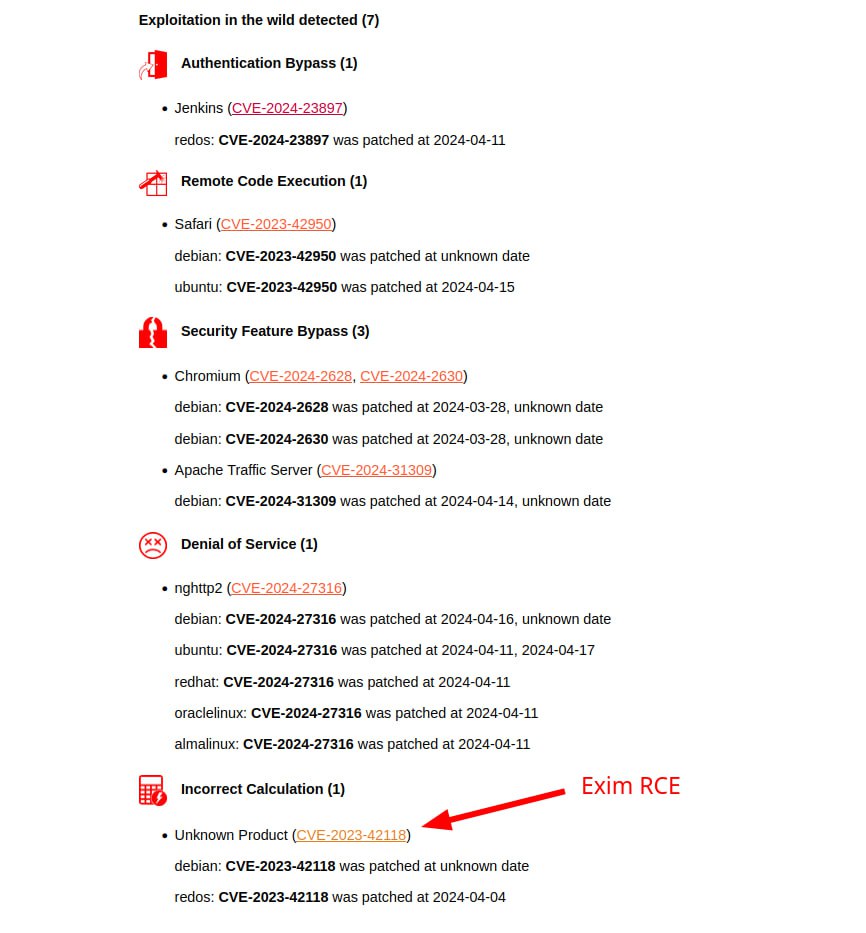
Let's start with 7 vulnerabilities with signs of exploitation in the wild and exploits:

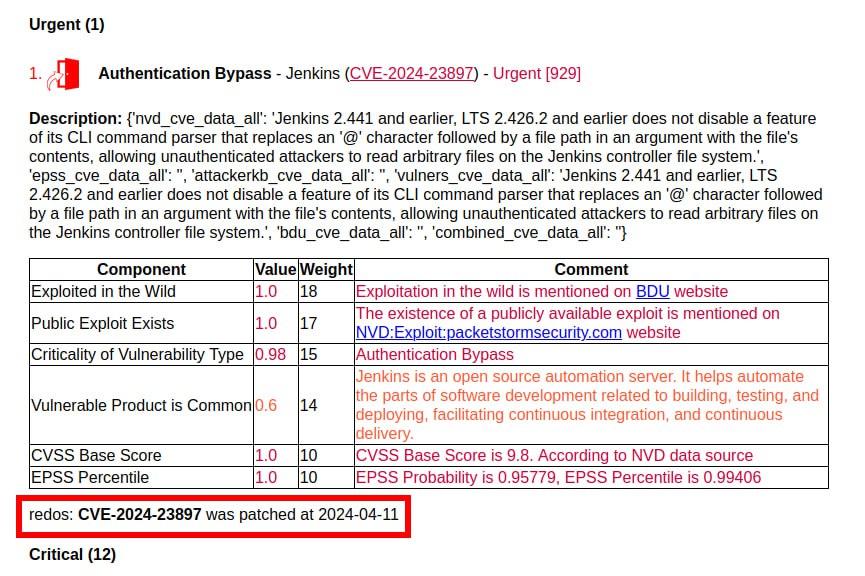
🔻 The trending January vulnerability Authentication Bypass - Jenkins (CVE-2024-23897) unexpectedly appeared in the TOP. As far as I understand, Linux distributions usually do not include Jenkins packages in the official repositories and, accordingly, do not add Jenkins vulnerability detection rules to their OVAL content. Unlike the Russian Linux distribution RedOS. Therefore, RedOS has the earliest fix timestamp for this vulnerability.

🔻 2 RCE vulnerabilities. The most interesting of them is Remote Code Execution - Exim (CVE-2023-42118). When generating the report, I deliberately did not take into account the vulnerability description and product names from the BDU database (flags --bdu-use-product-names-flag, --bdu-use-vulnerability-descriptions-flag set to False). Otherwise, the report would be partly in English and partly in Russian. But it turned out that so far only BDU has an adequate description of this vulnerability. 🤷‍♂️ You need to take a closer look at this vulnerability because Exim is a fairly popular mail server. The second RCE vulnerability is in the web browser, Remote Code Execution - Safari (CVE-2023-42950).

🔻2 DoS vulnerabilities. Denial of Service - nghttp2/Apache HTTP Server (CVE-2024-27316) and Denial of Service - Apache Traffic Server (CVE-2024-31309). The second is classified in the report as Security Feature Bypass, but this is due to incorrect CWE in NVD (CWE-20 - Improper Input Validation)

🔻 2 browser vulnerabilities Security Feature Bypass - Chromium (CVE-2024-2628, CVE-2024-2630)

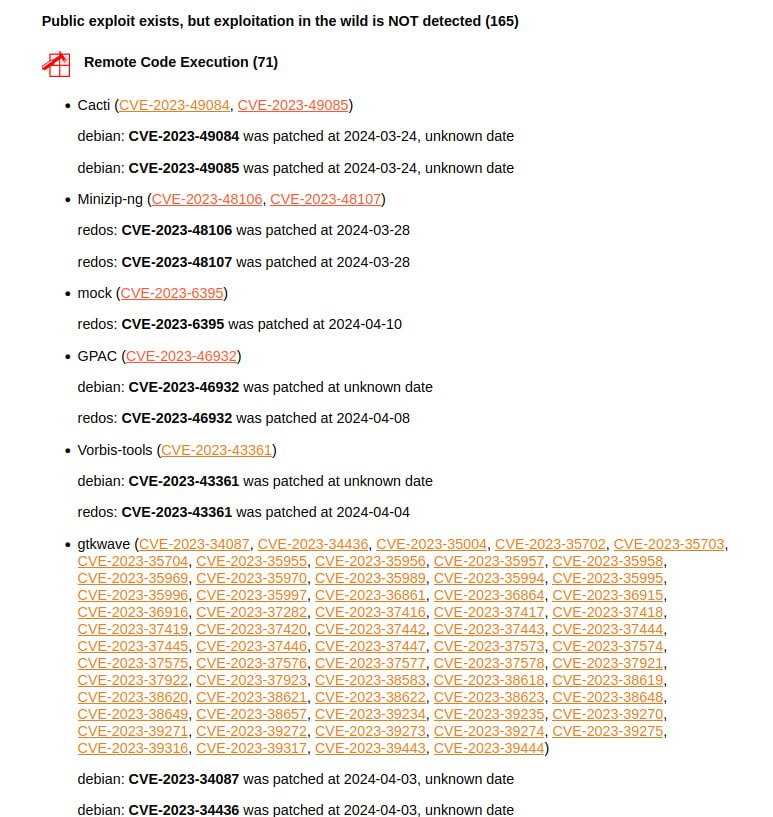
Among the vulnerabilities for which there are only signs of the existence of exploits so far, you can pay attention to the following:

🔸 A large number of RCE vulnerabilities (71). Most of them are in the gtkwave product. This is a viewer for VCD (Value Change Dump) files, which are typically created by digital circuit simulators. Also, the Remote Code Execution - Cacti (CVE-2023-49084, CVE-2023-49085) vulnerabilities look dangerous. Cacti is a solution for monitoring servers and network devices.

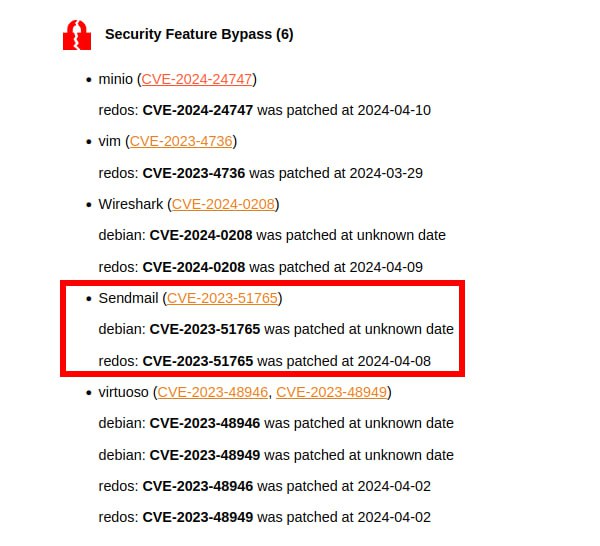
🔸 Security Feature Bypass - Sendmail (CVE-2023-51765). Allows an attacker to inject email messages with a spoofed MAIL FROM address.

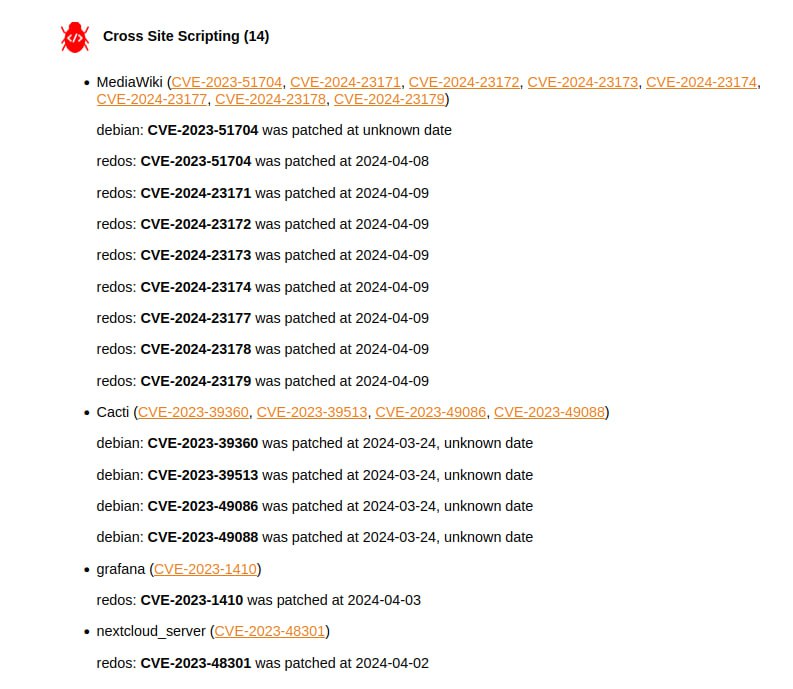
🔸 A pack of Cross Site Scripting vulnerabilities in MediaWiki, Cacti, Grafana, Nextcloud.

There is a lot to explore this time. 🤩

🗒 April Linux Patch Wednesday

На русском