Tag Archives: Safari

April Linux Patch Wednesday

April Linux Patch Wednesday

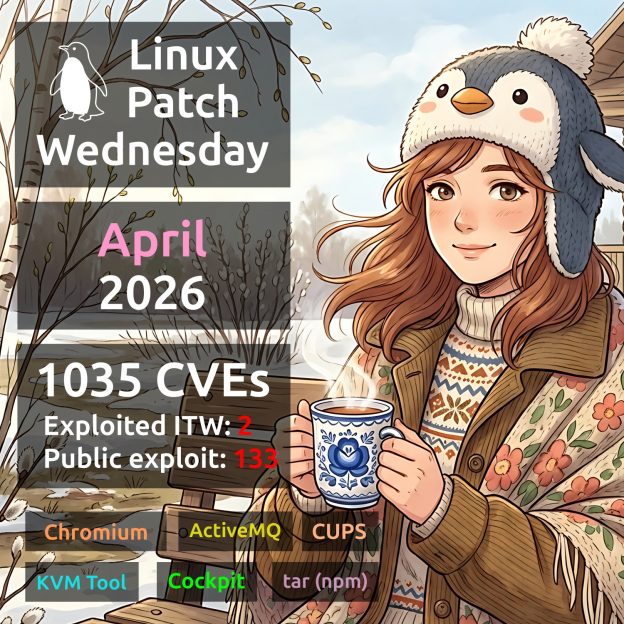
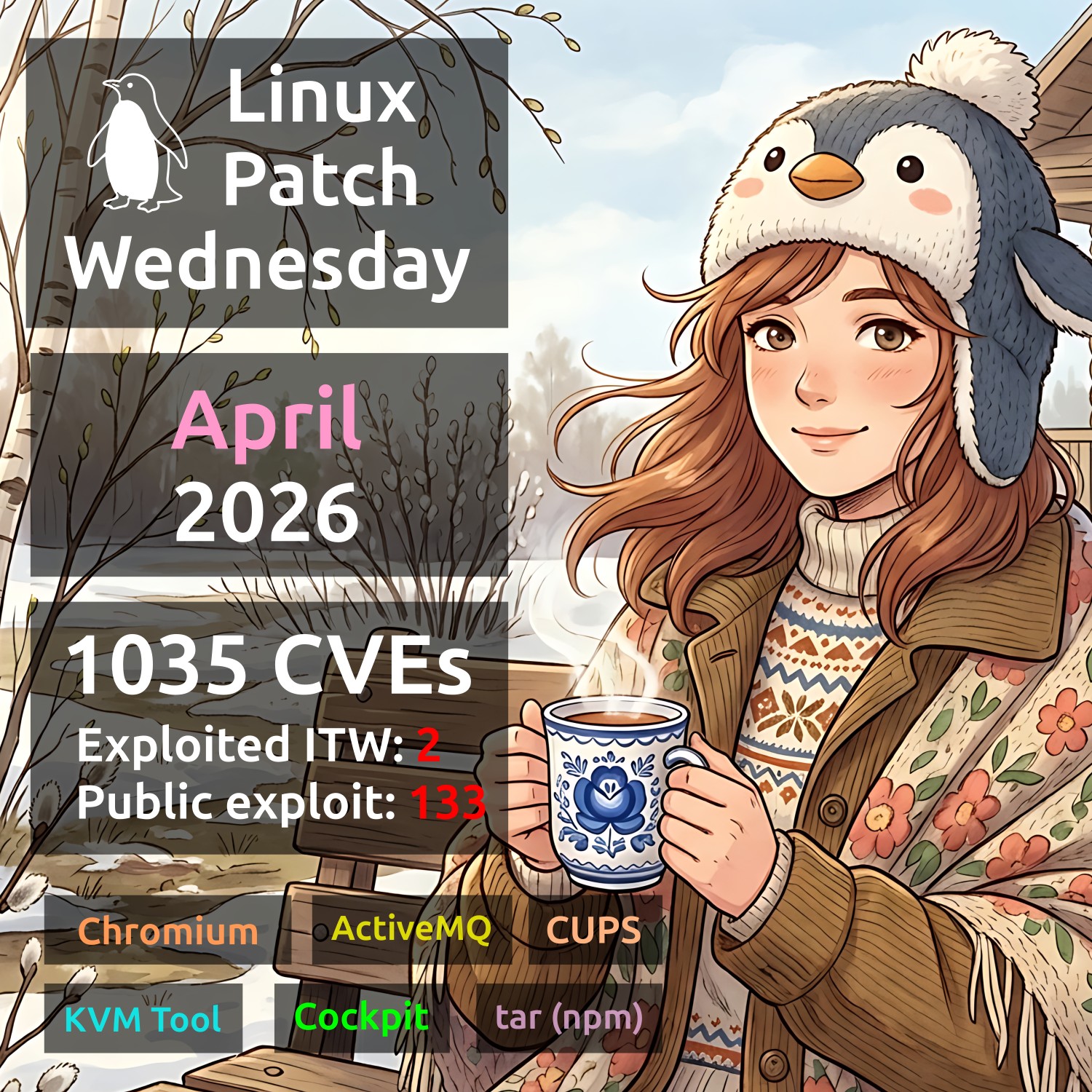
April Linux Patch Wednesday. In April, Linux vendors addressed 1,035 vulnerabilities - nearly twice as many as in March. One might assume that most of these would again be Linux Kernel vulnerabilities, but that's not the case! Linux Kernel vulnerabilities were relatively few - just 209. The remaining vulnerabilities are distributed across more than 200 affected products. Notably, two vulnerabilities show evidence of active exploitation in the wild:

🔻 RCE - Apache ActiveMQ (CVE-2026-34197). Remote code execution is possible via the Jolokia API (/api/jolokia/) with no authentication required. The vulnerability remained hidden in the codebase for 13 years before being discovered using AI. Listed in the CISA KEV since April 16. Numerous exploits are available on GitHub.

🔻 RCE - Chromium (CVE-2026-5281). A use-after-free vulnerability in Dawn (Chromium's graphics layer and WebGPU implementation) affects Google Chrome versions prior to 146.0.7680.178. A remote attacker who has gained control of the rendering process can execute arbitrary code via a specially crafted HTML page. Listed in the CISA KEV since April 1.

Public exploits are available, or signs of their existence have been observed, for another 133 (❗️) vulnerabilities. The most notable ones, in my opinion:

🔸 RCE - Cockpit (CVE-2026-4631). Cockpit is a web‑based tool for server administration in Linux systems, enabling users to manage servers, containers, storage, and network configurations through a browser interface. An attacker with network access to the Cockpit web service can send a single HTTP request to the login page, injecting malicious SSH options or commands and executing code on the Cockpit server - all without valid credentials.

🔸 RCE - CUPS (CVE-2026-34990 + CVE-2026-34980). CUPS (Common UNIX Printing System) is a printing system for Unix‑like operating systems, including Linux and macOS. A chain of these vulnerabilities allows a remote attacker without authentication to overwrite files with root permissions over the network, effectively gaining root access on a typical Linux system.

🔸 RCE - KVM Tool (CVE-2021-45464). KVM Tool is a lightweight tool for running virtual machines based on KVM (Kernel‑based Virtual Machine) in Linux. KVM Tool prior to commit 39181fc contains an out‑of‑bounds write vulnerability, allowing a guest OS user to execute arbitrary code on the host machine.

🔸 PathTrav - tar (npm) (CVE-2026-31802, CVE-2026-24842). Prior to version 7.5.11, the npm package allowed creating a symbolic link pointing outside the extraction directory, leading to file overwrites.

Other vulnerabilities worth paying attention to:

🔸 RCE - Handlebars (CVE-2026-33937), tiemu (CVE-2017-20225), Netwide Assembler (CVE-2026-6067), openexr (CVE-2026-34545), Axios (CVE-2026-40175), hdf5 (CVE-2026-29043)
🔸 CodeInj - GLPI (CVE-2025-66417), glances (CVE-2026-30930, CVE-2026-32611), Handlebars (CVE-2026-33938, CVE-2026-33940), dynaconf (CVE-2026-33154), icalendar (CVE-2026-33635)
🔸 SFB - ormar (CVE-2026-27953), cpp-httplib (CVE-2026-34441), Safari (CVE-2026-20643), rack (CVE-2026-34835), wolfssl (CVE-2026-5194), Traefik (CVE-2026-32695), glances (CVE-2026-32632, CVE-2026-32634), Vert.x-Web (CVE-2026-1002), ecdsa (CVE-2026-33936), glibc (CVE-2026-4438), incus (CVE-2026-33542), Mongoose (CVE-2026-2968)
🔸 AuthBypass - scitokens_cpp_library (CVE-2026-32725, CVE-2026-32726), Node.js pbkdf2 (CVE-2026-32633), rack-session (CVE-2026-39324), Traefik (CVE-2026-33433), grpc (CVE-2026-33186), nltk (CVE-2026-33231)
🔸 ArbFileWrite - Rust (CVE-2026-33056)
🔸 CmdInj - Netty (CVE-2026-33870), awstats (CVE-2025-63261)
🔸 EoP - Keycloak (CVE-2026-4636), QEMU (CVE-2026-33711), glances (CVE-2026-33641)


🗒 Full Vulristics report

January Linux Patch Wednesday

January Linux Patch Wednesday

January Linux Patch Wednesday. In January, Linux vendors started fixing 918 vulnerabilities, one and a half times more than in December. Of these, 616 are in the Linux Kernel. Three show signs of exploitation in the wild:

🔻 AuthBypass - GNU Inetutils (telnetd) (CVE-2026-24061)
🔻 RCE - Safari (CVE-2025-43529); fixed in Linux distributions in webkit packages
🔻 MemCor - Chromium (CVE-2025-14174)

Another 97 vulnerabilities have public exploits or signs of their existence. Key examples:

🔸 MemCor - libpng (CVE-2026-22695)
🔸 XSS - Roundcube (CVE-2025-68461)
🔸 RCE - expr-eval (CVE-2025-13204)
🔸 ComInj - cpp-httplib (CVE-2026-21428), httparty (CVE-2025-68696), Miniflux (CVE-2026-21885)
🔸 SQLi - parsl (CVE-2026-21892)
🔸 SFB - OWASP CRS (CVE-2026-21876), Authlib (CVE-2025-68158)
🔸 AFW - node-tar (CVE-2026-23745)
🔸 PathTrav - GNU Wget2 (CVE-2025-69194), Tar (CVE-2025-45582)

🗒 Full Vulristics Report

На русском

I generated a Vulristics report on the April Linux Patch Wednesday

I generated a Vulristics report on the April Linux Patch Wednesday
I generated a Vulristics report on the April Linux Patch WednesdayI generated a Vulristics report on the April Linux Patch WednesdayI generated a Vulristics report on the April Linux Patch WednesdayI generated a Vulristics report on the April Linux Patch WednesdayI generated a Vulristics report on the April Linux Patch WednesdayI generated a Vulristics report on the April Linux Patch Wednesday

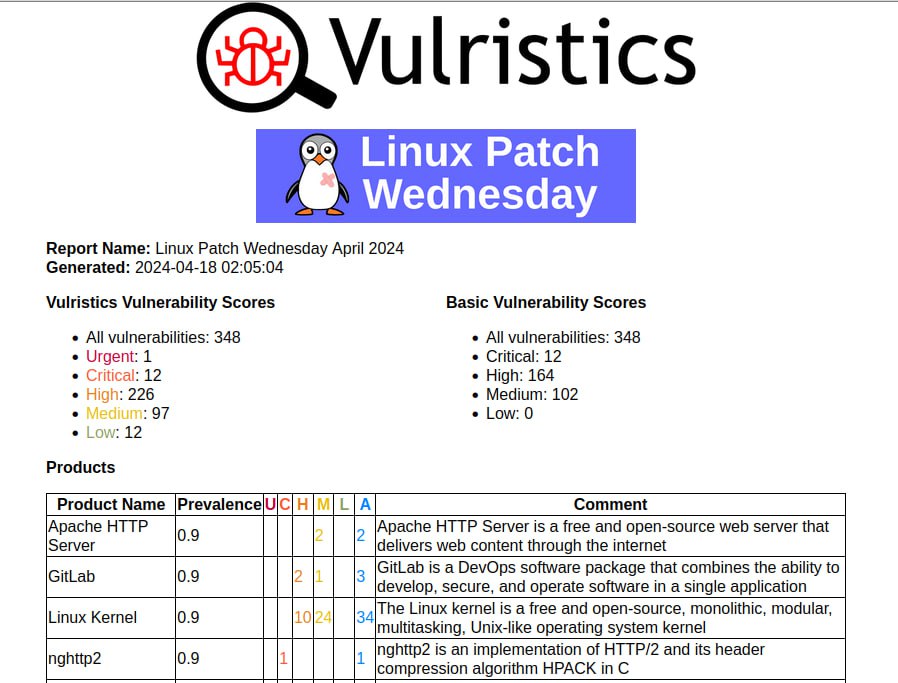
I generated a Vulristics report on the April Linux Patch Wednesday. Over the past month, Linux vendors have begun releasing patches for a record number of vulnerabilities - 348. There are signs of exploitation in the wild for 7 vulnerabilities (data on incidents from the FSTEC BDU). Another 165 have a link to an exploit or a sign of the existence of a public/private exploit.

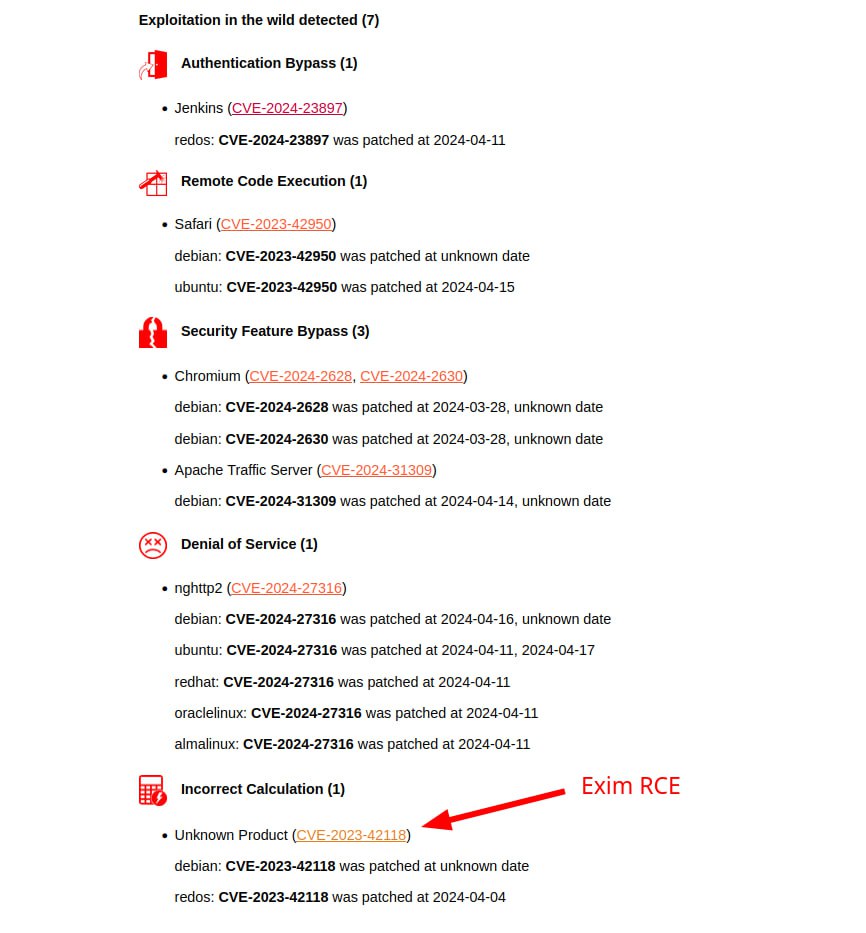
Let's start with 7 vulnerabilities with signs of exploitation in the wild and exploits:

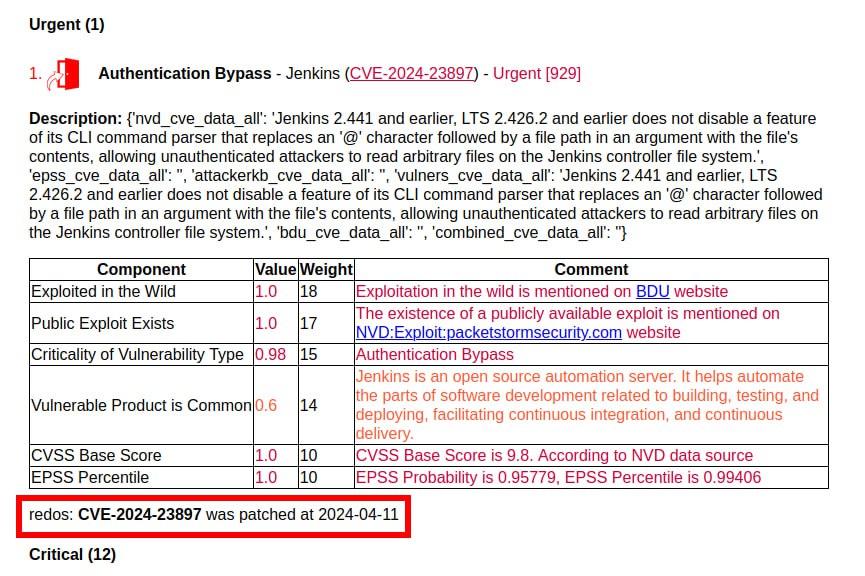
🔻 The trending January vulnerability Authentication Bypass - Jenkins (CVE-2024-23897) unexpectedly appeared in the TOP. As far as I understand, Linux distributions usually do not include Jenkins packages in the official repositories and, accordingly, do not add Jenkins vulnerability detection rules to their OVAL content. Unlike the Russian Linux distribution RedOS. Therefore, RedOS has the earliest fix timestamp for this vulnerability.

🔻 2 RCE vulnerabilities. The most interesting of them is Remote Code Execution - Exim (CVE-2023-42118). When generating the report, I deliberately did not take into account the vulnerability description and product names from the BDU database (flags --bdu-use-product-names-flag, --bdu-use-vulnerability-descriptions-flag set to False). Otherwise, the report would be partly in English and partly in Russian. But it turned out that so far only BDU has an adequate description of this vulnerability. 🤷‍♂️ You need to take a closer look at this vulnerability because Exim is a fairly popular mail server. The second RCE vulnerability is in the web browser, Remote Code Execution - Safari (CVE-2023-42950).

🔻2 DoS vulnerabilities. Denial of Service - nghttp2/Apache HTTP Server (CVE-2024-27316) and Denial of Service - Apache Traffic Server (CVE-2024-31309). The second is classified in the report as Security Feature Bypass, but this is due to incorrect CWE in NVD (CWE-20 - Improper Input Validation)

🔻 2 browser vulnerabilities Security Feature Bypass - Chromium (CVE-2024-2628, CVE-2024-2630)

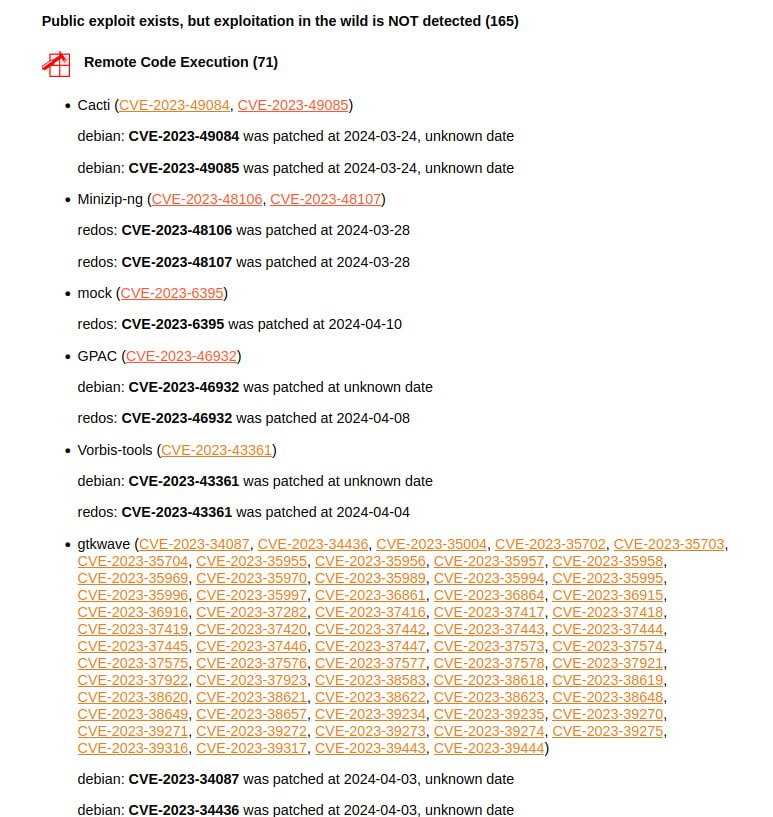
Among the vulnerabilities for which there are only signs of the existence of exploits so far, you can pay attention to the following:

🔸 A large number of RCE vulnerabilities (71). Most of them are in the gtkwave product. This is a viewer for VCD (Value Change Dump) files, which are typically created by digital circuit simulators. Also, the Remote Code Execution - Cacti (CVE-2023-49084, CVE-2023-49085) vulnerabilities look dangerous. Cacti is a solution for monitoring servers and network devices.

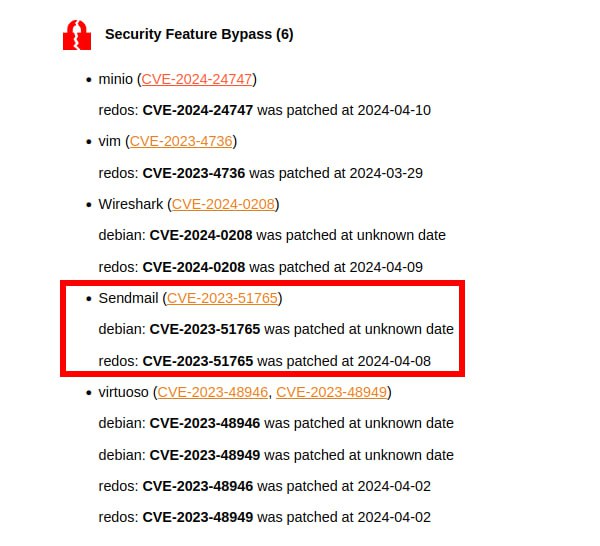
🔸 Security Feature Bypass - Sendmail (CVE-2023-51765). Allows an attacker to inject email messages with a spoofed MAIL FROM address.

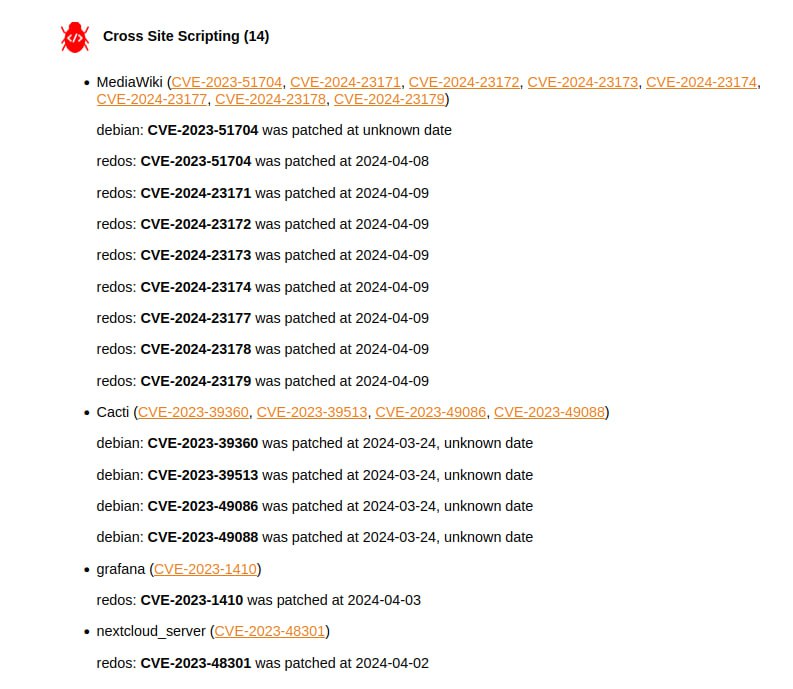
🔸 A pack of Cross Site Scripting vulnerabilities in MediaWiki, Cacti, Grafana, Nextcloud.

There is a lot to explore this time. 🤩

🗒 April Linux Patch Wednesday

На русском

November 2023 - January 2024: New Vulristics Features, 3 Months of Microsoft Patch Tuesdays and Linux Patch Wednesdays, Year 2023 in Review

November 2023 – January 2024: New Vulristics Features, 3 Months of Microsoft Patch Tuesdays and Linux Patch Wednesdays, Year 2023 in Review. Hello everyone! It has been 3 months since the last episode. I spent most of this time improving my Vulristics project. So in this episode, let’s take a look at what’s been done.

Alternative video link (for Russia): https://vk.com/video-149273431_456239139

Also, let’s take a look at the Microsoft Patch Tuesdays vulnerabilities, Linux Patch Wednesdays vulnerabilities and some other interesting vulnerabilities that have been released or updated in the last 3 months. Finally, I’d like to end this episode with a reflection on how my 2023 went and what I’d like to do in 2024.

Continue reading