Tag Archives: PoC

May "In the Trend of VM" (#27): high-profile vulnerabilities in Linux, ActiveMQ, SharePoint, and Adobe Acrobat Reader

May In the Trend of VM (#27): high-profile vulnerabilities in Linux, ActiveMQ, SharePoint, and Adobe Acrobat Reader

May "In the Trend of VM" (#27): high-profile vulnerabilities in Linux, ActiveMQ, SharePoint, and Adobe Acrobat Reader. Presenting the traditional monthly roundup of trending vulnerabilities according to Positive Technologies. While the previous April edition featured only one vulnerability, this one includes four, covering different technologies and attack scenarios.

🗞 Post on Habr (rus)
🗒 Digest on the PT website (rus)

🔻 EoP - Linux Kernel "Copy Fail" (CVE-2026-31431). The vulnerability allows an attacker to gain root privileges.

🔻 RCE - Apache ActiveMQ (CVE-2026-34197). A vulnerability in a solution widely used in enterprise systems and integration platforms.

🔻 Spoofing - Microsoft SharePoint Server (CVE-2026-32201). A vulnerability in a Microsoft solution widely used in enterprise systems for collaboration, document management, and internal portal development.

🔻 RCE - Adobe Reader (CVE-2026-34621). A vulnerability in a widely used PDF document viewer; actively exploited in phishing attacks.

🟥 The full list of trending vulnerabilities is available on the portal

About Elevation of Privilege - Linux Kernel "Copy Fail" (CVE-2026-31431) vulnerability

About Elevation of Privilege - Linux Kernel Copy Fail (CVE-2026-31431) vulnerability

About Elevation of Privilege - Linux Kernel "Copy Fail" (CVE-2026-31431) vulnerability. A local privilege escalation vulnerability in the Linux kernel AF_ALG component, which is caused by a memory handling flaw, allows an unprivileged user to escalate privileges to root. By exploiting this vulnerability, an attacker can fully compromise the system: read and modify any files, including passwords and keys, replace system binaries, disable security controls and monitoring tools, stealthily install backdoors and maintain persistence, hide traces of their activity, and use the host as a foothold for attacks on other network assets.

⚙️🛠 On April 1, patches addressing the vulnerability were merged into the main branch of the Linux kernel. On April 22, a CVE identifier was assigned to the vulnerability. On April 29, experts from Theori published an analysis of the vulnerability and a public exploit. The vulnerability's exploitability has been confirmed on up-to-date versions of widely used Linux distributions, including Ubuntu, Amazon Linux, RHEL, and SUSE.

👾 On May 1, the vulnerability was added to the CISA KEV catalog, indicating it is being exploited in the wild.

What distinguishes this vulnerability from similar EOP/LPE issues in Linux?

There have been high-profile privilege escalation vulnerabilities in the Linux kernel. Dirty COW required winning a race condition. Multiple attempts were often needed, and this sometimes led to system crashes. Dirty Pipe was tied to specific versions and required precise pipe buffer manipulation.

But unlike Dirty COW and Dirty Pipe, researchers report that Copy Fail is a straight-line logic flaw. It triggers without races, retries, or crash-prone timing windows.

🧬 Portability. The same exploit script works across all tested distributions and architectures, including Ubuntu, Amazon Linux, Red Hat Enterprise Linux (RHEL), and SUSE Linux Enterprise. No per-distribution offsets. No recompilation. No version checks in the exploit.

✧ Minimalism. The entire exploit is a short Python script using only standard library modules (os, socket, zlib). It requires Python 3.10+ for os.splice. No compiled payloads, no dependency installation.

🥷 Stealth. The write bypasses the ordinary VFS write path. The corrupted page is never marked dirty by the kernel's writeback machinery. Standard file integrity tools that compare on-disk checksums will not detect it, because the on-disk file remains unchanged. Only the in-memory page cache is corrupted.

📦 Cross-container impact. The page cache is shared across all processes on the system, including across container boundaries. Copy Fail is not just a local privilege escalation. It is a container escape primitive and a vector for Kubernetes node compromise.

How to fix the vulnerability?

To remediate the vulnerability, users need to update to Linux kernel versions 6.18.22, 6.19.12, and 7.0. The kernel can be built manually, or users can wait for their Linux distribution vendor to release updated kernel packages. As of May 4, updates have been released for Ubuntu, Debian, RHEL, Fedora, SUSE, CloudLinux, Arch Linux, and ROSA Linux.

As a workaround, researchers suggest blocking the creation of AF_ALG sockets:

echo "install algif_aead /bin/false" > /etc/modprobe.d/disable-algif-aead.conf
rmmod algif_aead 2>/dev/null

November 2023 - January 2024: New Vulristics Features, 3 Months of Microsoft Patch Tuesdays and Linux Patch Wednesdays, Year 2023 in Review

November 2023 – January 2024: New Vulristics Features, 3 Months of Microsoft Patch Tuesdays and Linux Patch Wednesdays, Year 2023 in Review. Hello everyone! It has been 3 months since the last episode. I spent most of this time improving my Vulristics project. So in this episode, let’s take a look at what’s been done.

Alternative video link (for Russia): https://vk.com/video-149273431_456239139

Also, let’s take a look at the Microsoft Patch Tuesdays vulnerabilities, Linux Patch Wednesdays vulnerabilities and some other interesting vulnerabilities that have been released or updated in the last 3 months. Finally, I’d like to end this episode with a reflection on how my 2023 went and what I’d like to do in 2024.

Continue reading

August 2023: GitHub PoCs, Vulristics, Qualys First-Party, Tenable ExposureAI, SC Awards and Rapid7, Anglo-Saxon list, MS Patch Tuesday, WinRAR, Juniper

August 2023: GitHub PoCs, Vulristics, Qualys First-Party, Tenable ExposureAI, SC Awards and Rapid7, Anglo-Saxon list, MS Patch Tuesday, WinRAR, Juniper. Hello everyone! This month I decided NOT to make an episode completely dedicated to Microsoft Patch Tuesday. Instead, this episode will be an answer to the question of how my Vulnerability Management month went. A retrospection of some kind.

Alternative video link (for Russia): https://vk.com/video-149273431_456239134

Continue reading

Vulnerability Life Cycle and Vulnerability Disclosures

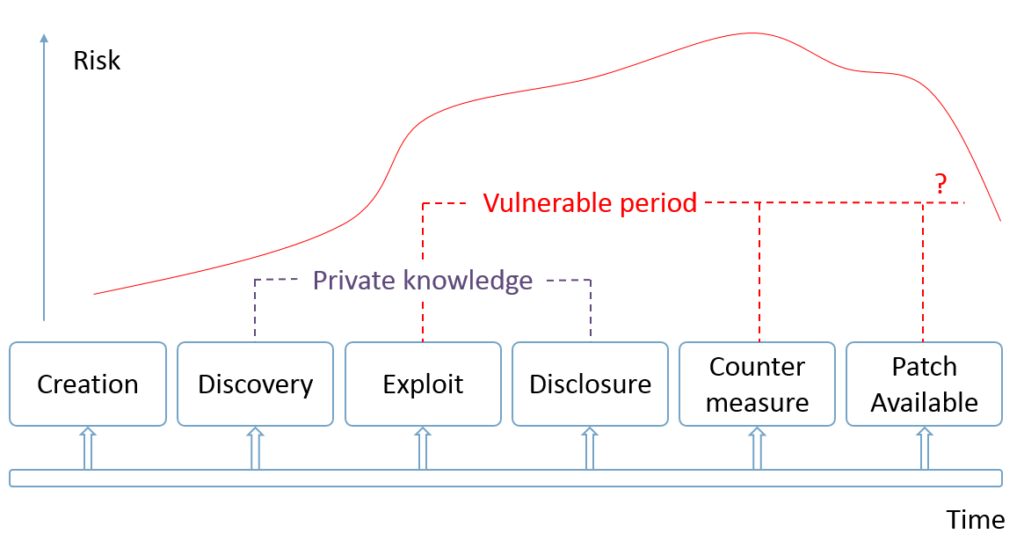
Vulnerability Life Cycle and Vulnerability Disclosures. Vulnerability Life Cycle diagram shows possible states of the vulnerability. In a previous post I suggested to treat vulnerabilities as bugs. Every known vulnerability, as same as every bug, was implemented by some software developer at some moment of time and was fixed at some moment of time later. What happens between this two events?

Vulnerability life-cycle

Right after the vulnerability was implemented in the code by some developer (creation) nobody knows about it. Well, of course, if it was done unintentionally. By the way, making backdoors look like an ordinary vulnerabilities it’s a smart way to do such things. 😉 But let’s say it WAS done unintentionally.

Time passed and some researcher found (discovery) this vulnerability and described it somehow. What’s next? It depends on who was that researcher.

Continue reading