Tag Archives: BDU

About Remote Code Execution - TrueConf Server (CVE-2026-72529, CVE-2026-72530) vulnerability

About Remote Code Execution - TrueConf Server (CVE-2026-72529, CVE-2026-72530) vulnerability

About Remote Code Execution - TrueConf Server (CVE-2026-72529, CVE-2026-72530) vulnerability. TrueConf Server is a Russian on-premises corporate messaging and UltraHD video conferencing platform. The attack chain consists of two critical vulnerabilities. The first vulnerability, CVE-2026-72529, is caused by missing authentication for a critical function (CWE-306) and allows an unauthenticated remote attacker with network access to TCP port 4307 (open by default, according to TrueConf documentation) to invoke an undocumented TrueConf Server function and execute an arbitrary script within an isolated environment ("sandbox") where potentially dangerous libraries are unavailable. The second vulnerability, CVE-2026-72530, allows an attacker to perform code injection (CWE-94), escape the isolated environment, and execute arbitrary code on the host operating system with the highest privileges. Among other things, an attacker can delete TrueConf event log entries associated with exploitation activity.

⚙️ Security fixes for these vulnerabilities were released on June 18, 2026. The affected versions are 5.3.x below 5.3.9, 5.4.x below 5.4.9, 5.5.x below 5.5.5, as well as the 5.2 branch and earlier versions (upgrading legacy versions requires contacting technical support). Re-registration of the server is not required when upgrading within the 5.3-5.5 branches. However, the vendor strongly recommends creating a backup before installing the update. If an immediate upgrade is not possible, access to TCP port 4307 should be restricted to trusted networks.

👾 Kaspersky ICS CERT experts have disclosed details of the vulnerability exploitation chain in a post published on August 12. Since July 2026, threat actors have been exploiting CVE-2026-72529 and CVE-2026-72530 in attacks targeting Russian organizations. The attackers first gained network access to TrueConf Server through TCP port 4307 and used CVE-2026-72529 to execute a script within the sandbox. They then exploited CVE-2026-72530 to escape the sandbox and execute code with NT AUTHORITY\SYSTEM privileges. This enabled them to replace one of the TrueConf Server files with a web shell of their own. The attackers then used the web shell to gather information about the organization's IT infrastructure, gain privileged access to the TrueConf Server database, and replace legitimate TrueConf Client installers with malicious versions containing the PhantomCore malware. Users were subsequently prompted to download what appeared to be a new version of the TrueConf Client, which was in fact malicious.

IMPORTANT: Even if your organization does not use TrueConf, your employees may have connected to compromised TrueConf servers used by contractors or business partners to participate in online conferences. In doing so, they may have inadvertently installed a malicious version of the TrueConf client on their workstations.

The PhantomCore malware, associated with the Head Mare APT group, launches automatically when the system starts and allows attackers to execute arbitrary commands, effectively giving them full control over the compromised host. Kaspersky researchers also identified a new backdoor used in the attacks, which they named PhantomGraph. Both vulnerabilities, CVE-2026-72529 and CVE-2026-72530, were added to the CISA KEV on August 20, 2026.

🛠 A public exploit for CVE-2026-72530 was published on GitHub on August 26. So far, no public exploit for the complete CVE-2026-72529/CVE-2026-72530 exploitation chain has been observed, despite the corresponding flags in the BDU FSTEC vulnerability database.

🌐 TrueConf Server is widely used both in Russia and internationally, including by government agencies, as well as organizations in the financial, industrial, healthcare, and education sectors.


April Linux Patch Wednesday

April Linux Patch Wednesday

April Linux Patch Wednesday. Total vulnerabilities: 251. 👌 164 in the Linux Kernel. No vulnerabilities show signs of being exploited in the wild. There are 7 vulnerabilities that appear to have publicly available exploits.

For 2 vulnerabilities, exploit code with detailed explanation is available on GitHub. Both were first patched in RedOS packages:

🔸 SQL injection - Exim (CVE-2025-26794)
🔸 Code Injection - MariaDB (CVE-2023-39593)

For the Memory Corruption - Mozilla Firefox (CVE-2025-3028), the NVD states the exploit code is in Mozilla’s bug tracker, but access is restricted. 🤷‍♂️

BDU FSTEC reports public exploits for 4 vulnerabilities:

🔸 Information Disclosure - GLPI (CVE-2025-21626)
🔸 Security Feature Bypass - GLPI (CVE-2025-23024)
🔸 Denial of Service / Remote Code Execution - Perl (CVE-2024-56406)
🔸 Memory Corruption - Libsoup (CVE-2025-32050)

🗒 Full Vulristics report

На русском

Linux Patch Wednesday: here is this May peak!

Linux Patch Wednesday: here is this May peak!

Linux Patch Wednesday: here is this May peak! 🤦‍♂️ Also about June Linux Patch Wednesday. If you remember, in my post about the May Linux Patch Wednesday I was happy that, despite the launch of the rule for Unknown dates, the peak in May was insignificant. Although "32406 oval definitions without a date received a nominal date of 2024-05-15". It turned out that the peak was not visible due to an error in the code. Ba-dum-tss! 🥸🤷‍♂️

I noticed that not all CVEs are in LPW bulletins, despite the addition of nominal dates, for example the high-profile vulnerability Elevation of Privilege (Local Privilege Escalation) - Linux Kernel (CVE-2024-1086). I could not find it anywhere. I debugged the function that distributes vulnerabilities into bulletins and added tests. I have ensured that all 38362 CVEs from the Linux OVAL content are actually distributed in bulletins. Including CVE-2024-1086. Here it is in February:

$ grep "CVE-2024-1086"  bulletins/*
bulletins/2024-02-21.json: "CVE-2024-1086": [
bulletins/2024-02-21.json: "title": "CVE-2024-1086 linux",

Well, there really is a peak in May. And how huge it is! 11476 CVEs! 😱 This is so much that I regenerated the Vulristics report for it only using 2 sources: Vulners and BDU. Since even from Vulners the data was not collected quickly enough. The report contains 77 vulnerabilities with signs of active exploitation in the wild and 1404 vulnerabilities with exploits, but without signs of active exploitation in the wild. Since for the most part these are old vulnerabilities for which it was simply not clear exactly when they were fixed, for example, Remote Code Execution - Apache HTTP Server (CVE-2021-42013), I will not analyze them in detail - for those interested, see the report. But please note that the report size is very large.

🗒 Vulristics report on the May Linux Patch Wednesday (31.3 MB)

As for the June Linux Patch Wednesday, which was finalized on June 19, there are 1040 vulnerabilities. Also quite a lot. Why is this so? On the one hand, the rule for Unknown dates added 977 Debian OVAL definitions without a date. Not 30k, like in May, but also significant. Out of 1040 vulnerabilities, 854 are Linux Kernel vulnerabilities. Moreover, there are quite a lot of "old" vulnerability identifiers, but created in 2024. For example, CVE-2021-47489 with NVD Published Date 05/22/2024. 🤔 CNA Linux Kernel is doing something strange.

🔻 With signs of exploitation in the wild again Remote Code Execution - Chromium (CVE-2024-5274, CVE-2024-4947), like in Microsoft Patch Tuesday. According to the BDU, Remote Code Execution - Libarchive (CVE-2024-26256) is also exploited in the wild.

🔸 Another 20 vulnerabilities with a public exploit. I can highlight separately Remote Code Execution - Cacti (CVE-2024-25641) and Remote Code Execution - onnx/onnx framework (CVE-2024-5187).

🗒 Vulristics report on the June Linux Patch Wednesday (4.4 MB)

I generated a Vulristics report on the April Linux Patch Wednesday

I generated a Vulristics report on the April Linux Patch Wednesday
I generated a Vulristics report on the April Linux Patch WednesdayI generated a Vulristics report on the April Linux Patch WednesdayI generated a Vulristics report on the April Linux Patch WednesdayI generated a Vulristics report on the April Linux Patch WednesdayI generated a Vulristics report on the April Linux Patch WednesdayI generated a Vulristics report on the April Linux Patch Wednesday

I generated a Vulristics report on the April Linux Patch Wednesday. Over the past month, Linux vendors have begun releasing patches for a record number of vulnerabilities - 348. There are signs of exploitation in the wild for 7 vulnerabilities (data on incidents from the FSTEC BDU). Another 165 have a link to an exploit or a sign of the existence of a public/private exploit.

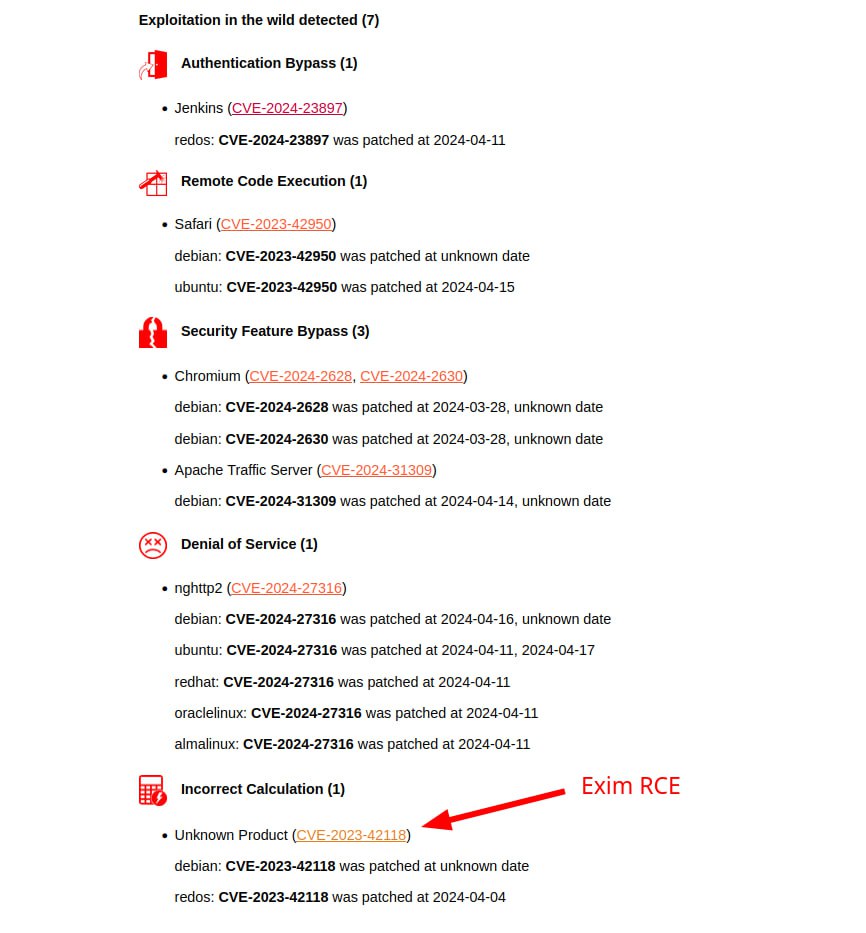
Let's start with 7 vulnerabilities with signs of exploitation in the wild and exploits:

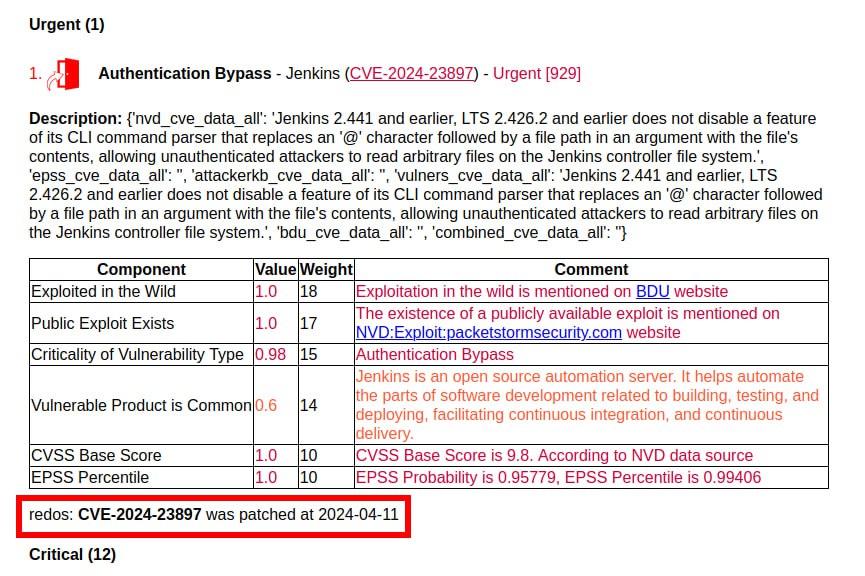
🔻 The trending January vulnerability Authentication Bypass - Jenkins (CVE-2024-23897) unexpectedly appeared in the TOP. As far as I understand, Linux distributions usually do not include Jenkins packages in the official repositories and, accordingly, do not add Jenkins vulnerability detection rules to their OVAL content. Unlike the Russian Linux distribution RedOS. Therefore, RedOS has the earliest fix timestamp for this vulnerability.

🔻 2 RCE vulnerabilities. The most interesting of them is Remote Code Execution - Exim (CVE-2023-42118). When generating the report, I deliberately did not take into account the vulnerability description and product names from the BDU database (flags --bdu-use-product-names-flag, --bdu-use-vulnerability-descriptions-flag set to False). Otherwise, the report would be partly in English and partly in Russian. But it turned out that so far only BDU has an adequate description of this vulnerability. 🤷‍♂️ You need to take a closer look at this vulnerability because Exim is a fairly popular mail server. The second RCE vulnerability is in the web browser, Remote Code Execution - Safari (CVE-2023-42950).

🔻2 DoS vulnerabilities. Denial of Service - nghttp2/Apache HTTP Server (CVE-2024-27316) and Denial of Service - Apache Traffic Server (CVE-2024-31309). The second is classified in the report as Security Feature Bypass, but this is due to incorrect CWE in NVD (CWE-20 - Improper Input Validation)

🔻 2 browser vulnerabilities Security Feature Bypass - Chromium (CVE-2024-2628, CVE-2024-2630)

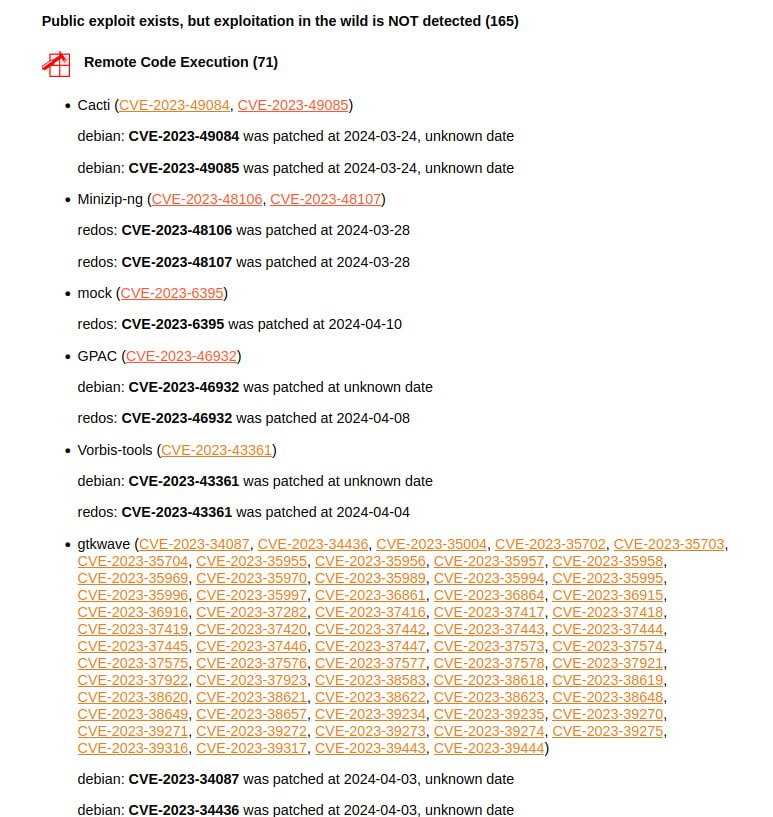
Among the vulnerabilities for which there are only signs of the existence of exploits so far, you can pay attention to the following:

🔸 A large number of RCE vulnerabilities (71). Most of them are in the gtkwave product. This is a viewer for VCD (Value Change Dump) files, which are typically created by digital circuit simulators. Also, the Remote Code Execution - Cacti (CVE-2023-49084, CVE-2023-49085) vulnerabilities look dangerous. Cacti is a solution for monitoring servers and network devices.

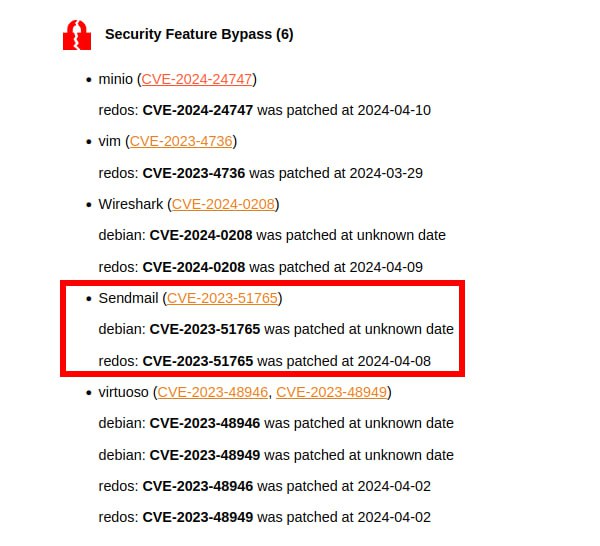
🔸 Security Feature Bypass - Sendmail (CVE-2023-51765). Allows an attacker to inject email messages with a spoofed MAIL FROM address.

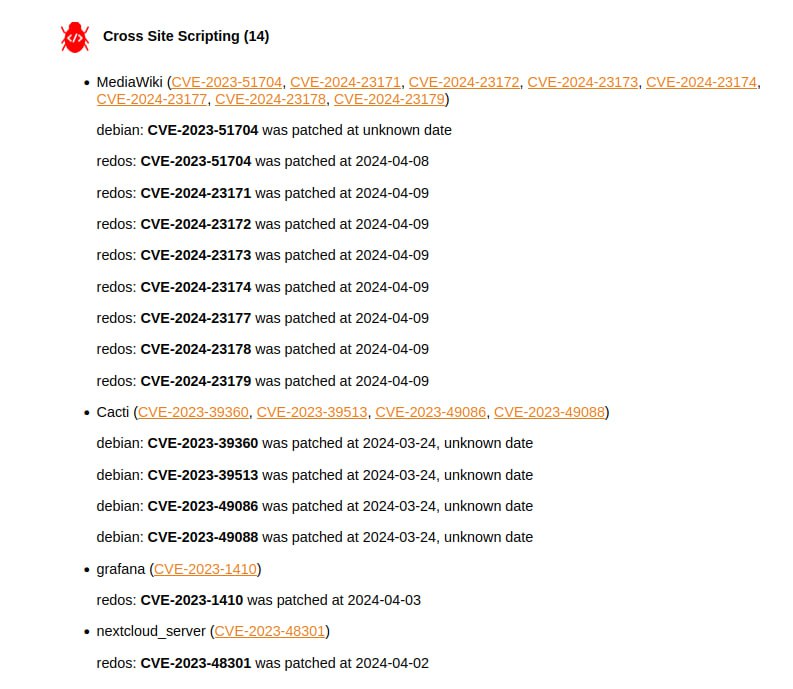
🔸 A pack of Cross Site Scripting vulnerabilities in MediaWiki, Cacti, Grafana, Nextcloud.

There is a lot to explore this time. 🤩

🗒 April Linux Patch Wednesday

На русском