

Tag Archives: Zimbra

About Remote Code Execution - Zimbra Collaboration (CVE-2026-73570) vulnerability

About Remote Code Execution - Zimbra Collaboration (CVE-2026-73570) vulnerability

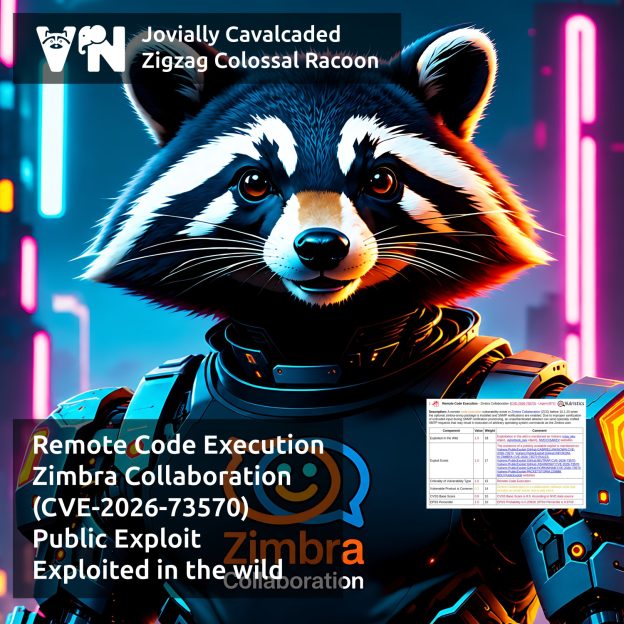
About Remote Code Execution - Zimbra Collaboration (CVE-2026-73570) vulnerability. Zimbra Collaboration is a collaboration software suite that includes a mail server and web client. In terms of functionality, it is comparable to Microsoft Exchange. The vulnerability allows an unauthenticated attacker to send specially crafted SMTP requests that can result in arbitrary operating system command execution with the privileges of the zimbra user. The vulnerability is caused by the lack of proper sanitization of untrusted input when processing data to generate SNMP notifications. Exploitation requires the optional zimbra-snmp package to be installed, SNMP notifications to be enabled, and the swatchdog service to be running.

Successful exploitation allows an attacker to install malware, establish persistence, and use the compromised server as a foothold for further access to the organization's internal infrastructure. An attacker may also gain unauthorized access to corporate emails and other data stored on the system, as well as disrupt Zimbra-related services and business processes.

👾 Experts at CERT Polska reported that the vulnerability was being exploited in the wild on August 17. They recommended checking /var/log/zimbra.log for malicious commands, as well as looking for files created by the zimbra user within the last 30 days in the following directories: /opt/zimbra/jetty/webapps/, /opt/zimbra/jetty_base/webapps/, and /tmp/. The vulnerability was added to the CISA KEV catalog on August 21.

🛠 Public exploits have been available on GitHub since August 24. According to researcher Gabriel P. Lipski's exploit description, an unauthenticated attacker connects to an SMTP port (25, 465, or 587) and sends a standard SMTP session with a command injected into the RCPT TO. Zimbra logs this data in /var/log/zimbra.log regardless of whether the request is accepted or rejected. The swatchdog process then automatically searches the log for lines matching a specific pattern, extracts the attacker-controlled parameter, and passes it to the shell script responsible for sending SNMP notifications without any sanitization. The shell script consequently executes the attacker's command on the host with the privileges of the zimbra operating system user.

⚙️ To remediate the vulnerability, update Zimbra to version 10.1.20 or later. As compensating measures, organizations can disable SNMP notifications, stop the swatchdog service, remove the zimbra-snmp package, and restrict SMTP connections.

🌐 As of August 30, Shadowserver is tracking 5,326 potentially vulnerable hosts, including 172 in Russia. Shadowserver experts also reported the compromise of 274 hosts on August 24.

November "In the Trend of VM" (#21): vulnerabilities in Windows, SharePoint, Redis, XWiki, Zimbra Collaboration, and Linux

November In the Trend of VM (#21): vulnerabilities in Windows, SharePoint, Redis, XWiki, Zimbra Collaboration, and Linux

November "In the Trend of VM" (#21): vulnerabilities in Windows, SharePoint, Redis, XWiki, Zimbra Collaboration, and Linux. The usual monthly roundup. After several months, here's a big one. 🔥

🗞 Post on Habr (rus)
🗞 Post on SecurityLab (rus)
🗒 Digest on the PT website (rus)

A total of nine vulnerabilities:

🔻 RCE - Windows Server Update Services (WSUS) (CVE-2025-59287)
🔻 RCE - Microsoft SharePoint "ToolShell" (CVE-2025-49704)
🔻 RCE - Windows LNK File (CVE-2025-9491)
🔻 EoP - Windows Remote Access Connection Manager (CVE-2025-59230)
🔻 EoP - Windows Agere Modem Driver (CVE-2025-24990)
🔻 RCE - Redis "RediShell" (CVE-2025-49844)
🔻 RCE - XWiki Platform (CVE-2025-24893)
🔻 XSS - Zimbra Collaboration (CVE-2025-27915)
🔻 EoP - Linux Kernel (CVE-2025-38001)

🟥 Trending Vulnerabilities Portal

На русском

About Cross Site Scripting - Zimbra Collaboration (CVE-2025-27915) vulnerability

About Cross Site Scripting - Zimbra Collaboration (CVE-2025-27915) vulnerability

About Cross Site Scripting - Zimbra Collaboration (CVE-2025-27915) vulnerability. Zimbra Collaboration is a collaboration software suite, somewhat similar to Microsoft Exchange. Exploiting this vulnerability in the web mail client (Classic Web Client) allows an unauthenticated attacker to execute arbitrary JavaScript in the context of the victim's session. To do this, the attacker only needs to send an email with a specially crafted ICS file (iCalendar). The payload is triggered when the message is viewed in the web interface.

⚙️ The vulnerability was patched on January 27 in versions 9.0.0 Patch 44, 10.0.13, 10.1.5, as well as in the unofficial free Zimbra FOSS build from Maldua.

🛠 On September 30, StrikeReady Labs published a vulnerability analysis with a public exploit.

👾 StrikeReady Labs reported the vulnerability was exploited against Brazil's military in January, before the patch was released. The vulnerability was added to CISA KEV on October 7.

На русском

June "In the Trend of VM" (#16): vulnerabilities in Microsoft Windows, Apache HTTP Server, the web interfaces of MDaemon and Zimbra, and the 7-Zip archiver

June In the Trend of VM (#16): vulnerabilities in Microsoft Windows, Apache HTTP Server, the web interfaces of MDaemon and Zimbra, and the 7-Zip archiver

June "In the Trend of VM" (#16): vulnerabilities in Microsoft Windows, Apache HTTP Server, the web interfaces of MDaemon and Zimbra, and the 7-Zip archiver. A traditional monthly vulnerability roundup. 🙂

🗞 Post on Habr (rus)
🗒 Digest on the PT website (rus)

A total of 7 trending vulnerabilities:

🔻 Elevation of Privilege - Microsoft DWM Core Library (CVE-2025-30400)
🔻 Elevation of Privilege - Windows Common Log File System Driver (CVE-2025-32701, CVE-2025-32706)
🔻 Remote Code Execution & Arbitrary File Reading - Apache HTTP Server (CVE-2024-38475)
🔻 Cross Site Scripting - MDaemon Email Server (CVE-2024-11182)
🔻 Cross Site Scripting - Zimbra Collaboration (CVE-2024-27443)
🔻 Remote Code Execution - 7-Zip (BDU:2025-01793)

На русском

About Cross Site Scripting - Zimbra Collaboration (CVE-2024-27443) vulnerability

About Cross Site Scripting - Zimbra Collaboration (CVE-2024-27443) vulnerability

About Cross Site Scripting - Zimbra Collaboration (CVE-2024-27443) vulnerability. Zimbra Collaboration is a collaboration software suite that includes a mail server and a web client. An attacker can send an email containing a specially crafted calendar header with an embedded payload. If the user opens the email in the classic Zimbra web interface, the malicious JavaScript code will be executed in the context of the web browser window.

The vulnerability was fixed on February 28, 2024. As with the MDaemon vulnerability, exploitation of this vulnerability in the wild was reported by ESET researchers (Operation "RoundPress"). They discovered attacks in 2024, after the patch had already been released. The malicious code allowed attackers to steal credentials, extract contacts and settings, and gain access to email messages.

ESET published information about the attacks and a PoC exploit only on May 15, 2025. 🤷‍♂️ The flaw was added to the CISA KEV catalog on May 19.

На русском

Last Week’s Security news: Serious Sam in Metasploit, PetitPotam, Zimbra Hijack, Joint Advisory TOP30 CVEs

Last Week’s Security news: Serious Sam in Metasploit, PetitPotam, Zimbra Hijack, Joint Advisory TOP30 CVEs. Hello everyone! Last Week’s Security News, July 26 – August 1.

Serious Sam in Metasploit

Last week I talked about the Serious Sam vulnerability (CVE-2021-36934), also known as HiveNightmare. The name HiveNightmare comes from the fact that Windows stores its registry data in a small number of proprietary database files called hives. Due to mismanagement of SAM and SYSTEM hives in Windows 10, it is possible for an unprivileged user to read those files and then, for example, extract the account password hashes. An exploit for this vulnerability is now available in Metasploit and it will be much easier for attackers to exploit this vulnerability. The issues is still under investigation by Microsoft and a patch is not currently available, only the list of vulnerable OS versions, however a workaround has been provided.

PetitPotam

At the beginning of last week, PetitPotam (Little Hippo) attack made a lot of noise. It could force remote Windows systems to reveal password hashes that could then be easily cracked.

“The PetitPotam bug is tied to the Windows operating system and the abuse of a remote access protocol called Encrypting File System Remote Protocol (MS-EFSRPC). The protocol is designed to allow Windows systems to access remote encrypted data stores, allowing for management of the data while enforcing access control policies. […]
The PetitPotam PoC is a form of manipulator-in-the-middle (MitM) attack against Microsoft’s NTLM authentication system. Next, an attacker uses the file-sharing protocol Server Message Block (SMB) to request access to a remote system’s MS-EFSRPC interface. According to [security researcher Gilles Lionel], this forces the targeted computer to initiate an authentication procedure and share its authentication details via NTLM.

In response to the public availability of the PoC, Microsoft was quick to respond, outlining several mitigation options. For starters, Microsoft recommends disabling NTLM authentication on Windows domain controllers. It also suggests enabling the Extended Protection for Authentication (EPA) feature on AD CS services.”

But there won’t be any special fix. Microsoft: “PetitPotam is a classic NTLM Relay Attack, and such attacks have been previously documented by Microsoft along with numerous mitigation options to protect customers.”

Continue reading