
Tag Archives: NCSC

April Microsoft Patch Tuesday

April Microsoft Patch Tuesday

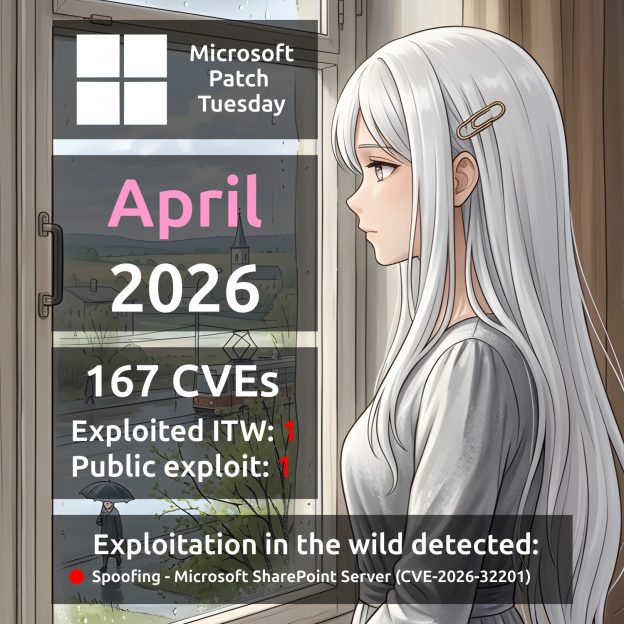
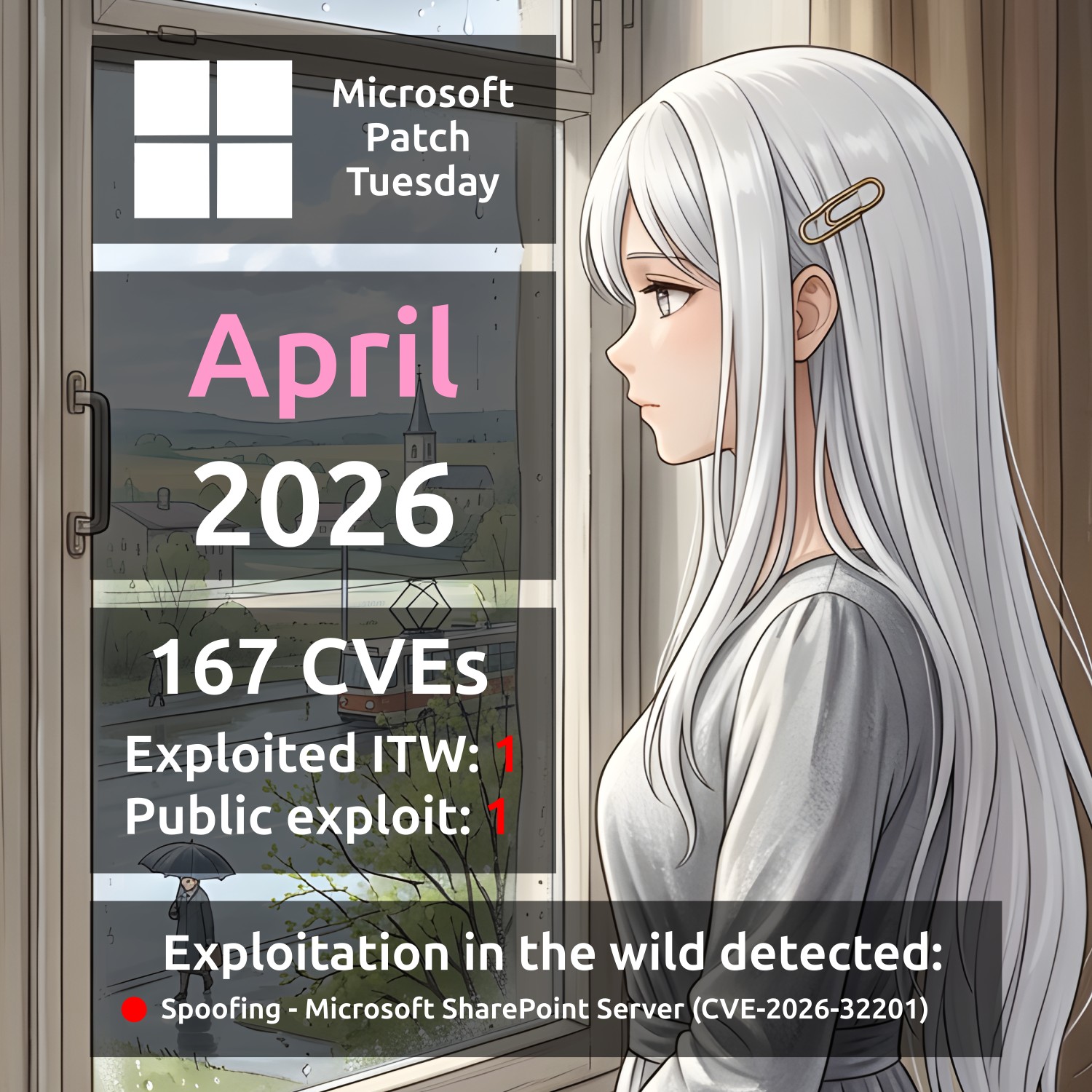
April Microsoft Patch Tuesday. A total of 167 vulnerabilities, about twice as many as in March. There is one vulnerability already being exploited in the wild:

🔻 Spoofing - Microsoft SharePoint Server (CVE-2026-32201). ZDI experts say "Spoofing bugs in SharePoint often manifest as cross-site scripting (XSS) bugs". "An attacker who successfully exploited the vulnerability could view some sensitive information (Confidentiality), make changes to disclosed information (Integrity), but cannot limit access to the resource (Availability)". There is no info yet about how widely it is being used in attacks, but you should not delay patching, especially if SharePoint is exposed to the Internet.

Formally, there are no public exploits yet. However, there are strong indications that a public exploit may already exist for one vulnerability.

🔸 EoP - Microsoft Defender (CVE-2026-33825). "Insufficient granularity of access control" in Microsoft Defender allows a logged-in attacker to gain higher privileges on a local system. Tenable and ZDI say the bug looks similar to the BlueHammer zero-day, for which a public exploit was released on GitHub on April 3. The researcher who published it, Chaotic Eclipse, criticized Microsoft’s disclosure process. ZDI says the exploit is real, but exploitation is unstable and not always reliable.

Other important issues:

🔹 RCE - Windows Active Directory (CVE-2026-33826). To exploit this, the attacker must have an account. The attacker sends a specially crafted RPC request to a vulnerable server, which can lead to code execution. Microsoft says the attacker must be in the same restricted Active Directory domain as the target system.

🔹 RCE - Windows Internet Key Exchange (IKE) Service Extensions (CVE-2026-33824). ZDI says this vulnerability is wormable, meaning it could allow malware to spread automatically between systems. It affects systems with IKE enabled, which creates a large attack surface. Microsoft recommends blocking UDP ports 500 and 4500 at the network edge. However, attackers inside the network can still use it for lateral movement. Patch quickly if you use IKE.

🔹 RCE - Windows TCP/IP (CVE-2026-33827). ZDI also says this may be wormable, especially on systems using IPv6 and IPSec. A race condition makes it harder to exploit, but similar bugs are often exploited at Pwn2Own, so you should not rely on that difficulty. If you use IPv6, test and deploy the patch quickly before exploits appear.

🔹 EoP - Windows Push Notifications (CVE-2026-26167). This Patch Tuesday includes several sandbox escape vulnerabilities, including in Push Notifications, AFD for Winsock, Windows Management Services, and User Interface Core. CVE-2026-26167 (Push Notifications) is the most important because it is the only one with low attack complexity. The others require winning a race condition (AC:H).

🔹 Spoofing - Remote Desktop (CVE-2026-26151). Weak warnings in the Remote Desktop interface allow a network attacker to trick a user into opening a specially crafted file, leading to spoofing. The issue was found by the UK National Cyber Security Centre (NCSC).

🗒 Full Vulristics report

Last Week’s Security news: Serious Sam in Metasploit, PetitPotam, Zimbra Hijack, Joint Advisory TOP30 CVEs

Last Week’s Security news: Serious Sam in Metasploit, PetitPotam, Zimbra Hijack, Joint Advisory TOP30 CVEs. Hello everyone! Last Week’s Security News, July 26 – August 1.

Serious Sam in Metasploit

Last week I talked about the Serious Sam vulnerability (CVE-2021-36934), also known as HiveNightmare. The name HiveNightmare comes from the fact that Windows stores its registry data in a small number of proprietary database files called hives. Due to mismanagement of SAM and SYSTEM hives in Windows 10, it is possible for an unprivileged user to read those files and then, for example, extract the account password hashes. An exploit for this vulnerability is now available in Metasploit and it will be much easier for attackers to exploit this vulnerability. The issues is still under investigation by Microsoft and a patch is not currently available, only the list of vulnerable OS versions, however a workaround has been provided.

PetitPotam

At the beginning of last week, PetitPotam (Little Hippo) attack made a lot of noise. It could force remote Windows systems to reveal password hashes that could then be easily cracked.

“The PetitPotam bug is tied to the Windows operating system and the abuse of a remote access protocol called Encrypting File System Remote Protocol (MS-EFSRPC). The protocol is designed to allow Windows systems to access remote encrypted data stores, allowing for management of the data while enforcing access control policies. […]
The PetitPotam PoC is a form of manipulator-in-the-middle (MitM) attack against Microsoft’s NTLM authentication system. Next, an attacker uses the file-sharing protocol Server Message Block (SMB) to request access to a remote system’s MS-EFSRPC interface. According to [security researcher Gilles Lionel], this forces the targeted computer to initiate an authentication procedure and share its authentication details via NTLM.

In response to the public availability of the PoC, Microsoft was quick to respond, outlining several mitigation options. For starters, Microsoft recommends disabling NTLM authentication on Windows domain controllers. It also suggests enabling the Extended Protection for Authentication (EPA) feature on AD CS services.”

But there won’t be any special fix. Microsoft: “PetitPotam is a classic NTLM Relay Attack, and such attacks have been previously documented by Microsoft along with numerous mitigation options to protect customers.”

Continue reading

PHDays 10: U.S. Sanctions, My Talk on Vulristics, Other Great Talks Related to VM

PHDays 10: U.S. Sanctions, My Talk on Vulristics, Other Great Talks Related to VM. Today I will talk about the Positive Hack Days conference, which took place on May 20 and May 21 in Moscow. I can say that this was and remains the main event for Information Security Practitioners in Russia.

First of all, I have to say a few words about the sanctions. The organizer of the event, Positive Technologies, is under the sanctions of the US Treasury Department since April 2021 among the “COMPANIES IN THE TECHNOLOGY SECTOR SUPPORTING RUSSIAN INTELLIGENCE SERVICES”. In a press release, the Treasury Department wrote that Positive Technologies hosts large-scale conventions that are used as recruiting events for russian special services. Well, I don’t know exactly what they mean. Maybe they mean PHDays or maybe not. But to say this about PHDays is like saying that any major international conference, Black Hat or RSA, is a recruiting event. This is ridiculous. In my humble opinion, these are some dirty political games. It is sad that reputable information security companies and security researchers are suffering from this.

Now let’s talk about my speech at PHDays 10. This year I had the opportunity to talk for an hour about my pet project – Vulristics. This project can help you prioritize known vulnerabilities. Anything that has a CVE id. There is a full video of my speech. I have uploaded this to my YouTube channel.

Russian version.

And a version that was dubbed into English.

So, if you’re interested, I recommend watching the full video. Here I will simply repeat the main points.

Continue reading