

Tag Archives: 7zip

Июльский Linux Patch Wednesday

Июльский Linux Patch Wednesday

July Linux Patch Wednesday. A total of 2,017 vulnerabilities were addressed (539 in the Linux kernel and 504 in Chromium). For comparison, there were 1,888 vulnerabilities in June. Once again, a new record. Moreover, next month will most likely set another record, as 1,704 vulnerabilities have already been addressed 2.5 weeks before the August LPW. 🤷‍♂️ But for now, let's take a closer look at the July report. Only one vulnerability shows signs of exploitation in the wild:

🔻 RCE - Gogs (CVE-2025-8110). Gogs is a self-hosted web service for managing Git repositories, similar in purpose to GitHub or GitLab. An attacker can achieve remote code execution by manipulating the .git/config file through symbolic link bypasses and injecting commands via sshCommand. Multiple public exploits are available on GitHub. The vulnerability has been added to the CISA KEV catalog.

There are also 178 vulnerabilities with public exploits available or indications that they exist, but there are currently no signs of exploitation in the wild. For comparison, last month there were 109 such vulnerabilities. Among them, the following stand out:

🔸 RCE - NGINX (CVE-2026-42533). NGINX is a web server and software for handling network requests, which is often used as a reverse proxy, load balancer, and gateway for web applications. An unauthenticated attacker can exploit this vulnerability for remote code execution by sending crafted HTTP requests.

🔸 RCE - libssh2 (CVE-2026-55200). libssh2 is a C library that implements the SSH-2 protocol and allows applications to establish secure SSH connections, execute commands, and transfer files via SFTP/SCP. A remote attacker can send crafted SSH packets with excessively large packet_length values to corrupt heap memory and achieve remote code execution.

🔸 RCE - Linux Kernel "RefluXFS" (CVE-2026-64600). An attacker with an ordinary local account can exploit the vulnerability to overwrite protected files on disk and gain root privileges on affected systems, including installations running SELinux in Enforcing mode. In practice, the vulnerability allows an attacker to set an empty root password.

🔸 RCE - Gogs (CVE-2025-64111). Due to an insufficient patch for CVE-2024-56731, it is still possible to modify files in the .git directory and achieve remote command execution. Based on the exploit code, authentication is required for exploitation.

🔸 CodeInj - MediaWiki (CVE-2026-58025). MediaWiki is a free and open-source web platform for creating and managing wiki websites, powering Wikipedia and other collaborative content editing projects. An attacker with the importupload or import permission (default: sysop group) can craft a malicious XML import file containing serialized PHP objects in params fields, triggering arbitrary object instantiation and potentially leading to remote code execution through gadget chains.

🔸 RCE - FFmpeg (CVE-2026-8461). FFmpeg is a free and open-source collection of libraries and utilities for processing audio and video data. An out-of-bounds write vulnerability in FFmpeg's libavcodec library, specifically in the MagicYUV decoder, allows denial-of-service and, in some cases, can be exploited for remote code execution.

🔸 RCE - 7-Zip (CVE-2026-14266). 7-Zip is a free and open-source file archiver that allows users to create and extract archives in various formats, including its native 7z format, ZIP, RAR, and others. Crafted XZ-compressed data can trigger an overflow of a heap-based buffer. An attacker can leverage this vulnerability to execute code in the context of the current process.

🔸 MemCor - Linux Kernel (CVE-2026-53359). This is essentially a KVM vulnerability. KVM (Kernel-based Virtual Machine) is a virtualization technology built into the Linux kernel that allows multiple isolated virtual machines to run on a single physical server. A KVM escape vulnerability lets a guest escape to the host in a KVM/x86 environment. It is triggerable on both Intel and AMD.


🗒 Full Vulristics report

October Linux Patch Wednesday

October Linux Patch Wednesday

October Linux Patch Wednesday. In October, Linux vendors began addressing 801 vulnerabilities, slightly more than in September. Of these, 546 are in the Linux Kernel. One is being exploited in the wild:

🔻 EoP - VMware Tools (CVE-2025-41244). This vulnerability has been exploited since October 2024, and public exploits are available. According to the description, exploitation requires VMware Aria Operations.

Public or suspected exploits exist for 39 more vulnerabilities, including:

🔸 RCE - Redis (CVE-2025-49844 - RediShell, CVE-2025-46817), OpenSSH (CVE-2025-61984), 7-Zip (CVE-2025-11001, CVE-2025-11002)
🔸 EoP - FreeIPA (CVE-2025-7493), Asterisk (CVE-2025-1131)
🔸 SQLi - MapServer (CVE-2025-59431)
🔸 SFB - authlib (CVE-2025-59420)
🔸 MemCor - Binutils (CVE-2025-11082 and 7 more), Open Babel (CVE-2025-10995 and 6 more)

🗒 Full Vulristics report

На русском

September "In the Trend of VM" (#19): vulnerabilities in the WinRAR and 7-Zip archivers, SAP NetWeaver, and TrueConf Server

September In the Trend of VM (#19): vulnerabilities in the WinRAR and 7-Zip archivers, SAP NetWeaver, and TrueConf Server

September "In the Trend of VM" (#19): vulnerabilities in the WinRAR and 7-Zip archivers, SAP NetWeaver, and TrueConf Server. A traditional monthly roundup - for the first time with NO Microsoft vulnerabilities! 😲🙂

🗞 Post on Habr (rus)
🗒 Digest on the PT website (rus)

A total of eight trending vulnerability IDs in four products:

🔻 Remote Code Execution - WinRAR (CVE-2025-6218, CVE-2025-8088). An exploitable RCE during archive extraction.
🔻 Remote Code Execution - SAP NetWeaver (CVE-2025-31324, CVE-2025-42999). An exploitable RCE in a component of a popular ERP system.
🔻 Remote Code Execution - 7-Zip (CVE-2025-55188). Mostly a Linux RCE during archive extraction - a public exploit is available.
🔻 Remote Code Execution - TrueConf Server (BDU:2025-10116, BDU:2025-10115, BDU:2025-10114). Critical flaws in Russian videoconferencing system.

На русском

About Remote Code Execution - 7-Zip (CVE-2025-55188) vulnerability

About Remote Code Execution - 7-Zip (CVE-2025-55188) vulnerability

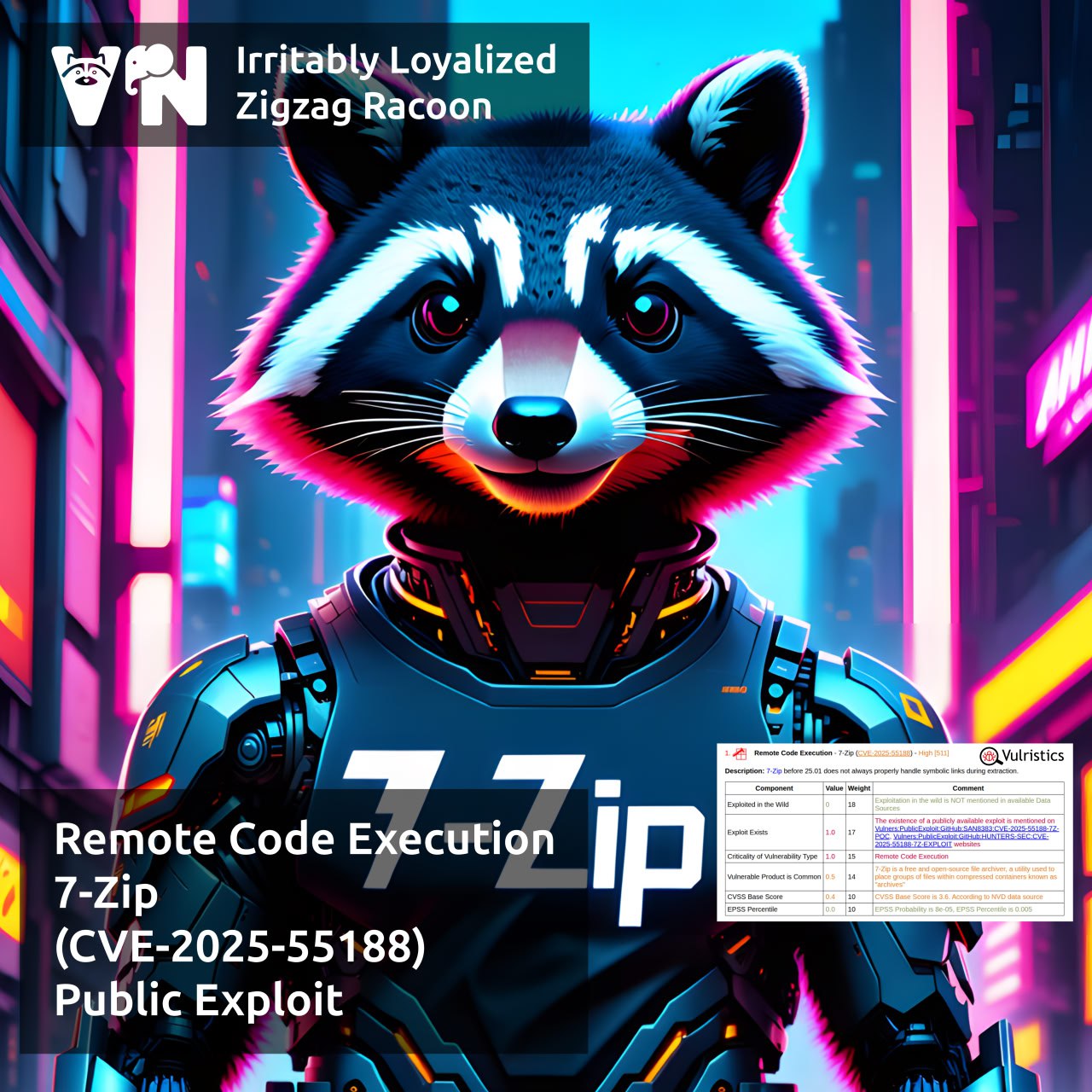
About Remote Code Execution - 7-Zip (CVE-2025-55188) vulnerability. 7-Zip is a popular open-source archiver. It’s a Windows application, but the project also provides command-line versions for Linux and macOS. The gist of the vulnerability: 7-Zip improperly handles symbolic links and, when extracting a specially crafted archive, can overwrite arbitrary files outside the extraction directory. Sounds like the recent WinRAR vulnerability, right? 😉

🔻 It's mainly exploited on Linux. Attackers can overwrite SSH keys, startup (autostart) scripts, etc.

🔻 Exploitation is also possible on Windows, but the 7-Zip extraction process must have permission to create symlinks (requires running as Administrator or enabling Developer Mode). 🤔

🩹 The vulnerability was fixed in 7-Zip 25.01, released on August 3.

🛠 The researcher lunbun reported it on Aug 9 and posted a write-up on Aug 28. PoCs have been available on GitHub since Aug 11.

👾 No signs of in-the-wild exploitation so far.

На русском

August Linux Patch Wednesday

August Linux Patch Wednesday

August Linux Patch Wednesday. I’m late with this LPW since I was improving the generation of LPW bulletin lists and the operation of Vulristics. 🙂 In August, Linux vendors addressed 867 vulnerabilities, nearly twice July’s total, including 455 in the Linux Kernel. One vulnerability is confirmed exploited in the wild (CISA KEV):

🔻 SFB - Chromium (CVE-2025-6558) - an exploited SFB in Chromium for the fourth month in a row. 🙄

Public exploits are available or suspected for 72 (❗️) vulnerabilities. The most important are:

🔸 RCE - WordPress (CVE-2024-31211) - from last year, but recently fixed in Debian; Kubernetes (CVE-2025-53547), NVIDIA Container Toolkit (CVE-2025-23266), Kafka (CVE-2025-27819)
🔸 Command Injection - Kubernetes (CVE-2024-7646)
🔸 Code Injection - PostgreSQL (CVE-2025-8714/8715), Kafka (CVE-2025-27817)
🔸 Arbitrary File Writing - 7-Zip (CVE-2025-55188)

🗒 Full Vulristics report

На русском

June "In the Trend of VM" (#16): vulnerabilities in Microsoft Windows, Apache HTTP Server, the web interfaces of MDaemon and Zimbra, and the 7-Zip archiver

June In the Trend of VM (#16): vulnerabilities in Microsoft Windows, Apache HTTP Server, the web interfaces of MDaemon and Zimbra, and the 7-Zip archiver

June "In the Trend of VM" (#16): vulnerabilities in Microsoft Windows, Apache HTTP Server, the web interfaces of MDaemon and Zimbra, and the 7-Zip archiver. A traditional monthly vulnerability roundup. 🙂

🗞 Post on Habr (rus)
🗒 Digest on the PT website (rus)

A total of 7 trending vulnerabilities:

🔻 Elevation of Privilege - Microsoft DWM Core Library (CVE-2025-30400)
🔻 Elevation of Privilege - Windows Common Log File System Driver (CVE-2025-32701, CVE-2025-32706)
🔻 Remote Code Execution & Arbitrary File Reading - Apache HTTP Server (CVE-2024-38475)
🔻 Cross Site Scripting - MDaemon Email Server (CVE-2024-11182)
🔻 Cross Site Scripting - Zimbra Collaboration (CVE-2024-27443)
🔻 Remote Code Execution - 7-Zip (BDU:2025-01793)

На русском

About Remote Code Execution - 7-Zip (BDU:2025-01793) vulnerability

About Remote Code Execution - 7-Zip (BDU:2025-01793) vulnerability

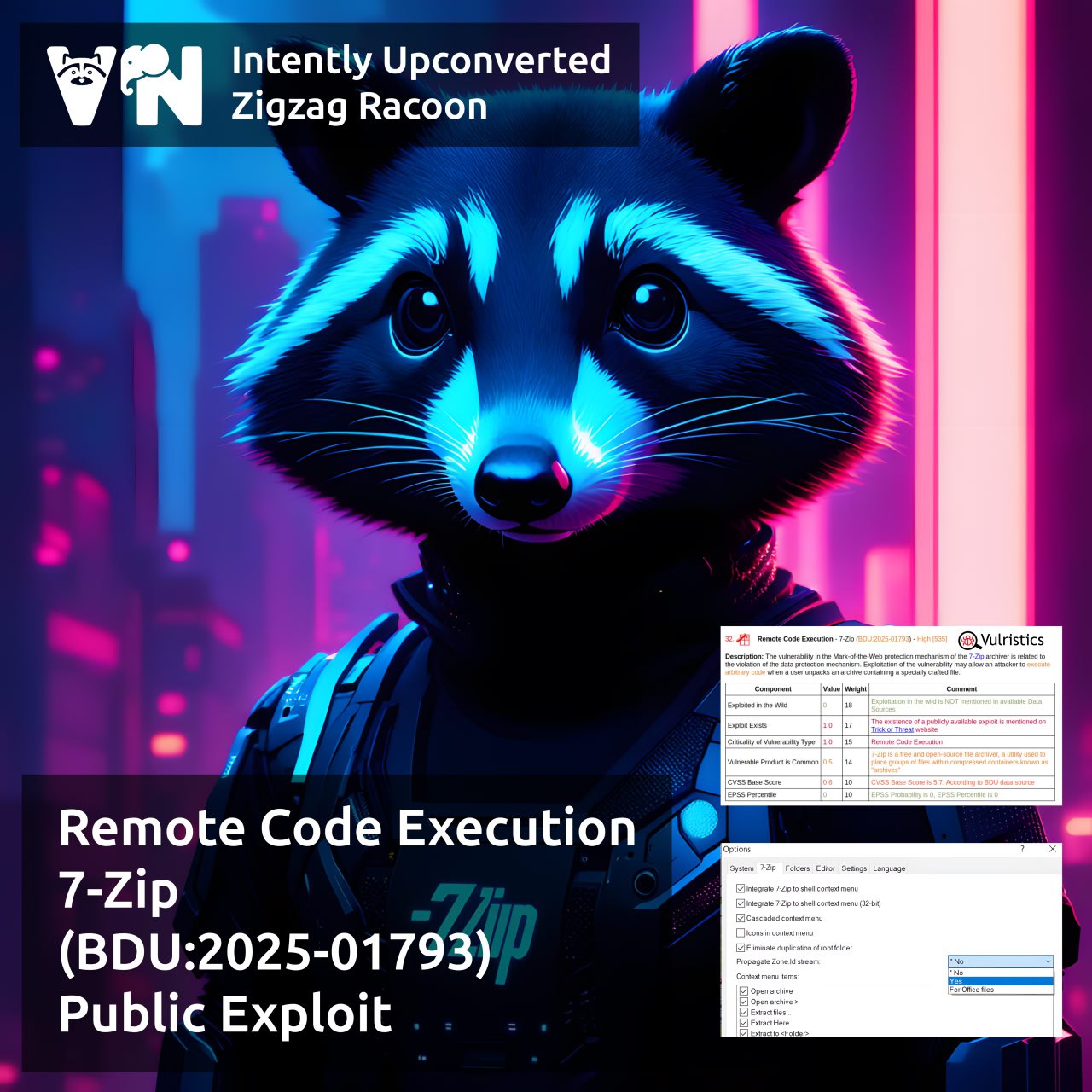
About Remote Code Execution - 7-Zip (BDU:2025-01793) vulnerability. It's about the fact that files unpacked using 7-Zip don't get the Mark-of-the-Web. As a result, Windows security mechanisms don't block the execution of the unpacked malware. If you remember, there was a similar vulnerability in January - CVE-2025-0411. The problem was with running files from the 7-Zip UI, and a fix has been released. But in this case, the problem is with fully unpacked archives — and the developers aren't planning to fix it! 🤷‍♂️

Igor Pavlov, the author of the utility, responded to our colleague Konstantin Dymov that not assigning the Mark-of-the-Web by default is intentional behavior. They don't plan to change the default settings. To have the Mark-of-the-Web applied, you need to set "" to "".

If 7-Zip is used in your organization, be aware of this insecure default behavior. Apply hardening measures or switch to a different tool.

На русском