

Tag Archives: FreeIPA

September Linux Patch Wednesday

September Linux Patch Wednesday

September Linux Patch Wednesday. There are 2,653 vulnerabilities in total. For comparison, in August, there were 3,060 - 13% more. This time, the Linux Kernel has 812 vulnerabilities, and Chromium has 644. There are signs of exploitation in the wild for 6 vulnerabilities:

🔻 RCE - Gitea (CVE-2026-60004). Gitea is a popular platform for hosting Git repositories on your own servers. An attacker with basic write access to a repository can run arbitrary shell commands as the Gitea OS user. With open registration enabled by default, even an unauthenticated attacker can get the required access by creating an account and a repository. The vulnerability was added to CISA KEV on August 25. A campaign exploiting the vulnerability to install the XMRig cryptominer has been observed. Public exploits have been available on GitHub since July 29. The vulnerability was fixed in ALT Linux packages on August 27.

🔻 AuthBypass - Gitea (CVE-2026-20896). The vulnerability allows a remote attacker to bypass authentication and log in to Gitea as another user, including an administrator. The vulnerability was added to VulnCheck KEV on July 6. Public exploits have been available on GitHub since July 2. The vulnerability was fixed in ALT Linux packages on August 27.

🔻 AuthBypass - Keycloak (CVE-2026-18963). Keycloak is a popular platform for identity and access management (IAM/SSO). A vulnerability in the password reset mechanism allows an unauthenticated remote attacker to reset any user's password and take over their account without email confirmation. The vulnerability was added to VulnCheck KEV on August 25. Public exploits have been available on GitHub since August 20. The vulnerability was fixed in ALT Linux packages on August 20.

🔻 RCE - Chromium (CVE-2026-85046, CVE-2026-87491). Chromium is a web browser project that forms the basis of Google Chrome and other browsers. Vulnerabilities in the V8 JavaScript engine allow a remote attacker to execute arbitrary code within the browser sandbox if a user opens a malicious HTML page. Both vulnerabilities are exploited in the wild and were added to the CISA KEV on September 4 and September 9. Public exploits have been available on GitHub since September 4. The vulnerabilities have been fixed in ALT Linux and Debian packages since September 5.

🔻 RCE - SPIP (CVE-2026-77806). SPIP is an open-source CMS for creating and collaboratively editing websites. The critical vulnerability allows an unauthenticated remote attacker to execute arbitrary code on the server. The vulnerability was added to VulnCheck KEV on August 21. A Metasploit module is available. The vulnerability has been fixed in Debian packages since August 21.

For another 205 vulnerabilities, there are currently no signs of exploitation in the wild, but public exploits are available. Among them, the following stand out:

🔸 AuthBypass - FreeIPA (CVE-2026-76578). FreeIPA is a solution for centralized identity and access management in Linux infrastructures (LDAP/Kerberos). A remote, unauthenticated attacker can obtain membership in the FreeIPA administrator group and perform administrative operations against the directory and, on SID-enabled deployments, other IdM services. A public exploit has been available on GitHub since September 9. The vulnerability was fixed in ALT Linux packages on September 7.

🔸 RCE - PHP/Adminer (CVE-2026-56705). Adminer is a popular web-based tool for database administration, often deployed alongside PHP applications. The vulnerability allows an unauthenticated remote attacker to write PHP code to the web server's document root and execute it, thereby achieving RCE. A public exploit has been available on GitHub since August 25. The vulnerability has been fixed in Debian packages since September 16.


🗒 Full Vulristics report

October Linux Patch Wednesday

October Linux Patch Wednesday

October Linux Patch Wednesday. In October, Linux vendors began addressing 801 vulnerabilities, slightly more than in September. Of these, 546 are in the Linux Kernel. One is being exploited in the wild:

🔻 EoP - VMware Tools (CVE-2025-41244). This vulnerability has been exploited since October 2024, and public exploits are available. According to the description, exploitation requires VMware Aria Operations.

Public or suspected exploits exist for 39 more vulnerabilities, including:

🔸 RCE - Redis (CVE-2025-49844 - RediShell, CVE-2025-46817), OpenSSH (CVE-2025-61984), 7-Zip (CVE-2025-11001, CVE-2025-11002)
🔸 EoP - FreeIPA (CVE-2025-7493), Asterisk (CVE-2025-1131)
🔸 SQLi - MapServer (CVE-2025-59431)
🔸 SFB - authlib (CVE-2025-59420)
🔸 MemCor - Binutils (CVE-2025-11082 and 7 more), Open Babel (CVE-2025-10995 and 6 more)

🗒 Full Vulristics report

На русском

May Linux Patch Wednesday

May Linux Patch Wednesday
May Linux Patch WednesdayMay Linux Patch WednesdayMay Linux Patch WednesdayMay Linux Patch WednesdayMay Linux Patch Wednesday

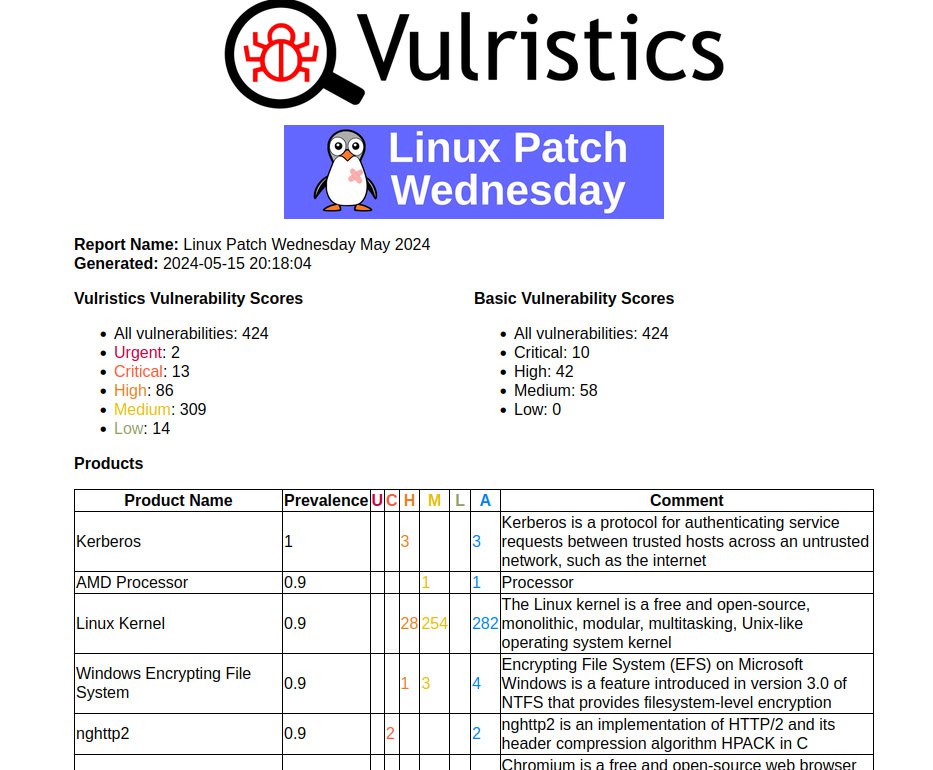
May Linux Patch Wednesday. Last month, we jointly decided that it was worth introducing a rule for Unknown dates starting from May 2024. Which, in fact, is what I implemented. Now, if I see an oval definition that does not have a publication date (date when patches for related vulnerabilities were available), then I nominally assign today's date. Thus, 32406 oval definitions without a date received a nominal date of 2024-05-15. One would expect that we would get a huge peak for vulnerabilities that "started being patched in May" based on the nominal date. How did it really turn out?

In fact, the peak was not very large. There are 424 CVEs in the May Linux Patch Wednesday. While in April there were 348. It's comparable. Apparently the not very large peak is due to the fact that most of the vulnerabilities had patch dates older than the nominal one set (2024-05-15). And this is good. 🙂 It should get even better in June.

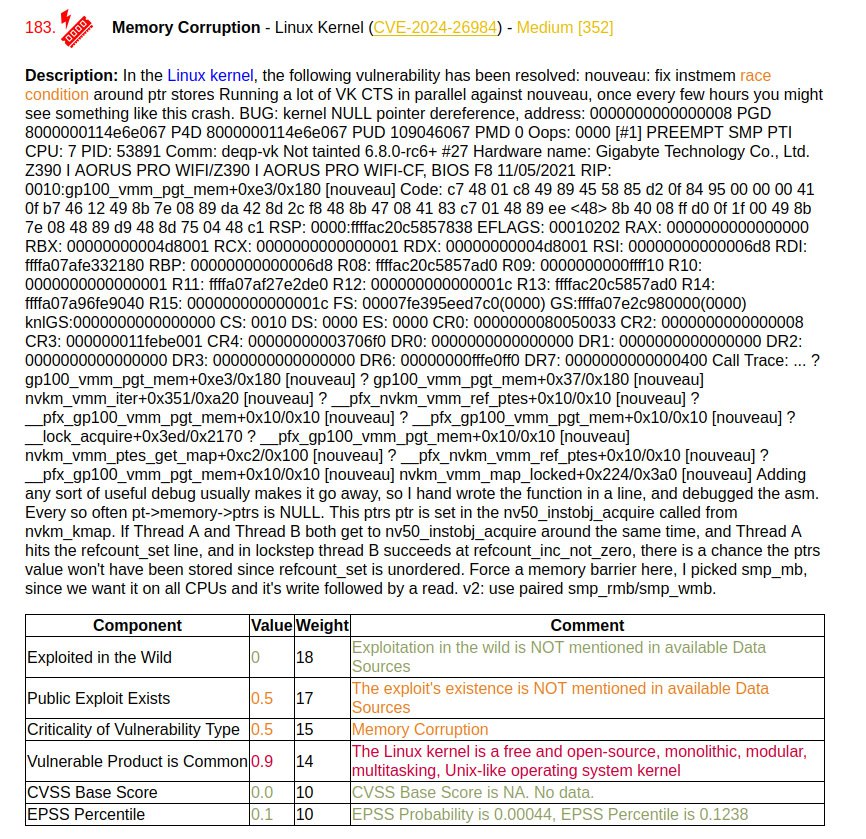
As usual, I generated a Vulristics report for the May vulnerabilities. Most of the vulnerabilities (282) relate to the Linux Kernel. This is due to the fact that Linux Kernel is now a CNA and they can issue CVEs for all sorts of things like bugs with huge traces right in the vulnerability descriptions.

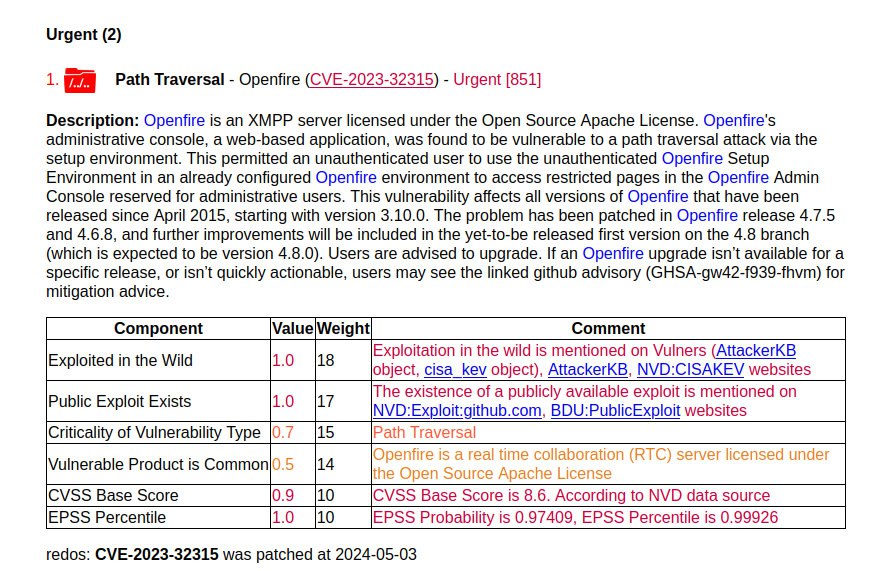
The vulnerability from CISA KEV comes first.

🔻Path Traversal - Openfire (CVE-2023-32315). This is the August 2023 trending vulnerability. It was included in the report due to a fix in RedOS 2024-05-03. Has it not been fixed in other Linux distributions? It looks like this. In Vulners, among the related security objects, we can only see the RedOS bulletin. Apparently there are no Openfire packages in the repositories of other Linux distributions.

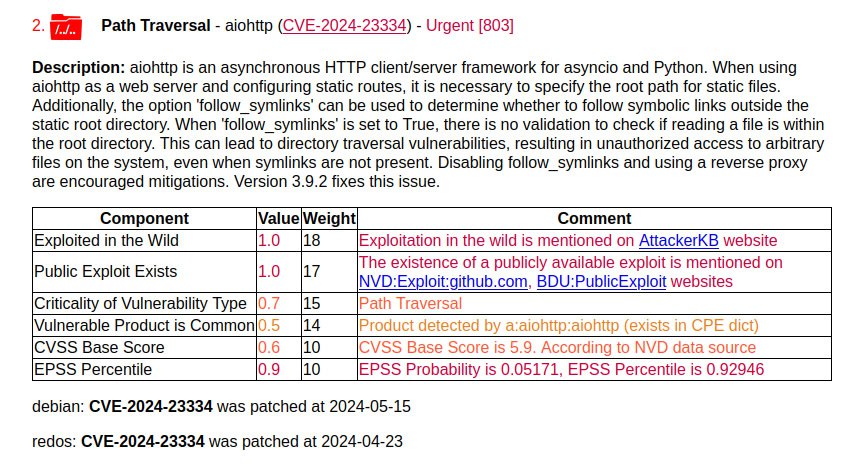
In second place is a vulnerability with a sign of active exploitation according to AttackerKB.

🔻 Path Traversal - aiohttp (CVE-2024-23334). The bug allows unauthenticated attackers to access files on vulnerable servers.

According to data from the FSTEC BDU, another 16 vulnerabilities have signs of active exploitation in the wild.

🔻 Memory Corruption - nghttp2 (CVE-2024-27983)
🔻 Memory Corruption - Chromium (CVE-2024-3832, CVE-2024-3833, CVE-2024-3834, CVE-2024-4671)
🔻 Memory Corruption - FreeRDP (CVE-2024-32041, CVE-2024-32458, CVE-2024-32459, CVE-2024-32460)
🔻 Memory Corruption - Mozilla Firefox (CVE-2024-3855, CVE-2024-3856)
🔻 Security Feature Bypass - bluetooth_core_specification (CVE-2023-24023)
🔻 Security Feature Bypass - Chromium (CVE-2024-3838)
🔻 Denial of Service - HTTP/2 (CVE-2023-45288)
🔻 Denial of Service - nghttp2 (CVE-2024-28182)
🔻 Incorrect Calculation - FreeRDP (CVE-2024-32040)

Another 22 vulnerabilities have an exploit (public or private), but so far there are no signs of active exploitation in the wild. I won’t list them all here, but you can pay attention to:

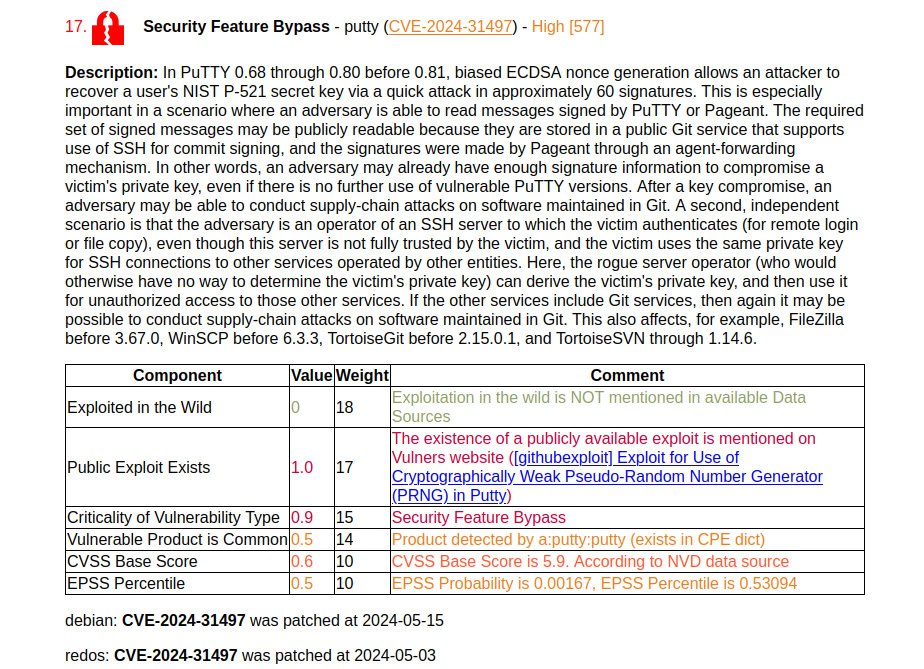
🔸 Security Feature Bypass - putty (CVE-2024-31497). A high-profile vulnerability that allows an attacker to recover a user's private key.
🔸 Remote Code Execution - GNU C Library (CVE-2014-9984)
🔸 Remote Code Execution - Flatpak (CVE-2024-32462)
🔸 Command Injection - aiohttp (CVE-2024-23829)
🔸 Security Feature Bypass - FreeIPA (CVE-2024-1481)

I think that to improve the Vulristics report, it makes sense to separately group vulnerabilities with public exploits and private exploits, since this still greatly affects the criticality. Put 🐳 if you would like to see this feature.

🗒 Vulristics report on the May Linux Patch Wednesday

На русском