

Tag Archives: ALTLinux

October Linux Patch Wednesday

October Linux Patch Wednesday

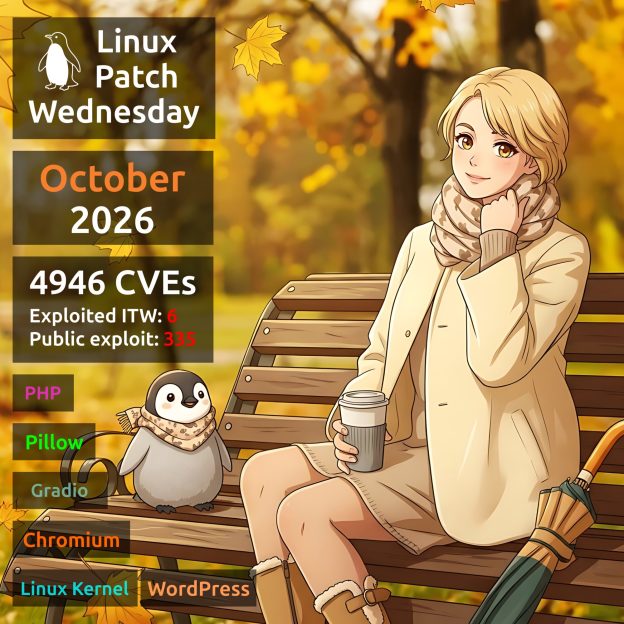
October Linux Patch Wednesday. There are 4,946 vulnerabilities in total. By comparison, there were 2,653 in September. That's an 86% increase! This time, there are 1,954 vulnerabilities in the Linux Kernel and 814 in Chromium. Together, they make up 56% of all vulnerabilities.

Six vulnerabilities show signs of being exploited in the wild:

🔻 RCE - PHP "PHP2Shell" (CVE-2026-109618, CVE-2026-109619). PHP is a popular programming language widely used for web application development. CVE-2026-109618 is an out-of-memory (OOM) handling vulnerability that allows remote code execution when an application receives a specially crafted request. CVE-2026-109619 is a use-after-free vulnerability that allows PHP to access stale references to freed memory, potentially leading to remote code execution. Linux distributions began releasing patches on the day the vulnerabilities were disclosed, October 21. More than 470 links to public exploits are available on GitHub. Both vulnerabilities were added to the CISA KEV on October 26.

🔻 SFB - Linux Kernel "PwnEscape" (CVE-2026-99999). The vulnerability affects the Linux kernel's networking stack and allows an attacker inside a KVM guest virtual machine to corrupt the host kernel's memory. This could expose sensitive host memory contents or cause the host system to crash. Researchers demonstrated a complete escape from a guest VM to the host. Linux distributions began releasing patched packages on October 16, and public exploits appeared on GitHub the same day. The vulnerability was added to the VulnCheck KEV on October 19.

🔻 RCE - WordPress (CVE-2026-87902). WordPress is a popular content management system (CMS) for building websites and blogs. Under certain conditions, this vulnerability allows an unauthenticated attacker to execute arbitrary code remotely on the server. Public exploits have been available on GitHub since September 22. The vulnerability was added to the CISA KEV on September 25. Debian released patched packages on September 28.

🔻 XSS - WordPress "Comment2Shell" (CVE-2026-93485). The vulnerability allows an unauthenticated attacker to inject JavaScript code through a specially crafted comment. The code is executed in the browser when an administrator views the comment, allowing the attacker to hijack his session and potentially execute arbitrary code on the server. The vulnerability was added to the VulnCheck KEV on September 18. Public exploits have been available on GitHub since September 22. Patched packages have been available in Debian since September 28.

🔻 AFR - Gradio (CVE-2026-28414). Gradio is a Python library for quickly building machine learning interfaces. The vulnerability allows unauthenticated attackers to read arbitrary files from a Windows server running Python 3.13 or later, even when Gradio authentication is enabled. A public exploit appeared on February 27. The vulnerability was added to the VulnCheck KEV on May 31. ALT Linux has been providing patched packages since October 1.

Another 335 vulnerabilities have no known signs of exploitation in the wild, but public exploits are available for them. Notable examples include:

🔸 EoP - Linux Kernel (CVE-2026-98260). This use-after-free vulnerability in the POSIX CPU timers mechanism allows a local unprivileged user to escalate privileges to root. Researcher v4bel demonstrated a root shell on Ubuntu 26.04 running kernel 7.0.0-30-generic as part of the Infinity Core project. The exploit is also reported to enable container escapes and privilege escalation on Android. Patched packages have been available since October 15. A public exploit was published on GitHub on October 17.

🔸 RCE - Pillow (CVE-2026-112900). Pillow is a Python library for image processing. An attacker can upload an EPS file to execute arbitrary code on the server. Patched packages have been available in Debian since October 21. Public exploits have been available on GitHub since October 23.

🗒 Full Vulristics report (ZIP; 1.7 MB)
September Linux Patch Wednesday

September Linux Patch Wednesday

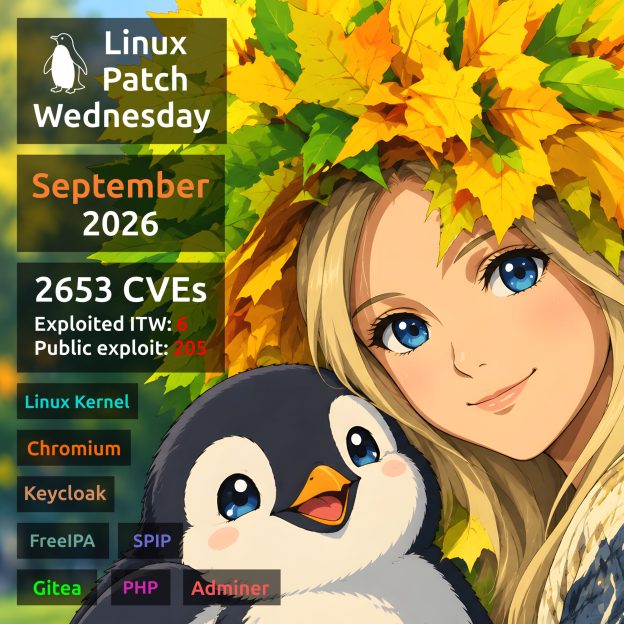
September Linux Patch Wednesday. There are 2,653 vulnerabilities in total. For comparison, in August, there were 3,060 - 13% more. This time, the Linux Kernel has 812 vulnerabilities, and Chromium has 644. There are signs of exploitation in the wild for 6 vulnerabilities:

🔻 RCE - Gitea (CVE-2026-60004). Gitea is a popular platform for hosting Git repositories on your own servers. An attacker with basic write access to a repository can run arbitrary shell commands as the Gitea OS user. With open registration enabled by default, even an unauthenticated attacker can get the required access by creating an account and a repository. The vulnerability was added to CISA KEV on August 25. A campaign exploiting the vulnerability to install the XMRig cryptominer has been observed. Public exploits have been available on GitHub since July 29. The vulnerability was fixed in ALT Linux packages on August 27.

🔻 AuthBypass - Gitea (CVE-2026-20896). The vulnerability allows a remote attacker to bypass authentication and log in to Gitea as another user, including an administrator. The vulnerability was added to VulnCheck KEV on July 6. Public exploits have been available on GitHub since July 2. The vulnerability was fixed in ALT Linux packages on August 27.

🔻 AuthBypass - Keycloak (CVE-2026-18963). Keycloak is a popular platform for identity and access management (IAM/SSO). A vulnerability in the password reset mechanism allows an unauthenticated remote attacker to reset any user's password and take over their account without email confirmation. The vulnerability was added to VulnCheck KEV on August 25. Public exploits have been available on GitHub since August 20. The vulnerability was fixed in ALT Linux packages on August 20.

🔻 RCE - Chromium (CVE-2026-85046, CVE-2026-87491). Chromium is a web browser project that forms the basis of Google Chrome and other browsers. Vulnerabilities in the V8 JavaScript engine allow a remote attacker to execute arbitrary code within the browser sandbox if a user opens a malicious HTML page. Both vulnerabilities are exploited in the wild and were added to the CISA KEV on September 4 and September 9. Public exploits have been available on GitHub since September 4. The vulnerabilities have been fixed in ALT Linux and Debian packages since September 5.

🔻 RCE - SPIP (CVE-2026-77806). SPIP is an open-source CMS for creating and collaboratively editing websites. The critical vulnerability allows an unauthenticated remote attacker to execute arbitrary code on the server. The vulnerability was added to VulnCheck KEV on August 21. A Metasploit module is available. The vulnerability has been fixed in Debian packages since August 21.

For another 205 vulnerabilities, there are currently no signs of exploitation in the wild, but public exploits are available. Among them, the following stand out:

🔸 AuthBypass - FreeIPA (CVE-2026-76578). FreeIPA is a solution for centralized identity and access management in Linux infrastructures (LDAP/Kerberos). A remote, unauthenticated attacker can obtain membership in the FreeIPA administrator group and perform administrative operations against the directory and, on SID-enabled deployments, other IdM services. A public exploit has been available on GitHub since September 9. The vulnerability was fixed in ALT Linux packages on September 7.

🔸 RCE - PHP/Adminer (CVE-2026-56705). Adminer is a popular web-based tool for database administration, often deployed alongside PHP applications. The vulnerability allows an unauthenticated remote attacker to write PHP code to the web server's document root and execute it, thereby achieving RCE. A public exploit has been available on GitHub since August 25. The vulnerability has been fixed in Debian packages since September 16.

🗒 Full Vulristics report

I added support for ALT Linux OVAL content in Linux Patch Wednesday

I added support for ALT Linux OVAL content in Linux Patch Wednesday

I added support for ALT Linux OVAL content in Linux Patch Wednesday. Now I track when specific CVEs were fixed in ALT Linux packages and take that into account when generating the monthly bulletins. The more data sources on patched vulnerabilities in Linux distributions are used, the more accurate the bulletins become. 👍 Especially when those Linux distributions are independent, not derivatives. 😇

Currently, the LPW generator uses 7 OVAL sources:

🔹 Debian
🔹 Ubuntu
🔹 Oracle Linux
🔹 RedOS
🔹 AlmaLinux
🔹 Red Hat
🔹 ALT Linux

Plus one more source from Debian’s mailing list.

I'm a bit late with the June Linux Patch Wednesday review (due to these improvements and my vacation), but I plan to release it soon. Especially since there aren't that many vulnerabilities this time - only 598. 🙂

На русском