Tag Archives: UseAfterFree

About Elevation of Privilege - Windows Ancillary Function Driver for WinSock (CVE-2026-68820) vulnerability

About Elevation of Privilege - Windows Ancillary Function Driver for WinSock (CVE-2026-68820) vulnerability

About Elevation of Privilege - Windows Ancillary Function Driver for WinSock (CVE-2026-68820) vulnerability. The Ancillary Function Driver (AFD) is a Windows component that supports Windows Sockets applications and is contained in the afd.sys file. The afd.sys driver runs in kernel mode and manages the Winsock TCP/IP communications protocol. This vulnerability is from the August Microsoft Patch Tuesday. Use-after-free (CWE-416) in the Windows Ancillary Function Driver for WinSock allows an authorized attacker to elevate privileges locally to SYSTEM level. Successful exploitation requires an attacker to win the race condition. As a result, the attacker can gain full control over the Windows host, execute commands with SYSTEM-level privileges, disable security protections, install malware, and access other users' data.

👾 The vulnerability was already being exploited in the wild when it was disclosed as part of Microsoft's August Patch Tuesday on August 11. That same day, it was added to the CISA KEV catalog. Notably, Microsoft listed the Exploit Code Maturity in the CVSS as "Unproven". 🤷‍♂️ Microsoft credited researchers from Check Point for reporting the vulnerability.

Details on how the vulnerability was exploited in attacks were published in a Check Point blog post on August 11. The vulnerability was exploited as part of the "Operation Dream Job" campaign, which targeted organizations worldwide, with a particular focus on the defense sector in Europe and India. The campaign is linked to the Lazarus Group. The campaign begins with targeted phishing messages offering victims attractive job opportunities at well-known companies in the defense, aerospace, and aviation industries. Victims are lured into opening a PDF decoy masquerading as a Lockheed Martin job description. This triggers the execution of a lightweight in-memory loader - MISTPEN. The loader uses the Microsoft Graph API to access OneDrive, from which it retrieves additional modules and runs them in memory. During the initial stages of the infection, the attacker deploys several reconnaissance modules that gather information about the system and running processes. Once the target is deemed of interest, MISTPEN retrieves an additional persistence module, which installs the malware on disk and ensures that MISTPEN is automatically launched after a system reboot. After establishing persistence, MISTPEN loads an in-memory module designed to exploit the CVE-2026-68820 vulnerability. Check Point researchers believe that this vulnerability was already being exploited in the "Operation Dream Job" campaign in early July 2026. Successful exploitation enables the malware to launch FudModule, a Lazarus kernel-level rootkit, with SYSTEM privileges. The final backdoor delivered by MISTPEN - ForestTiger - provides attackers with remote access to the compromised system, allowing them to execute commands, collect host information, and download additional malicious components.

🛠 No public exploits have been observed so far. Some people are offering exploits for sale, but they don't look reliable.

⚙️ Security updates are available for Windows 10, Windows 11, and Windows Server 2019.
September Microsoft Patch Tuesday

September Microsoft Patch Tuesday

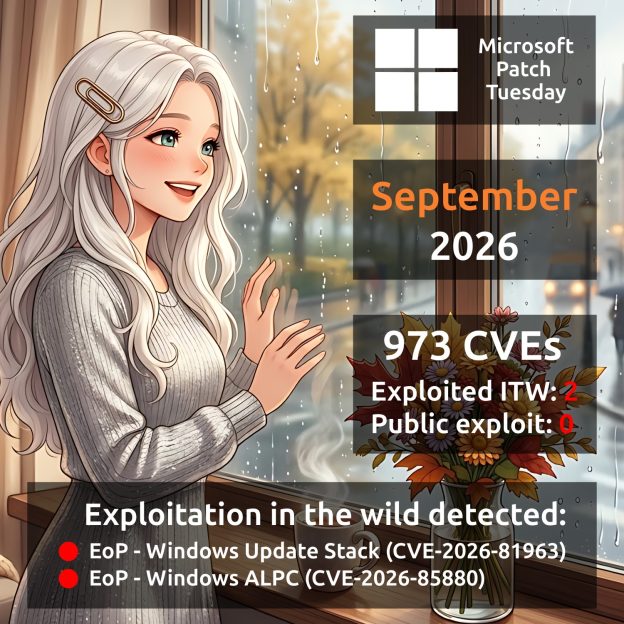
September Microsoft Patch Tuesday. A total of 973 vulnerabilities were addressed - more than twice as many as in August. Seven products had 20 or more vulnerabilities fixed: Windows Biometric Service (64), Microsoft SQL Server (54), Windows DHCP Server (36), Microsoft Office Word (35), Windows NTFS (29), Microsoft Excel (28), and Windows Win32k (24). Vulnerabilities affecting these products account for just under one-third of the total. Two vulnerabilities are known to have been exploited in the wild:

🔻 EoP - Windows Update Stack (CVE-2026-81963). A link following flaw in the Windows Update Stack (CWE-59) may allow an authenticated attacker to elevate privileges locally. An attacker who successfully exploited this vulnerability could gain SYSTEM privileges.

🔻 EoP - Windows Advanced Local Procedure Call (ALPC) (CVE-2026-85880). A heap-based buffer overflow flaw in Windows ALPC (CWE-122) may allow an authenticated attacker to elevate privileges locally. An attacker who successfully exploited this vulnerability could gain SYSTEM privileges.

There are no vulnerabilities with public exploits yet. Of the remaining vulnerabilities, the following can be highlighted:

🔹 RCE - Microsoft Exchange (CVE-2026-55007). A remote, unauthenticated attacker could achieve code execution on a vulnerable Exchange server by sending an email containing a malicious Visio attachment. The code is executed when the server processes the message, without requiring the victim to open it or use the Preview Pane.

🔹 RCE - Remote Desktop Services (CVE-2026-69525). Successful exploitation of this flaw would allow an unauthenticated attacker to execute arbitrary code by exploiting a use-after-free flaw.

🔹 RCE - Windows DNS Server (CVE-2026-69730). According to the advisory, an unauthenticated, remote attacker could send a crafted packet to exploit a use-after-free flaw in Windows DNS in order to achieve remote code execution.

🔹 RCE - Windows USB Mass Storage Class Driver (CVE-2026-68839). Successful exploitation of this vulnerability could allow an attacker the ability to gain remote code execution via an in-network attacker calling arbitrary endpoints.

🔹 RCE - Windows Kerberos (CVE-2026-69676). An authentication-bypass flaw via capture-replay in Windows Kerberos may allow an authenticated attacker to execute code over a network.

🔹 RCE - Windows Key Distribution Center (CVE-2026-69712). A use-after-free flaw in the Windows Key Distribution Center may allow an authenticated attacker to execute code over a network.

🔹 EoP - Microsoft Exchange (CVE-2026-69380). An authenticated attacker with access to a mailbox through a low-privileged user account could exploit this vulnerability to gain access to other mailboxes. Successful exploitation would allow the attacker to send and receive emails on behalf of other Exchange users as well as access attachments.

🗒 Full Vulristics report

May Microsoft Patch Tuesday

May Microsoft Patch Tuesday

May Microsoft Patch Tuesday. A total of 119 vulnerabilities, approximately 1.5 times fewer than in April. There are currently no vulnerabilities marked as actively exploited in the wild. However, there is one vulnerability with a public exploit:

🔸 EoP - Windows Kernel (CVE-2026-40369). A detailed write-up and exploit for this vulnerability were published on May 14, two days after the May MSPT. The researcher describes exploitation of the vulnerability as follows: "A single syscall from any unprivileged process — including inside Chrome's renderer sandbox — can increment arbitrary kernel memory addresses. No race conditions. No heap spray. No special tokens. 100% deterministic privilege escalation to SYSTEM."

Among the remaining ones, the following stand out:

🔹 RCE - Windows DNS Client (CVE-2026-41096). A ZDI analyst commented on this vulnerability as follows: "This patch fixes a heap-based buffer overflow in the DNS Client triggered by a malicious DNS response. No authentication or user interaction needed, and since the DNS Client runs on virtually every Windows machine, the attack surface is enormous. An attacker with a position to influence DNS responses (MitM, rogue server) could achieve unauthenticated RCE across your enterprise."

🔹 RCE - Windows Netlogon (CVE-2026-41089). The vulnerability allows an unauthenticated remote attacker to execute arbitrary code on a domain controller by sending a specially crafted network request. Exploitation does not require credentials or user interaction, which classifies this vulnerability as wormable. Compromise of a domain controller means full compromise of the organization's entire domain. A Rapid7 analyst added in their commentary: "No privileges or user interaction are required, and attack complexity is low, which suggests that creation of a reliable exploit might not be especially difficult for anyone with knowledge of the specific mechanism. Microsoft assesses exploitation as less likely, but since those exploitability assessments are provided without an accompanying explanation, it's not clear how much reassurance defenders should take. Anyone who remembers the much-discussed CVE-2020-1472 (aka ZeroLogon) back in 2020 will note that CVE-2026-41089 offers an attacker more immediate control of a domain controller. Patches are available for all versions of Windows Server from 2012 onwards."

🔹 RCE - Windows TCP/IP (CVE-2026-40415). Commentary from a ZDI analyst: "This bug in the TCP/IP stack results from a use-after-free (UAF) and could allow a remote, unauthenticated threat actor to execute code without user interaction. That makes this another wormable bug. However, this one is much less likely to be exploited. The target needs to be under sustained low-memory (memory pressure) conditions, which is pretty rare."

🔹 RCE - Microsoft Word (CVE-2026-40361, CVE-2026-40364, CVE-2026-40366, CVE-2026-40367). An attacker can exploit these vulnerabilities through social engineering by sending a malicious file to a targeted victim. Successful exploitation would grant the attacker arbitrary code execution. Microsoft researchers note that the Preview Pane is an attack vector for each of these vulnerabilities.

🔹 RCE - Microsoft Office (CVE-2026-40363, CVE-2026-42831). A heap-based buffer overflow vulnerability in Microsoft Office may allow an unauthorized attacker to remotely execute arbitrary code.

🔹 RCE - Windows GDI (CVE-2026-35421). A heap-based buffer overflow vulnerability in the Windows GDI component may allow an unauthorized attacker to remotely execute arbitrary code.

🔹 RCE - Microsoft Dynamics 365 On-Premises (CVE-2026-42898). Commentary from a ZDI analyst: "It allows any authenticated user to execute code with a scope change, meaning exploitation can break out and affect resources beyond the vulnerable component itself. Scope changes are pretty rare, so if you're running Dynamics 365 On-Prem, definitely test and deploy this patch quickly."

🔹 EoP - Windows Kernel (CVE-2026-33841, CVE-2026-35420, CVE-2026-40369). CVE-2026-33841 and CVE-2026-40369 are rated "Exploitation More Likely". A local attacker can use these vulnerabilities to elevate privileges to SYSTEM level. In the case of CVE-2026-33841, the attacker can elevate privileges to Medium/High integrity level.

🗒 Full Vulristics report