Tag Archives: ALPC

October "In the Trend of VM" (#32): Windows and Check Point vulnerabilities

October In the Trend of VM (#32): Windows and Check Point vulnerabilities

October "In the Trend of VM" (#32): Windows and Check Point vulnerabilities. Here is the latest edition of Positive Technologies' traditional monthly roundup of trending vulnerabilities. The previous September edition featured six vulnerabilities. This time, there are just two.

🗞 Post on Habr (rus)
🗒 Digest on the PT website (rus)

🔻 EoP - Windows ALPC (CVE-2026-85880). A vulnerability in Windows' interprocess communication mechanism that is exploited in the wild to escalate privileges to SYSTEM. The exploit is included in the BlueMoon exploit kit.

🔻 RCE - Check Point Quantum Security Gateway (CVE-2026-85102). A vulnerability in Check Point's enterprise security gateways that allows an unauthenticated remote attacker to execute arbitrary code. The vulnerability is being actively exploited in the wild, and public exploits are available.

🟥 The full list of trending vulnerabilities is available on the portal

About Elevation of Privilege - Windows Advanced Local Procedure Call (ALPC) (CVE-2026-85880) vulnerability

About Elevation of Privilege - Windows Advanced Local Procedure Call (ALPC) (CVE-2026-85880) vulnerability

About Elevation of Privilege - Windows Advanced Local Procedure Call (ALPC) (CVE-2026-85880) vulnerability. ALPC is an internal Windows mechanism for high-speed message exchange between processes. It is used by Windows system components. This vulnerability was addressed in the September Microsoft Patch Tuesday. An attacker who can execute code in a low-privilege AppContainer could exploit this vulnerability locally to escape the sandbox and elevate privileges on the affected system. No additional user interaction is required. An attacker who successfully exploited this vulnerability could gain SYSTEM privileges. With SYSTEM privileges, the attacker may attempt to disable or bypass antivirus software and other Windows security tools, steal credentials and authentication tokens, maintain persistence on the system, and expand the attack across the corporate network, including by deploying malware.

👾 Microsoft experts reported evidence of in-the-wild exploitation on the day the September MSPT updates were released (September 8). On the same day, the vulnerability was added to the CISA KEV catalog. On September 9, Proofpoint experts reported on the BlueMoon exploit kit, which had been used in attacks since August 28. BlueMoon exploited three vulnerabilities in sequence: CVE-2026-85046 (a type confusion vulnerability in Chromium V8), CVE-2026-87491 (a V8 sandbox escape), and CVE-2026-85880 (a Windows kernel privilege escalation vulnerability in ALPC, with WNF - the Windows Notification Facility - also involved in exploitation). The exploit kit was used in attacks targeting US non-governmental organizations (NGOs), mining and materials companies, US aerospace companies, an unnamed manufacturing company in Vietnam, and government, consulting, and financial organizations in Indonesia and Singapore.

🛠 No public exploits have been observed so far.

⚙️ Security updates are available for Windows 10 versions 1607, 1809, 21H2, and 22H2, as well as Windows Server 2012, 2012 R2, 2016, 2019, and 2022.

September Microsoft Patch Tuesday

September Microsoft Patch Tuesday

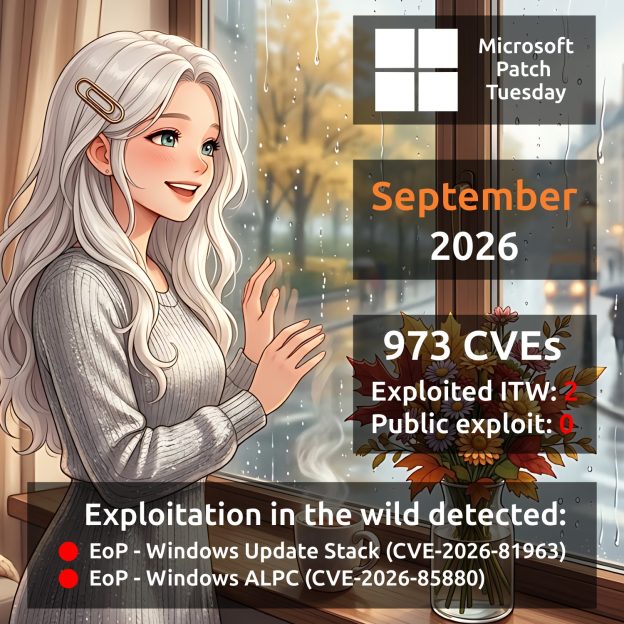
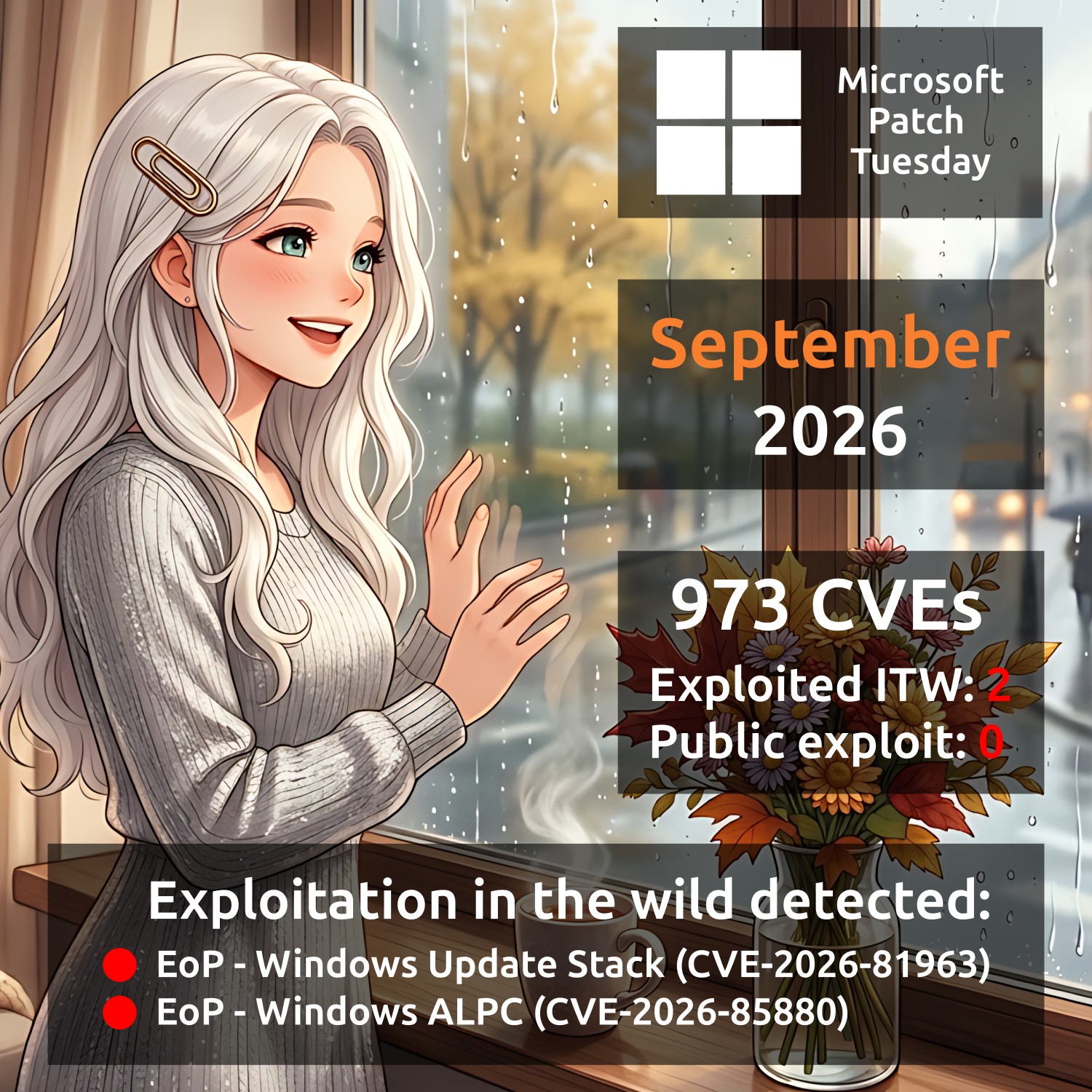
September Microsoft Patch Tuesday. A total of 973 vulnerabilities were addressed - more than twice as many as in August. Seven products had 20 or more vulnerabilities fixed: Windows Biometric Service (64), Microsoft SQL Server (54), Windows DHCP Server (36), Microsoft Office Word (35), Windows NTFS (29), Microsoft Excel (28), and Windows Win32k (24). Vulnerabilities affecting these products account for just under one-third of the total. Two vulnerabilities are known to have been exploited in the wild:

🔻 EoP - Windows Update Stack (CVE-2026-81963). A link following flaw in the Windows Update Stack (CWE-59) may allow an authenticated attacker to elevate privileges locally. An attacker who successfully exploited this vulnerability could gain SYSTEM privileges.

🔻 EoP - Windows Advanced Local Procedure Call (ALPC) (CVE-2026-85880). A heap-based buffer overflow flaw in Windows ALPC (CWE-122) may allow an authenticated attacker to elevate privileges locally. An attacker who successfully exploited this vulnerability could gain SYSTEM privileges.

There are no vulnerabilities with public exploits yet. Of the remaining vulnerabilities, the following can be highlighted:

🔹 RCE - Microsoft Exchange (CVE-2026-55007). A remote, unauthenticated attacker could achieve code execution on a vulnerable Exchange server by sending an email containing a malicious Visio attachment. The code is executed when the server processes the message, without requiring the victim to open it or use the Preview Pane.

🔹 RCE - Remote Desktop Services (CVE-2026-69525). Successful exploitation of this flaw would allow an unauthenticated attacker to execute arbitrary code by exploiting a use-after-free flaw.

🔹 RCE - Windows DNS Server (CVE-2026-69730). According to the advisory, an unauthenticated, remote attacker could send a crafted packet to exploit a use-after-free flaw in Windows DNS in order to achieve remote code execution.

🔹 RCE - Windows USB Mass Storage Class Driver (CVE-2026-68839). Successful exploitation of this vulnerability could allow an attacker the ability to gain remote code execution via an in-network attacker calling arbitrary endpoints.

🔹 RCE - Windows Kerberos (CVE-2026-69676). An authentication-bypass flaw via capture-replay in Windows Kerberos may allow an authenticated attacker to execute code over a network.

🔹 RCE - Windows Key Distribution Center (CVE-2026-69712). A use-after-free flaw in the Windows Key Distribution Center may allow an authenticated attacker to execute code over a network.

🔹 EoP - Microsoft Exchange (CVE-2026-69380). An authenticated attacker with access to a mailbox through a low-privileged user account could exploit this vulnerability to gain access to other mailboxes. Successful exploitation would allow the attacker to send and receive emails on behalf of other Exchange users as well as access attachments.

🗒 Full Vulristics report

February "In the Trend of VM" (#24): vulnerabilities in Microsoft products

February In the Trend of VM (#24): vulnerabilities in Microsoft products

February "In the Trend of VM" (#24): vulnerabilities in Microsoft products. A traditional monthly roundup of trending vulnerabilities. This time, compact and all-Microsoft.

🗞 Post on Habr (rus)
🗒 Digest on the PT website (rus)

In total, two vulnerabilities:

🔻 RCE - Microsoft Office (CVE-2026-21509)
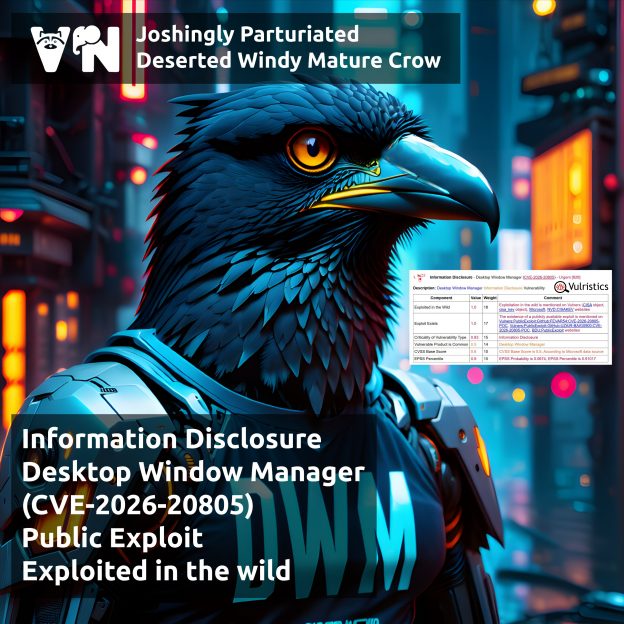
🔻 InfDisc - Desktop Window Manager (CVE-2026-20805)

🟥 Trending Vulnerabilities Portal

На русском

About Information Disclosure - Desktop Window Manager (CVE-2026-20805) vulnerability

About Information Disclosure - Desktop Window Manager (CVE-2026-20805) vulnerability

About Information Disclosure - Desktop Window Manager (CVE-2026-20805) vulnerability. Desktop Window Manager is a compositing window manager that has been part of Windows since Windows Vista. Exploitation of the vulnerability, which was addressed in the January Microsoft Patch Tuesday, allows a local attacker to disclose the "section address from a remote ALPC port which is user-mode memory".

👾 Microsoft noted that this vulnerability is being exploited in attacks. The vulnerability was added to CISA’s KEV catalog on January 13. There are no public details about the attacks yet, but Rapid7 experts suggest that the disclosed memory address can be used to bypass ASLR, "increasing the chance of developing a stable elevation of privilege exploit for DWM".

🛠 Public exploit PoCs have been available on GitHub since January 14.

На русском

Microsoft Patch Tuesday January 2023: ALPC EoP, Win Backup EoP, LocalPotato, Exchange, Remote RCEs

Microsoft Patch Tuesday January 2023: ALPC EoP, Win Backup EoP, LocalPotato, Exchange, Remote RCEs. Hello everyone! This episode will be about Microsoft Patch Tuesday for January 2023, including vulnerabilities that were added between December and January Patch Tuesdays.

Alternative video link (for Russia): https://vk.com/video-149273431_456239115

As usual, I use my open source Vulristics project to analyse and prioritize vulnerabilities. I took the comments about the vulnerabilities from the Qualys, Nessus, Rapid7 and ZDI Patch Tuesday reviews.

Continue reading →