

Tag Archives: Shadowserver

May "In the Trend of VM" (#27): high-profile vulnerabilities in Linux, ActiveMQ, SharePoint, and Adobe Acrobat Reader

May In the Trend of VM (#27): high-profile vulnerabilities in Linux, ActiveMQ, SharePoint, and Adobe Acrobat Reader

May "In the Trend of VM" (#27): high-profile vulnerabilities in Linux, ActiveMQ, SharePoint, and Adobe Acrobat Reader. Presenting the traditional monthly roundup of trending vulnerabilities according to Positive Technologies. While the previous April edition featured only one vulnerability, this one includes four, covering different technologies and attack scenarios.

🗞 Post on Habr (rus)
🗒 Digest on the PT website (rus)

🔻 EoP - Linux Kernel "Copy Fail" (CVE-2026-31431). The vulnerability allows an attacker to gain root privileges.

🔻 RCE - Apache ActiveMQ (CVE-2026-34197). A vulnerability in a solution widely used in enterprise systems and integration platforms.

🔻 Spoofing - Microsoft SharePoint Server (CVE-2026-32201). A vulnerability in a Microsoft solution widely used in enterprise systems for collaboration, document management, and internal portal development.

🔻 RCE - Adobe Reader (CVE-2026-34621). A vulnerability in a widely used PDF document viewer; actively exploited in phishing attacks.

🟥 The full list of trending vulnerabilities is available on the portal

About Remote Code Execution - Apache ActiveMQ (CVE-2026-34197) vulnerability

About Remote Code Execution - Apache ActiveMQ (CVE-2026-34197) vulnerability

About Remote Code Execution - Apache ActiveMQ (CVE-2026-34197) vulnerability. Apache ActiveMQ is a popular open-source message broker written in Java. Its main purpose is to send messages between different services, systems, and microservices without a direct connection between them.

This vulnerability is from the April Linux Patch Wednesday. Details about this vulnerability were published on April 7 in the HORIZON3.ai company blog. They claim that the Apache ActiveMQ Classic vulnerability has been hiding in plain sight for 13 years. An attacker can invoke a management operation through ActiveMQ's Jolokia API to trick the broker into fetching a remote configuration file and running arbitrary OS commands. As a result, the attacker can gain access to sensitive information, including messages, credentials, and configuration files, deploy malware, or use the compromised server to conduct further attacks within the internal infrastructure.

The vulnerability requires credentials, but default credentials (admin:admin) are common in many environments. On some versions (6.0.0–6.1.1), no credentials are required at all due to another vulnerability, CVE-2024-32114, which inadvertently exposes the Jolokia API without authentication. In those versions, CVE-2026-34197 is effectively an unauthenticated RCE.

🛠 Public exploits have been available on GitHub since April 8.

👾 Indicators of exploitation in the wild were observed by FortiGuard experts on April 13. The vulnerability was added to the CISA KEV catalog on April 16.

🌐 According to data from The Shadowserver Foundation, as of May 14, approximately 7,000 vulnerable Apache ActiveMQ servers remain exposed on the internet.

⚙️ According to the vendor bulletin, the vulnerability has been fixed in ActiveMQ versions 5.19.4 and 6.2.3. However, according to HORIZON3.ai, it was fixed in 5.19.6 and 6.2.5. It is better to install newer versions. 😉

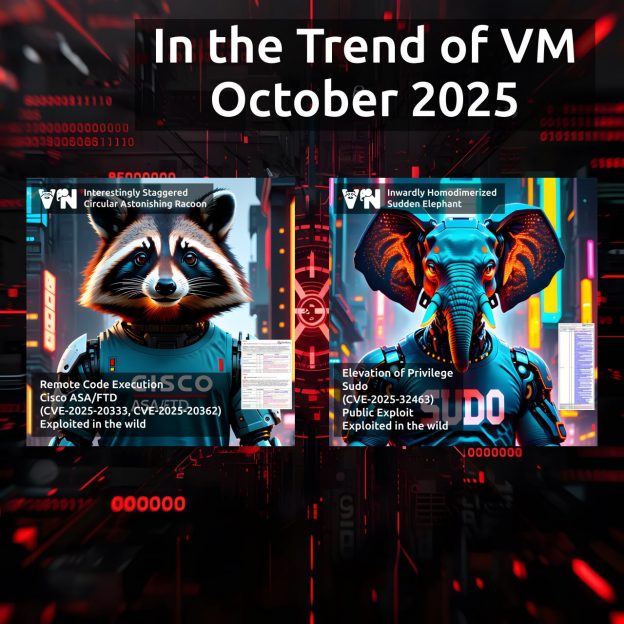
October "In the Trend of VM" (#20): vulnerabilities in Cisco ASA/FTD and sudo

October In the Trend of VM (#20): vulnerabilities in Cisco ASA/FTD and sudo

October "In the Trend of VM" (#20): vulnerabilities in Cisco ASA/FTD and sudo. A traditional monthly roundup. This time, once again, no Microsoft vulnerabilities. 😲

🗞 Post on Habr (rus)
🗞 Post on SecurityLab (rus)
🗒 Digest on the PT website (rus)

Only three identifiers in total:

🔻 Remote Code Execution - Cisco ASA/FTD (CVE-2025-20333, CVE-2025-20362). This vulnerability chain has been exploited in attacks since May 2025, but there are no public exploits yet.
🔻 Elevation of Privilege - Sudo (CVE-2025-32463). There are signs of in-the-wild exploitation and many public exploits are available.

На русском

About Remote Code Execution - Cisco ASA/FTD (CVE-2025-20333, CVE-2025-20362) vulnerability

About Remote Code Execution - Cisco ASA/FTD (CVE-2025-20333, CVE-2025-20362) vulnerability

About Remote Code Execution - Cisco ASA/FTD (CVE-2025-20333, CVE-2025-20362) vulnerability. Cisco ASA and FTD are among the most widely used solutions for perimeter protection and for providing remote access to corporate infrastructure. 🔗 On September 25, Cisco released updates addressing a chain of vulnerabilities that could allow attackers take full control of affected devices:

🔻 Vulnerability CVE-2025-20362 allows an unauthenticated attacker to access a restricted URL.

🔻 Vulnerability CVE-2025-20333 allows an authenticated attacker to execute arbitrary code as root.

👾 Cisco reports that the vulnerability chain has been exploited in attacks since May 2025. The attacks are linked to the ArcaneDoor campaign and use the LINE VIPER and RayInitiator malware.

🛠 There are no public exploits yet.

🌐 Shadowserver shows over 45,000 vulnerable hosts, with more than 2,000 of them in Russia.

На русском

New episode "In the Trend of VM" (#12): 8 February CVEs & Why the Darknet Matters for VM Specialists

New episode "In the Trend of VM" (#12): 8 February CVEs & Why the Darknet Matters for VM Specialists. Now with a new design and new video editing. 😉

📹 Video on YouTube and LinkedIn
🗞 Post on Habr (rus)
🗒 Digest on the PT website

Content:

🔻 00:00 Greetings
🔻 00:23 Remote Code Execution - Windows Lightweight Directory Access Protocol (LDAP) (CVE-2024-49112)
🔻 01:35 Remote Code Execution - Microsoft Configuration Manager (CVE-2024-43468)
🔻 02:38 Remote Code Execution - Windows OLE (CVE-2025-21298)
🔻 03:55 Elevation of Privilege - Windows Hyper-V NT Kernel Integration VSP (CVE-2025-21333, CVE-2025-21334, CVE-2025-21335)
🔻 05:02 Authentication Bypass – FortiOS/FortiProxy (CVE-2024-55591)
🔻 06:16 Remote Code Execution - 7-Zip (CVE-2025-0411)
🔻 07:27 Should a VM specialist be aware of what is happening in the Darknet?
🔻 08:48 About the digest of trending vulnerabilities

На русском

About Authentication Bypass - FortiOS (CVE-2024-55591) vulnerability

About Authentication Bypass - FortiOS (CVE-2024-55591) vulnerability

About Authentication Bypass - FortiOS (CVE-2024-55591) vulnerability. A critical flaw allows remote attackers to gain super-admin privileges via crafted requests to the Node.js websocket module. Affected systems include Fortinet devices running FortiOS (e.g., FortiGate NGFW) and FortiProxy.

🔹 On January 10, Arctic Wolf reported attacks on Fortinet devices that began in November 2024. Attackers create accounts with random names, modify device settings, and gain access to internal systems.

🔹 The vendor advisory was published on January 14. The vulnerability was added to the CISA KEV.

🔹 A public exploit has been available on GitHub since January 21.

🔹 As of January 26, Shadow Server reports around 45,000 vulnerable devices accessible from the Internet.

The vendor recommends updating FortiOS and FortiProxy to secure versions and restricting or disabling administrative HTTP/HTTPS interfaces.

На русском

New episode "In The Trend of VM" (#10): 8 trending vulnerabilities of November, zero budget VM and who should look for patches

New episode "In The Trend of VM" (#10): 8 trending vulnerabilities of November, zero budget VM and who should look for patches. The competition for the best question on the topic of VM continues. 😉🎁

📹 Video on YouTube, LinkedIn
🗞 Post on Habr (rus)
🗒 Digest on the PT website

Content:

🔻 00:29 Spoofing - Windows NTLM (CVE-2024-43451)
🔻 01:16 Elevation of Privilege - Windows Task Scheduler (CVE-2024-49039)
🔻 02:16 Spoofing - Microsoft Exchange (CVE-2024-49040)
🔻 03:03 Elevation of Privilege - needrestart (CVE-2024-48990)
🔻 04:11 Remote Code Execution - FortiManager "FortiJump" (CVE-2024-47575)
🔻 05:19 Authentication Bypass - PAN-OS (CVE-2024-0012)
🔻 06:32 Elevation of Privilege - PAN-OS (CVE-2024-9474)
🔻 07:42 Path Traversal - Zyxel firewall (CVE-2024-11667)
🔻 08:37 Is it possible to Manage Vulnerabilities with no budget?
🔻 09:53 Should a VM specialist specify a patch to install on the host in a Vulnerability Remediation task?
🔻 10:51 Full digest of trending vulnerabilities
🔻 11:18 Backstage

На русском