Tag Archives: PANOS

June "In the Trend of VM" (#28): Linux kernel, Microsoft Defender, and Palo Alto Networks device vulnerabilities

June In the Trend of VM (#28): Linux kernel, Microsoft Defender, and Palo Alto Networks device vulnerabilities

June "In the Trend of VM" (#28): Linux kernel, Microsoft Defender, and Palo Alto Networks device vulnerabilities. Presenting the traditional monthly roundup of trending vulnerabilities according to Positive Technologies. In the previous May edition, we covered four vulnerabilities. This time, there are also four vulnerabilities associated with five CVE identifiers.

🗞 Post on Habr (rus)
🗒 Digest on the PT website (rus)

🔻 EoP - Linux Kernel "Dirty Frag" (CVE-2026-43284, CVE-2026-43500). A chain of vulnerabilities with a public exploit to obtain root access. There are signs of in-the-wild exploitation.

🔻 EoP - Linux Kernel "Fragnesia" (CVE-2026-46300). Another vulnerability for gaining root access with a public exploit.

🔻 EoP - Microsoft Defender "RedSun" (CVE-2026-41091). A privilege escalation vulnerability leading to SYSTEM-level access, with a public exploit available and indications of in-the-wild exploitation. Pay special attention to Windows server and desktop environments where Microsoft Defender is enabled but there is no Internet access for regular updates.

🔻 RCE - PAN-OS (CVE-2026-0300). An unauthenticated RCE with root privileges affecting PA-Series and VM-Series firewalls. A public exploit exists, and there are indications of in-the-wild exploitation.

🟥 The full list of trending vulnerabilities is available on the portal

About Remote Code Execution - PAN-OS (CVE-2026-0300) vulnerability

About Remote Code Execution - PAN-OS (CVE-2026-0300) vulnerability

About Remote Code Execution - PAN-OS (CVE-2026-0300) vulnerability. PAN-OS is an operating system for Palo Alto Networks firewalls and security platforms. User-ID™ Authentication Portal (also known as Captive Portal) is a non-default PAN-OS feature used to map IP addresses to usernames. By exploiting a buffer overflow vulnerability (CWE-787), an unauthenticated remote attacker can send specially crafted packets to a device with the Authentication Portal enabled, achieving arbitrary code execution with root privileges on the affected device. No authentication or user interaction is required. If the vulnerability is successfully exploited, the attacker gains full control over network traffic: they can intercept, modify, or block connections, access sensitive data, bypass security policies, hide traces of compromise, install backdoors, and use the device as a foothold for attacks on internal infrastructure.

⚙️ The vendor security advisory was published on May 6. PA-Series and VM-Series firewalls are affected. Prisma Access, Cloud NGFW, and Panorama appliances are not impacted by this vulnerability. Security updates for affected devices became available on May 13. As a workaround, the vendor recommended restricting User-ID™ Authentication Portal access to only trusted internal zones or disabling the User-ID™ Authentication Portal entirely if it is not required.

👾 On the same day, May 6, researchers from Palo Alto Networks Unit 42 published a report on active exploitation of the vulnerability in the wild. Post-exploitation activity includes deployment of publicly available tunneling tools (EarthWorm, ReverseSocks5), Active Directory enumeration using credentials likely obtained from the firewall, and systematic destruction of logs and other evidence of compromise. On the same day, the vulnerability was added to the CISA KEV catalog.

🛠 A public exploit was also published on GitHub on May 6.

🌐 PAN-OS is among the most widely deployed enterprise firewall operating systems in the world. As of June 5, Shodan identifies approximately 135,755 internet-facing PAN-OS instances, representing a significant attack surface.

March episode "In the Trend of VM" (#13): vulnerabilities of Microsoft, PAN-OS, СommuniGate and who should patch hosts with deployed application

March episode "In the Trend of VM" (#13): vulnerabilities of Microsoft, PAN-OS, СommuniGate and who should patch hosts with deployed application. I'm posting the translated video with a big delay, but it's better than never. 😉

📹 Video on YouTube and LinkedIn
🗞 Post on Habr (rus)
🗒 Digest on the PT website

Content:

🔻 00:00 Greetings
🔻 00:31 Elevation of Privilege - Windows Ancillary Function Driver for WinSock (CVE-2025-21418)
🔻 01:12 Elevation of Privilege - Windows Storage (CVE-2025-21391)
🔻 01:53 Authentication Bypass - PAN-OS (CVE-2025-0108)
🔻 03:09 Remote Code Execution - CommuniGate Pro (BDU:2025-01331)
🔻 04:27 The VM riddle: who should patch hosts with a deployed application?
🔻 07:11 About the digest of trending vulnerabilities

На русском

About Authentication Bypass - PAN-OS (CVE-2025-0108) vulnerability

About Authentication Bypass - PAN-OS (CVE-2025-0108) vulnerability

About Authentication Bypass - PAN-OS (CVE-2025-0108) vulnerability. PAN-OS is the operating system used in all Palo Alto Network NGFWs. This vulnerability allows an unauthenticated attacker to gain access to the PAN-OS management web interface. The attacker can then "invoke certain PHP scripts", compromising the integrity and confidentiality of PAN-OS. 😏

🔹 The vendor bulletin was released on February 12. On the same day, Assetnote posted a write-up on the vulnerability. The next day, a PoC exploit appeared on GitHub.

🔹 On February 18, GreyNoise reported that they had detected active exploitation attempts. According to Palo Alto, the vulnerability is being exploited alongside EoP CVE-2024-9474 and Authenticated File Read CVE-2025-0111 vulnerabilities. As a result, the attacker gains the ability to execute Linux commands on the device as root. 😱

Install updates and restrict access to administrative web interfaces! 😉

На русском

New episode "In The Trend of VM" (#10): 8 trending vulnerabilities of November, zero budget VM and who should look for patches

New episode "In The Trend of VM" (#10): 8 trending vulnerabilities of November, zero budget VM and who should look for patches. The competition for the best question on the topic of VM continues. 😉🎁

📹 Video on YouTube, LinkedIn
🗞 Post on Habr (rus)
🗒 Digest on the PT website

Content:

🔻 00:29 Spoofing - Windows NTLM (CVE-2024-43451)
🔻 01:16 Elevation of Privilege - Windows Task Scheduler (CVE-2024-49039)
🔻 02:16 Spoofing - Microsoft Exchange (CVE-2024-49040)
🔻 03:03 Elevation of Privilege - needrestart (CVE-2024-48990)
🔻 04:11 Remote Code Execution - FortiManager "FortiJump" (CVE-2024-47575)
🔻 05:19 Authentication Bypass - PAN-OS (CVE-2024-0012)
🔻 06:32 Elevation of Privilege - PAN-OS (CVE-2024-9474)
🔻 07:42 Path Traversal - Zyxel firewall (CVE-2024-11667)
🔻 08:37 Is it possible to Manage Vulnerabilities with no budget?
🔻 09:53 Should a VM specialist specify a patch to install on the host in a Vulnerability Remediation task?
🔻 10:51 Full digest of trending vulnerabilities
🔻 11:18 Backstage

На русском

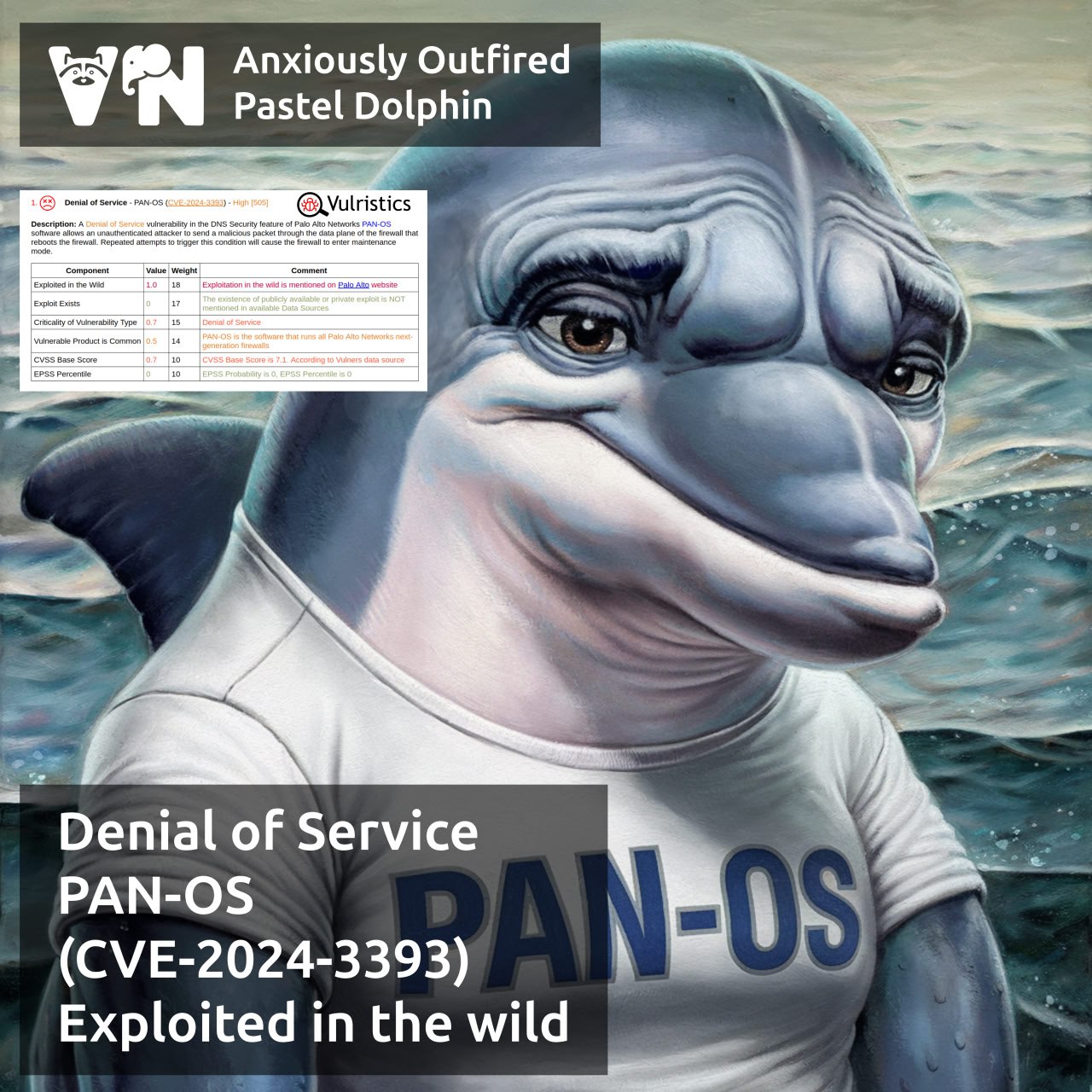
About Denial of Service - PAN-OS (CVE-2024-3393) vulnerability

About Denial of Service - PAN-OS (CVE-2024-3393) vulnerability

About Denial of Service - PAN-OS (CVE-2024-3393) vulnerability. PAN-OS is the operating system that runs all Palo Alto Network NGFWs. The vendor's advisory was released on December 27. Аn unauthenticated attacker can send a malicious packet through the data plane of the firewall, causing it to reboot. Repeated attempts to trigger this condition will cause the firewall to enter maintenance mode. For exploitation the logging option of the "DNS Security" feature must be enabled.

👾 Palo Alto has already detected attacks that exploit this vulnerability. There are no public exploits yet.

👀 CyberOK detects more than 500 PAN-OS installations in RuNet, of which 32 are potentially vulnerable. Additionally, 218 hosts are running PAN-OS version 11.0.x, which is no longer supported by the vendor since November 17.

🔧 To fix the vulnerability, you need to update your device or, as a workaround, disable the logging option of the "DNS Security" function.

На русском

About Elevation of Privilege - PAN-OS (CVE-2024-9474) vulnerability

About Elevation of Privilege - PAN-OS (CVE-2024-9474) vulnerability

About Elevation of Privilege - PAN-OS (CVE-2024-9474) vulnerability. An attacker with PAN-OS administrator access to the management web interface can perform actions on the Palo Alto device with root privileges. Linux commands can be injected via unvalidated input in script.

The need for authentication and admin access could limit this vulnerability's impact, but here we have the previous vulnerability Authentication Bypass - PAN-OS (CVE-2024-0012). 😏 Exploitation of this vulnerability chain was noted by Palo Alto on November 17. After November 19, when the watchTowr Labs article was published and exploits appeared, mass attacks began.

On November 21, Shadowserver reported that ~2000 hosts were compromised, mostly in the US and India. According to Wiz, attackers deployed web shells, Sliver implants and cryptominers.

На русском