Tag Archives: MicrosoftDefender

June "In the Trend of VM" (#28): Linux kernel, Microsoft Defender, and Palo Alto Networks device vulnerabilities

June In the Trend of VM (#28): Linux kernel, Microsoft Defender, and Palo Alto Networks device vulnerabilities

June "In the Trend of VM" (#28): Linux kernel, Microsoft Defender, and Palo Alto Networks device vulnerabilities. Presenting the traditional monthly roundup of trending vulnerabilities according to Positive Technologies. In the previous May edition, we covered four vulnerabilities. This time, there are also four vulnerabilities associated with five CVE identifiers.

🗞 Post on Habr (rus)
🗒 Digest on the PT website (rus)

🔻 EoP - Linux Kernel "Dirty Frag" (CVE-2026-43284, CVE-2026-43500). A chain of vulnerabilities with a public exploit to obtain root access. There are signs of in-the-wild exploitation.

🔻 EoP - Linux Kernel "Fragnesia" (CVE-2026-46300). Another vulnerability for gaining root access with a public exploit.

🔻 EoP - Microsoft Defender "RedSun" (CVE-2026-41091). A privilege escalation vulnerability leading to SYSTEM-level access, with a public exploit available and indications of in-the-wild exploitation. Pay special attention to Windows server and desktop environments where Microsoft Defender is enabled but there is no Internet access for regular updates.

🔻 RCE - PAN-OS (CVE-2026-0300). An unauthenticated RCE with root privileges affecting PA-Series and VM-Series firewalls. A public exploit exists, and there are indications of in-the-wild exploitation.

🟥 The full list of trending vulnerabilities is available on the portal

About Elevation of Privilege - Microsoft Defender "RedSun" (CVE-2026-41091) vulnerability

About Elevation of Privilege - Microsoft Defender RedSun (CVE-2026-41091) vulnerability

About Elevation of Privilege - Microsoft Defender "RedSun" (CVE-2026-41091) vulnerability. Microsoft Defender is a built-in security solution developed by Microsoft to protect the Windows operating system and user data from viruses, malware, and other cyber threats in real time. An improper link resolution vulnerability prior to file access ("link following", CWE-59) in Microsoft Defender, specifically within the Malware Protection Engine component, allows an authenticated local attacker to escalate privileges to SYSTEM level. As a result, an attacker could gain full control over the affected system, including unrestricted access to data, the ability to modify system settings, install software, manage user accounts, and disable security protections.

🛠 An exploit for the vulnerability was published on GitHub by security researcher Nightmare Eclipse on April 15, alongside exploits targeting other Windows component vulnerabilities. The account was later removed by GitHub administrators; however, this did not prevent the exploit code from spreading further.

⚙️ The security advisory and patches were released on May 19 outside Microsoft's regular Patch Tuesday schedule. Versions of Microsoft Malware Protection Engine from 1.1.26030.3008 through 1.1.26040.8 are affected. Systems with Microsoft Defender disabled are not vulnerable. By default, Microsoft Defender automatically updates Windows security components, antivirus definitions, and Microsoft Malware Protection Engine, so no additional user action is typically required. Malware Protection Engine is updated monthly or as new threats emerge, while antivirus definitions are updated several times per day. Update checks may run automatically anywhere from once to several times daily when an Internet connection is available. Manual update checks are also supported.

👾 According to Microsoft, the vulnerability is being exploited in the wild. The vulnerability was added to the CISA KEV catalog on May 20.

💡 Special attention should be paid to server and desktop Windows hosts where Microsoft Defender is not disabled, but Internet access is unavailable for regular updates.

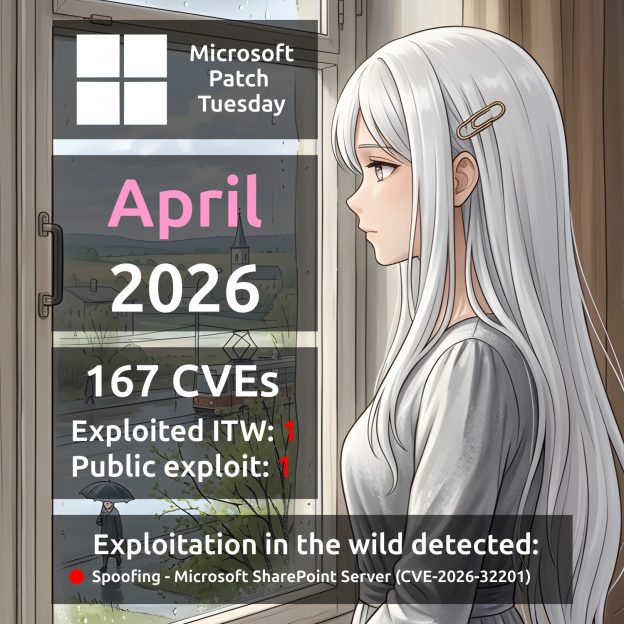
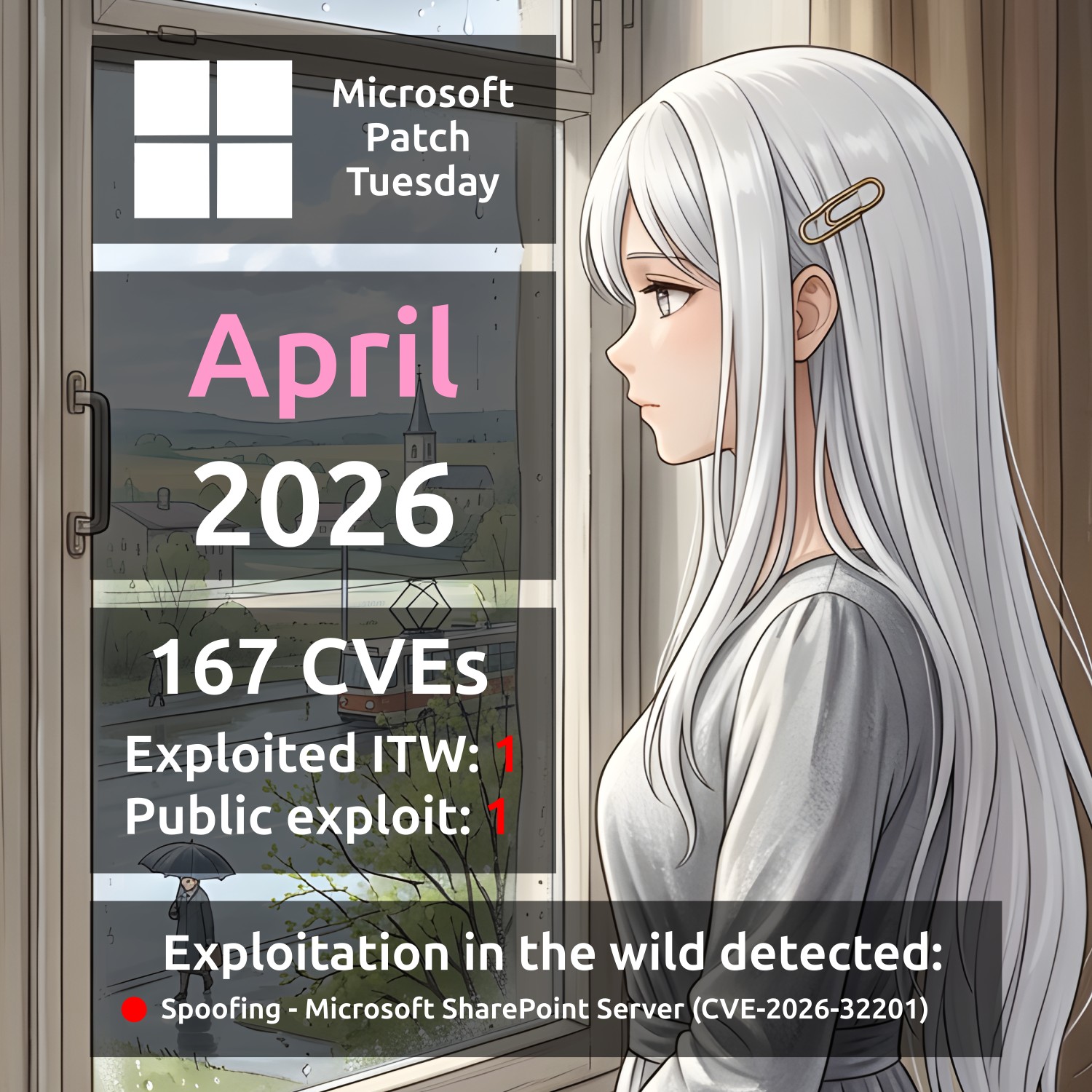
April Microsoft Patch Tuesday

April Microsoft Patch Tuesday

April Microsoft Patch Tuesday. A total of 167 vulnerabilities, about twice as many as in March. There is one vulnerability already being exploited in the wild:

🔻 Spoofing - Microsoft SharePoint Server (CVE-2026-32201). ZDI experts say "Spoofing bugs in SharePoint often manifest as cross-site scripting (XSS) bugs". "An attacker who successfully exploited the vulnerability could view some sensitive information (Confidentiality), make changes to disclosed information (Integrity), but cannot limit access to the resource (Availability)". There is no info yet about how widely it is being used in attacks, but you should not delay patching, especially if SharePoint is exposed to the Internet.

Formally, there are no public exploits yet. However, there are strong indications that a public exploit may already exist for one vulnerability.

🔸 EoP - Microsoft Defender (CVE-2026-33825). "Insufficient granularity of access control" in Microsoft Defender allows a logged-in attacker to gain higher privileges on a local system. Tenable and ZDI say the bug looks similar to the BlueHammer zero-day, for which a public exploit was released on GitHub on April 3. The researcher who published it, Chaotic Eclipse, criticized Microsoft’s disclosure process. ZDI says the exploit is real, but exploitation is unstable and not always reliable.

Other important issues:

🔹 RCE - Windows Active Directory (CVE-2026-33826). To exploit this, the attacker must have an account. The attacker sends a specially crafted RPC request to a vulnerable server, which can lead to code execution. Microsoft says the attacker must be in the same restricted Active Directory domain as the target system.

🔹 RCE - Windows Internet Key Exchange (IKE) Service Extensions (CVE-2026-33824). ZDI says this vulnerability is wormable, meaning it could allow malware to spread automatically between systems. It affects systems with IKE enabled, which creates a large attack surface. Microsoft recommends blocking UDP ports 500 and 4500 at the network edge. However, attackers inside the network can still use it for lateral movement. Patch quickly if you use IKE.

🔹 RCE - Windows TCP/IP (CVE-2026-33827). ZDI also says this may be wormable, especially on systems using IPv6 and IPSec. A race condition makes it harder to exploit, but similar bugs are often exploited at Pwn2Own, so you should not rely on that difficulty. If you use IPv6, test and deploy the patch quickly before exploits appear.

🔹 EoP - Windows Push Notifications (CVE-2026-26167). This Patch Tuesday includes several sandbox escape vulnerabilities, including in Push Notifications, AFD for Winsock, Windows Management Services, and User Interface Core. CVE-2026-26167 (Push Notifications) is the most important because it is the only one with low attack complexity. The others require winning a race condition (AC:H).

🔹 Spoofing - Remote Desktop (CVE-2026-26151). Weak warnings in the Remote Desktop interface allow a network attacker to trick a user into opening a specially crafted file, leading to spoofing. The issue was found by the UK National Cyber Security Centre (NCSC).

🗒 Full Vulristics report