

Tag Archives: TeamCity

About Remote Code Execution - TeamCity (CVE-2026-63077) vulnerability

About Remote Code Execution - TeamCity (CVE-2026-63077) vulnerability

About Remote Code Execution - TeamCity (CVE-2026-63077) vulnerability. TeamCity is a proprietary solution developed by JetBrains for automating software build, testing, and deployment processes. TeamCity uses a central server to coordinate builds and separate build agents to execute them. An agent can communicate with the server through the agent polling protocol: it registers with the server, requests the next command, and reports whether the command succeeded or failed. The vulnerability allows an unauthenticated remote attacker with HTTP(S) access to a TeamCity On-Premises server to execute arbitrary operating system commands with the privileges of the TeamCity Server process through the agent polling protocol. The vulnerability is caused by insecure deserialization of XML data (CWE-502). Depending on the privileges of the TeamCity Server process, successful exploitation may allow an attacker to access TeamCity data, configurations, and stored credentials, modify the server state, and potentially compromise the integrity of build artifacts and downstream CI/CD pipelines.

⚙️ A notice about this critical vulnerability was published on the JetBrains blog on July 27. The vulnerability affects all versions of TeamCity On-Premises. To remediate the vulnerability, users should upgrade to version 2025.11.7 or 2026.1.3. As a compensating measure, a security patch plugin can be installed on TeamCity 2017.1 and later to prevent exploitation of the vulnerability. For TeamCity 2017.1-2018.1, the server must be restarted after installing the plugin. Starting with TeamCity 2018.2, the plugin can be enabled without restarting the TeamCity server. As a longer-term security measure, the vendor recommends limiting network access to TeamCity servers to trusted networks, including restricting access to the TeamCity login page and REST API. It is also recommended to run the TeamCity server under an operating system account with the minimum privileges required for normal operation. TeamCity servers should be deployed on dedicated hosts separate from build agents, as described in the documentation.

👾 The vulnerability was added to the CISA KEV on August 5. On August 7, JetBrains published a report confirming exploitation of the vulnerability in the wild. The vendor recommended checking TeamCity logs for com.thoughtworks.xstream.converters.ConversionException messages, which may indicate successful exploitation of the vulnerability and warrant further investigation. After updating the server or installing the security patch plugin, logs can be checked for com.thoughtworks.xstream.security.ForbiddenClassException messages, which indicate that an exploitation attempt was blocked. Unauthorized build agents, particularly those with names beginning with scan, may also indicate exploitation attempts.

🛠 A technical analysis of the vulnerability and a link to a public exploit were published on the Rapid7 blog on August 7. A Metasploit module for simplified exploitation of the vulnerability has been available since August 28.

🌐 According to JetBrains, TeamCity is used by more than 30,000 organizations worldwide across government, technology, financial services, healthcare, and other sectors, including some Fortune 500 companies. As of July 30, Censys had detected approximately 4,500 TeamCity installations exposed to the Internet. Of these, 450 were running versions 2025.11.7 or 2026.1.3. Most of the remaining installations were running earlier versions or did not disclose version information.

I have finalized the list of trending vulnerabilities for 2024 according to Positive Technologies

I have finalized the list of trending vulnerabilities for 2024 according to Positive Technologies

I have finalized the list of trending vulnerabilities for 2024 according to Positive Technologies. Last year, 74 vulnerabilities were classified as trending (to compare the scale, just over 40,000 were added to NVD in 2024).

All trending vulnerabilities are found in Western commercial products and open source projects. This year, the vulnerabilities of domestic Russian products did not reach the level of criticality required to classify them as trending.

For 55 of all trending vulnerabilities there are currently signs of exploitation in attacks, for 17 there are public exploits (but no signs of exploitation) and for the remaining 2 there is only a possibility of future exploitation.

Vulnerabilities were often added to trending ones before signs of exploitation in the wild appeared. For example, the remote code execution vulnerability in VMware vCenter (CVE-2024-38812) was added to the list of trending vulnerabilities on September 20, 3 days after the vendor's security bulletin appeared. There were no signs of exploitation in the wild or public exploit for this vulnerability. Signs of exploitation appeared only 2 months later, on November 18.

Most of the vulnerabilities in the trending list are of the following types: Remote Code or Command Execution (24) and Elevation of Privilege (21).

4 vulnerabilities in Barracuda Email Security Gateway (CVE-2023-2868), MOVEit Transfer (CVE-2023-34362), papercut (CVE-2023-27350) and SugarCRM (CVE-2023-22952) were added in early January 2024. These vulnerabilities were massively exploited in the West in 2023, and attacks using these vulnerabilities could also tangentially affect those domestic Russian organizations where these products had not yet been taken out of service. The rest of the vulnerabilities became trending in 2024.

34 trending vulnerabilities affect Microsoft products (45%).

🔹 17 of them are Elevation of Privilege vulnerabilities in the Windows kernel and standard components.

🔹 1 Remote Code Execution vulnerability in Windows Remote Desktop Licensing Service (CVE-2024-38077).

2 trending Elevation of Privilege vulnerabilities affect Linux systems: one in nftables (CVE-2024-1086), and the second in needrestart (CVE-2024-48990).

Other groups of vulnerabilities

🔻 Phishing attacks: 19 (Windows components, Outlook, Exchange, Ghostscript, Roundcube)
🔻 Network security and entry points: 13 (Palo Alto, Fortinet, Juniper, Ivanti, Check Point, Zyxel)
🔻 Virtual infrastructure and backups: 7 (VMware, Veeam, Acronis)
🔻 Software development: 6 (GitLab, TeamCity, Jenkins, PHP, Fluent Bit, Apache Struts)
🔻 Collaboration tools: 3 (Atlassian Confluence, XWiki)
🔻 CMS WordPress plugins: 3 (LiteSpeed Cache, The Events Calendar, Hunk Companion)

🗒 Full Vulristics report

🟥 Article on the official website "Vulnerable software and hardware vs. security researchers" (rus)

На русском

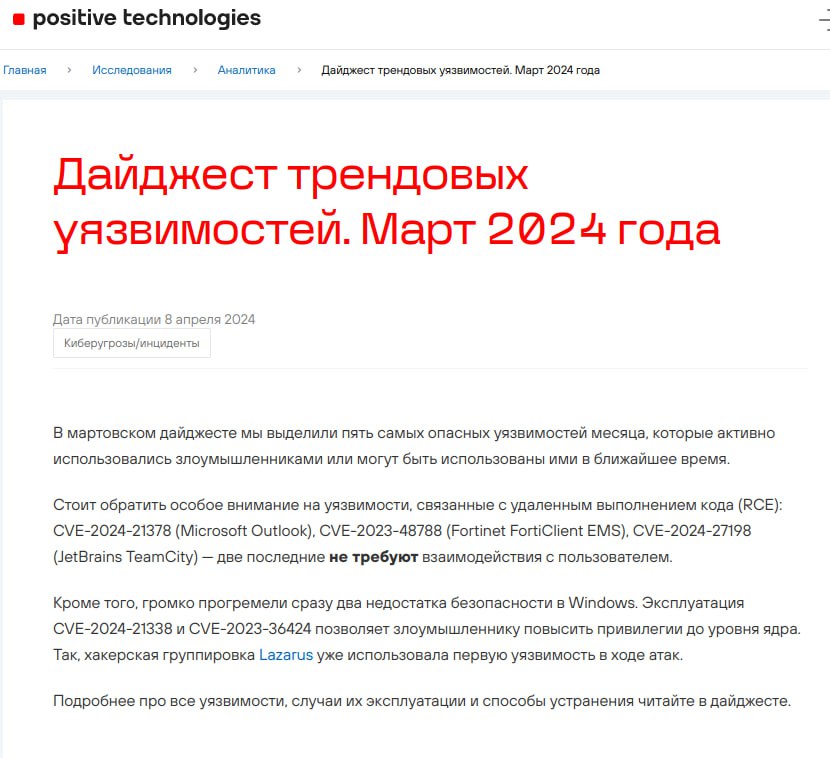
The digest of March trending vulnerabilities was published on the Positive Technologies website (in Russian)

The digest of March trending vulnerabilities was published on the Positive Technologies website (in Russian)The digest of March trending vulnerabilities was published on the Positive Technologies website (in Russian)The digest of March trending vulnerabilities was published on the Positive Technologies website (in Russian)The digest of March trending vulnerabilities was published on the Positive Technologies website (in Russian)The digest of March trending vulnerabilities was published on the Positive Technologies website (in Russian)

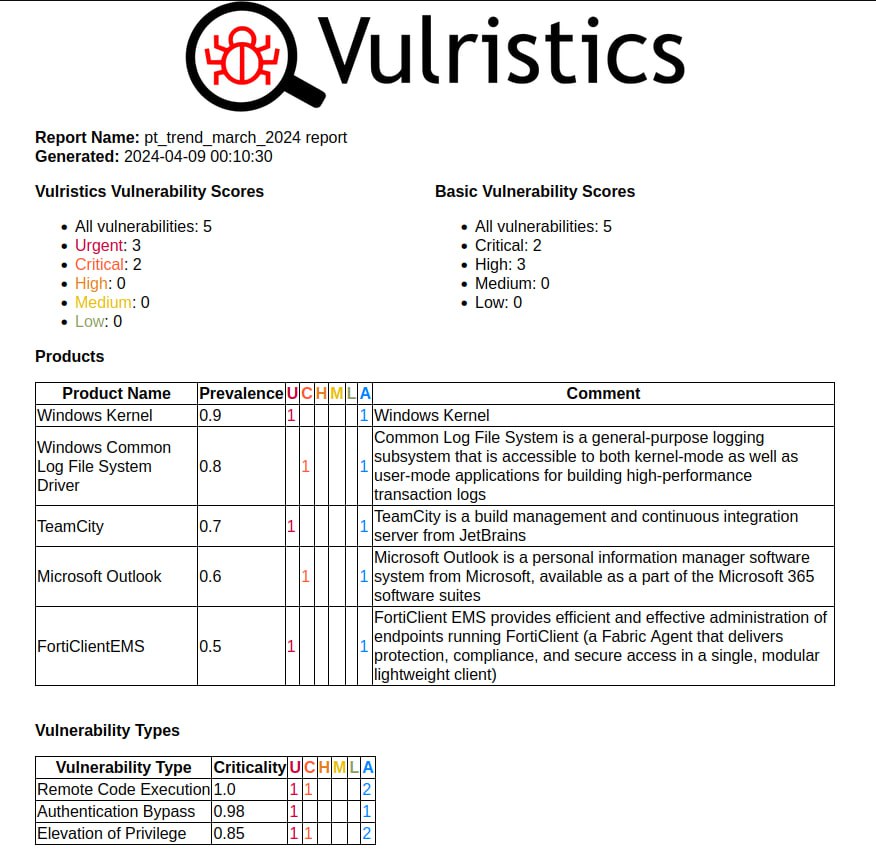
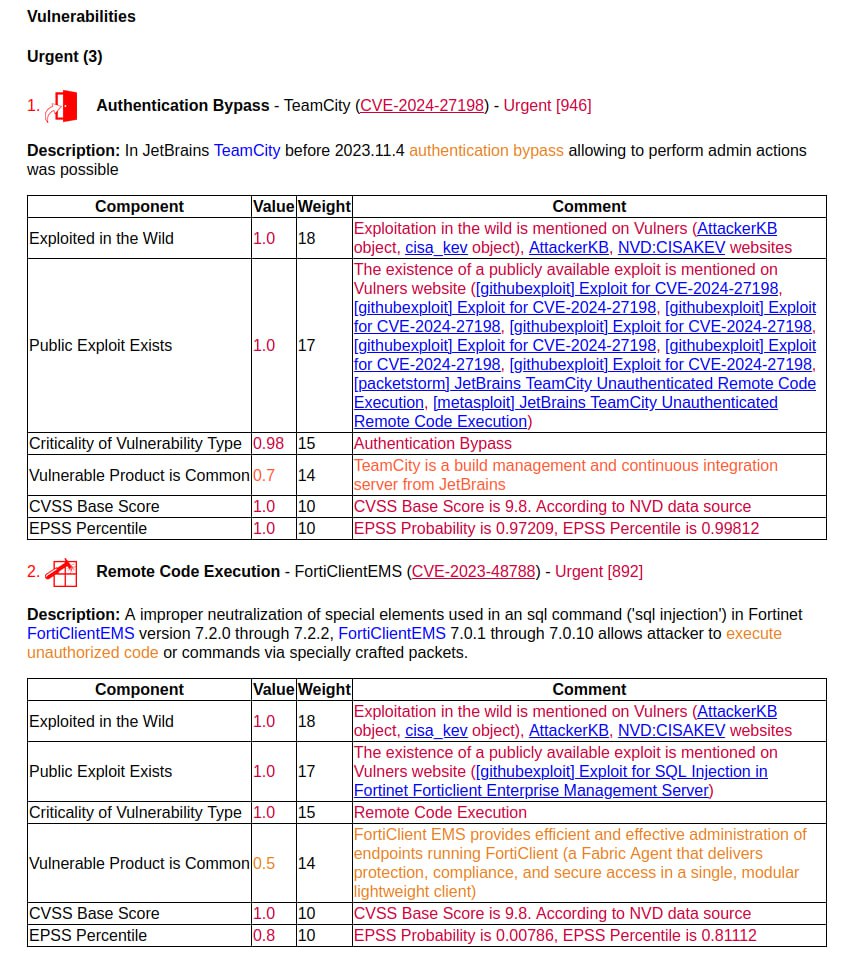
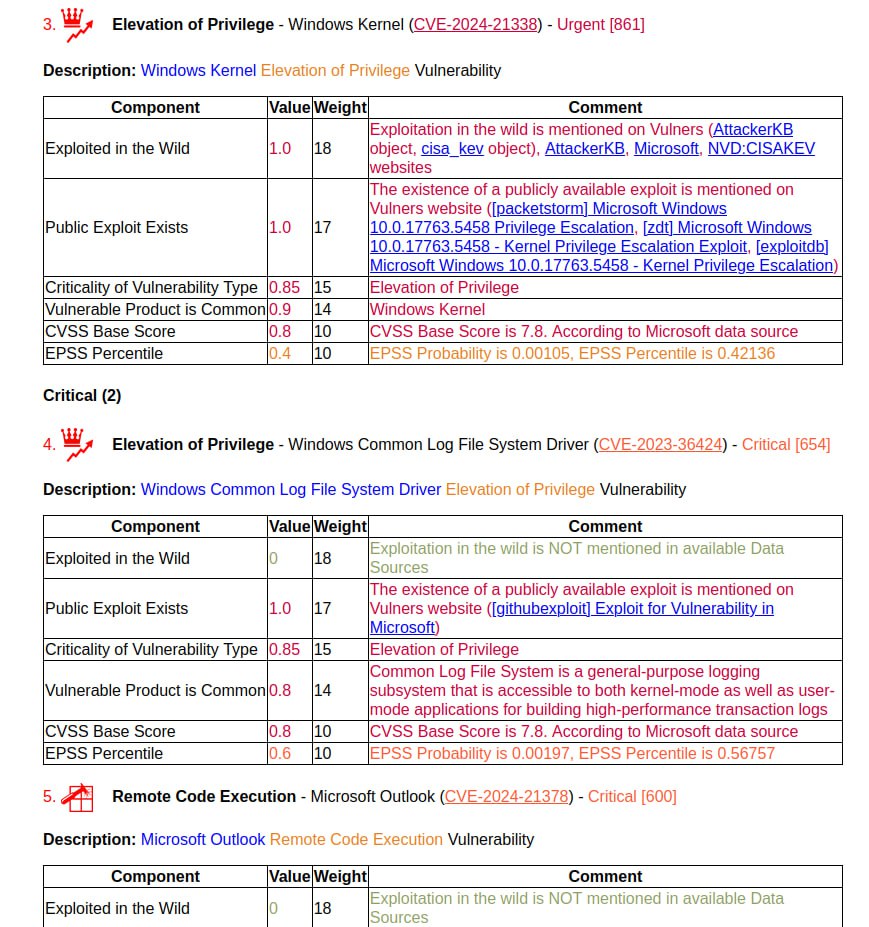
The digest of March trending vulnerabilities was published on the Positive Technologies website (in Russian). I also generated a Vulristics report for these vulnerabilities. There are 5 vulnerabilities in total.

🔻 For 3 vulnerabilities there are exploits and confirmed signs of exploitation in the wild: AuthBypass - TeamCity (CVE-2024-27198), RCE - FortiClientEMS (CVE-2023-48788), EoP - Windows Kernel (CVE-2024-21338).

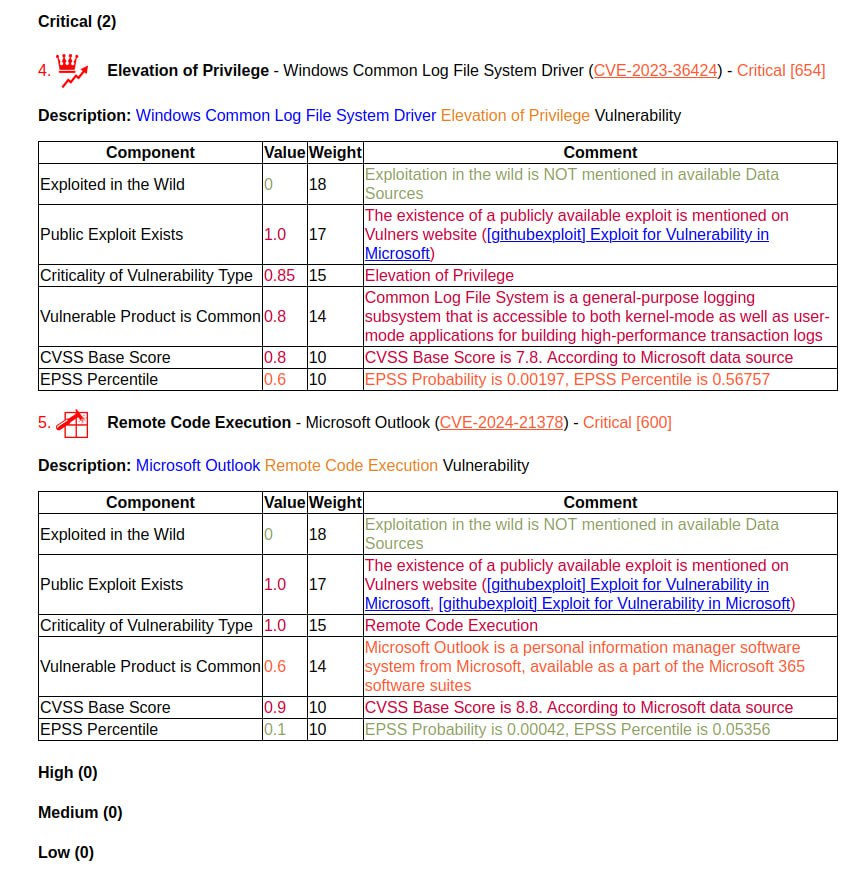
🔻 For 2 more vulnerabilities there are no signs of exploitation in the wild yet, but there are exploits: EoP - Windows CLFS Driver (CVE-2023-36424), RCE - Microsoft Outlook (CVE-2024-21378).

На русском

October 2023: back to Positive Technologies, Vulristics updates, Linux Patch Wednesday, Microsoft Patch Tuesday, PhysTech VM lecture

October 2023: back to Positive Technologies, Vulristics updates, Linux Patch Wednesday, Microsoft Patch Tuesday, PhysTech VM lecture. Hello everyone! October was an interesting and busy month for me. I started a new job, worked on my open source Vulristics project, and analyzed vulnerabilities using it. Especially Linux vulnerabilities as part of my new Linux Patch Wednesday project. And, of course, analyzed Microsoft Patch Tuesday as well. In addition, at the end of October I was a guest lecturer at MIPT/PhysTech university. But first thing first.

Alternative video link (for Russia): https://vk.com/video-149273431_456239138

Continue reading