Tag Archives: Nextcloud

June Linux Patch Wednesday

June Linux Patch Wednesday

June Linux Patch Wednesday. A total of 1,888 vulnerabilities (324 in the Linux kernel, and a whopping 728 in Chromium ❗️). For comparison, there were 1,638 vulnerabilities in May. The increase isn't as dramatic as it was from April to May, but it's still a new record. One of the vulnerabilities has been flagged as actively exploited in the wild:

🔻 RCE - Chromium (CVE-2026-11645). Chromium is the open-source web browser project that serves as the foundation for many modern browsers, including Google Chrome, Microsoft Edge, Brave, Opera, and Vivaldi. A publicly available Metasploit module exploits a vulnerability in the web browser's V8 JavaScript engine. The vulnerability is triggered by a specific code pattern that causes type confusion between internal V8 objects, resulting in out-of-bounds memory access. Successful exploitation may lead to remote code execution in the context of the browser process.

There are also 109 vulnerabilities with public exploits or evidence that exploits exist, although there are no signs of active exploitation in real-world attacks yet. Among them, the following stand out:

🔸 EoP - Linux Kernel "CIFSwitch" (CVE-2026-46243). This vulnerability could allow attackers to forge CIFS authentication key descriptions, abuse the kernel's key request mechanism, and gain root privileges.

🔸 EoP - Linux Kernel "PinTheft" (CVE-2026-43494). On a successfully exploited configuration, the chain completes and hands off to the discovered SUID binary with an overwritten first page - yielding a root shell if the race and kernel state align.

🔸 RCE - Apache ActiveMQ (CVE-2026-42588). ActiveMQ is an open-source message broker written in Java. Exploitation of this vulnerability requires valid credentials for the ActiveMQ Web Console. However, the default credentials are admin/admin.

🔸 InfDisc - Squid "Squidbleed" (CVE-2026-47729). Squid is an open-source caching proxy server. The vulnerability causes Squid's FTP parser to read beyond the boundary of a memory buffer, into a region that may contain a previous user's uncleared HTTP request data.

🔸 AuthBypass - Nextcloud (CVE-2026-45156). Nextcloud is an open source content collaboration platform. A missing signature verification in User OIDC allowed a malicious ID4me authority to identify as any user.

🔸 XSS - Nextcloud (CVE-2025-59788). A vulnerability in a reachable files_pdfviewer example directory in Nextcloud allows attackers to execute arbitrary JavaScript in the context of a user's browser via a crafted PDF file to viewer.html.

🔸 XSS - Roundcube (CVE-2026-48849). Roundcube is a free, open-source webmail application. An unsanitized subject field in the draft restored value could lead to stored XSS/HTML/CSS injection on shared mailboxes.

🔸 DoS - ImageMagick (CVE-2026-46522). ImageMagick is an open-source image processing tool used to create, edit, and convert images. Due to a missing check in the MIFF decoder, a crafted file could cause an infinite loop resulting in CPU exhaustion.


🗒 Full Vulristics report

I generated a Vulristics report on the April Linux Patch Wednesday

I generated a Vulristics report on the April Linux Patch Wednesday
I generated a Vulristics report on the April Linux Patch WednesdayI generated a Vulristics report on the April Linux Patch WednesdayI generated a Vulristics report on the April Linux Patch WednesdayI generated a Vulristics report on the April Linux Patch WednesdayI generated a Vulristics report on the April Linux Patch WednesdayI generated a Vulristics report on the April Linux Patch Wednesday

I generated a Vulristics report on the April Linux Patch Wednesday. Over the past month, Linux vendors have begun releasing patches for a record number of vulnerabilities - 348. There are signs of exploitation in the wild for 7 vulnerabilities (data on incidents from the FSTEC BDU). Another 165 have a link to an exploit or a sign of the existence of a public/private exploit.

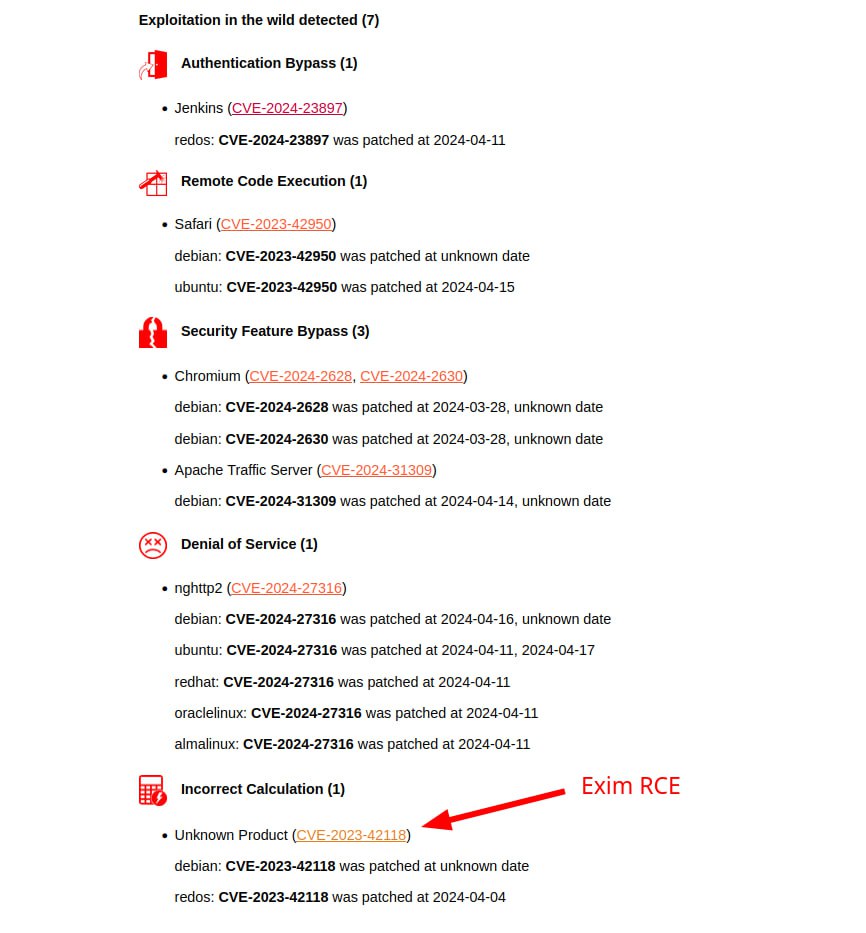
Let's start with 7 vulnerabilities with signs of exploitation in the wild and exploits:

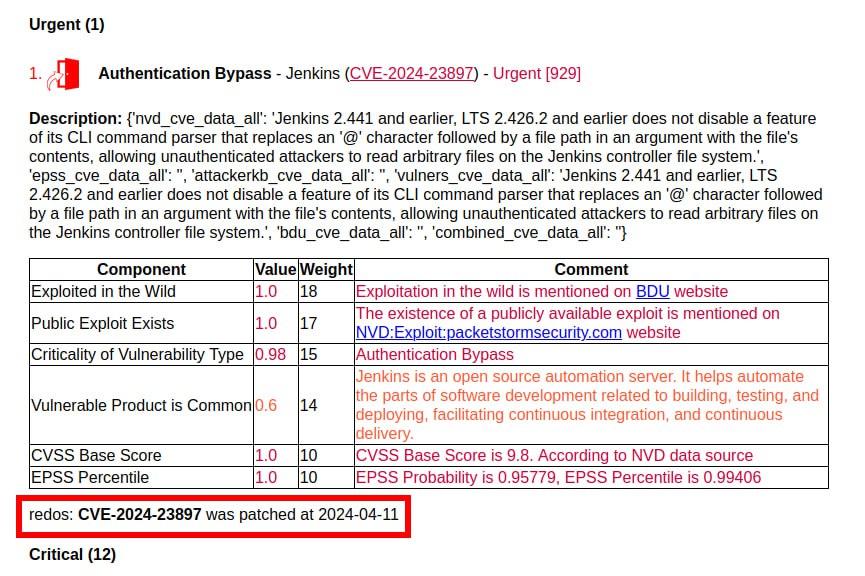
🔻 The trending January vulnerability Authentication Bypass - Jenkins (CVE-2024-23897) unexpectedly appeared in the TOP. As far as I understand, Linux distributions usually do not include Jenkins packages in the official repositories and, accordingly, do not add Jenkins vulnerability detection rules to their OVAL content. Unlike the Russian Linux distribution RedOS. Therefore, RedOS has the earliest fix timestamp for this vulnerability.

🔻 2 RCE vulnerabilities. The most interesting of them is Remote Code Execution - Exim (CVE-2023-42118). When generating the report, I deliberately did not take into account the vulnerability description and product names from the BDU database (flags --bdu-use-product-names-flag, --bdu-use-vulnerability-descriptions-flag set to False). Otherwise, the report would be partly in English and partly in Russian. But it turned out that so far only BDU has an adequate description of this vulnerability. 🤷‍♂️ You need to take a closer look at this vulnerability because Exim is a fairly popular mail server. The second RCE vulnerability is in the web browser, Remote Code Execution - Safari (CVE-2023-42950).

🔻2 DoS vulnerabilities. Denial of Service - nghttp2/Apache HTTP Server (CVE-2024-27316) and Denial of Service - Apache Traffic Server (CVE-2024-31309). The second is classified in the report as Security Feature Bypass, but this is due to incorrect CWE in NVD (CWE-20 - Improper Input Validation)

🔻 2 browser vulnerabilities Security Feature Bypass - Chromium (CVE-2024-2628, CVE-2024-2630)

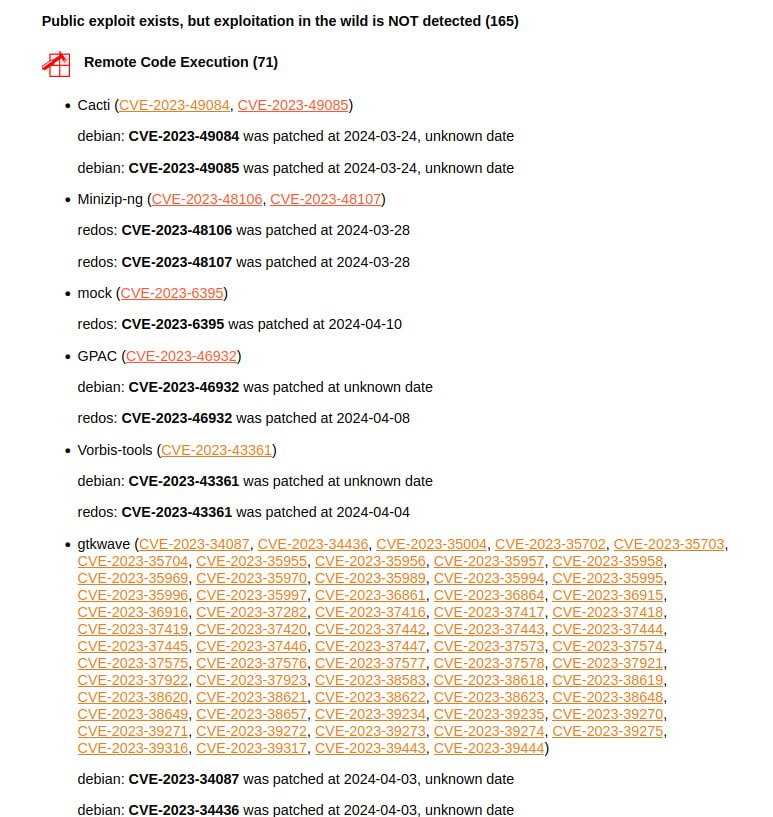
Among the vulnerabilities for which there are only signs of the existence of exploits so far, you can pay attention to the following:

🔸 A large number of RCE vulnerabilities (71). Most of them are in the gtkwave product. This is a viewer for VCD (Value Change Dump) files, which are typically created by digital circuit simulators. Also, the Remote Code Execution - Cacti (CVE-2023-49084, CVE-2023-49085) vulnerabilities look dangerous. Cacti is a solution for monitoring servers and network devices.

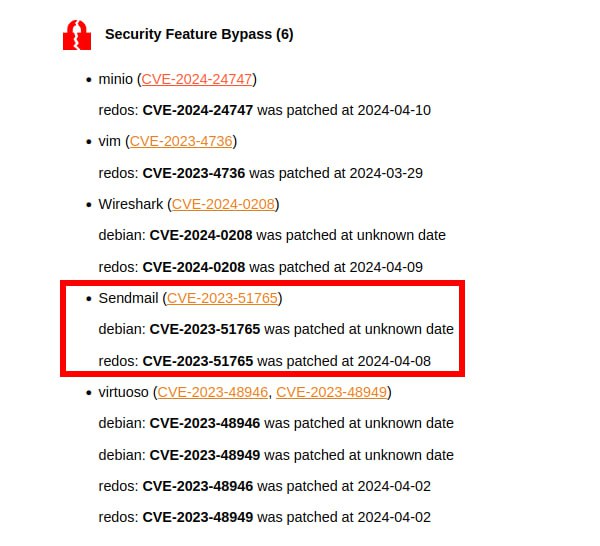
🔸 Security Feature Bypass - Sendmail (CVE-2023-51765). Allows an attacker to inject email messages with a spoofed MAIL FROM address.

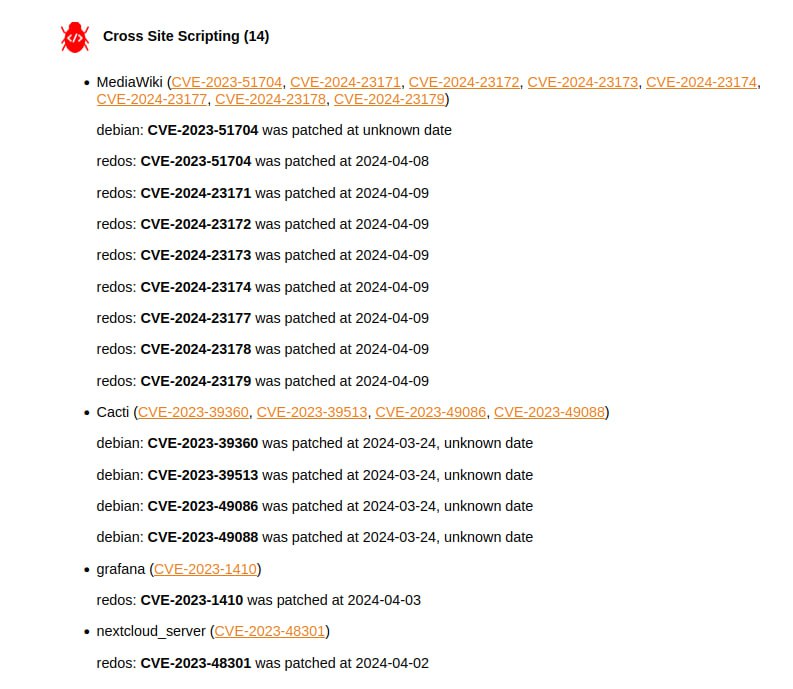
🔸 A pack of Cross Site Scripting vulnerabilities in MediaWiki, Cacti, Grafana, Nextcloud.

There is a lot to explore this time. 🤩

🗒 April Linux Patch Wednesday

На русском