Tag Archives: email

June Linux Patch Wednesday

June Linux Patch Wednesday

June Linux Patch Wednesday. A total of 1,888 vulnerabilities (324 in the Linux kernel, and a whopping 728 in Chromium ❗️). For comparison, there were 1,638 vulnerabilities in May. The increase isn't as dramatic as it was from April to May, but it's still a new record. One of the vulnerabilities has been flagged as actively exploited in the wild:

🔻 RCE - Chromium (CVE-2026-11645). Chromium is the open-source web browser project that serves as the foundation for many modern browsers, including Google Chrome, Microsoft Edge, Brave, Opera, and Vivaldi. A publicly available Metasploit module exploits a vulnerability in the web browser's V8 JavaScript engine. The vulnerability is triggered by a specific code pattern that causes type confusion between internal V8 objects, resulting in out-of-bounds memory access. Successful exploitation may lead to remote code execution in the context of the browser process.

There are also 109 vulnerabilities with public exploits or evidence that exploits exist, although there are no signs of active exploitation in real-world attacks yet. Among them, the following stand out:

🔸 EoP - Linux Kernel "CIFSwitch" (CVE-2026-46243). This vulnerability could allow attackers to forge CIFS authentication key descriptions, abuse the kernel's key request mechanism, and gain root privileges.

🔸 EoP - Linux Kernel "PinTheft" (CVE-2026-43494). On a successfully exploited configuration, the chain completes and hands off to the discovered SUID binary with an overwritten first page - yielding a root shell if the race and kernel state align.

🔸 RCE - Apache ActiveMQ (CVE-2026-42588). ActiveMQ is an open-source message broker written in Java. Exploitation of this vulnerability requires valid credentials for the ActiveMQ Web Console. However, the default credentials are admin/admin.

🔸 InfDisc - Squid "Squidbleed" (CVE-2026-47729). Squid is an open-source caching proxy server. The vulnerability causes Squid's FTP parser to read beyond the boundary of a memory buffer, into a region that may contain a previous user's uncleared HTTP request data.

🔸 AuthBypass - Nextcloud (CVE-2026-45156). Nextcloud is an open source content collaboration platform. A missing signature verification in User OIDC allowed a malicious ID4me authority to identify as any user.

🔸 XSS - Nextcloud (CVE-2025-59788). A vulnerability in a reachable files_pdfviewer example directory in Nextcloud allows attackers to execute arbitrary JavaScript in the context of a user's browser via a crafted PDF file to viewer.html.

🔸 XSS - Roundcube (CVE-2026-48849). Roundcube is a free, open-source webmail application. An unsanitized subject field in the draft restored value could lead to stored XSS/HTML/CSS injection on shared mailboxes.

🔸 DoS - ImageMagick (CVE-2026-46522). ImageMagick is an open-source image processing tool used to create, edit, and convert images. Due to a missing check in the MIFF decoder, a crafted file could cause an infinite loop resulting in CPU exhaustion.
🗒 Full Vulristics report

How to make Email Bot service in Python

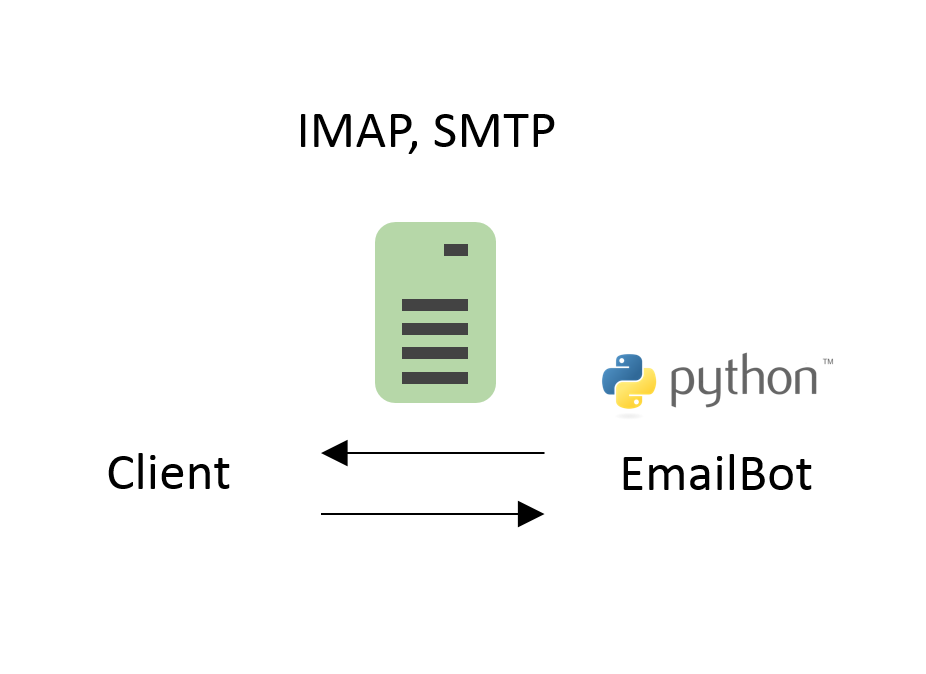
How to make Email Bot service in Python. First of all, why you may want to use such service? Despite the fact that currently there are so many different channels of communication (including various messaging apps), Email is still a default and universal way to do it.

  • Literally every enterprise service supports email notifications, even if it’s integration capabilities are rather limited. So, with Email Bot you can automatically process such notifications.
  • Email is good, simple, reliable and familiar way to communicate with humans. Send an email – get response. Everyone can do it. So, email bot can make basic routine operations, like organizing the external meetings, pretty much like a human secretary.
  • It’s easier to code Email bot than any other interface, and the code can be reused for other communication channels, for example messaging apps.
How to make Email Bot service in Python

I get email messages from IMAP server in python3 using easyimap module.

Continue reading

Creating Splunk Alerts using API

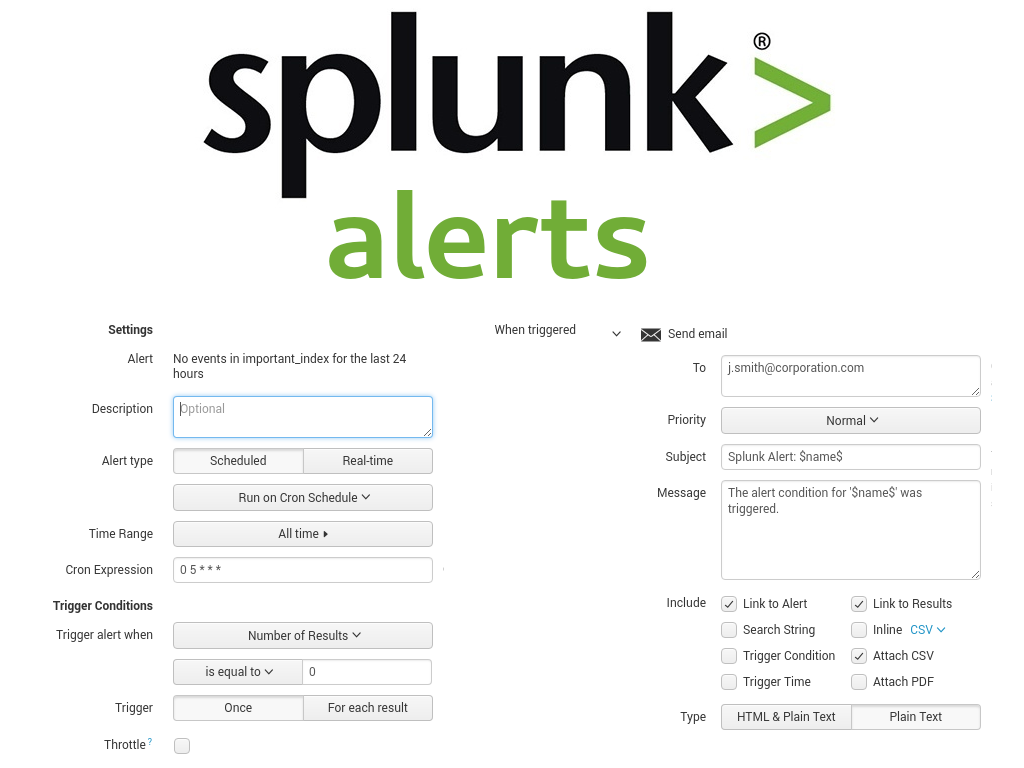
Creating Splunk Alerts using API. As I mentioned in “Accelerating Splunk Dashboards with Base Searches and Saved Searches“, Splunk Reports are basically the Saved Searches. Moreover, Splunk Alerts are also the same Saved Searches with some additional parameters.

Creating Splunk Alerts using API

The question is what parameters you need to set to get the right Alert.

Continue reading

New Vulners.com services for Linux Security Audit and Vulnerability Alerting

New Vulners.com services for Linux Security Audit and Vulnerability Alerting. Upd. This post is out of date! Check out “Vulners Linux Audit API for Host Vulnerability Detection: Manual Auditing, Python Scripting and Licensing” from 2021.

A few weeks ago I was describing how to perform Linux Vulnerability Assessment without a Vulnerability Scanner. I also wrote in “Vulnerability scanners: a view from the vendor and end user side” that vulnerability scanning is not rocket science and it is easy to make your own scanner for vulnerabilities for a particular OS. Especially it is a popular Linux Distribution.

But. It’s one thing to write that you can do it, and another thing to develop a script for home use, and quite another thing to make a publicly available and efficient service…

Vulners Team guys have actually created such free Linux Vulnerability Audit service!

Linux Vulnerability Audit Service

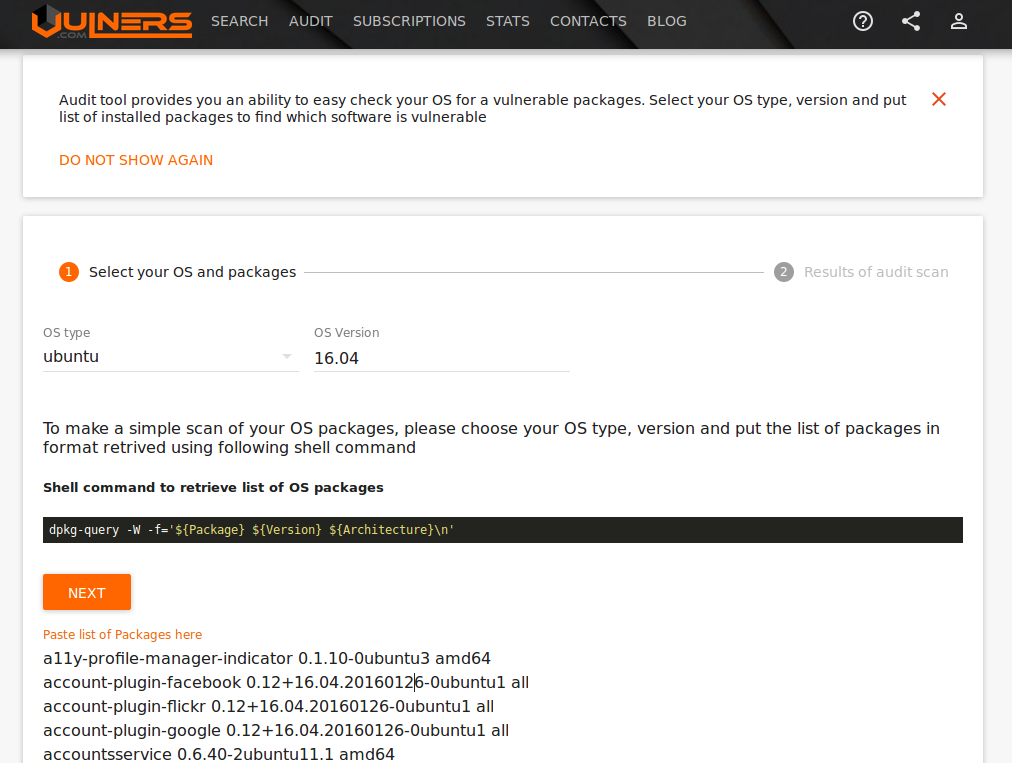
First of all, they made a GUI where you can specify OS version (usually it is in the /etc/os-release file), list of packages installed on the host and get the list of vulnerabilities.

For example, here are the vulnerabilities for my Ubuntu Laptop, which I update frequently:

Ubuntu Vulners Linux Audit Input

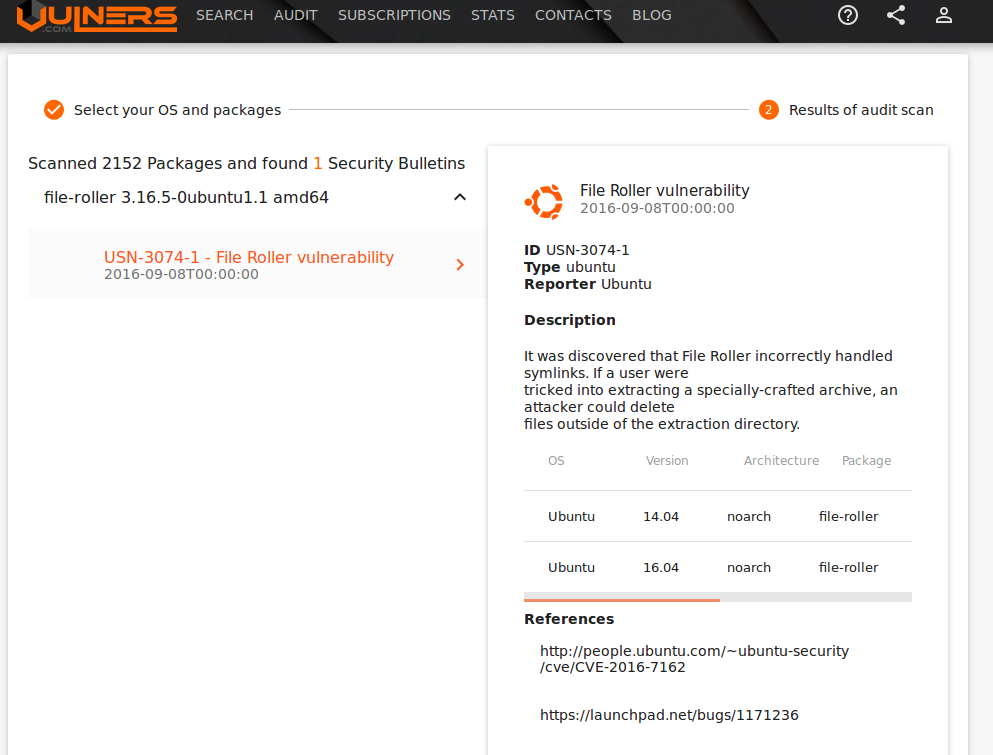
One vulnerability was found:

Ubuntu Vulners Linux Audit Results

But GUI is good for demonstration. In real life, you can use Vulners Audit API. It will return list of vulnerabilities in JSON.

Continue reading