
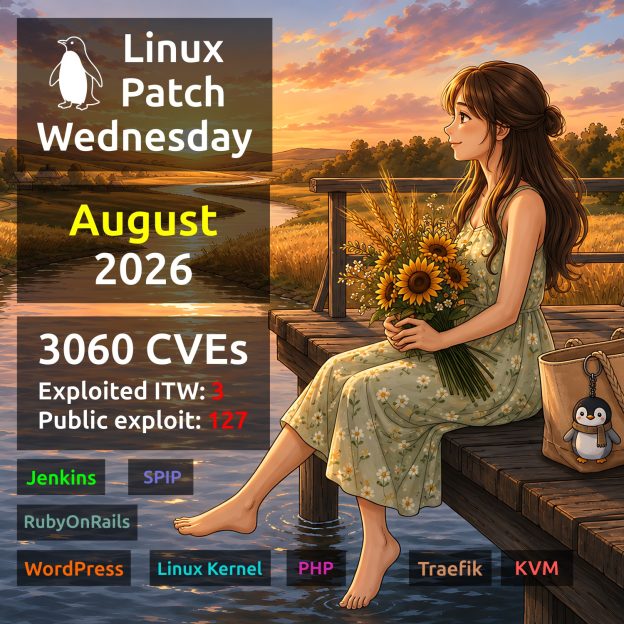
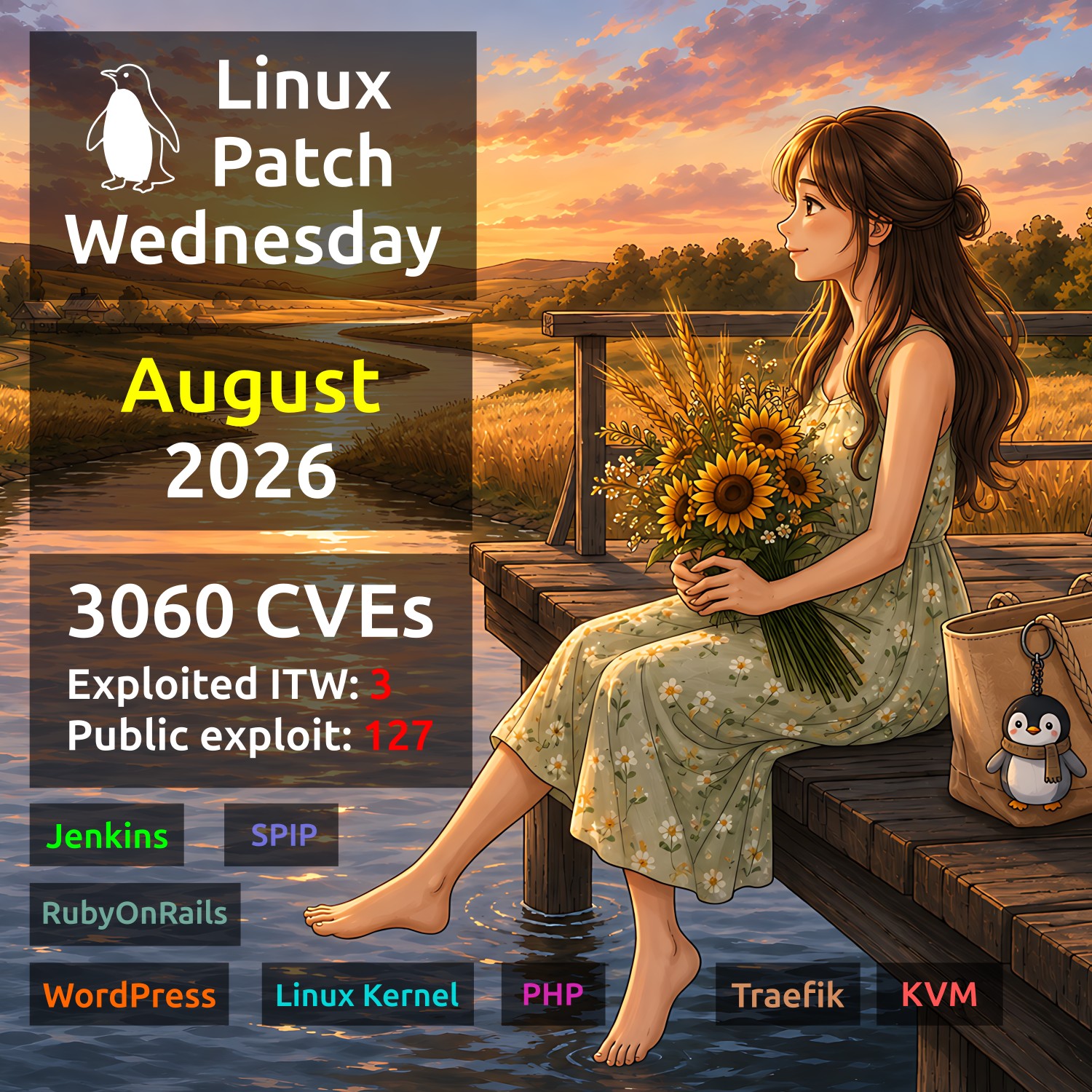
August Linux Patch Wednesday. A total of 3,060 vulnerabilities. For comparison, there were 2,017 in July. That's a 52% increase and another new record. This time, there are 1,354 vulnerabilities in the Linux Kernel and 447 in Chromium. For 3 vulnerabilities, there are signs of exploitation in the wild:
🔻 RCE - Jenkins (CVE-2026-53435). Jenkins is a development automation server used to build, test, and deploy software. The vulnerability allows a remote authenticated attacker to use the Script Console to execute arbitrary code and read files from the Jenkins controller. The vulnerability was added to the VulnCheck KEV on June 15 and fixed in RedOS on August 12.
🔻 CodeInj - WordPress (CVE-2026-60137). WordPress is a popular open-source CMS for creating websites and blogs. The vulnerability leads to a blind SQL injection in the WordPress core, allowing a remote unauthenticated attacker to read user accounts and password hashes from the WordPress database. Code execution is then possible by installing a malicious plugin. Multiple public exploits are available. The vulnerability was added to the CISA KEV catalog on July 21. A fix for the wordpress package in the Debian repository was released on July 23.
🔻 RCE - SPIP (CVE-2026-77647). SPIP is an open-source CMS for creating and collaboratively editing websites. The vulnerability allows an unauthenticated remote attacker to execute arbitrary PHP code. The vulnerability was added to the VulnCheck KEV on August 20. A fix for the spip package in the Debian repository was released on August 18.
Strictly speaking, the report contains one more vulnerability RCE - WinRAR (CVE-2025-8088) that is being exploited in the wild. The vulnerability was fixed in the clamav package in the Alt Linux repository. However, exploitation is only possible on Windows, so it is out of scope.
Another 127 vulnerabilities are not known to be exploited in the wild, but public exploits are available for them, or there are indications that such exploits exist. Notable examples include:
🔸 RCE - Action Pack "KindaRails2Shell" (CVE-2026-66066). Action Pack is a component of Ruby on Rails responsible for handling web requests, routing, and generating responses. An attacker can upload a specially crafted image to a vulnerable application and achieve remote code execution.
🔸 RCE - WordPress "XSS2Shell" (CVE-2026-64638). The attack chain allows an unauthenticated XSS on the login page to be escalated to arbitrary PHP code execution.
🔸 CodeInj - PHP (CVE-2026-17543). Improper escaping of backslashes in attacker-controlled parameters can lead to a trivial SQL injection in PHP.
🔸 EoP - Linux Kernel "Zapscape" (CVE-2026-64561). This KVM escape vulnerability allows an attacker to break out of a virtual machine in KVM/x86 environments and execute commands on the host with root privileges.
🔸 EoP - Linux Kernel "OVSwrap" (CVE-2026-64531), Linux Kernel "SCTPhantom" (CVE-2026-64564), Linux Kernel "Ubuntu PPPoL2TP" (CVE-2026-68398). These vulnerabilities allow a local attacker to escalate privileges to root.
🔸 AuthBypass - Traefik (CVE-2026-48020). Traefik is an HTTP reverse proxy and load balancer. A high-severity vulnerability in the StripPrefix middleware allows an unauthenticated attacker to bypass route-level authentication and authorization.