Tag Archives: CMS

August Linux Patch Wednesday

August Linux Patch Wednesday

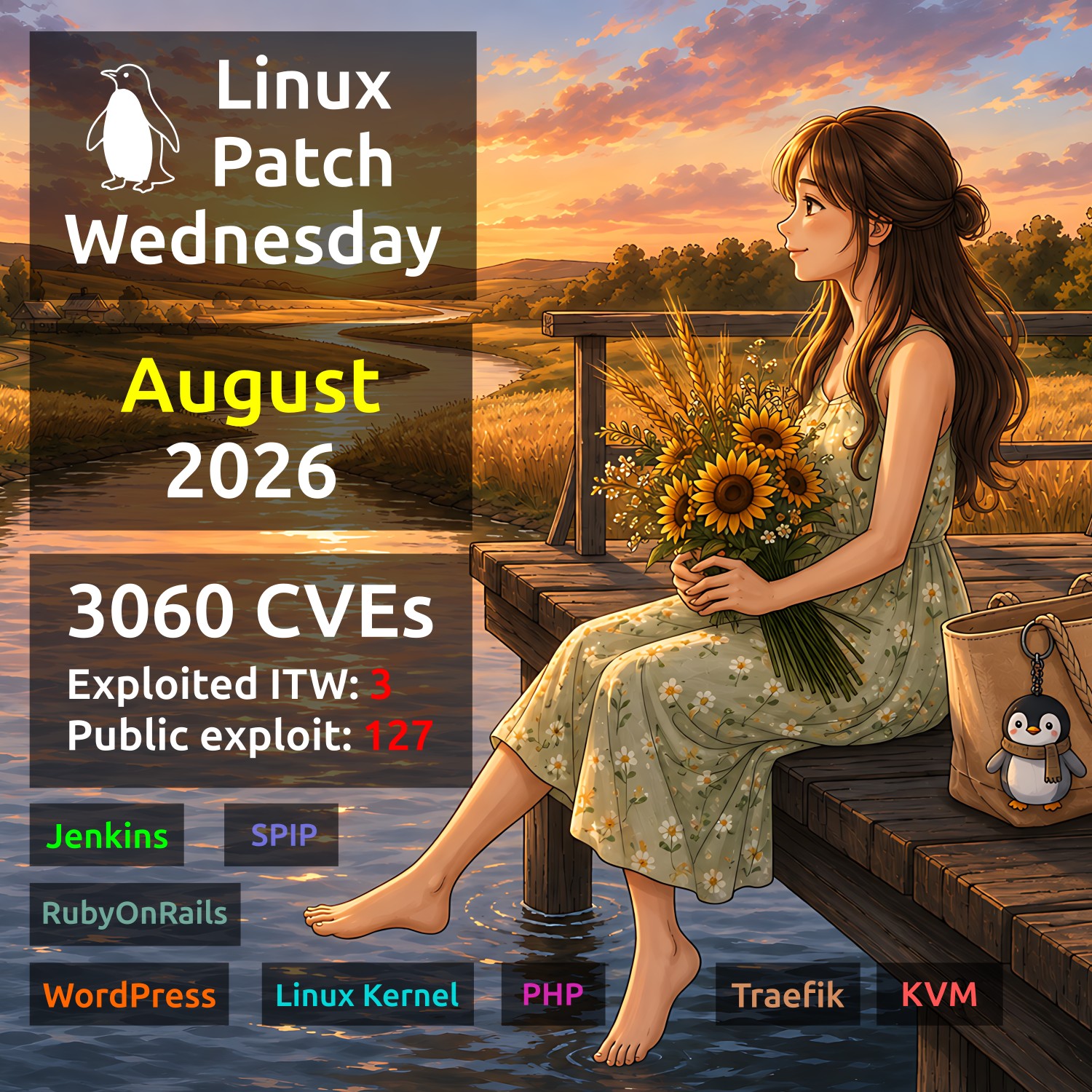
August Linux Patch Wednesday. A total of 3,060 vulnerabilities. For comparison, there were 2,017 in July. That's a 52% increase and another new record. This time, there are 1,354 vulnerabilities in the Linux Kernel and 447 in Chromium. For 3 vulnerabilities, there are signs of exploitation in the wild:

🔻 RCE - Jenkins (CVE-2026-53435). Jenkins is a development automation server used to build, test, and deploy software. The vulnerability allows a remote authenticated attacker to use the Script Console to execute arbitrary code and read files from the Jenkins controller. The vulnerability was added to the VulnCheck KEV on June 15 and fixed in RedOS on August 12.

🔻 CodeInj - WordPress (CVE-2026-60137). WordPress is a popular open-source CMS for creating websites and blogs. The vulnerability leads to a blind SQL injection in the WordPress core, allowing a remote unauthenticated attacker to read user accounts and password hashes from the WordPress database. Code execution is then possible by installing a malicious plugin. Multiple public exploits are available. The vulnerability was added to the CISA KEV catalog on July 21. A fix for the wordpress package in the Debian repository was released on July 23.

🔻 RCE - SPIP (CVE-2026-77647). SPIP is an open-source CMS for creating and collaboratively editing websites. The vulnerability allows an unauthenticated remote attacker to execute arbitrary PHP code. The vulnerability was added to the VulnCheck KEV on August 20. A fix for the spip package in the Debian repository was released on August 18.

Strictly speaking, the report contains one more vulnerability RCE - WinRAR (CVE-2025-8088) that is being exploited in the wild. The vulnerability was fixed in the clamav package in the Alt Linux repository. However, exploitation is only possible on Windows, so it is out of scope.

Another 127 vulnerabilities are not known to be exploited in the wild, but public exploits are available for them, or there are indications that such exploits exist. Notable examples include:

🔸 RCE - Action Pack "KindaRails2Shell" (CVE-2026-66066). Action Pack is a component of Ruby on Rails responsible for handling web requests, routing, and generating responses. An attacker can upload a specially crafted image to a vulnerable application and achieve remote code execution.

🔸 RCE - WordPress "XSS2Shell" (CVE-2026-64638). The attack chain allows an unauthenticated XSS on the login page to be escalated to arbitrary PHP code execution.

🔸 CodeInj - PHP (CVE-2026-17543). Improper escaping of backslashes in attacker-controlled parameters can lead to a trivial SQL injection in PHP.

🔸 EoP - Linux Kernel "Zapscape" (CVE-2026-64561). This KVM escape vulnerability allows an attacker to break out of a virtual machine in KVM/x86 environments and execute commands on the host with root privileges.

🔸 EoP - Linux Kernel "OVSwrap" (CVE-2026-64531), Linux Kernel "SCTPhantom" (CVE-2026-64564), Linux Kernel "Ubuntu PPPoL2TP" (CVE-2026-68398). These vulnerabilities allow a local attacker to escalate privileges to root.

🔸 AuthBypass - Traefik (CVE-2026-48020). Traefik is an HTTP reverse proxy and load balancer. A high-severity vulnerability in the StripPrefix middleware allows an unauthenticated attacker to bypass route-level authentication and authorization.
🗒 Full Vulristics report

The Vulners team has released nmap-vulners 2.0

The Vulners team has released nmap-vulners 2.0

The Vulners team has released nmap-vulners 2.0. This plugin (an NSE script) turns the popular Nmap port scanner into a black-box vulnerability scanner. Simply run $ nmap -sV --script vulners <target> to get a prioritized report on vulnerabilities and exploits. And all of this is available for free with no limitations. 🆓😉

How exactly does this plugin work?

To find vulnerabilities, the software is identified first:

🔹 The service's CPE identifier may be provided by Nmap itself (using the -sV option).

🔹 If Nmap fails to identify the service, the plugin attempts to determine the CPE identifier from the raw banner using rules for FTP, SMTP, SSH, MySQL, DNS, NTP, LDAP, and other services. Starting with version 2.0, the fingerprint catalog is updated weekly based on Recog, Wappalyzer, WhatWeb, FingerprintHub, and nuclei-templates. The latest catalog is automatically fetched when the plugin runs.

🔹 If an HTTP service is detected, nmap-vulners also attempts to identify the web stack, including the framework, CMS, or PHP version behind a reverse proxy. It analyzes Server and X-Powered-By headers, cookies, the page title, meta tags, filenames in script src, and page content. The plugin includes more than 700 rules. In version 2.0, the number of HTTP path fingerprints increased from 125 to 939, while parallelization kept the processing time at around 6 seconds per port.

🔹 If a product is identified but its version is unknown, the plugin makes a single request to a known file that contains version information, such as /CHANGELOG.txt for Drupal or /administrator/manifests/files/joomla.xml for Joomla. This works with Concrete5, Drupal, Jira, Joomla, Apache Tomcat, and WordPress.

🔹 Finally, if a service cannot be identified, Smart Audit can be used. The raw banner is sent to the Vulners server, which identifies the software and its version and then looks for related vulnerabilities. This is the only paid feature! Each unique request costs 1 credit, and results are cached. The number of requests is limited by the vulners.max_items parameter, which defaults to 32. Smart Audit can be disabled entirely with --script-args vulners.max_items=0.

The service data is then sent to the Vulners server, which returns a prioritized vulnerability report. For each vulnerability or exploit, the report includes its ID, SEVERITY level, CVSS and EPSS scores, Vulners AI score, KEV and EXP flags, and a link to its page on the Vulners website.

So, is an API key actually required?

🔹 The plugin can work without an API key. However, detection will use the legacy endpoint, and some vulnerability and exploit data will not be available.

🔹 Adding an API key, even without credits, enables the "EXP" flag for vulnerabilities and the "KEV" flag for both vulnerabilities and exploits. It also adds an EPSS score column, providing more complete prioritization: KEV → CISA SSVC Exploitation Active → exploits → EPSS → CVSS. So, an API key is recommended. 😉

🔹 If your API key has credits, the Smart Audit feature is also available (see above).

Installation

To install the plugin, simply run the one-line script. The installer automatically finds Nmap and its NSE script directory, installs the latest vulners.nse version, and removes old 1.x files. It then runs nmap --script-updatedb and verifies the installation. The --user and --prefix options let you specify the installation directory, while --uninstall removes the plugin. If needed, the installer prompts for a Vulners API key, validates it, and saves it to ~/.nmap/vulners.key with permissions set to 600.

Detectify Asset Inventory and Monitoring

Detectify Asset Inventory and Monitoring. Continuing the topic about perimeter services. As I mentioned earlier, I don’t think that the external perimeter services should be considered as a fully functional replacement for custom Vulnerability Management processes. I would rather see their results as an additional feed showing the problems your current VM process has. Recently I tested the Detectify’s Asset Inventory (Monitoring) solution, which provides such feed by automatically detecting the issues with your second, third (and more) leveled domains and related web services.

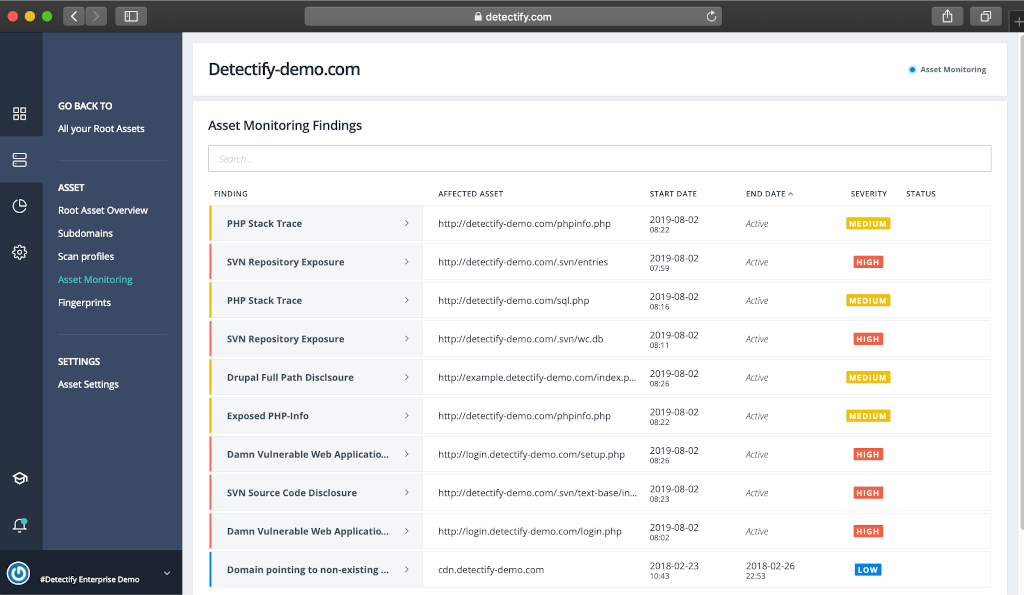
Detectify Asset Inventory screenshot from the official blog

Let say your organization has several second level web domains, over9000 third (and more) level domains, and you even don’t know for what services they are used. This is a normal situation for a large organization. So, you simply add yourorganization.com to Detectify, activate Asset Monitoring, and Detectify automatically discovers third (and more) level domains and related technologies: web services, CMS, JavaScript frameworks and libraries. “It provides thousands of fingerprints and hundreds of tests for stateless vulnerabilities such as code repository exposure for SVN or Git.” This is called fingerprinting.

Continue reading