
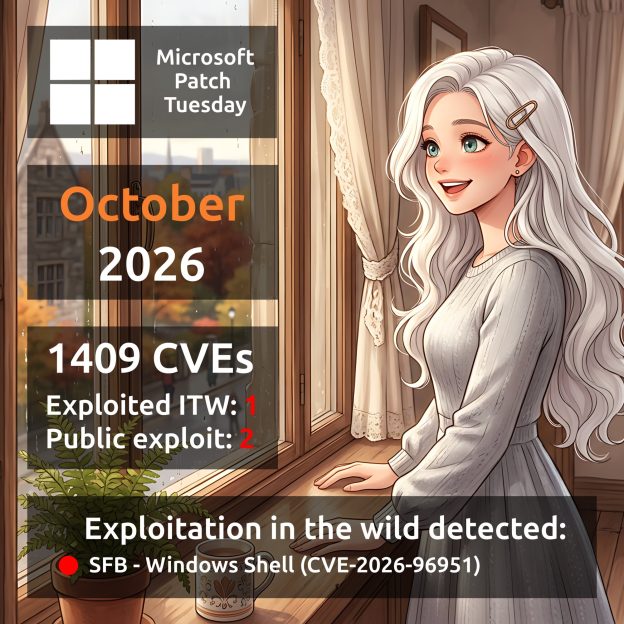
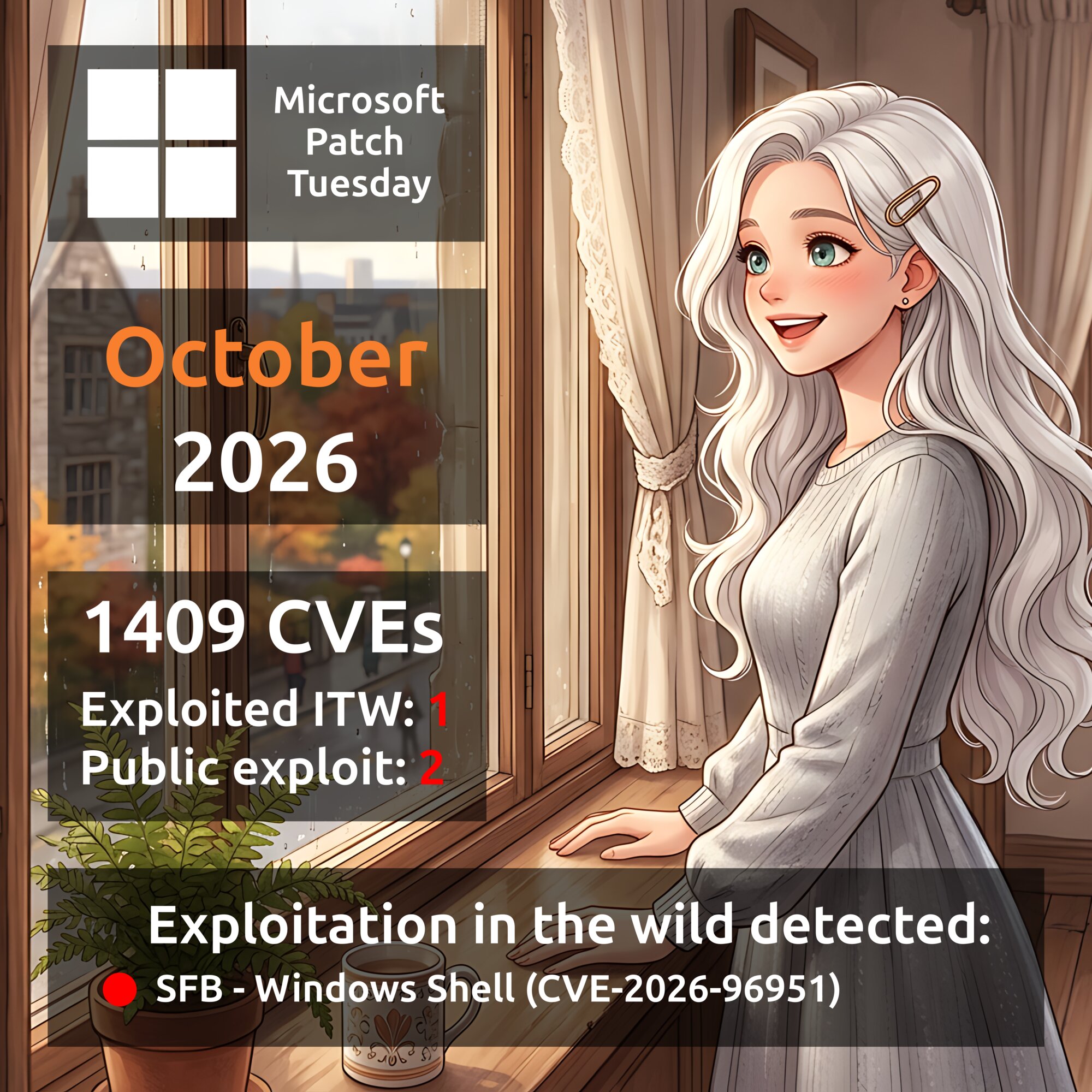
October Microsoft Patch Tuesday. A total of 1,409 vulnerabilities. For comparison, there were 973 in September, an increase of about 45%. 🙈 Thirteen products had fixes for 20 or more vulnerabilities: Microsoft Office Excel (68), Windows Kernel (46), Role: DNS Server (41), Windows Installer (38), Microsoft Office SharePoint (35), Windows Win32k (31), Windows NTFS (26), .NET (25), Microsoft Windows Search Component (23), Microsoft Office Word (22), Windows Error Reporting (21), Windows Broadcast DVR User Service (20), and Microsoft SQL Server (20). A total of 416 vulnerabilities were fixed in these products. That's 30% of all vulnerabilities. One vulnerability is flagged as exploited in the wild:
🔻 SFB - Windows Shell (CVE-2026-96951). The vulnerability allows an attacker to bypass Mark of the Web (MOTW), a Windows feature that marks files downloaded from the Internet. To exploit it, the attacker must trick the user into opening a malicious file or clicking a malicious link.
There are two vulnerabilities with public exploits:
🔸 RCE - Raw Image Extension (CVE-2026-21413). A heap-based buffer overflow in Windows Raw Image Extension allows an attacker to execute arbitrary code remotely using a specially crafted file. A technical write-up of the vulnerability, which NVD classifies as an exploit, was published on the Cisco Talos blog on April 7.
🔸 EoP - Windows Health and Optimized Experiences Service (CVE-2026-85884). Missing authentication for a critical function in Windows Health and Optimized Experiences Service allows a local attacker to gain SYSTEM privileges. A public exploit has been available on GitHub since October 13.
Other notable vulnerabilities include:
🔹 RCE - Microsoft Exchange (CVE-2026-70571). An unauthenticated attacker can send a specially crafted email to a vulnerable Exchange server and execute arbitrary code on the server. The attack requires an in-depth understanding of the target environment. No user interaction is required.
🔹 RCE - Microsoft Office Outlook (CVE-2026-70242, CVE-2026-97749, CVE-2026-97016, CVE-2026-88156, CVE-2026-70291). An attacker can execute arbitrary code on the victim's device by sending a specially crafted email. To exploit the vulnerability, the victim only needs to view the email in Outlook's reading pane without opening it or taking any further action.
🔹 RCE - Windows Domain Name Service (CVE-2026-96113). A heap-based buffer overflow in DNS Server allows an unauthorized attacker to execute code over a network.
🔹 SFB - .NET Framework (CVE-2026-108398). An authenticated attacker can place a specially crafted .NET assembly on an affected system and register it to be loaded by a protected process. This allows the attacker to bypass Windows Defender Application Control (WDAC) restrictions and run unauthorized code within the protected process. No user interaction is required.
🔹 Spoofing - Microsoft Exchange (CVE-2026-70279). An attacker can send a specially crafted link to a user and trick them into opening it. No authentication is required. If the user has administrator privileges, the attacker could act as that user and access or modify the organization's data.