
Tag Archives: WindowsInstaller

October Microsoft Patch Tuesday

October Microsoft Patch Tuesday

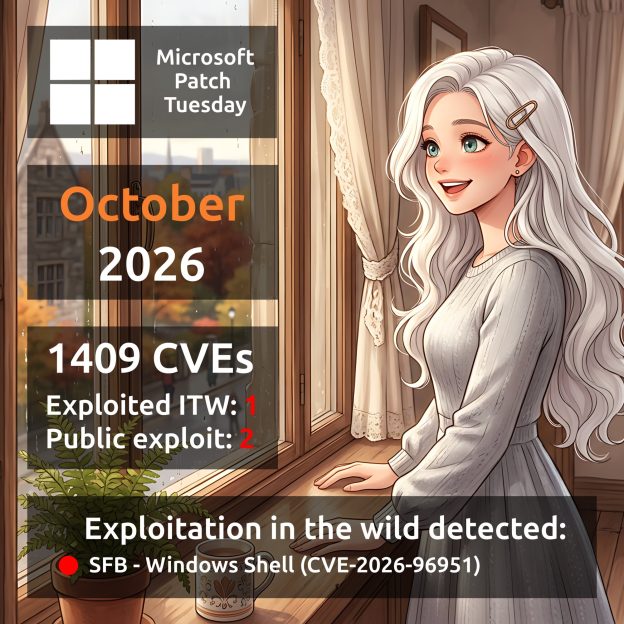
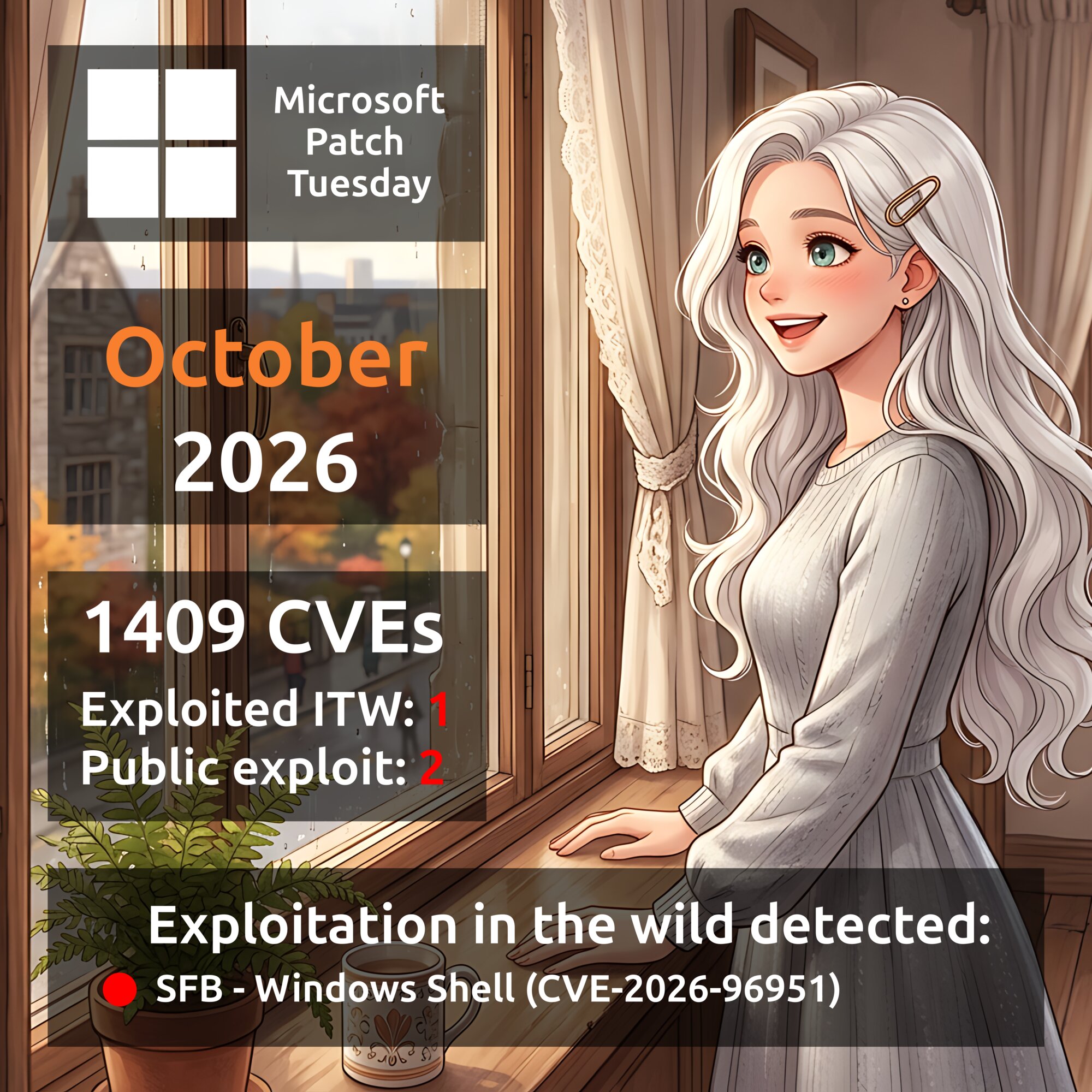
October Microsoft Patch Tuesday. A total of 1,409 vulnerabilities. For comparison, there were 973 in September, an increase of about 45%. 🙈 Thirteen products had fixes for 20 or more vulnerabilities: Microsoft Office Excel (68), Windows Kernel (46), Role: DNS Server (41), Windows Installer (38), Microsoft Office SharePoint (35), Windows Win32k (31), Windows NTFS (26), .NET (25), Microsoft Windows Search Component (23), Microsoft Office Word (22), Windows Error Reporting (21), Windows Broadcast DVR User Service (20), and Microsoft SQL Server (20). A total of 416 vulnerabilities were fixed in these products. That's 30% of all vulnerabilities. One vulnerability is flagged as exploited in the wild:

🔻 SFB - Windows Shell (CVE-2026-96951). The vulnerability allows an attacker to bypass Mark of the Web (MOTW), a Windows feature that marks files downloaded from the Internet. To exploit it, the attacker must trick the user into opening a malicious file or clicking a malicious link.

There are two vulnerabilities with public exploits:

🔸 RCE - Raw Image Extension (CVE-2026-21413). A heap-based buffer overflow in Windows Raw Image Extension allows an attacker to execute arbitrary code remotely using a specially crafted file. A technical write-up of the vulnerability, which NVD classifies as an exploit, was published on the Cisco Talos blog on April 7.

🔸 EoP - Windows Health and Optimized Experiences Service (CVE-2026-85884). Missing authentication for a critical function in Windows Health and Optimized Experiences Service allows a local attacker to gain SYSTEM privileges. A public exploit has been available on GitHub since October 13.

Other notable vulnerabilities include:

🔹 RCE - Microsoft Exchange (CVE-2026-70571). An unauthenticated attacker can send a specially crafted email to a vulnerable Exchange server and execute arbitrary code on the server. The attack requires an in-depth understanding of the target environment. No user interaction is required.

🔹 RCE - Microsoft Office Outlook (CVE-2026-70242, CVE-2026-97749, CVE-2026-97016, CVE-2026-88156, CVE-2026-70291). An attacker can execute arbitrary code on the victim's device by sending a specially crafted email. To exploit the vulnerability, the victim only needs to view the email in Outlook's reading pane without opening it or taking any further action.

🔹 RCE - Windows Domain Name Service (CVE-2026-96113). A heap-based buffer overflow in DNS Server allows an unauthorized attacker to execute code over a network.

🔹 SFB - .NET Framework (CVE-2026-108398). An authenticated attacker can place a specially crafted .NET assembly on an affected system and register it to be loaded by a protected process. This allows the attacker to bypass Windows Defender Application Control (WDAC) restrictions and run unauthorized code within the protected process. No user interaction is required.

🔹 Spoofing - Microsoft Exchange (CVE-2026-70279). An attacker can send a specially crafted link to a user and trick them into opening it. No authentication is required. If the user has administrator privileges, the attacker could act as that user and access or modify the organization's data.
🗒 Full Vulristics report

September episode of "In The Trend of VM": 7 CVEs, fake reCAPTCHA, lebanese pagers, VM and IT annual bonuses

September episode of "In The Trend of VM": 7 CVEs, fake reCAPTCHA, lebanese pagers, VM and IT annual bonuses. Starting this month, we decided to slightly expand the topics of the videos and increase their duration. I cover not only the trending vulnerabilities of September, but also social engineering cases, real-world vulnerability exploitation, and practices of vulnerability management process. At the end we announce a contest of questions about Vulnerability Management with gifts. 🎁

📹 Video "In The Trend of VM" on YouTube
🗞 A post on Habr (rus) a slightly expanded script of the video
🗒 A compact digest on the official PT website

Content:

🔻 00:51 Elevation of Privilege - Windows Installer (CVE-2024-38014) and details about this vulnerability
🔻 02:42 Security Feature Bypass - Windows Mark of the Web "LNK Stomping" (CVE-2024-38217)
🔻 03:50 Spoofing - Windows MSHTML Platform (CVE-2024-43461)
🔻 05:07 Remote Code Execution - VMware vCenter (CVE-2024-38812)
🔻 06:20 Remote Code Execution - Veeam Backup & Replication (CVE-2024-40711), while the video was being edited, data about exploitation in the wild appeared
🔻 08:33 Cross Site Scripting - Roundcube Webmail (CVE-2024-37383)
🔻 09:31 SQL Injection - The Events Calendar plugin for WordPress (CVE-2024-8275)
🔻 10:30 Human vulnerabilities: fake reCAPTCHA
🔻 11:45 Real world vulnerabilities: еxplosions of pagers and other electronic devices in Lebanon and the consequences for the whole world
🔻 14:42 Vulnerability management process practices: tie annual bonuses of IT specialists to meeting SLAs for eliminating vulnerabilities
🔻 16:03 Final and announcement of the contest
🔻 16:24 Backstage

На русском

A few details about Elevation of Privilege - Windows Installer (CVE-2024-38014)

A few details about Elevation of Privilege - Windows Installer (CVE-2024-38014)

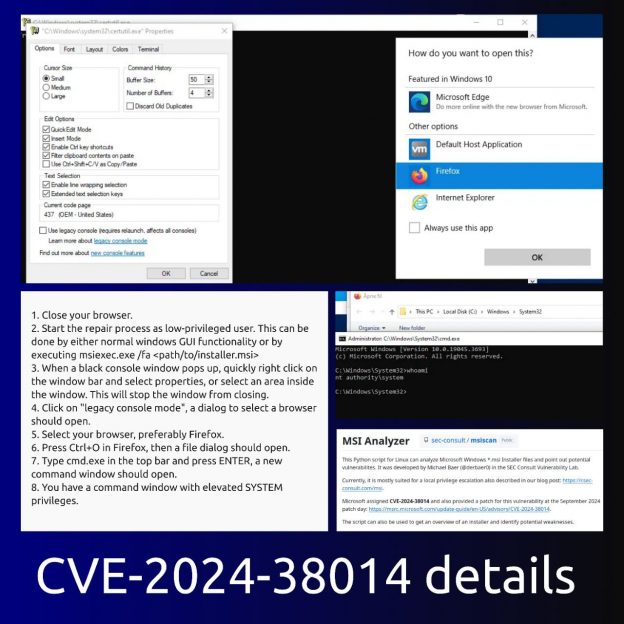
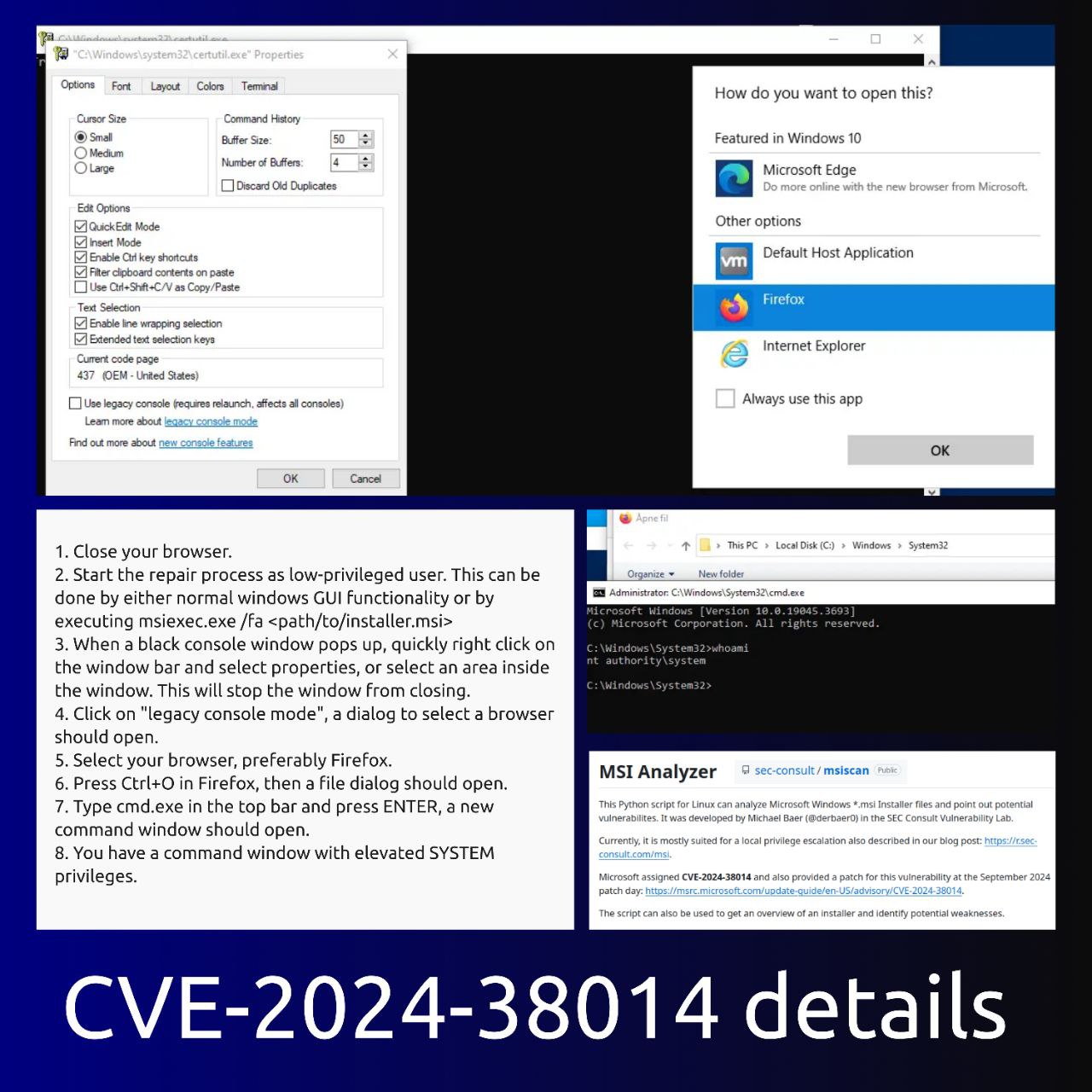
A few details about Elevation of Privilege - Windows Installer (CVE-2024-38014). So that you don't get the impression that this vulnerability can be exploited absolutely universally.

🔹 The attacker needs access to the Windows GUI. Naturally, the console window needs to be seen and "caught". Just with the mouse. The task can be simplified by the SetOpLock utility, which does not allow the window to close.

🔹 The attacker needs a web browser installed on the host. Moreover, the current Edge or IE will not work, Firefox or Chrome is needed. And the browser should not be running before the attack. And Edge or IE should not be set as the default browser.

🔹 This will not work for every MSI file. SEC Consult has released a utility called msiscan to detect MSI files that can be used to exploit this and similar vulnerabilities.

На русском

About Elevation of Privilege - Windows Installer (CVE-2024-38014) vulnerability

About Elevation of Privilege - Windows Installer (CVE-2024-38014) vulnerability

About Elevation of Privilege - Windows Installer (CVE-2024-38014) vulnerability. The vulnerability was fixed on September 11 as part of the September Microsoft Patch Tuesday. It was discovered by Michael Baer from SEC Consult. On September 12, a post was published in their blog with exploitation details.

MSI files are the standard way to install, repair, and uninstall programs in Windows. Installation requires high privileges. But the repair function can be launched by a low-privileged user. At the same time, the function itself might be executed in the context of NT AUTHORITY\SYSTEM. 🤔

The attacker launches the MSI file of an installed application, selects repair mode, and interacts with the console window launched with SYSTEM privileges. After a few steps, attacker gets an interactive SYSTEM console.

The Microsoft fix activates a UAC prompt when the MSI installer performs an action with elevated privileges, i.e. before the console window appears.

На русском

Microsoft Patch Tuesday December 2021

Microsoft Patch Tuesday December 2021. Hello everyone! It’s even strange to talk about other vulnerabilities, while everyone is so focused on vulnerabilities in log4j. But life doesn’t stop. Other vulnerabilities appear every day. And of course, there are many critical ones among them that require immediate patching. This episode will be about Microsoft Patch Tuesday for December 2021.

I will traditionally use my open source Vulristics tool for analysis.

Continue reading →