Tag Archives: PrintSpooler

November Microsoft Patch Tuesday

November Microsoft Patch Tuesday

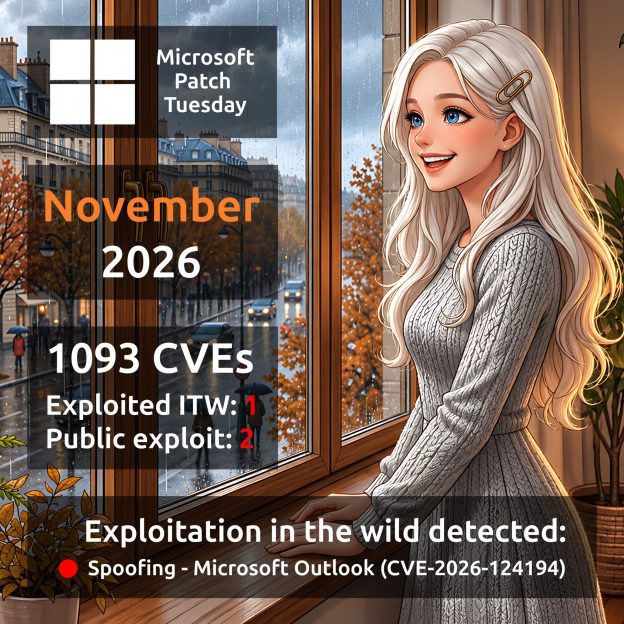
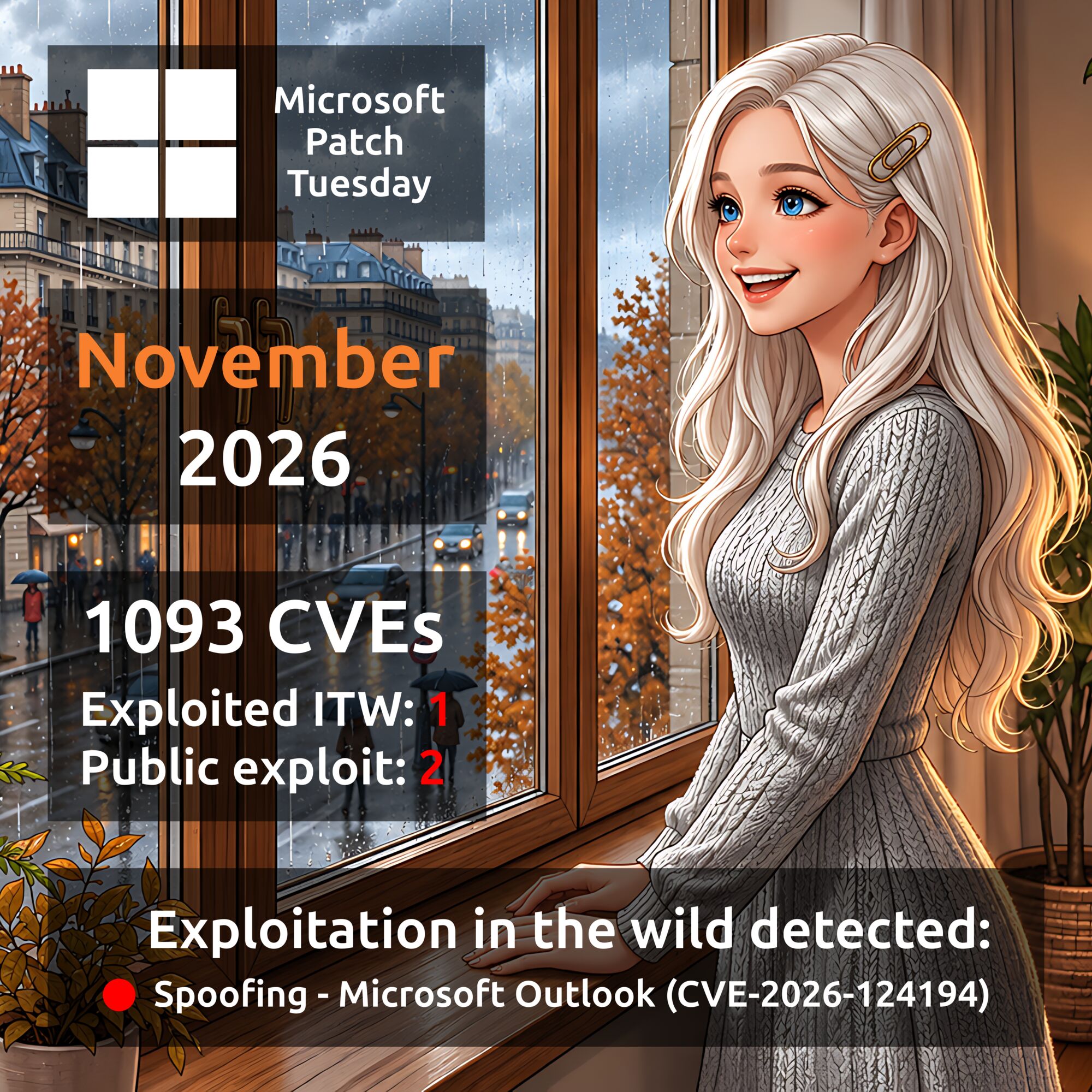
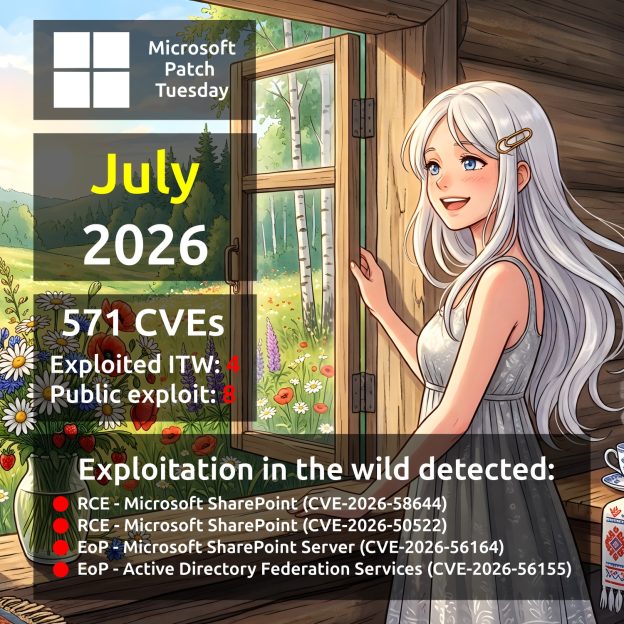
November Microsoft Patch Tuesday. A total of 1,093 vulnerabilities. For comparison, there were 1,409 in October, a decrease of 22.4%. Ten products had 20 or more vulnerabilities fixed: Microsoft Office Excel (64), Microsoft Office Word (61), Microsoft SQL Server (50), Windows Advanced Rasterization Platform (37), Windows Installer (36), Windows Graphics Kernel (35), Windows Kernel (28), Microsoft Office SharePoint (26), Windows DNS (21), Windows Print Spooler Components (20). Together, these products had 378 vulnerabilities fixed, or slightly more than one-third (34.6%) of the total. One vulnerability is flagged as having been exploited in the wild:

🔻 Spoofing - Microsoft Outlook (CVE-2026-124194). Microsoft Outlook is a Microsoft application for managing email, calendars, scheduling meetings, organizing contacts, and setting reminders. An attacker sends a specially crafted message file and convinces a user to open it. Outlook then connects to an attacker-controlled network location without showing the usual external-content warning, which discloses the user’s NTLMv2 hash. The attacker can use that hash to authenticate as the user. The Preview Pane is not an attack vector. A public exploit for the vulnerability is available on GitHub.

There are two vulnerabilities with public exploits, but no evidence of exploitation in the wild has been observed so far.

🔸 EoP - Microsoft Windows App Store (CVE-2026-119987). Microsoft Store (Windows App Store) is Microsoft's official app store for finding, downloading, and installing applications, games, and other digital content on Windows devices. Untrusted search path in Microsoft Windows App Store allows an authorized attacker to elevate privileges locally. A PoC was published on GitHub but later removed. A copy is available on Vulners.

🔸 EoP - Windows AppX Deployment Service (CVE-2026-116714). Windows AppX Deployment Service is a Windows system service responsible for installing, updating, and removing applications. An attacker who successfully exploited this vulnerability could gain SYSTEM privileges.

Other notable vulnerabilities include:

🔹 RCE - Windows LDAP (CVE-2026-119958). Windows LDAP is a service and protocol used to search and manage information about users, computers, and other resources in an enterprise network. An out-of-bounds write vulnerability allows an unauthorized attacker to execute arbitrary code by sending specially crafted LDAP requests over the network.

🔹 RCE - Windows Search / Exchange Server (CVE-2026-116928). An unauthenticated attacker could exploit the Windows Search component used by Microsoft Exchange Server (Microsoft's server platform for managing enterprise email, calendars, contacts, and shared meeting scheduling) by sending an email containing a specially crafted attachment. Exchange automatically processes the attachment for indexing, so the recipient does not need to open the email or attachment. Successful exploitation could allow the attacker to execute code with the permissions of the affected processing service.

🔹 RCE - Microsoft Exchange (CVE-2026-118207). An authenticated attacker with low-level access to an affected server could send a specially crafted request to execute code on the server. User interaction is not required.

🔹 RCE - Windows Active Directory Domain Services (CVE-2026-118146). Windows Active Directory Domain Services is a Windows service for centrally managing users, computers, and access to enterprise network resources. An authenticated attacker with low-level access to an affected server could send a specially crafted request to execute code on the server. User interaction is not required.

🔹 RCE - Windows Virtual Filtering Platform (VFP) (CVE-2026-95962). Windows Virtual Filtering Platform (VFP) is a Windows system component responsible for processing and filtering network traffic. Use after free bug allows an unauthorized attacker to execute code by sending a specially crafted packet to the affected service over the network.

🔹 RCE - Windows Schannel (CVE-2026-119952). Windows Schannel is a Windows system component that provides secure network connections and encryption of transmitted data. An unauthenticated attacker could exploit this vulnerability by sending a specially crafted packet to an affected service over the network. Successful exploitation could allow the attacker to execute code on the target system. No authentication or user interaction is required.

🔹 EoP - Microsoft SharePoint Server (CVE-2026-120002). Microsoft SharePoint Server is Microsoft's enterprise platform for creating intranet portals, storing and collaborating on documents, sharing information, and managing business workflows within an organization. An authenticated attacker with site read access and membership in the relevant SharePoint Secure Store target application could send a specially crafted network request to an affected SharePoint server. Successful exploitation could cause SharePoint to perform unauthorized actions on a connected business service using shared credentials. No additional user interaction is required.
🗒 Full Vulristics report

July Microsoft Patch Tuesday

July Microsoft Patch Tuesday

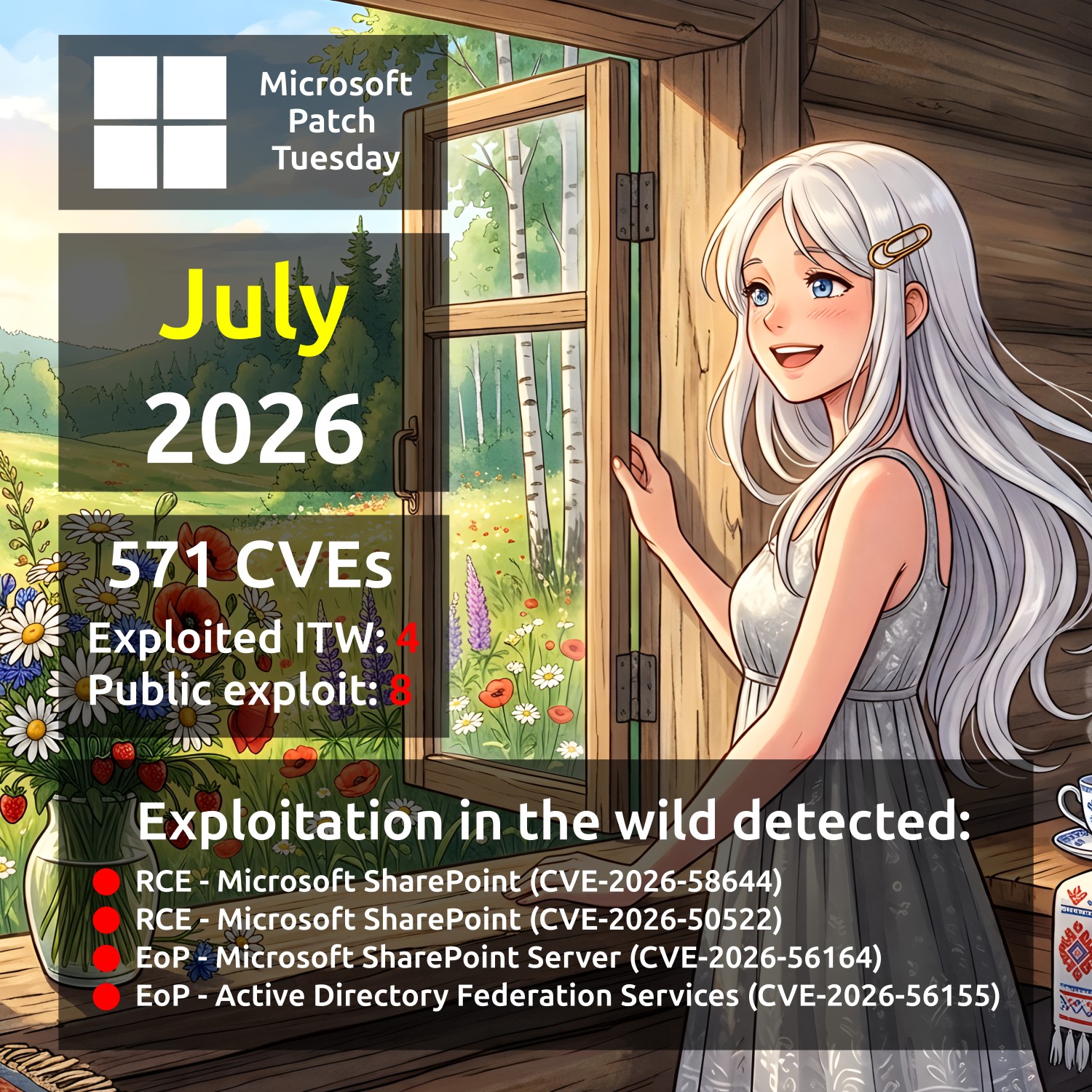
July Microsoft Patch Tuesday. In the second week of July, I was on vacation in St. Petersburg. After that, I got caught up with a bunch of other tasks, so I'm only publishing this roundup now. Better late than never, especially considering how unusual this MSPT turned out to be. 😉 In total, 571 vulnerabilities were addressed - almost three times (❗️) more than in June. There are four vulnerabilities that have been reported as exploited in the wild:

🔻 RCE - Microsoft SharePoint (CVE-2026-58644). An attacker with Site Owner privileges or higher can remotely inject and execute arbitrary code on the SharePoint Server.

🔻 RCE - Microsoft SharePoint (CVE-2026-50522). The vulnerability description is identical to CVE-2026-58644. According to ZDI, the CVE-2026-50522 vulnerability was successfully demonstrated at Pwn2Own Berlin. Despite this, Microsoft rates its Exploit Maturity as "Unknown", even though researchers have already provided a working exploit to the company. This once again shows that organizations should not rely solely on software vendors' assessments and should instead perform their own risk evaluation. If you have Internet-facing SharePoint servers, you should test and deploy the patch addressing this vulnerability as soon as possible.

🔻 EoP - Microsoft SharePoint Server (CVE-2026-56164). Missing authentication for a critical function in Microsoft Office SharePoint could allow an unauthenticated attacker to elevate privileges over a network. Microsoft mentioned in the advisory that enabling the Antimalware Scan Interface (AMSI) on the server and setting the Request Body Scan mode to Full can help mitigate this flaw.

🔻 EoP - Active Directory Federation Services (CVE-2026-56155). Insufficient granularity of access control (CWE-1220) in Active Directory Federation Services (AD FS) allows an authorized attacker to elevate privileges locally. An attacker who successfully exploited this vulnerability could gain administrator privileges.

There are eight more vulnerabilities with publicly available exploits:

🔸 EoP - Windows User Interface Core (CVE-2026-50454). Relative path traversal (CWE-23) allows an authorized attacker to elevate privileges locally. An attacker who successfully exploited this vulnerability could gain SYSTEM privileges. The PoC starts from a normal, non-elevated process belonging to a local administrator and opens an interactive command prompt as NT AUTHORITY\SYSTEM.

🔸 EoP - Windows WalletService (CVE-2026-49176). Improper privilege management (CWE-269) allows an authorized attacker to elevate privileges locally. The exploit PoC starts a command prompt as SYSTEM in the active desktop session.

🔸 RCE - Microsoft Message Queuing Queue Manager (CVE-2026-54992). The existing exploit PoC demonstrates denial of service; it does not demonstrate code execution.

🔸 EoP - Windows Narrator Braille (CVE-2026-58635). According to Microsoft's description, an attacker who successfully exploited this vulnerability could execute code in the security context of the NT AUTHORITY\Network Service account. However, the description of the exploit PoC states that an unprivileged attacker would gain NT AUTHORITY\SYSTEM privileges.

🔸 EoP - Windows Cloud Files Mini Filter Driver (CVE-2026-58613). Use after free (CWE-416) in the Windows Cloud Files Mini Filter Driver allows an authorized attacker to elevate privileges locally. An attacker who successfully exploits this vulnerability can gain SYSTEM privileges. Exploitation details are available in the Talos Vulnerability Report TALOS-2026-2426.

🔸 InfDisc - Windows Win32k (CVE-2026-50416). An attacker who successfully exploited this vulnerability could potentially read small portions of heap memory. The exploit PoC description mentions Chrome tabs, Discord, Explorer, Spotify, and tray windows. However, it seems that it will not be possible to intercept passwords using this vulnerability.

🔸 InfDisc - Windows Kernel (CVE-2026-50475). A buffer over-read (CWE-126) in the Windows Kernel allows an authorized attacker to disclose information locally. Exploitation details are available in the Talos Vulnerability Report TALOS-2026-2443.

🔸 EoP - Azure Spring Apps (CVE-2026-50338). An attacker who successfully exploited this vulnerability could gain elevated privileges, potentially allowing them to perform actions beyond their original permissions. According to the author of the exploit PoC, the vulnerability is a Spring Cloud Azure B2C resource server cross-issuer authentication bypass.

Among the remaining vulnerabilities, the following can be highlighted:

🔹 RCE - Windows Remote Desktop Protocol (CVE-2026-56190). An unauthenticated, network-reachable, no user interaction required vulnerability. The root cause is a classic one: the use of an uninitialized resource (CWE-908), meaning specially crafted RDP traffic can interact with memory that was never properly initialized, letting an attacker corrupt memory and potentially steer code execution. RDP Servers are a common target, so audit your systems to see which are internet accessible and start from there.

🔹 RCE - Microsoft Dynamics NAV and Microsoft Dynamics 365 Business Central (On Premises) (CVE-2026-55944). Successful exploitation can be achieved by sending a crafted login request to an affected Dynamics NAV or Business Central server in order to trigger a deserialization of untrusted data vulnerability. Microsoft's advisory cautions that no user-interaction is required, nor is authentication a requirement in order to successfully exploit this vulnerability.

🔹 EoP - Microsoft Windows VMSwitch (CVE-2026-57092). It's a use-after-free that lets a low-privileged attacker escalate to full host compromise across a VM boundary. ZDI reported that a similar exploit was demonstrated on ESXi at Pwn2Own Berlin, but this issue is not limited to ESXi. If you use VMSwitch in Hyper-V deployments (which is likely), test and deploy the fix quickly.

🔹 Spoofing - Microsoft Exchange (CVE-2026-55008). An attacker can send a specially crafted email that runs arbitrary JavaScript when the victim opens it in OWA. No attachment or macro is required - simply viewing the email is enough. If your organization uses OWA, it is recommended to test and deploy the fix as soon as possible.

🔹 RCE - Windows DHCP Server (CVE-2026-50518, CVE-2026-56159, CVE-2026-48564, CVE-2026-50370), Windows DHCP Client (CVE-2026-54128), Windows Message Queuing Service (MSMQ) (CVE-2026-50447), Windows Admin Center (WAC) (CVE-2026-56196), Windows FTP Service (CVE-2026-49172), Windows GDI+ (CVE-2026-50380), Windows Server Network driver (CVE-2026-56188), Microsoft Exchange (CVE-2026-55005), Windows Active Directory Domain Services (CVE-2026-49178), Windows Remote Desktop Client (CVE-2026-50474), Windows Remote Desktop Client (CVE-2026-54990, CVE-2026-58594), Windows TCP/IP (CVE-2026-54999), Windows Print Spooler (CVE-2026-58608), Windows Reliable Multicast Transport Driver (RMCAST) (CVE-2026-54982, CVE-2026-54995), Microsoft SQL Server (CVE-2026-54117), Microsoft Copilot (CVE-2026-48561).

🔹 SFB - Microsoft SharePoint Server (CVE-2026-55040).

🔹 EoP - Windows Server Update Service (WSUS) (CVE-2026-50444), Active Directory Certificate Services (CVE-2026-54121).

There is also a rather curious vulnerability:

RCE - Game: Age of Empires II: Definitive Edition (CVE-2026-50663). 😃 A relative path traversal in Age of Empires II: Definitive Edition Game allows an unauthorized attacker to execute code over a network. Age of Empires II is a cult classic real-time strategy game by Microsoft, set in the medieval era. Players develop chosen civilizations, manage resources, research technologies, and command armies in historical campaigns and multiplayer battles. The Definitive Edition features improved graphics, updated audio, and additional content. If you're still playing this game, be sure to update. 😉

🗒 Full Vulristics Report

March Microsoft Patch Tuesday

March Microsoft Patch Tuesday

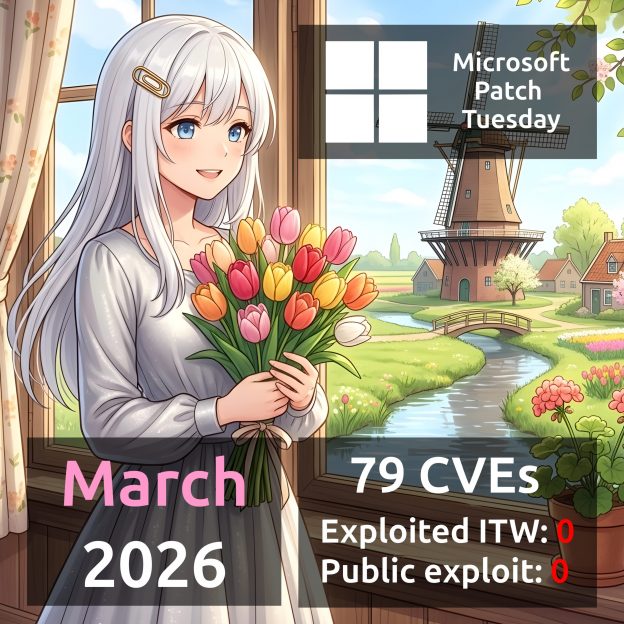
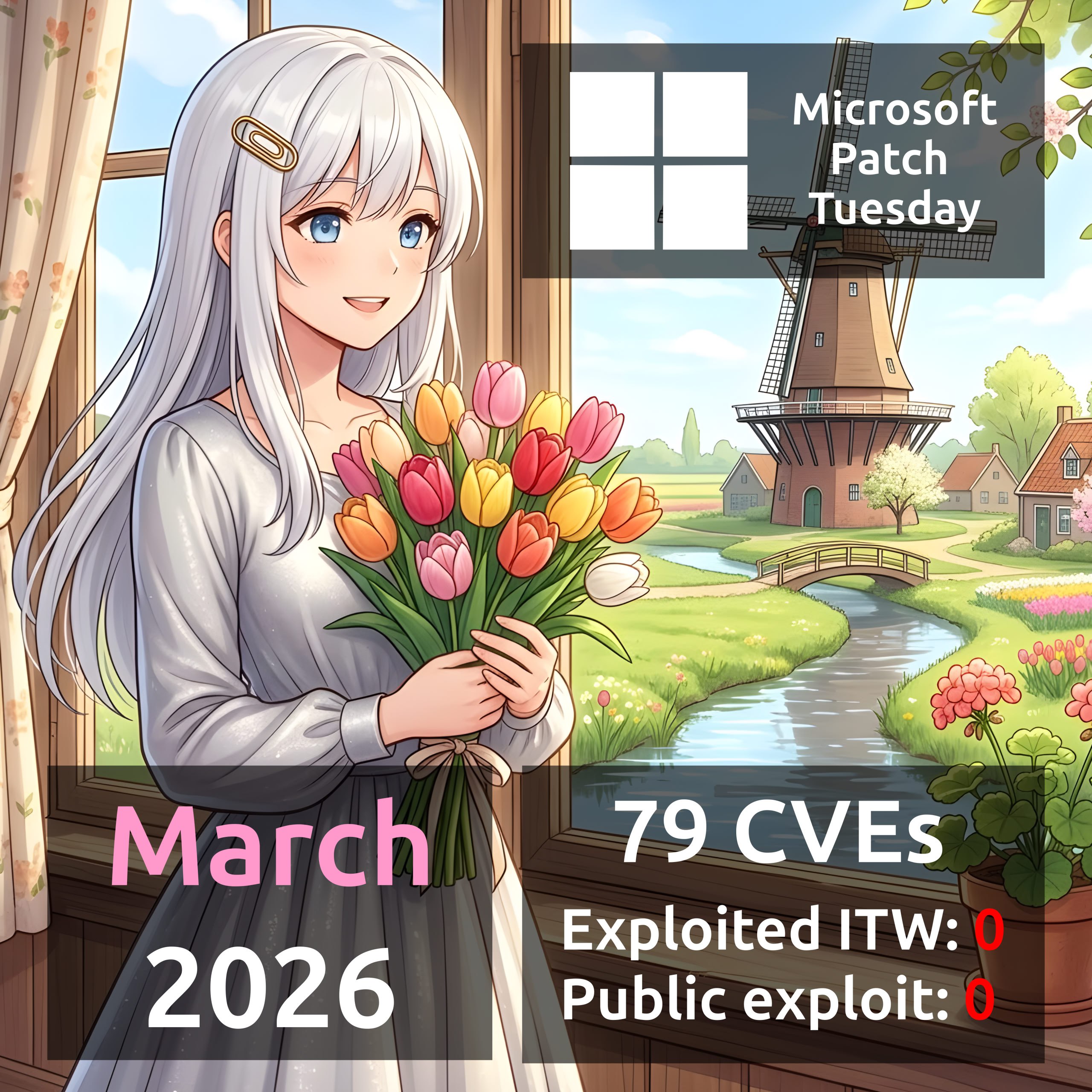
March Microsoft Patch Tuesday. A total of 79 vulnerabilities, about one and a half times more than in February. What's truly unusual is that this time there were no vulnerabilities with signs of exploitation in the wild or a public exploit! 🤔 At least not yet. 😏

The following vulnerabilities can be highlighted:

🔹 RCE - Print Spooler (CVE-2026-23669), Office (CVE-2026-26110, CVE-2026-26113), Excel (CVE-2026-26107, CVE-2026-26108, CVE-2026-26109, CVE-2026-26112), SharePoint Server (CVE-2026-26106, CVE-2026-26114)
🔹 EoP - SQL Server (CVE-2026-21262, CVE-2026-26115, CVE-2026-26116), Windows Kernel (CVE-2026-24287, CVE-2026-24289, CVE-2026-26132), Windows Win32k (CVE-2026-24285), SMB Server (CVE-2026-24294, CVE-2026-26128), Windows Graphics Component (CVE-2026-23668), .NET (CVE-2026-26131)
🔹 DoS - .NET (CVE-2026-26127)

🗒 Full Vulristics report

На русском