Category Archives: Projects

February Microsoft Patch Tuesday

February Microsoft Patch Tuesday

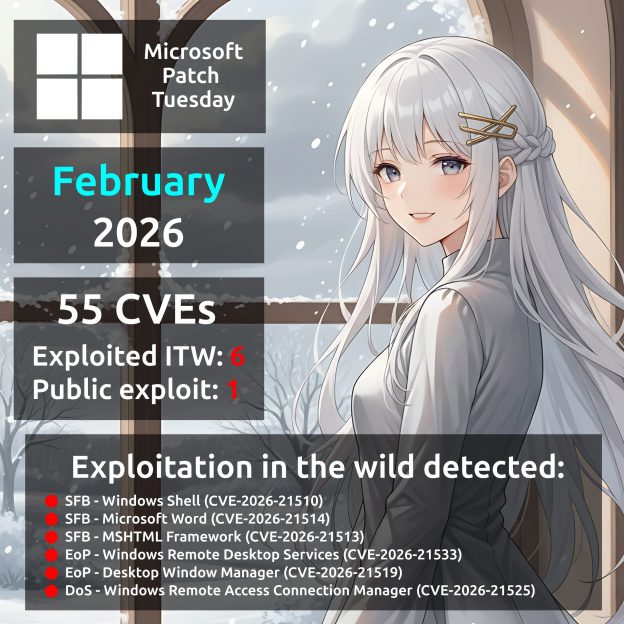
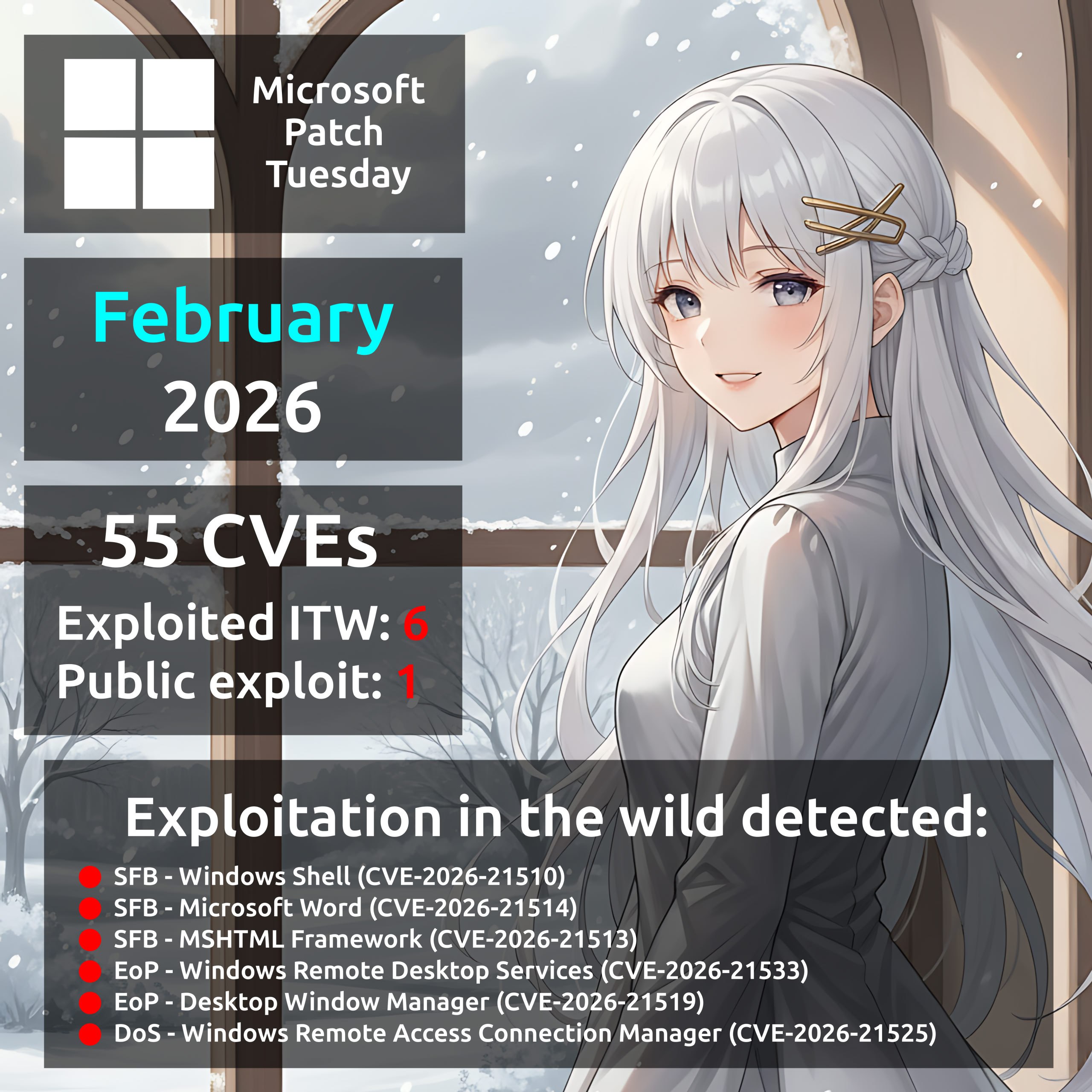
February Microsoft Patch Tuesday. A total of 55 vulnerabilities, half as many as in January. There are as many as six (❗️) vulnerabilities being exploited in the wild:

🔻 SFB – Windows Shell (CVE-2026-21510)
🔻 SFB – Microsoft Word (CVE-2026-21514)
🔻 SFB – MSHTML Framework (CVE-2026-21513)
🔻 EoP – Windows Remote Desktop Services (CVE-2026-21533)
🔻 EoP – Desktop Window Manager (CVE-2026-21519)
🔻 DoS – Windows Remote Access Connection Manager (CVE-2026-21525)

There is also one vulnerability with a public exploit:

🔸 DoS – libjpeg (CVE-2023-2804)

Among the remaining vulnerabilities, the following stand out:

🔹 RCE – Windows Notepad App (CVE-2026-20841)
🔹 Spoofing – Outlook (CVE-2026-21511)
🔹 EoP – Windows Kernel (CVE-2026-21231, CVE-2026-21239, CVE-2026-21245), Windows AFD.sys (CVE-2026-21236, CVE-2026-21238, CVE-2026-21241)

🗒 Full Vulristics report

На русском

I released Vulristics 1.0.11: added Server-Side Request Forgery (SSRF) as a distinct vulnerability type

I released Vulristics 1.0.11: added Server-Side Request Forgery (SSRF) as a distinct vulnerability type

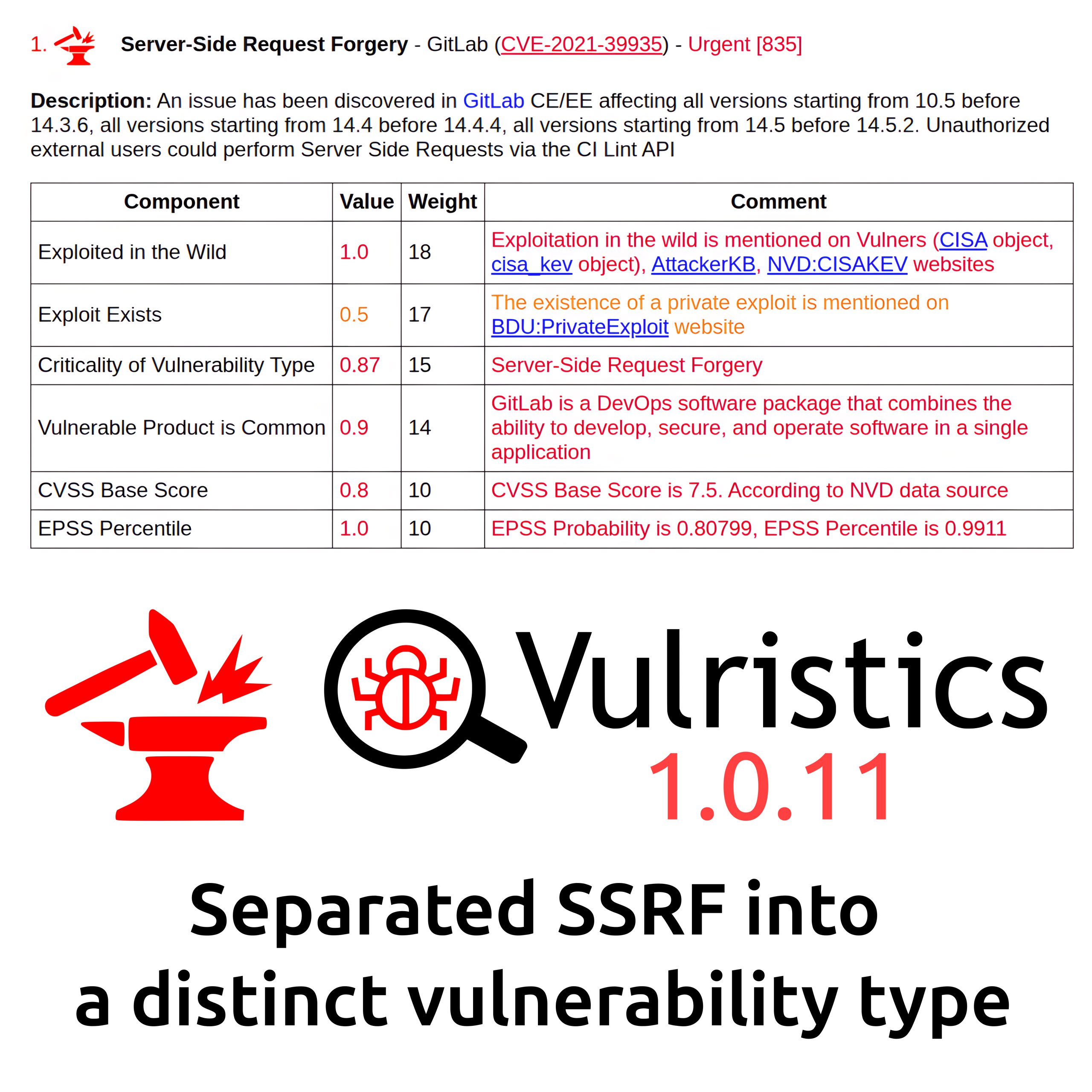
I released Vulristics 1.0.11: added Server-Side Request Forgery (SSRF) as a distinct vulnerability type. I try to use a very small set of base vulnerability types (around 20) in Vulristics and map everything else to them. With a few exceptions, these are the same types Microsoft uses – and Microsoft doesn’t like SSRF.

SSRF is a vulnerability that allows an attacker to make network requests to arbitrary destinations.

Microsoft usually classifies SSRFs as EoP, Information Disclosure, or RCE. 🤯

I used to map SSRF to Command Injection, based on the logic that crafting a request can be considered a form of command execution. But, of course, that’s… questionable. 🙄

So I decided to add a dedicated SSRF type (with a severity of 0.87) and stopped doing mental gymnastics. 🙂 For the icon, I drew an anvil (a play on words with “forge”). I also uploaded the icon to avleonov.com so that Vulristics HTML reports render correctly.

На русском

January Linux Patch Wednesday

January Linux Patch Wednesday

January Linux Patch Wednesday. In January, Linux vendors started fixing 918 vulnerabilities, one and a half times more than in December. Of these, 616 are in the Linux Kernel. Three show signs of exploitation in the wild:

🔻 AuthBypass – GNU Inetutils (telnetd) (CVE-2026-24061)
🔻 RCE – Safari (CVE-2025-43529); fixed in Linux distributions in webkit packages
🔻 MemCor – Chromium (CVE-2025-14174)

Another 97 vulnerabilities have public exploits or signs of their existence. Key examples:

🔸 MemCor – libpng (CVE-2026-22695)
🔸 XSS – Roundcube (CVE-2025-68461)
🔸 RCE – expr-eval (CVE-2025-13204)
🔸 ComInj – cpp-httplib (CVE-2026-21428), httparty (CVE-2025-68696), Miniflux (CVE-2026-21885)
🔸 SQLi – parsl (CVE-2026-21892)
🔸 SFB – OWASP CRS (CVE-2026-21876), Authlib (CVE-2025-68158)
🔸 AFW – node-tar (CVE-2026-23745)
🔸 PathTrav – GNU Wget2 (CVE-2025-69194), Tar (CVE-2025-45582)

🗒 Full Vulristics Report

На русском

January Microsoft Patch Tuesday

January Microsoft Patch Tuesday

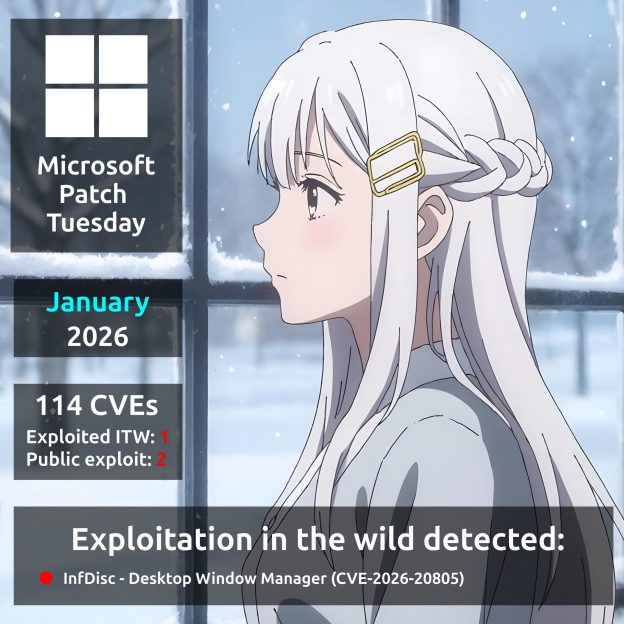
January Microsoft Patch Tuesday. A total of 114 vulnerabilities, twice as many as in December. There is one vulnerability with evidence of in-the-wild exploitation:

🔻 InfDisc – Desktop Window Manager (CVE-2026-20805)

There are also two vulnerabilities with public exploits:

🔸 RCE – Windows Deployment Services (CVE-2026-0386)
🔸 EoP – Windows Agere Soft Modem Driver (CVE-2023-31096)

Other notable vulnerabilities include:

🔹 RCE – Microsoft Office (CVE-2026-20952, CVE-2026-20953), Windows NTFS (CVE-2026-20840, CVE-2026-20922)
🔹 EoP – Desktop Windows Manager (CVE-2026-20871), Windows Virtualization-Based Security (VBS) Enclave (CVE-2026-20876)
🔹 SFB – Secure Boot Certificate Expiration (CVE-2026-21265)

Also noteworthy, reported by Positive Technologies:

🟥 EoP – Windows Telephony Service (CVE-2026-20931)

🗒 Full Vulristics report

На русском

December Linux Patch Wednesday

December Linux Patch Wednesday

December Linux Patch Wednesday. In December, Linux vendors began fixing 650 vulnerabilities, roughly the same as in November. Of these, 399 are in the Linux Kernel. No vulnerabilities with signs of in-the-wild exploitation were detected.

For 29 vulnerabilities, public exploits are available or there are indications of their existence. The following can be highlighted:

🔸 RCE – JupyterLab Extension Template (CVE-2024-39700), fontTools (CVE-2025-66034), Cacti (CVE-2025-66399), CUPS (CVE-2025-64524)
🔸 XXE – Apache Tika (CVE-2025-66516)
🔸 SQLi – phpPgAdmin (CVE-2025-60797, CVE-2025-60798)
🔸 AuthBypass – cpp-httplib (CVE-2025-66570)
🔸 OpenRedirect – Chromium (CVE-2024-13983)

🗒 Full Vulristics report

На русском

December Microsoft Patch Tuesday

December Microsoft Patch Tuesday

December Microsoft Patch Tuesday. A total of 56 vulnerabilities were fixed – 9 fewer than in November. There is one vulnerability with confirmed in-the-wild exploitation:

🔻 EoP – Windows Cloud Files Mini Filter Driver (CVE-2025-62221)

There are currently no vulnerabilities with publicly available exploits. Among the remaining vulnerabilities, the following stand out:

🔹 RCE – Microsoft Office (CVE-2025-62554, CVE-2025-62557), Microsoft PowerShell (CVE-2025-54100), Microsoft Outlook (CVE-2025-62562), GitHub Copilot for JetBrains (CVE-2025-64671)
🔹 EoP – Windows Win32k (CVE-2025-62458), Windows Cloud Files Mini Filter Driver (CVE-2025-62454, CVE-2025-62457), Windows Common Log File System Driver (CVE-2025-62470), Windows Remote Access Connection Manager (CVE-2025-62472), Windows Storage (CVE-2025-59516)

🗒 Full Vulristics report

На русском

November Linux Patch Wednesday

November Linux Patch Wednesday

November Linux Patch Wednesday. In November, Linux vendors began fixing 516 vulnerabilities, one and a half times fewer than in October. Of these, 232 are in the Linux Kernel. One vulnerability is exploited in the wild:

🔻 MemCor – Chromium (CVE-2025-13223). Added to CISA KEV on November 19.

For 64 more vulnerabilities, public or suspected exploits exist. Notable ones:

🔸 RCE – Samba (CVE-2025-10230), Apache Tomcat (CVE-2025-55752), NVIDIA Container Toolkit (CVE-2024-0132, CVE-2025-23359), Lasso (CVE-2025-47151), QuickJS (CVE-2025-62494), Keras (CVE-2025-9905)
🔸 SQLi – Django (CVE-2025-64459)
🔸 InfDisc – Webmin (CVE-2024-44762), Squid (CVE-2025-62168), BIND (CVE-2025-31133), QuickJS (CVE-2025-62492, CVE-2025-62493)
🔸 SFB – BIND (CVE-2025-40778)
🔸 AuthBypass – Webmin (CVE-2025-61541)
🔸 MemCor – Suricata (CVE-2025-59150)

🗒 Full Vulristics report

На русском