

Tag Archives: LNK

November “In the Trend of VM” (#21): vulnerabilities in Windows, SharePoint, Redis, XWiki, Zimbra Collaboration, and Linux

November In the Trend of VM (#21): vulnerabilities in Windows, SharePoint, Redis, XWiki, Zimbra Collaboration, and Linux

November “In the Trend of VM” (#21): vulnerabilities in Windows, SharePoint, Redis, XWiki, Zimbra Collaboration, and Linux. The usual monthly roundup. After several months, here’s a big one. 🔥

🗞 Post on Habr (rus)
🗞 Post on SecurityLab (rus)
🗒 Digest on the PT website (rus)

A total of nine vulnerabilities:

🔻 RCE – Windows Server Update Services (WSUS) (CVE-2025-59287)
🔻 RCE – Microsoft SharePoint “ToolShell” (CVE-2025-49704)
🔻 RCE – Windows LNK File (CVE-2025-9491)
🔻 EoP – Windows Remote Access Connection Manager (CVE-2025-59230)
🔻 EoP – Windows Agere Modem Driver (CVE-2025-24990)
🔻 RCE – Redis “RediShell” (CVE-2025-49844)
🔻 RCE – XWiki Platform (CVE-2025-24893)
🔻 XSS – Zimbra Collaboration (CVE-2025-27915)
🔻 EoP – Linux Kernel (CVE-2025-38001)

🟥 Trending Vulnerabilities Portal

На русском

About Remote Code Execution – Windows LNK File (CVE-2025-9491) vulnerability

About Remote Code Execution - Windows LNK File (CVE-2025-9491) vulnerability

About Remote Code Execution – Windows LNK File (CVE-2025-9491) vulnerability. A vulnerability in the Microsoft Windows shortcut (.LNK) handling mechanism allows malicious command-line arguments to be hidden in the Target field using whitespace characters, making them invisible to standard tools. Opening such an LNK file may lead to arbitrary code execution.

🔻 Peter Girnus, an expert at Trend Micro, notified Microsoft about the vulnerability on September 20, 2024, but they decided not to fix it. 🤷‍♂️ On August 26, 2025, this 0-day vulnerability (ZDI-CAN-25373) was assigned the identifier CVE-2025-9491.

👾 On March 18, 2025, Trend Micro reported that this vulnerability was exploited in APT attacks, and on October 30, Arctic Wolf Labs confirmed it was used to deploy PlugX malware against Hungarian and Belgian diplomatic missions.

🛠 The method for modifying .LNK files is described in the Trend Micro report.

На русском

Microsoft Patch Tuesday June 2020: The Bleeding Ghost of SMB

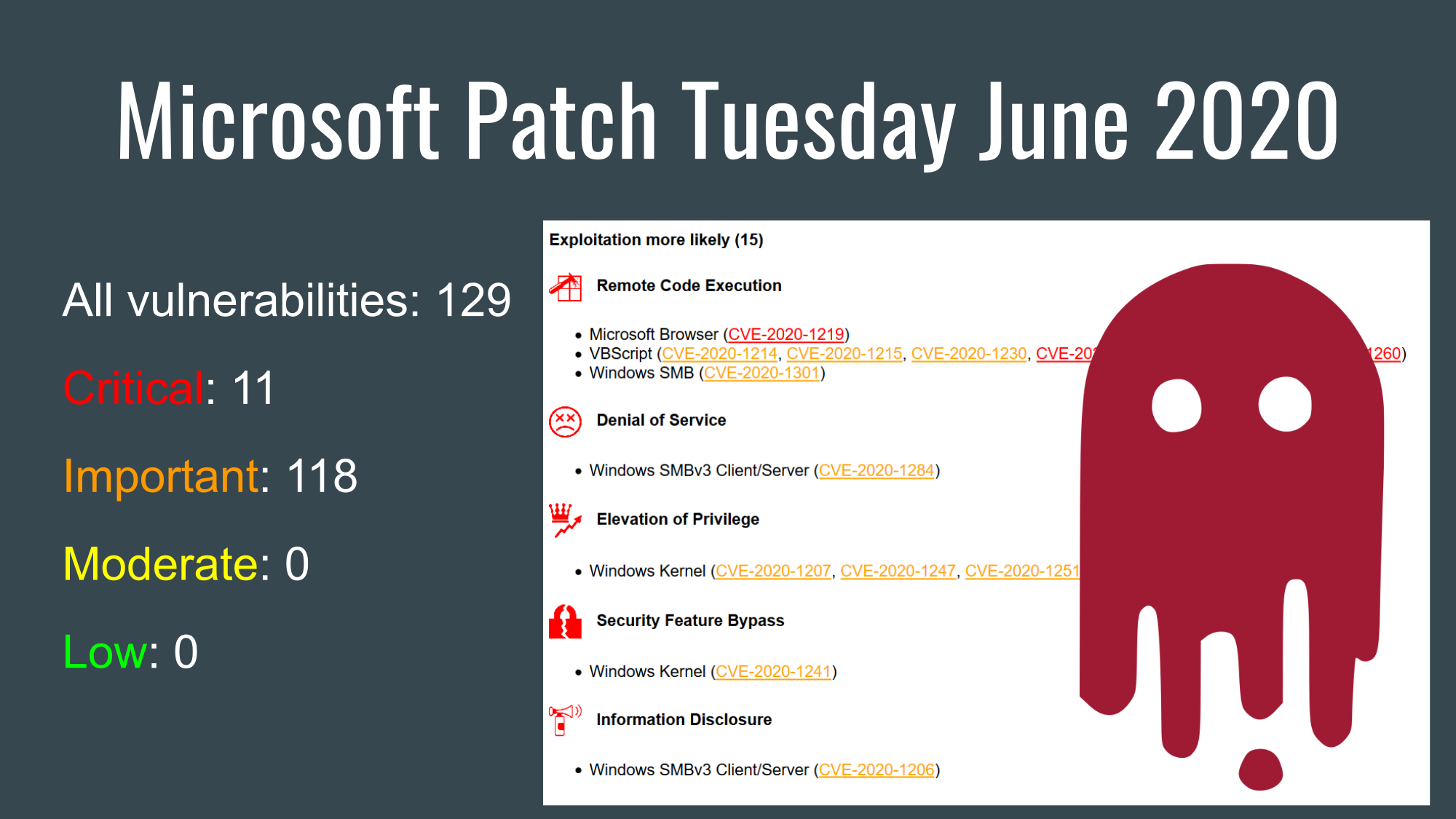
Microsoft Patch Tuesday June 2020: The Bleeding Ghost of SMB. This time, Microsoft addressed 129 vulnerabilities: 11 critical and 118 important. In fact, in the file that I exported from the Microsoft website, I saw 2 more CVEs (CVE-2020-1221, CVE-2020-1328) related to Microsoft Dynamics 365 (on-premises). But there is no information on them on the Microsoft website, in the MITRE CVE database and NVD. Does this mean that these CVE ids were mentioned unintentionally and related to some critical issues? I don’t think so, but this is strange.

This time there were no vulnerabilities with detected exploitation, so let’s start with the group “Exploitation more likely” according to Microsoft.

Continue reading

Microsoft Patch Tuesday March 2020: a new record was set, SMBv3 “Wormable” RCE and updates for February goldies

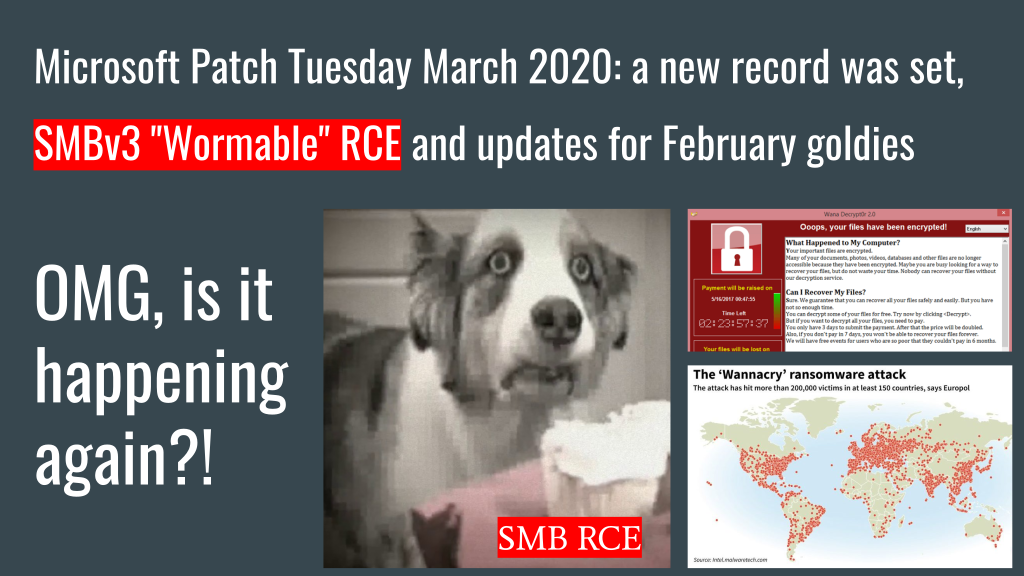
Microsoft Patch Tuesday March 2020: a new record was set, SMBv3 “Wormable” RCE and updates for February goldies. Without a doubt, the hottest Microsoft vulnerability in March 2020 is the “Wormable” Remote Code Execution in SMB v3 CVE-2020-0796. The most commonly used names for this vulnerability are EternalDarkness, SMBGhost and CoronaBlue.

Microsoft Patch Tuesday for March 2020: a new record was set, SMBv3  "Wormable" RCE and updates for February goldies

There was a strange story of how it was disclosed. It seems like Microsoft accidentally mentioned it in their blog. Than they somehow found out that the patch for this vulnerability will not be released in the March Patch Tuesday. So, they removed the reference to this vulnerability from the blogpost as quickly as they could.

But some security experts have seen it. And, of course, after EternalBlue and massive cryptolocker attacks in 2017, each RCE in SMB means “OMG, this is happening again, we need to do something really fast!” So, Microsoft just had to publish an advisory for this vulnerability with the workaround ADV200005 and to release an urgent patch KB4551762.

Continue reading