Tag Archives: Trendmicro

November “In the Trend of VM” (#21): vulnerabilities in Windows, SharePoint, Redis, XWiki, Zimbra Collaboration, and Linux

November In the Trend of VM (#21): vulnerabilities in Windows, SharePoint, Redis, XWiki, Zimbra Collaboration, and Linux

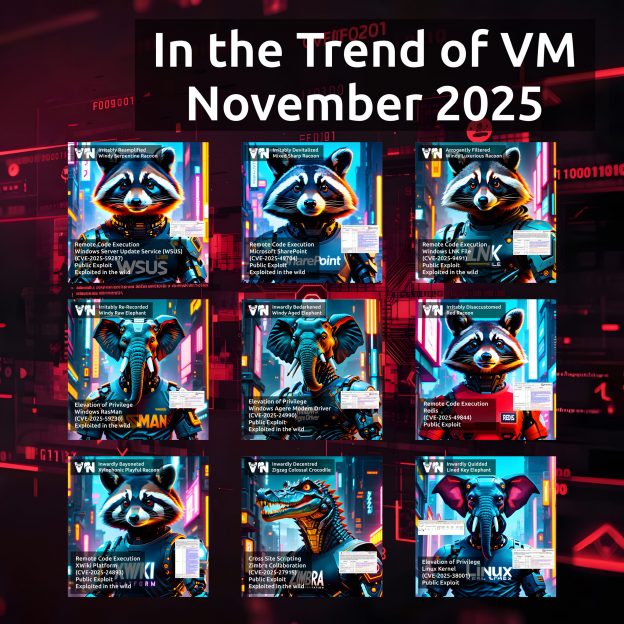
November “In the Trend of VM” (#21): vulnerabilities in Windows, SharePoint, Redis, XWiki, Zimbra Collaboration, and Linux. The usual monthly roundup. After several months, here’s a big one. 🔥

🗞 Post on Habr (rus)
🗞 Post on SecurityLab (rus)
🗒 Digest on the PT website (rus)

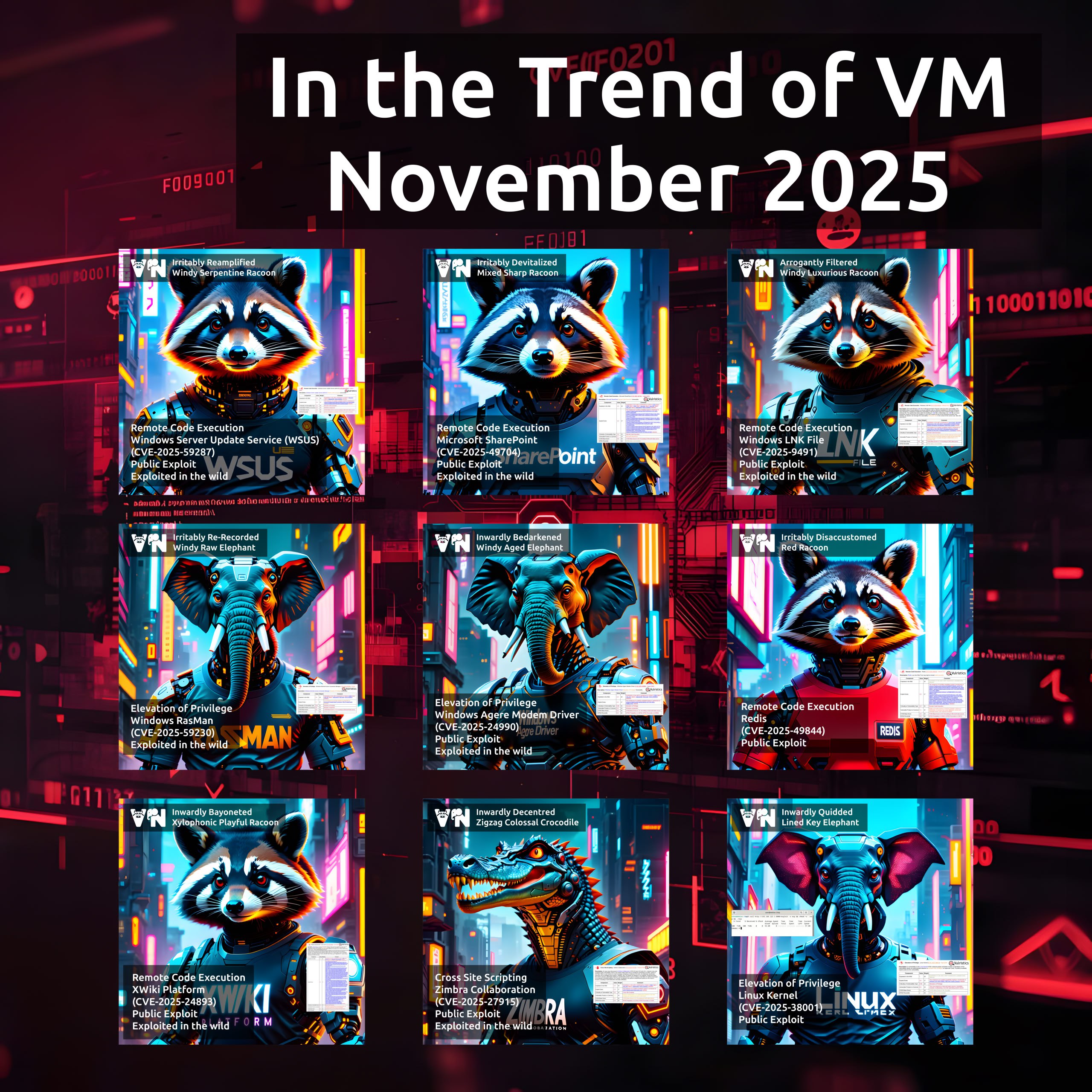
A total of nine vulnerabilities:

🔻 RCE – Windows Server Update Services (WSUS) (CVE-2025-59287)
🔻 RCE – Microsoft SharePoint “ToolShell” (CVE-2025-49704)
🔻 RCE – Windows LNK File (CVE-2025-9491)
🔻 EoP – Windows Remote Access Connection Manager (CVE-2025-59230)
🔻 EoP – Windows Agere Modem Driver (CVE-2025-24990)
🔻 RCE – Redis “RediShell” (CVE-2025-49844)
🔻 RCE – XWiki Platform (CVE-2025-24893)
🔻 XSS – Zimbra Collaboration (CVE-2025-27915)
🔻 EoP – Linux Kernel (CVE-2025-38001)


🟥 Trending Vulnerabilities Portal

На русском

About Remote Code Execution – Windows LNK File (CVE-2025-9491) vulnerability

About Remote Code Execution - Windows LNK File (CVE-2025-9491) vulnerability

About Remote Code Execution – Windows LNK File (CVE-2025-9491) vulnerability. A vulnerability in the Microsoft Windows shortcut (.LNK) handling mechanism allows malicious command-line arguments to be hidden in the Target field using whitespace characters, making them invisible to standard tools. Opening such an LNK file may lead to arbitrary code execution.

🔻 Peter Girnus, an expert at Trend Micro, notified Microsoft about the vulnerability on September 20, 2024, but they decided not to fix it. 🤷‍♂️ On August 26, 2025, this 0-day vulnerability (ZDI-CAN-25373) was assigned the identifier CVE-2025-9491.

👾 On March 18, 2025, Trend Micro reported that this vulnerability was exploited in APT attacks, and on October 30, Arctic Wolf Labs confirmed it was used to deploy PlugX malware against Hungarian and Belgian diplomatic missions.

🛠 The method for modifying .LNK files is described in the Trend Micro report.

На русском

Trending vulnerabilities of July according to Positive Technologies

Trending vulnerabilities of July according to Positive Technologies.

The SecLab film crew went on vacation. Therefore, there was a choice: to skip the episode of “In the trend of VM” about the July vulnerabilities, or to make a video myself. Which is what I tried to do. And from the next episode we will return to SecLab again.

📹 Video “In The Trend of VM” on YouTube
🗞 A post on Habr (rus) a slightly expanded script of the video
🗒 A compact digest (rus) on the official PT website

List of vulnerabilities:

🔻 00:33 Spoofing – Windows MSHTML Platform (CVE-2024-38112)
🔻 02:23 RCE – Artifex Ghostscript (CVE-2024-29510)
🔻 03:55 RCE – Acronis Cyber Infrastructure (CVE-2023-45249)

English voice over was generated by my open source utility subtivo (subtitles to voice over)

На русском

What is known about Spoofing – Windows MSHTML Platform (CVE-2024-38112) from the July Microsoft Patch Tuesday?

What is known about Spoofing - Windows MSHTML Platform (CVE-2024-38112) from the July Microsoft Patch Tuesday?

What is known about Spoofing – Windows MSHTML Platform (CVE-2024-38112) from the July Microsoft Patch Tuesday?

🔻 According to Check Point, attackers use special “.url” files with icons that look like PDF documents. If the user clicks on the file and ignores 2 uninformative warnings, then a malicious HTA application is launched in the outdated Internet Explorer browser built into Windows. 😱 Why in IE? This is all due to the processing of the “mhtml:” prefix in the “.url” file. The July update blocks this. 👍

🔻 Check Point found “.url” samples that could date back to January 2023. According to Trend Micro, the vulnerability is exploited by the APT group Void Banshee to install the Atlantida Stealer malware and collect passwords, cookies and other sensitive data. Void Banshee add malicious “.url” files to archives with PDF books and distribute them through websites, instant messengers and phishing.

На русском

Is it possible to detect Zero Day vulnerabilities with Vulnerability Management solutions?

Is it possible to detect Zero Day vulnerabilities with Vulnerability Management solutions? Hello everyone! In my English-language telegram chat avleonovchat, the question was asked: “How to find zero day vulnerabilities with Qualys?” Apparently this question can be expanded. Not just with Qualys, but with any VM solution in general. And is it even possible? There was an interesting discussion.

Alternative video link (for Russia): https://vk.com/video-149273431_456239109

Image generated by Stable Diffusion 2.1: “calendar on the wall cyber security vulnerability zero day”

The question is not so straightforward. To answer it, we need to define what a Zero Day vulnerability is. If we look at wikipedia, then historically “0” is the number of days a vendor has to fix a vulnerability.

“Eventually the term was applied to the vulnerabilities that allowed this hacking, and to the number of days that the vendor has had to fix them.”

Continue reading