Tag Archives: Windows

Remote Code Execution - Windows Remote Desktop Licensing Service "MadLicense" (CVE-2024-38077)

Remote Code Execution - Windows Remote Desktop Licensing Service MadLicense (CVE-2024-38077)

Remote Code Execution - Windows Remote Desktop Licensing Service "MadLicense" (CVE-2024-38077). The vulnerability was fixed in July Patch Tuesday. An unauthenticated attacker can get RCE by sending messages to RDL. CVSS 9.8. Updates for Win Server from 2008 to 2022.

What is the RDL service? By default, Remote Desktop Services allow only two simultaneous RDP connections to a Windows server. If you need more, you need to purchase additional licenses. These licenses are managed by the RDL service. Often, admins enable RDL on Win servers where it is not needed. 🙄🤷‍♂️

On August 9, a write-up and PoC for Server 2025 were posted on GitHub. So far, it's only Python pseudo-code without critical parts.

They write that 170,000 hosts with RDL are accessible from the Internet. 🤷‍♂️ And there should be countless of them on intranets.

❗️ Looks like a long-running trending vulnerability story.

Researchers promise us BadLicense and DeadLicense as well. 😉

На русском

No Boot - No Hacker!

No Boot - No Hacker! Updated track. It seems that the case with the CrowdStrike BSODStrike incident is coming to a logical conclusion. Why this happened is already more or less clear. All that remains is long legal battles between clients and the vendor. Therefore, I am closing this topic for myself with an updated track made in Suno. It's in Russian, but subtitles are available on YouTube.

My position is that BSODStrike was not the problems of a specific company, but rather the problems of cloud CyberSecurity services with agents, whose architecture is vulnerable. Such services literally force customers to overtrust them. 🤷‍♂️ I don't think it's right to keep silent about this. We need to call for improving the security, transparency and controllability of such services.

It should be understood that this was just a small and relatively harmless failure, but someday we will see a case with a full-scale attack through a hacked cloud vendor. And, as it seems to me, at the moment, on-premise solutions have their advantages.

На русском

Trending vulnerabilities for June according to Positive Technologies

Trending vulnerabilities for June according to Positive Technologies. Traditionally, in 3 formats (in Russian):

📹 The section "Trending VM" in the SecLab news video (starts at 15:03)
🗞 Post on the Habr website, in fact this is a slightly expanded scenario for the "Trending VM" section
🗒 Compact digest with technical details on the official PT website

List of vulnerabilities:

🔻 EoP in Microsoft Windows CSC (CVE-2024-26229)
🔻 EoP in Microsoft Windows Error Reporting (CVE-2024-26169)
🔻 EoP in Microsoft Windows Kernel (CVE-2024-30088)
🔻 RCE in PHP (CVE-2024-4577)
🔻 EoP in Linux Kernel (CVE-2024-1086)
🔻 InfDisclosure in Check Point Security Gateways (CVE-2024-24919)
🔻 RCE in VMware vCenter (CVE-2024-37079, CVE-2024-37080)
🔻 AuthBypass in Veeam Backup & Replication (CVE-2024-29849)

На русском

The severity of the Elevation of Privilege - Windows Kernel (CVE-2024-30088) has increased

The severity of the Elevation of Privilege - Windows Kernel (CVE-2024-30088) has increased

The severity of the Elevation of Privilege - Windows Kernel (CVE-2024-30088) has increased. The vulnerability is fresh, it is from the June Microsoft Patch Tuesday. I highlighted it in the review because, according to the CVSS vector, there was a private Proof-of-Concept Exploit for it. But there were no details. It was only clear that in case of successful exploitation, the attacker gains SYSTEM privileges. According to the ZDI advisory, the vulnerability affects the implementation of NtQueryInformationToken and is due to the lack of proper locking when performing operations on the object.

On June 24, 2 weeks after the June Patch Tuesday, a repository with technical details on this vulnerability and PoC appeared on GitHub. A video of running the utility to obtain SYSTEM privileges is also available.

A lot of exploits have begun to appear for Windows EoP/LPE vulnerabilities recently. Fix them in advance!

На русском

The criticality of the Elevation of Privilege - Windows Error Reporting Service (CVE-2024-26169) vulnerability has increased

The criticality of the Elevation of Privilege - Windows Error Reporting Service (CVE-2024-26169) vulnerability has increased

The criticality of the Elevation of Privilege - Windows Error Reporting Service (CVE-2024-26169) vulnerability has increased. If exploited successfully, the attacker gains SYSTEM privileges. The vulnerability was fixed in Microsoft's March Patch Tuesday. As often happens, no one highlighted this vulnerability back then. 🤷‍♂️

However, 3 months later, on June 12, Symantec researchers reported attacks related to the famous Black Basta ransomware, in which exploits for this vulnerability were used. If we believe the compilation timestamps, these exploits were created long before the release of Microsoft's patches, in February 2024 or even December 2023. Of course, attackers could fake them, but why would they do that? 🤔

On June 13, the vulnerability was added to CISA KEV. The exploit is not yet publicly available.

The moral is the same: vulnerability prioritization is good, but regular unconditional patching is better.

На русском

The criticality of the Elevation of Privilege - Windows CSC Service vulnerability (CVE-2024-26229) has increased dramatically

The criticality of the Elevation of Privilege - Windows CSC Service vulnerability (CVE-2024-26229) has increased dramatically

The criticality of the Elevation of Privilege - Windows CSC Service vulnerability (CVE-2024-26229) has increased dramatically. The vulnerability is from Microsoft's April Patch Tuesday. In April, no one highlighted this vulnerability at all.

Microsoft wrote about it "Exploitation Less Likely". All that was known was that if exploited successfully, the attacker could gain SYSTEM privileges.

But 2 months later, on June 10, an exploit appeared on GitHub. 🤷‍♂️ Surprise! The criticality of the vulnerability has increased dramatically.

Could this be somehow predicted? IMHO, not at all. Another confirmation that predicting trending vulnerabilities is, of course, good, but does not cancel regular unconditional patching according to the established SLA (AIT).

The author of the exploit clarified the CWE of the vulnerability.

It was: CWE-122 - Heap-based Buffer Overflow

It became: CWE-781 - Improper Address Validation in IOCTL with METHOD_NEITHER I/O Control Code

На русском

June Microsoft Patch Tuesday

June Microsoft Patch Tuesday

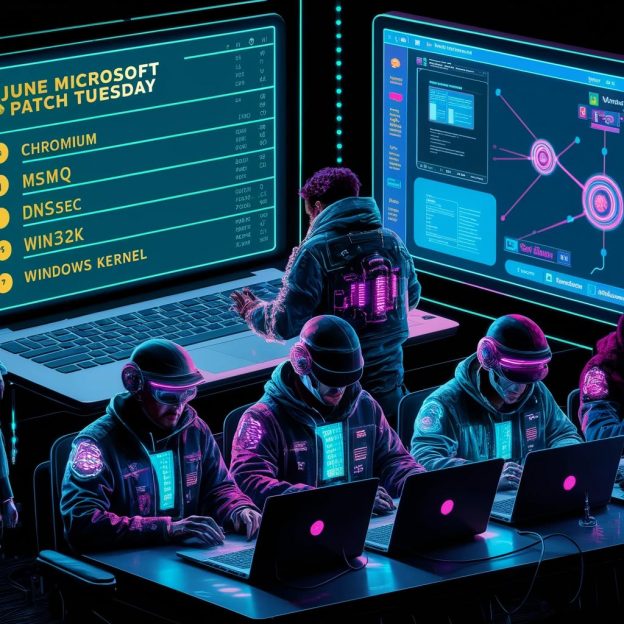
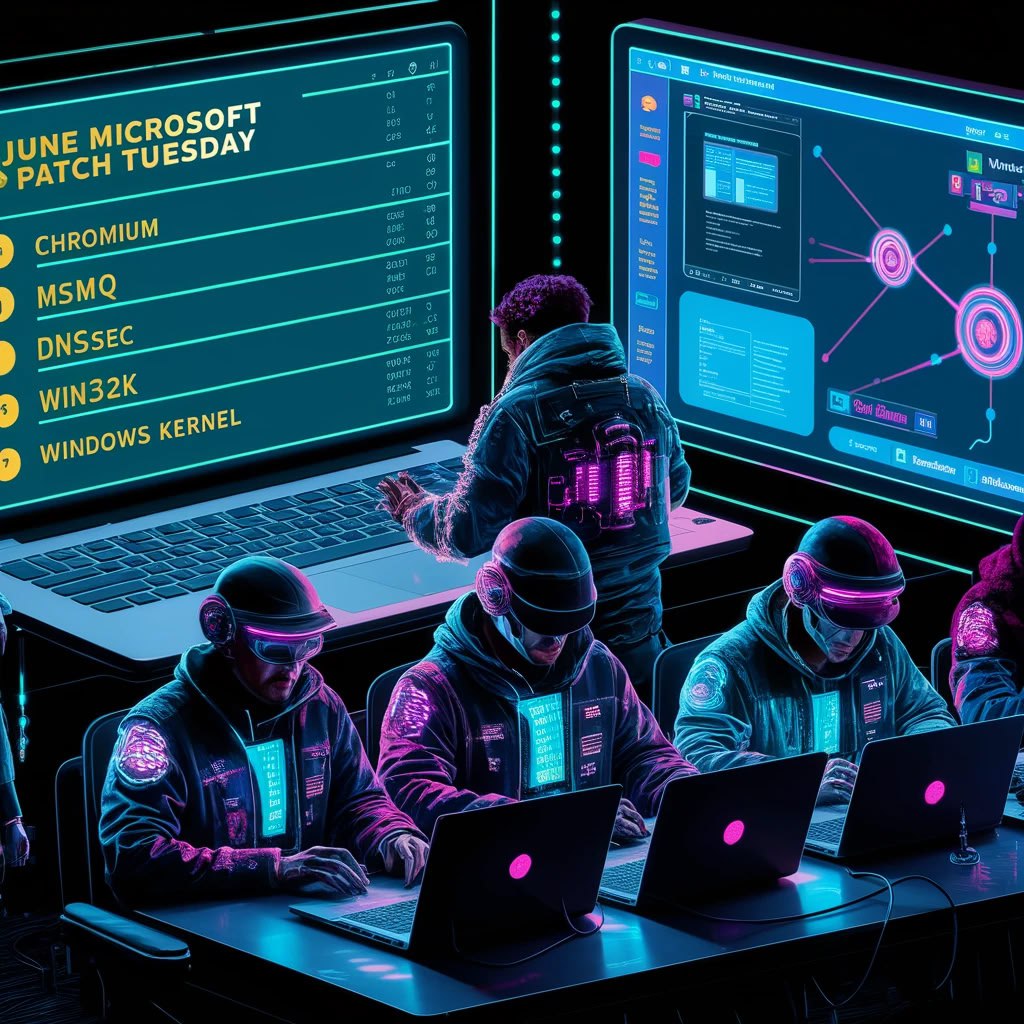
June Microsoft Patch Tuesday. There are 69 vulnerabilities in total, 18 of which were added between May and June Patch Tuesday. Among these added were 2 vulnerabilities with signs of exploitation in the wild:

🔻 Remote Code Execution - Chromium (CVE-2024-5274, CVE-2024-4947). Both vulnerabilities are in CISA KEV; there are no exploits for them yet.

For the remaining vulnerabilities, there are no formal signs of exploitation in the wild or public exploits yet.

The specialized InfoSec media pay attention to these 2:

🔸 Remote Code Execution - Microsoft Message Queuing (MSMQ) (CVE-2024-30080). This vulnerability has a high CVSS Score of 9.8. To get RCE, the attacker sends a specially crafted malicious packet to the MSMQ server. The vulnerability may well become wormable for Windows servers with MSMQ enabled. It is very similar to last year's QueueJumper (CVE-2023-21554).
🔸 Denial of Service - DNSSEC (CVE-2023-50868). Vulnerability in DNSSEC validation. An attacker can cause DoS using standard DNS integrity protocols. 🤷‍♂️ I don’t see any super criticality, but this is rare for MS Patch Tuesday, which is probably why everyone is writing about it.

What else you can pay attention to:

🔸 Elevation of Privilege - Windows Win32k (CVE-2024-30091), Windows Kernel (CVE-2024-30088, CVE-2024-30099) and Windows Cloud Files Mini Filter Driver (CVE-2024-30085). Why these? Microsoft's CVSS states that there are private Proof-of-Concept exploits for them.
🔸 Remote Code Execution - Microsoft Office (CVE-2024-30101). This is a Microsoft Outlook vulnerability. To successfully exploit this vulnerability, a user must open a malicious email in an affected version of Microsoft Outlook and then perform certain actions to trigger the vulnerability. It's enough to open the email in the Preview Pane. However, to successfully exploit this vulnerability, an attacker needs to win the race condition.
🔸 Remote Code Execution - Microsoft Outlook (CVE-2024-30103). Preview Pane is a vector. Authentication required. The vulnerability is somehow related to the creation of malicious DLL files. 🤷‍♂️
🔸 Remote Code Execution - Windows Wi-Fi Driver (CVE-2024-30078). An attacker can execute code on a vulnerable system by sending a specially crafted network packet. The victim must be within the attacker's Wi-Fi range and use a Wi-Fi adapter. Sounds interesting, let's wait for details. 😈
🔸 Remote Code Execution - Microsoft Office (CVE-2024-30104). An attacker must send the user a malicious file and convince the user to open the file. The Preview Pane is NOT an attack vector.

🗒 Vulristics report on June Microsoft Patch Tuesday

На русском