Category Archives: Topics

Is Vulnerability Management more about Vulnerabilities or Management?

Is Vulnerability Management more about Vulnerabilities or Management? I’ve just read a nice article about Vulnerability Management in the Acribia blog (in Russian). An extract and my comments below.

In the most cases Vulnerability Management is not about Vulnerabilities, but about Management. Just filtering the most critical vulnerabilities is not enough.

Practical Cases:

  1. “Oh, yes, we know ourselves that that everything is bad!” – CVE-2013−4786 IPMI password hash disclosure on > 500 servers. Customer just accepted the risks, Acribia proposed an effective workaround (unbrutable user IDs and passwords). It’s often hard to figure out right remediation measures and implement them. Someone should do it!
  2. “We can download OpenVAS without your help!” – CVE-2018-0171 Cisco Smart Install RCE on 350 hosts. Vulnerability detection rules of several Vulnerability Scanners were not good enough to detect this vulnerability. Do not rely on scanners, know how they work and their limitations.
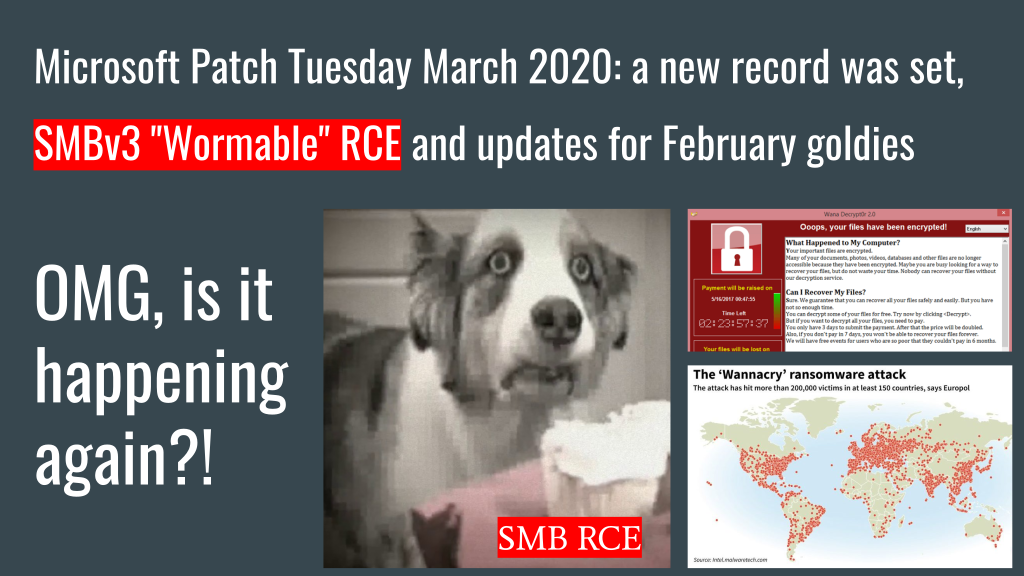
  3. “If the attackers wanted to hack us, they would have already done it!” – CVE-2017-0144 (MS17-010) Windows SMB RCE on domain controller and several other critical servers. Vulnerability was detected in infrastructure several times, the remediation was agreed with the management, but it was ignored by responsible IT guys. As a result, during the next successful WannaCry-like malware attack the servers, including the DC were destroyed. Vulnerability Management is about the willingness to patch anything, very quickly, as often as required. Otherwise, it makes no sense.

Big Microsoft day: EOL for Win7, Win2008 and crypt32.dll

Big Microsoft day: EOL for Win7, Win2008 and crypt32.dll. Big Microsoft day. End-of-life for Windows 7 desktops and Windows 2008 servers (strictly speaking Windows Server 2008 R2). I think that today many security guys had a fun task to count how many host hosts with win7 and win2008 they still have in the organization. So, Asset Management is a necessity! ?

Windows 7 desktop

Now an interesting time should begin, when critical unpatched vulnerabilities may appear for these operation systems. At the same time, the number of hosts with Windows 7 and Windows 2008 will be still big enough for massive attacks. ? Although I think that Microsoft will continue to release patches for the most critical vulnerabilities, like they did it for WinXP. Upd. Also note, that for Windows Server 2008/2008r2 it’s also possible to purchase an extended three years  security update subscription.

Windows 2008 server

The second interesting topic is the mysterious vulnerability in crypt32.dll (this dll appeared in Windows more than 20 years ago), which might somehow affect authentication and digital signatures in Windows.

crypt32.dll

Far now it has been only a rumor, but soon it will become clear how dangerous it is and how it can be used.

upd. 15.01. So, what about this vulnerability in crypt32.dll. Now it has the name NSACrypt (because NSA reported it) and the id CVE-2020-0601. It’s not for all versions of Windows, only for Windows 10, Windows Server 2016 and Windows Server 2019.

Continue reading

0day RCE in Firefox

0day RCE in Firefox. This seems like a pretty interesting vulnerability CVE-2019-17026 in Firefox (and Thunderbird) in Windows, MacOS and Linux.

A pretty interesting vulnerability in  Firefox  (and Thunderbird)

Incorrect alias information in IonMonkey JIT compiler for setting array elements could lead to a type confusion. We are aware of targeted attacks in the wild abusing this flaw”.

US-cert informs us that “an attacker could exploit this vulnerability to take control of an affected system“. Yep, it’s RCE.

On the one hand, it’s not a big deal, because Firefox will ask you to update it after the next launch.

Firefox will ask you to update it after the next launch

But if somewhere in your organization the old version of Firefox is used because it is the only version that is supported by some legacy application or plugin, you are in hell. Of course, this old browser may be only installed somewhere and not used, but still try to monitor this and take care. Especially if you use some custom Firefox-based build.

The first Zbrunk dashboard and other news

The first Zbrunk dashboard and other news. The long New Year holiday season in Russia was not in vain. I had time to work on Zbrunk. 😉 As you can see, I made my first dashboard and added other features.

The first Zbrunk dashboard

No more timestamps in code

I added functions to get Unix timestamps from lines in human-readable time format, e.g. “2019.12.10 13:00:00”.

Instead of a date, you can use words:

  • Today
  • Yesterday
  • N days ago
  • Beginning of Time
  • End of Time

API requests will continue to support only Unix timestamps.

Continue reading

Detectify Asset Inventory and Monitoring

Detectify Asset Inventory and Monitoring. Continuing the topic about perimeter services. As I mentioned earlier, I don’t think that the external perimeter services should be considered as a fully functional replacement for custom Vulnerability Management processes. I would rather see their results as an additional feed showing the problems your current VM process has. Recently I tested the Detectify’s Asset Inventory (Monitoring) solution, which provides such feed by automatically detecting the issues with your second, third (and more) leveled domains and related web services.

Detectify Asset Inventory screenshot from the official blog

Let say your organization has several second level web domains, over9000 third (and more) level domains, and you even don’t know for what services they are used. This is a normal situation for a large organization. So, you simply add yourorganization.com to Detectify, activate Asset Monitoring, and Detectify automatically discovers third (and more) level domains and related technologies: web services, CMS, JavaScript frameworks and libraries. “It provides thousands of fingerprints and hundreds of tests for stateless vulnerabilities such as code repository exposure for SVN or Git.” This is called fingerprinting.

Continue reading

Zbrunk search launcher and event types statistics

Zbrunk search launcher and event types statistics. I also changed the priorities. Now I think it would be better not to integrate with Grafana, but to create own dashboards and GUI. And to begin with, I created a simple interface for Searching (and Deleting) events.

upd. 16.12.2019

A small update on Zbrunk. First of all, I created a new API call that returns a list of object types in the database and number of this types for a certain period of time. Without it, debugging was rather inconvenient.

$ curl -k https://127.0.0.1:8088/services/searcher -d '{"get_types":"True", "search": {"time":{"from":"1471613579","to":"1471613580"}}, "output_mode": "json", "max_count":"10000000", "auth_token":"8DEE8A67-7700-4BA7-8CBF-4B917CE23512"}'

{"results": ["test_event"], "results_count": 1, "all_results_count": 0, "text": "Types found", "code": 0}

I also added some examples of working with Zbrunk http API from python3. Rewriting them from pure curl was not so trivial. ? Flask is rather moody, so I had to abandon the idea of making requests exactly the same as in Splunk. ? But the differences are cosmetic. It is now assumed that events will be passed to collector in valid json (not as a file with json events separated by ‘\n’). I also send all params of requests as json, not data. But for the compatibility reasons previous curl examples will also work. ?

CentOS 8 with IceWM Desktop Environment

CentOS 8 with IceWM Desktop Environment. Do you need CentOS 8 with IceWM as desktop Operating System? Most likely not. Especially if you want it to work smoothly without any worries and troubles. However, if you enjoy playing with new desktop environments, you might find it fun.

CentOS 8 with IceWM desktop environment

My reasons were as follows:

  1. I wanted to use the same Linux distribution for server and desktop. Just to minimize possible surprises during the deployment.
  2. I wanted to know what is going on in the RPM-based part of Linux world. The only way to achieve this is to use such distribution every day.
  3. I was tired of problems with the Virtual Box guest additions in CentOS 7 (yes , I run it all as a virtual machine), especially after the 3.10 kernel updates. It was time to move on.
  4. I didn’t want to use Gnome 3, because it’s slow and ugly (however it’s fully functional!). And there were no other DEs in CentOS 8 repositories at that time.

So, I tried CentOS 8 with IceWM (installed it from source) and it worked. IceWM is small, very fast, ascetic, and in some ways quite intuitive. There were some problems with the clipboard (in xTerm and with VBox shared clipboard) and with language switching, but I figured it out and I think that I would probably continue to use it. Below are some notes on how I installed it and resolved the issues.

Continue reading