Tag Archives: InternetExplorer

About Cross Site Scripting - Microsoft Exchange (CVE-2026-42897) vulnerability

About Cross Site Scripting - Microsoft Exchange (CVE-2026-42897) vulnerability

About Cross Site Scripting - Microsoft Exchange (CVE-2026-42897) vulnerability. The vulnerability was fixed on May 14 outside the regular Microsoft Patch Tuesday cycle. Improper neutralization of input during web page generation (CWE-79, XSS) in Microsoft Exchange Server allows an unauthorized attacker to perform spoofing over a network. In practical terms, this means that a remote attacker could exploit this vulnerability by sending a specially crafted email to a user. If the user opens the email in Outlook Web Access and certain interaction conditions are met, arbitrary JavaScript can be executed in the browser context. As a result, the attacker may gain control of the user's mailbox by using an active user session.

👾 Microsoft experts immediately reported signs of active exploitation in the wild for this vulnerability. The vulnerability was added to the CISA KEV on May 15.

⚒️ A public exploit for the vulnerability was published on GitHub on May 15 as well.

⚙️ Initially, mitigation measures were recommended to address the vulnerability, delivered via the Exchange Emergency Mitigation (EM) service or by using the Exchange on-premises Mitigation Tool (EOMT) script. Security updates that fix the vulnerability in Microsoft Exchange Server Subscription Edition RTM, Exchange Server 2016, and Exchange Server 2019 were released almost a month later, on June 9. Microsoft experts recommended keeping the mitigations enabled even after applying the patch, as they provide an additional layer of protection. However, applying these mitigations may cause issues (for example, errors when printing calendars and displaying images in OWA).

⚠️ Please note that Exchange Server 2016 and 2019, which are out of support, are also affected by this vulnerability. Only customers enrolled in the Period 2 Extended Security Update (ESU) program are eligible to receive Exchange Server 2016 and 2019 security updates released between May and October 2026.


Remote Code Execution - Scripting Engine (CVE-2024-38178)

Remote Code Execution - Scripting Engine (CVE-2024-38178)

Remote Code Execution - Scripting Engine (CVE-2024-38178). A vulnerability from the August Microsoft Patch Tuesday. The victim clicks on the attacker's link, memory corruption occurs and arbitrary attacker's code is executed.

The tricky part is that the victim has to open the link in Microsoft Edge browser in Internet Explorer compatibility mode. But why would the victim want to set the browser to this mode?

🔻 The victim may be using some old corporate web application that only works in Internet Explorer, so the browser is configured this way. Not such a rare situation. 😏

🔻An attacker may try to convince the victim to enable the setting "Allow sites to be reloaded in Internet Explorer mode (IE mode)" in Edge. 🤷‍♂️

One way or another, the vulnerability is exploited in the wild and there is already a (semi?🤔)public exploit for it. My colleagues at PT ESC shared today how they found and tested this exploit. 🔍

На русском

"The Mystery of the Hole": Remote Code Execution - Internet Explorer (CVE-2012-4792)

The Mystery of the Hole: Remote Code Execution - Internet Explorer (CVE-2012-4792)

"The Mystery of the Hole": Remote Code Execution - Internet Explorer (CVE-2012-4792). Yesterday, an old vulnerability "CDwnBindInfo" from 2012 was added to CISA KEV: the user opens a malicious website in MS Internet Explorer 6–8 and the attacker gets RCE on user's host. The vulnerability has been actively exploited since the end of 2012 as 0day in watering hole attacks on US organizations. In particular, the malicious code was placed on the hacked Council on Foreign Relations (CFR) website.

Why was the vulnerability added to CISA KEV only now?

🔹 New attacks on legacy systems (Win XP/ Vista/7, WinServer 2003/2008) were discovered? 🤪 It’s unlikely.

🔹 They saw a vulnerability with confirmed incidents, but it wasn’t in CISA KEV, so they added it? More likely, but why only this vulnerability? 🧐

🔹 There was no formal excuse for urgently updating found legacy systems? A bit strange. 🤷‍♂️

Let's wait for updates. 🙂

На русском

Microsoft Patch Tuesday August 2020: vulnerabilities with Detected Exploitation, useful for phishing and others

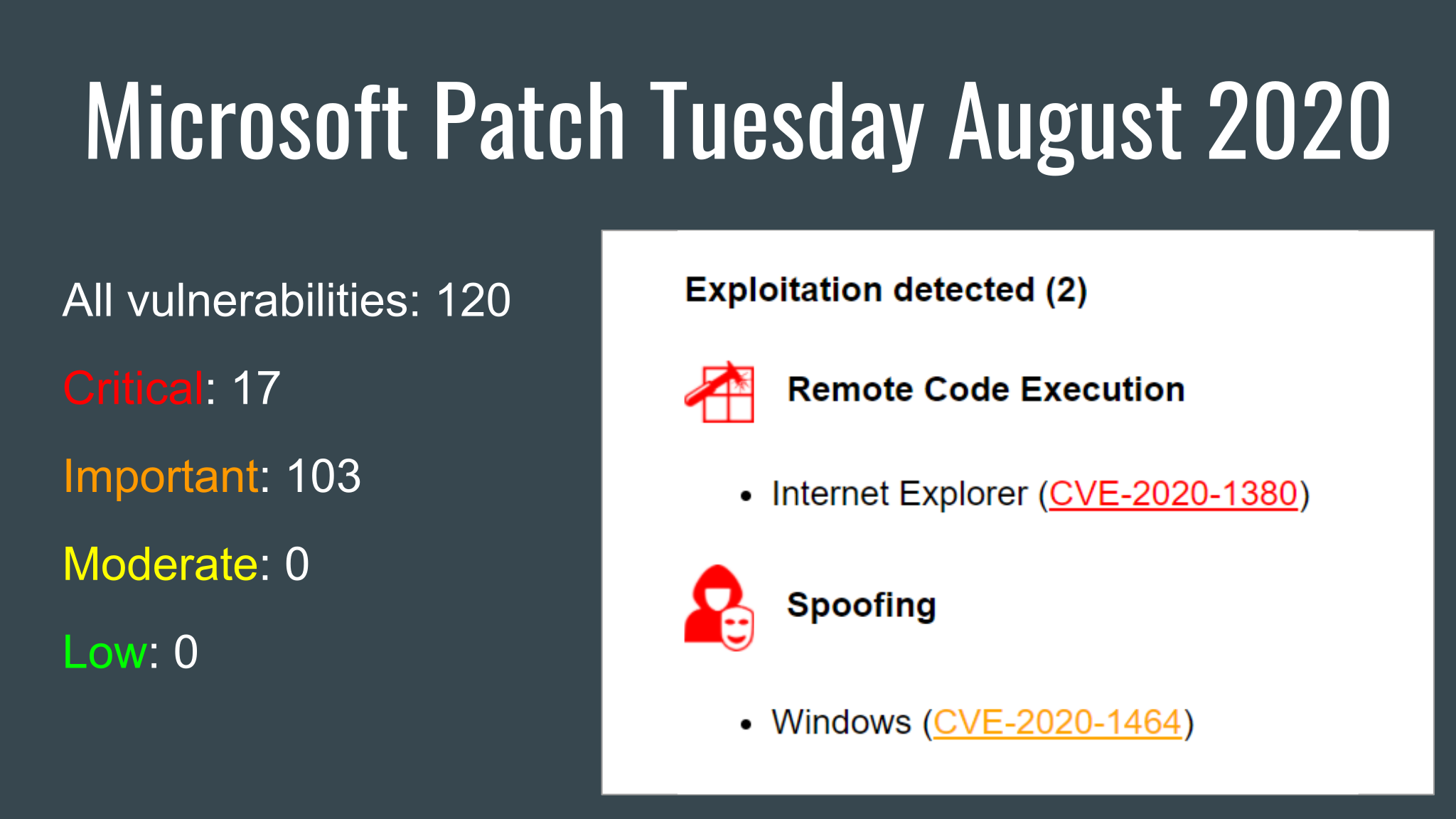
Microsoft Patch Tuesday August 2020: vulnerabilities with Detected Exploitation, useful for phishing and others. This time I would like to review not only the vulnerabilities that were published in the last August Microsoft Patch Tuesday, but also the CVEs that were published on other, not Patch Tuesday, days. Of course, if there are any.

But let’s start with the vulnerabilities that were presented on MS Patch Tuesday on August 11th. There were 120 vulnerabilities: 17 of them are Critical and 103 Important. My vulristics script could not find public exploits for these vulnerabilities on Vulners.com.

Continue reading

Microsoft Patch Tuesday April 2020: my classification script, confusing RCE in Adobe Type Manager and updates for older vulnerabilities

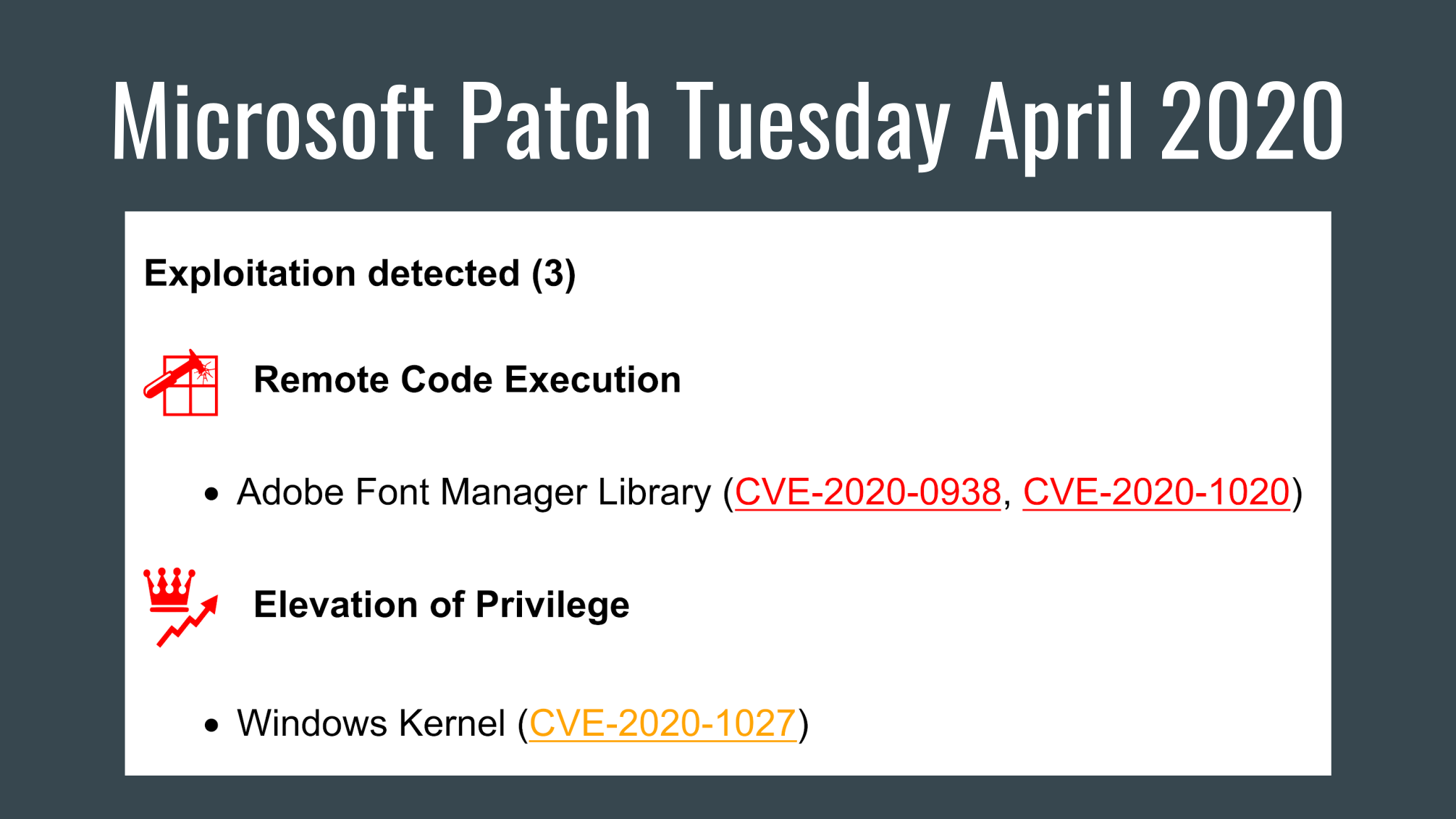
Microsoft Patch Tuesday April 2020: my classification script, confusing RCE in Adobe Type Manager and updates for older vulnerabilities. Making the reviews of Microsoft Patch Tuesday vulnerabilities should be an easy task. All vulnerability data is publicly available. Even better, dozens of reviews have already been written. Just read them, combine and post. Right?

Microsoft Patch Tuesday April 2020: my classification script, confusing RCE in Adobe Type Manager and updates for older vulnerabilities

Not really. In fact it is quite boring and annoying. It may be fun to write about vulnerabilities that were already used in some real attacks. But this is a very small part of all vulnerabilities. What about more than a hundred others? They are like “some vulnerability in some component may be used in some attack (or may be not)”. If you describe each of them, no one will read or listen this.

You must choose what to highlight. And when I am reading the reports from Tenable, Qualys and ZDI, I see that they choose very different groups of vulnerabilities, pretty much randomly.

My classification script

That’s why I created a script that takes Patch Tuesday CVE data from microsoft.com and visualizes it giving me helicopter view on what can be interesting there. With nice grouping by vulnerability type and product, with custom icons for vulnerability types, coloring based on severity, etc.

Continue reading