Category Archives: Topics

Sending tables from Atlassian Confluence to Splunk

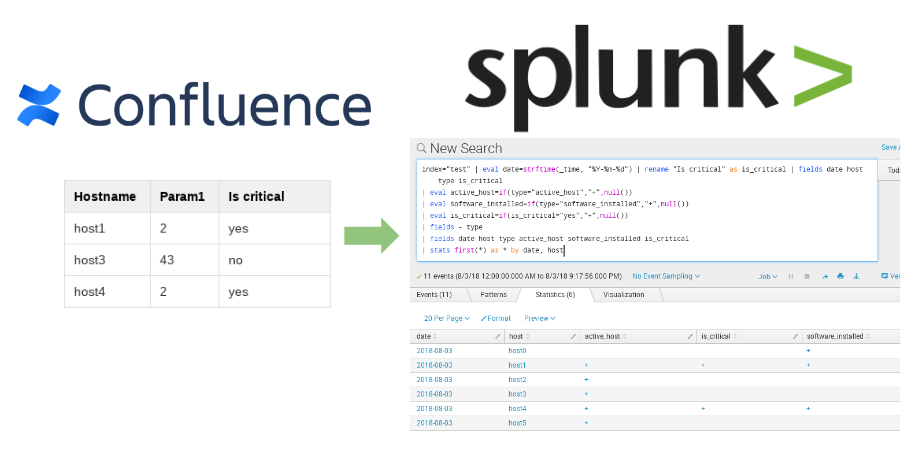
Sending tables from Atlassian Confluence to Splunk. Sometimes when we make automated analysis with Splunk, it might be necessary to use information that was entered or edited manually. For example, the classification of network hosts: do they belong to the PCI-DSS Scope or another group critical hosts or not.

Sending tables from Atlassian Confluence to Splunk

In this case, Confluence can be quite a convenient tool for maintaining such a registry. Page with a table can be created very quickly and multiple employees can immediately start working with it.

Let’s see how to convert such table, export it to Splunk and use it with other data.

Continue reading

Sending FireEye HX data to Splunk

Sending FireEye HX data to Splunk. FireEye HX is an agent-based Endpoint Protection solution. Something like an antivirus, but focused on Advanced Persistent Threats (APT). It has an appliance with GUI where you can manage the agents and see information about detected security incidents.

As with any agent-based solution, it’s necessary to ensure that the agents are installed on every supported host in your network. You may also want to analyze the alerts automatically. And for both purposes you can use Splunk. Let’s see how to do it. 😉

FireEye HX appliance login screen

Note, everything bellow is for FireEye Endpoint Security (HX) 4.0.6 and Splunk 7.0.2. If you use some other version, the things may be quite different.

The main idea is following. We should present FireEye hosts and alerts data in JSON format, add some mandatory fields ans send this packages to Splunk using HTTP Event connector. Then we can process it in Splunk like I’ve shown in “How to correlate different events in Splunk and make dashboards“.

Continue reading

How to correlate different events in Splunk and make dashboards

How to correlate different events in Splunk and make dashboards. Recently I’ve spent some time dealing with Splunk. Despite the fact that I have already done various Splunk searches before, for example in “Tracking software versions using Nessus and Splunk“, the correlation of different events in Splunk seems to be a very different task. And there not so many publicly available examples of this on the Internet. So, I decided to write a small post about it myself.

Splunk dashboard

Disclaimer: I’m not a pro in Splunk. I don’t have an idea if I am doing this the right or in optimal way. 😉 I just learned some tricks, they worked for me well and I want to share it with you. 

I will show the following case:

  1. We have some active network hosts.
  2. Some software product should be installed these hosts.
  3. We will send “host X is active” and “software is installed on host X” events to the Splunk server.
  4. We want to get some diagrams in Splunk that will show us on which hosts the software is  installed and how number of such hosts is changing in time.

As you can see, the task is quite a trivial and it can be easily implemented in pure Python. But the idea is to make it in Splunk. 😉

Continue reading

Masking Vulnerability Scan reports

Masking Vulnerability Scan reports. Continuing the series of posts about Kenna (“Analyzing Vulnerability Scan data“, “Connectors and REST API“) and similar services. Is it actually safe to send your vulnerability data to some external cloud service for analysis? Leakage of such information can potentially cause great damage to your organization, right?

Masking Vulnerability Scans

It’s once again a problem of trust to vendor. IMHO, in some cases it may make sense to hide the real hostnames and ip-addresses of the target hosts in scan reports. So, it would be clear for analysis vendor that some critical vulnerability exists somewhere, but it would not be clear where exactly.

To do this, each hostname/ip-address should be replaced to some values of similar type and should be replaced on the same value each time. So the algorithms of Kenna-like service could work with this masked reports. This mean that we need to create a replacement dictionary.

Continue reading

Kenna Security: Connectors and REST API

Kenna Security: Connectors and REST API. In the last post about Kenna Security cloud service I mentioned their main features for analyzing data from different vulnerability scanners. Now let’s see how to import Tenable Nessus scan results in Kenna. Here you can see the list of connectors for all supported products:

Kenna connectors

Three connectors for Nessus are available:

  • Nessus Importer retrieves existing scan results from your Nessus server.
  • Nessus Scanner can schedule scans on your Nessus server.
  • Nessus XML imports xml (.Nessus2) files.

First two connectors work with Nessus server directly. And they probably won’t work anymore with Nessus Professional 7, because of API removing (see “New Nessus 7 Professional and the end of cost-effective Vulnerability Management (as we knew it)“). If Nessus server is deployed on-premise you should use special Kenna Virtual Tunnel.

Last “Nessus XML” connector is the most flexible. No matter how you got your scan results, it will be possible to import them to Kenna. See how to get XML reports from from Nessus server in a post “Retrieving scan results through Nessus API“.  You can upload XML scan results using Kenna web GUI (not very efficient way, but for testing – why not?) or REST API.

To use Kenna REST API you will need an Application Token. Go to the the Settings menu -> Applications:

Kenna settings

Continue reading

Making simple Nmap SPA web GUI with Apache, AngularJS and Python Twisted

Making simple Nmap SPA web GUI with Apache, AngularJS and Python Twisted. The last time I was developing dynamic web applications years ago. I used CGI and PHP back then. 🙂 Now I am really interested in a modern approach, when you have a Single Page Web Application (SPA) written in HTML and JavaScript, that makes http requests to some external API.

It’s pretty cool, because your application becomes API-centric naturally. You work on human interface and improve integration capabilities at the same time. And the task of securing your web app mostly reduces to securing your formalized API.

nmap SPA GUI

The very best way to learn something new is to write a post about this stuff. 😉 Here I will reproduce my own steps of making a very basic web app:

  1. Launch Apache web-server with http/https.
  2. Make a simple API service: Nmap wrapper.
  3. Make a web-application with “multipage” experience. There should be at least two pages: Scan and About.
  4. On Scan page it will be possible to input a target (hostname or IP), scan arguments and  launch scan by clicking on the button. The same behavior will be if the target will be passed as a parameter in address bar.
  5. On other pages should be some static text.

As you can see, it is a very limited task, but it should clear up the most confusing parts of the process.

Continue reading

Kenna Security: Analyzing Vulnerability Scan data

Kenna Security: Analyzing Vulnerability Scan data. I’ve been following Kenna Security (before 2015 Risk I/O) for a pretty long time. Mainly, because they do the things I do on a daily basis: analyse various vulnerability scan results and feeds, and prioritize detected vulnerabilities for further mitigation. The only difference is that my scripts and reports are highly specific for my employer’s infrastructure and needs. And guys from Kenna team make a standardized scalable cloud solution that should be suitable for everyone.

I think their niche is really great. They do not compete directly with Vulnerability Management vendors. They can be partners with any of them, bringing additional features to the customers. Perfect win-win combination. That’s why Kenna speakers regularly participate in joint webinars with VM vendors.

I couldn’t lose a great opportunity to see Kenna Security service in action. 😉

In this post I will try to make a very brief review of Kenna functionality and formulate pros and cons of the solution.

When you submit trial request at https://www.eu.kennasecurity.com/signup (or https://app.kennasecurity.com/signup if you are not in Europe) you will get a link to your company account:

https://corporation.eu.kennasecurity.com/

The login screen will look like this:

Kenna login

Continue reading