

Tag Archives: CyberOK

About Authentication Bypass – GNU Inetutils (CVE-2026-24061) vulnerability

About Authentication Bypass - GNU Inetutils (CVE-2026-24061) vulnerability

About Authentication Bypass – GNU Inetutils (CVE-2026-24061) vulnerability. GNU Inetutils is a collection of common network programs, including, among other things, a Telnet server (telnetd). A vulnerability in GNU Inetutils telnetd allows a remote attacker to obtain a root shell on the host without any credentials by sending a crafted USER environment variable containing the value “-f root”.

⚙️ A patch fixing the vulnerability was released on January 20. Versions 1.9.3–2.7 are vulnerable; the issue went undisclosed for 10+ years. 🤷‍♂️

🛠 A detailed write-up and exploit were published by SafeBreach on January 22.

👾 Exploitation in the wild has been observed by GreyNoise since January 21.

🌐 Shodan estimates ~212,396 Telnet servers online in total. How many of them use GNU Inetutils and are vulnerable is still unclear. CyberOK discovered around 500 potentially vulnerable Telnet servers in the Russian Internet segment.

На русском

March episode “In the Trend of VM” (#13): vulnerabilities of Microsoft, PAN-OS, СommuniGate and who should patch hosts with deployed application

March episode “In the Trend of VM” (#13): vulnerabilities of Microsoft, PAN-OS, СommuniGate and who should patch hosts with deployed application. I’m posting the translated video with a big delay, but it’s better than never. 😉

📹 Video on YouTube and LinkedIn
🗞 Post on Habr (rus)
🗒 Digest on the PT website

Content:

🔻 00:00 Greetings
🔻 00:31 Elevation of Privilege – Windows Ancillary Function Driver for WinSock (CVE-2025-21418)
🔻 01:12 Elevation of Privilege – Windows Storage (CVE-2025-21391)
🔻 01:53 Authentication Bypass – PAN-OS (CVE-2025-0108)
🔻 03:09 Remote Code Execution – CommuniGate Pro (BDU:2025-01331)
🔻 04:27 The VM riddle: who should patch hosts with a deployed application?
🔻 07:11 About the digest of trending vulnerabilities

На русском

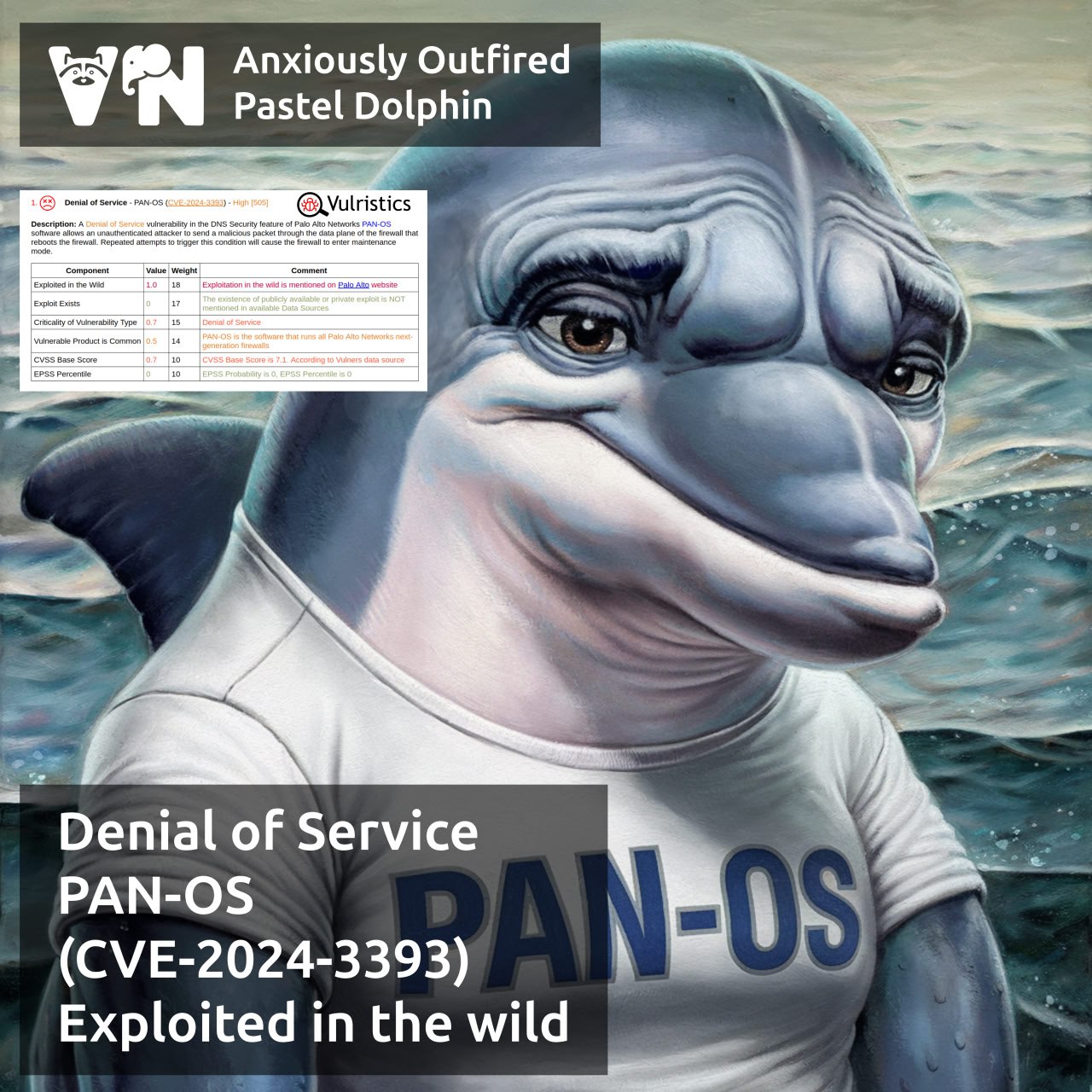
About Denial of Service – PAN-OS (CVE-2024-3393) vulnerability

About Denial of Service - PAN-OS (CVE-2024-3393) vulnerability

About Denial of Service – PAN-OS (CVE-2024-3393) vulnerability. PAN-OS is the operating system that runs all Palo Alto Network NGFWs. The vendor’s advisory was released on December 27. Аn unauthenticated attacker can send a malicious packet through the data plane of the firewall, causing it to reboot. Repeated attempts to trigger this condition will cause the firewall to enter maintenance mode. For exploitation the logging option of the “DNS Security” feature must be enabled.

👾 Palo Alto has already detected attacks that exploit this vulnerability. There are no public exploits yet.

👀 CyberOK detects more than 500 PAN-OS installations in RuNet, of which 32 are potentially vulnerable. Additionally, 218 hosts are running PAN-OS version 11.0.x, which is no longer supported by the vendor since November 17.

🔧 To fix the vulnerability, you need to update your device or, as a workaround, disable the logging option of the “DNS Security” function.

На русском