Category Archives: Vulnerability Management

PHDays VII: To Vulnerability Database and beyond

PHDays VII: To Vulnerability Database and beyond. Last Tuesday and Wednesday, May 23-24, I attended PHDays VII conference in Moscow. I was talking there about vulnerability databases and the evolution process of vulnerability assessment tools, as far as I understand it.
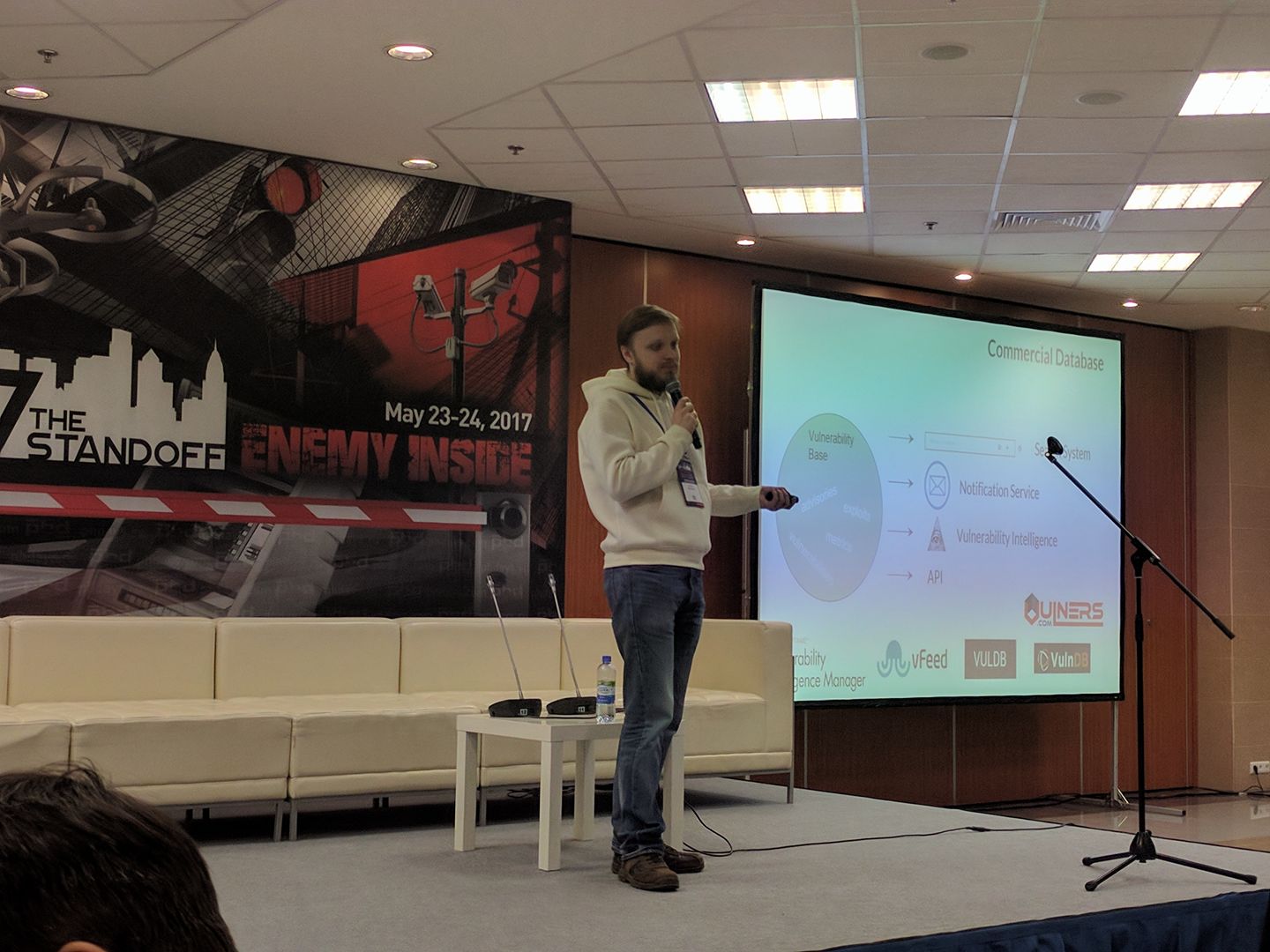
To Vulnerability Database and beyond

But first of all, a few words about the conference itself. I can tell that since the last year the event got even better. I’ve seen lot of new faces. Some people I didn’t know, but they knew me by my blog and accounts in social networks. What a strange, strange time we live in! I was very pleased to see and to talk with you all, guys! 🙂

PHDays is one of the few events that truly brings all Russian community of security professionals together. I’ve seen people I have studied with in university, colleagues from the all places where I have been worked, and nearly all researchers and security practitioners that I follow. Big thanks for the organizers, Positive Technologies, for such an amazing opportunity!

It is also a truly international event. You can see speakers from all over the world. And all information is available both in Russian and English. Almost all slides are in English. Three parallel streams of reports, workshops and panel discussions were dubbed by professional simultaneous interpreters, like it is a United Nations sessions or something, recorded and broadcast live by the team of operators and directors. Final result looks really great.

Video of my presentation:

I was talking too fast and used some expressions that was hard to translate. The translator, however, did an awesome job. He is my hero! 🙂 If you didn’t understand something on video, I made a transcript bellow.

A version without translation for Russian-speakers is here.

Slides:

Unfortunately gif animation is not working in the Slideshare viewer.

Today I would like to discuss vulnerability databases and how vulnerability assessment systems has been evolving. Prior to discussing vulnerability databases I need to say that any vulnerability is just a software error, a bug, that allowing hacker to do some cool things. Software developers and vendors post information about such vulnerabilities on their websites. And there are tons and tones of vendors, and websites, and software products, and vulnerabilities.
Continue reading

New vulnersBot for Telegram with advanced searches and subscriptions

New vulnersBot for Telegram with advanced searches and subscriptions. Vulners.com team have recently presented a new version of vulnerability intelligence bot for Telegram messenger. Now you can search for vulnerabilities and other security content by talking with bot.

Searches

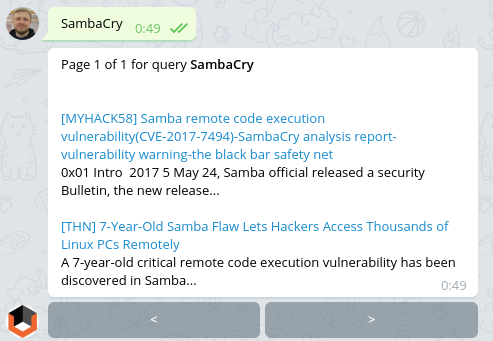
For example, I’ve heard about new critical vulnerability in Samba called SambaCry by analogy with famous WannaCry. Let’s see what Vulners knows about it.

SambaCry Vulners Bot Search

Ok, I see it has id CVE-2017-7494. Do we have exploits related to this vulnerability?
cvelist:CVE-2017-7494 AND bulletinFamily:”exploit”

Continue reading

WannaCry about Vulnerability Management

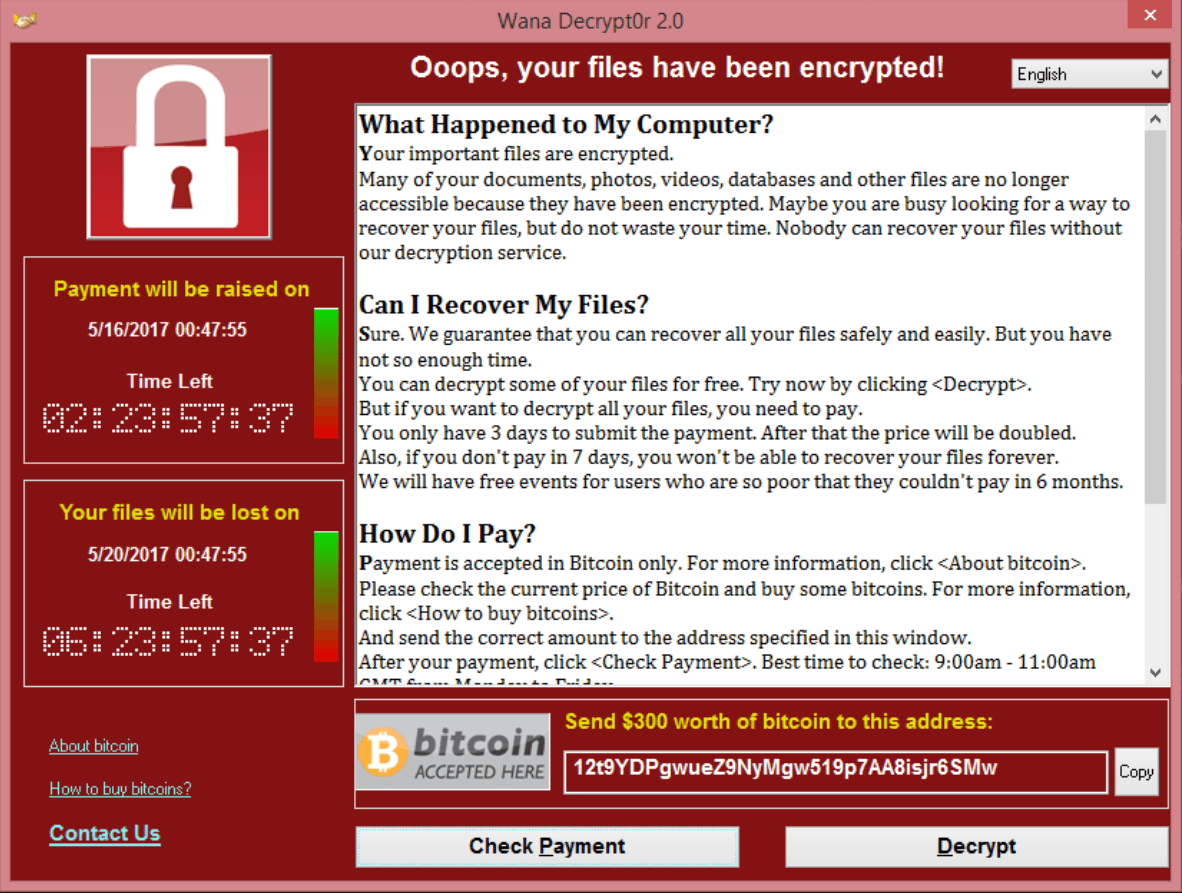
WannaCry about Vulnerability Management. Nearly all mainstream media wrote today about massive ransomware attacks around the world: 16 medical institutions in UK, strong rumours that huge companies in Russia, and even Russian Ministry of Internal Affairs suffered a damage.

At this moment Kaspersky recorded more than 45,000 attacks in 74 countries around the world, but mostly in Russia. During the attack WannaCry malware encrypts data with the extension “.WCRY” added to the filename – that’s why it is called this way.

WannaCry CryptoLocker

What I like in this WannaCry story, that it’s actually all about Vulnerability Management.

Continue reading

Vulnerability Quadrants

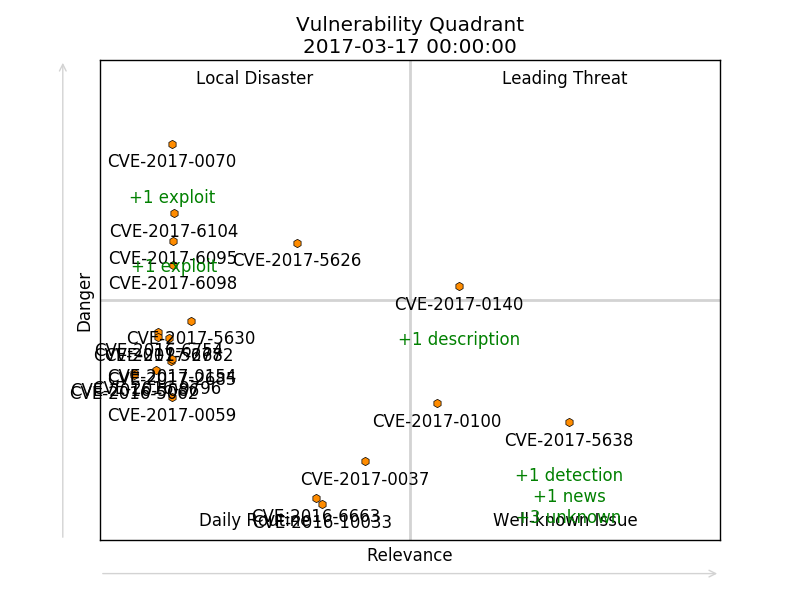
Vulnerability Quadrants. Hi everyone! Today I would like talk about software vulnerabilities. How to find really interesting vulnerabilities in the overall CVE flow. And how to do it automatically.

Vulnerability Quadrant

First of all, let’s talk why we may ever need to analyze software vulnerabilities? How people usually do their Vulnerability Management and Vulnerability Intelligence?

VM strategies

  • Some people have a Vulnerability scanner, scan infrastructure with it, patch founded vulnerabilities and think that this will be enough.
  • Some people pay attention to the vulnerabilities that are widely covered by media.
  • Some people use vulnerability databases and search for the most critical vulnerabilities by some criteria.

Each of these ways have some advantages and some disadvantages.

Continue reading

My comments on Forrester’s “Vulnerability Management vendor landscape 2017”

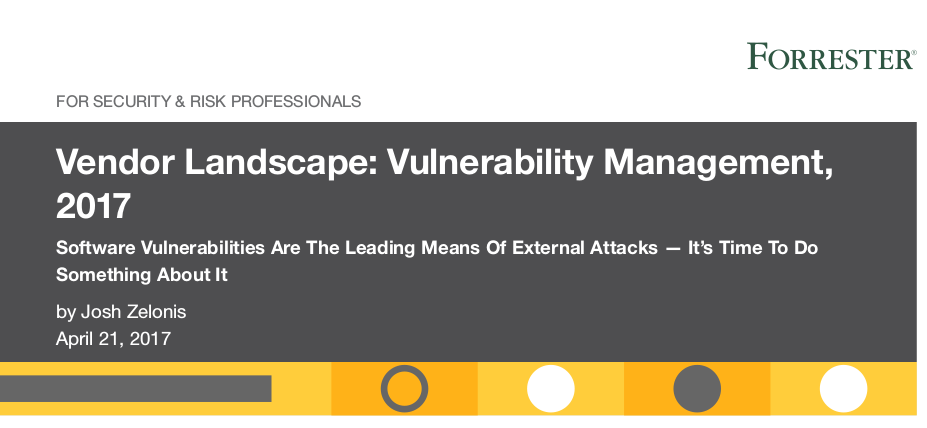
My comments on Forrester’s “Vulnerability Management vendor landscape 2017”. A top consulting company, Forrester Research, recently published report “Vendor Landscape: Vulnerability Management, 2017“. You can read for free by filling a small form on Tenable web site.

Forrester Vendor Landscape: Vulnerability Management, 2017

What’s interesting in this document? First of all, Josh Zelonis and co-authors presented their version of VM products  evolution. It consists of this steps (I have reformulated them a bit for the copyright reasons) :

  1. Initial fear of automated vulnerability assessment tools
  2. Mid-1990s and first productized offerings
  3. Authenticated scanning dramatically improved accuracy of scans
  4. Application scanning (DAST)
  5. Security assessment of software containers and DevOps in general.

As you see, the last one is about containerization. And it is now presented only in Tenable.io/FlawCheck. 😉

Continue reading

Vulnerability subscriptions in terms of business

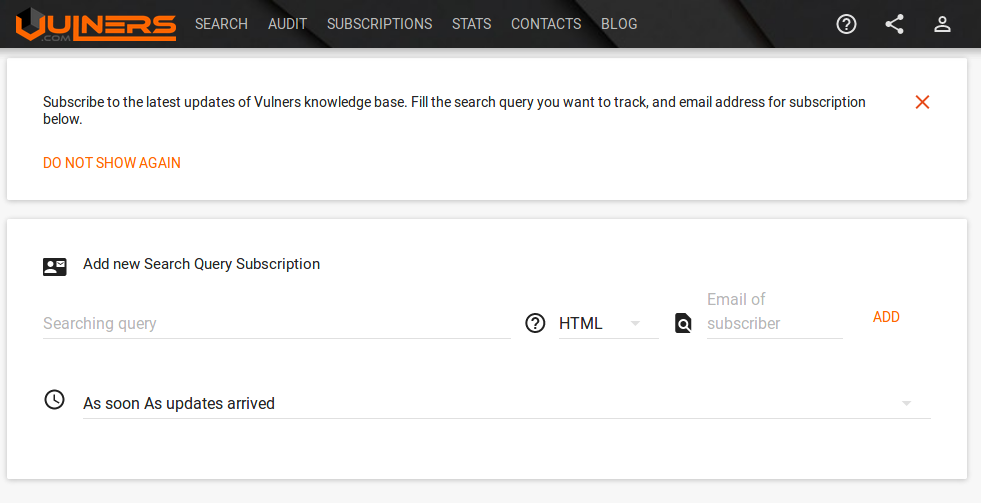
Vulnerability subscriptions in terms of business. The question is: do we really need an employee in organization that deals with vulnerabilities in infrastructure on a full-time basis? Since this is similar to what I do for living, I would naturally say that yes, it is necessary. But as person, who makes security automation, I can say that there are some options. ?

Vulners Subscriptions

What can and can’t Vulnerability Assessment (VA) specialist do?

VA specialist makes recommendations to remove vulnerabilities from your infrastructure using some tools: vulnerability scanners, vulnerability feeds, different news sources. In case of network vulnerabilities, he will most often tell your IT administrators: “Do we use A software with version BBB? As I see some security bulletin says that there is a critical vulnerability in it”. That’s it.

VA specialist by himself usually don’t patch the hosts. Moreover, sometimes he can’t detect the vulnerability, even he has an expansive vulnerability scanner, because some vulnerabilities can only be detected locally during authenticated scanning, and this IS specialist may not have permissions to do it.

Continue reading

Why you can’t update it all at once?

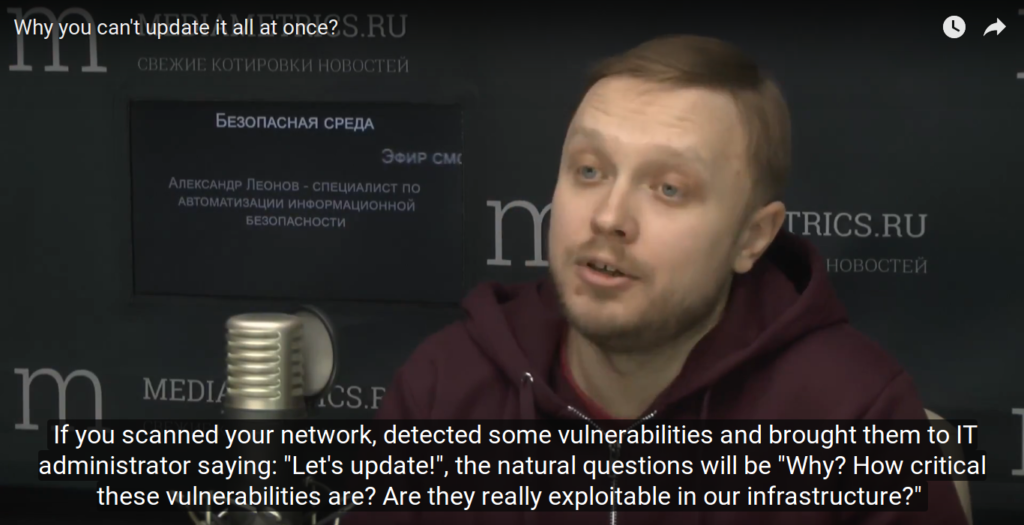
Why you can’t update it all at once? It’s the second part of our talk with Daniil Svetlov at his radio show “Safe Environment” recorded 29.03.2017. In this part we talk about vulnerabilities in Linux and proprietary software, problems of patch an vulnerability management, and mention some related compliance requirements.

How critical these vulnerabilities are? Are they really exploitable in our infrastructure?

Video with manually transcribed Russian/English subtitles:

Previous part “Programmers are also people who also make mistakes”.

Taking about the fact that if you use fully updated software and do not use some self-written scripts, programs, then in theory everything will be safe.

But recently there was some statistics that critical vulnerabilities stay in Linux kernel about 7 years from the moment they appeared as a result of a programmer’s error till the moment they were found by our white hat researcher.

But it is not clear during these seven years if cybercriminals have found them, used them and how many systems were broken using this vulnerabilities. Not to mention that some special government services may use it too.

For example: The latest Linux kernel flaw (CVE-2017-2636), which existed in the Linux kernel for the past seven years, allows a local unprivileged user to gain root privileges on affected systems or cause a denial of service (system crash). The Hacker News

Well yes. There is such a statistic. There is also some criticism from proprietary software developers. Like you say “many eyes that looks in code will find any error.” This is a quote from Linus Torvalds, if I’m not mistaken.

Not exactly. Linus’s Law is a claim about software development, named in honor of Linus Torvalds and formulated by Eric S. Raymond in his essay and book The Cathedral and the Bazaar (1999).[1][2] The law states that “given enough eyeballs, all bugs are shallow”; or more formally: “Given a large enough beta-tester and co-developer base, almost every problem will be characterized quickly and the fix obvious to someone.” Wikipedia

But in practice, yes, there are really old vulnerabilities that come up after many many years. Because apparently they did not looking for this vulnerabilities well enough.But we still don’t have anything else, except Linux kernel. Therefore, they can say anything, but they will use it anyway. It is in the first place.

Continue reading