Tag Archives: ZDI

Security Feature Bypass - Windows Mark of the Web "Copy2Pwn" (CVE-2024-38213)

Security Feature Bypass - Windows Mark of the Web Copy2Pwn (CVE-2024-38213)

Security Feature Bypass - Windows Mark of the Web "Copy2Pwn" (CVE-2024-38213). The vulnerability was released as part of the August Microsoft Patch Tuesday (although ZDI writes that MS fixed it earlier, in June).

The vulnerability allows attackers to bypass the SmartScreen security feature, which protects users from running potentially malicious files downloaded from the Internet.

What is it about? There is a set of extensions over HTTP for collaborative work with files - WebDAV.

🔹 The WebDAV share can be accessed via a web browser::

http://10_.37.129.2/example_webdav_folder/somefile

🔹 Or you can do it via Windows Explorer (like SMB):

\\10_.37.129.2@80\example_webdav_folder

When copying from the WebDAV share via Windows Explorer, the Mark-of-the-Web label was not set. 🤷‍♂️ That's why the name is "Copy2Pwn". 😏

According to ZDI, the vulnerability has been exploited by the DarkGate malware operator since at least March 2024.

На русском

Trending vulnerabilities for June according to Positive Technologies

Trending vulnerabilities for June according to Positive Technologies. Traditionally, in 3 formats (in Russian):

📹 The section "Trending VM" in the SecLab news video (starts at 15:03)
🗞 Post on the Habr website, in fact this is a slightly expanded scenario for the "Trending VM" section
🗒 Compact digest with technical details on the official PT website

List of vulnerabilities:

🔻 EoP in Microsoft Windows CSC (CVE-2024-26229)
🔻 EoP in Microsoft Windows Error Reporting (CVE-2024-26169)
🔻 EoP in Microsoft Windows Kernel (CVE-2024-30088)
🔻 RCE in PHP (CVE-2024-4577)
🔻 EoP in Linux Kernel (CVE-2024-1086)
🔻 InfDisclosure in Check Point Security Gateways (CVE-2024-24919)
🔻 RCE in VMware vCenter (CVE-2024-37079, CVE-2024-37080)
🔻 AuthBypass in Veeam Backup & Replication (CVE-2024-29849)

На русском

The severity of the Elevation of Privilege - Windows Kernel (CVE-2024-30088) has increased

The severity of the Elevation of Privilege - Windows Kernel (CVE-2024-30088) has increased

The severity of the Elevation of Privilege - Windows Kernel (CVE-2024-30088) has increased. The vulnerability is fresh, it is from the June Microsoft Patch Tuesday. I highlighted it in the review because, according to the CVSS vector, there was a private Proof-of-Concept Exploit for it. But there were no details. It was only clear that in case of successful exploitation, the attacker gains SYSTEM privileges. According to the ZDI advisory, the vulnerability affects the implementation of NtQueryInformationToken and is due to the lack of proper locking when performing operations on the object.

On June 24, 2 weeks after the June Patch Tuesday, a repository with technical details on this vulnerability and PoC appeared on GitHub. A video of running the utility to obtain SYSTEM privileges is also available.

A lot of exploits have begun to appear for Windows EoP/LPE vulnerabilities recently. Fix them in advance!

На русском

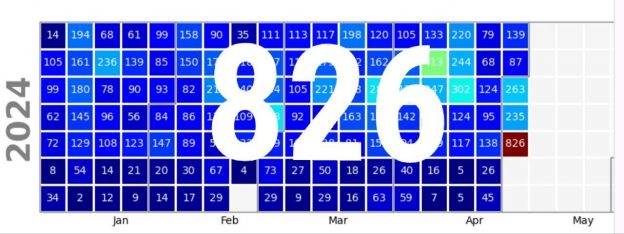
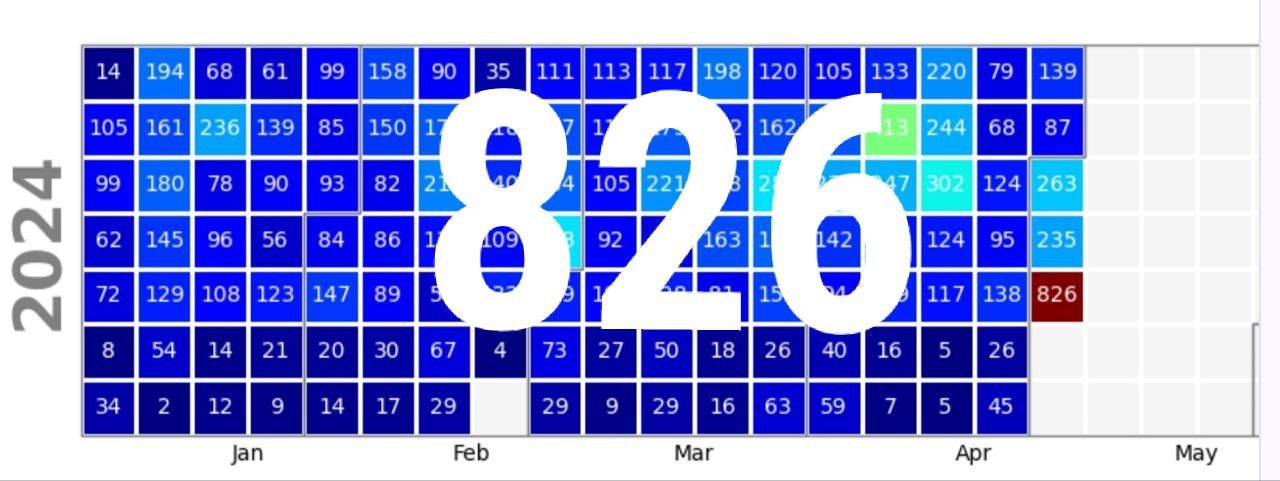
On May 3, more than 826 new vulnerabilities were added to NVD (in just one day)

On May 3, more than 826 new vulnerabilities were added to NVD (in just one day)

On May 3, more than 826 new vulnerabilities were added to NVD (in just one day). Picture from the CVE.icu service, which visualizes NVD changes. There is also a list of these vulnerabilities. Most of them, 709, were added by ZDI. Why would they do that? 🤔

Last November I had a post (in Russian) that a number of trending vulnerabilities that were reported by ZDI are displayed in NVD as "CVE ID Not Found". So, it seems the geniuses from Trend Micro ZDI finally noticed that their CVEs do not reach NVD and decided to fix this with such a massive import of problematic CVEs. 🤷‍♂️ At the same time, they clearly demonstrated the scale of the disaster. 🙂

Well, better late than never. But now it will be interesting to calculate the delay between the appearance of ZDI-CAN identifier and NVD CVE. 😏 For example, for RCE - WinRAR CVE-2023-40477, exploited in phishing attacks, it is 260 days. 🤠

PS: the final number for May 3rd is 847 CVE, but this is not that important.

На русском

First impressions of the April Microsoft Patch Tuesday

First impressions of the April Microsoft Patch Tuesday
First impressions of the April Microsoft Patch TuesdayFirst impressions of the April Microsoft Patch TuesdayFirst impressions of the April Microsoft Patch TuesdayFirst impressions of the April Microsoft Patch TuesdayFirst impressions of the April Microsoft Patch TuesdayFirst impressions of the April Microsoft Patch TuesdayFirst impressions of the April Microsoft Patch TuesdayFirst impressions of the April Microsoft Patch TuesdayFirst impressions of the April Microsoft Patch Tuesday

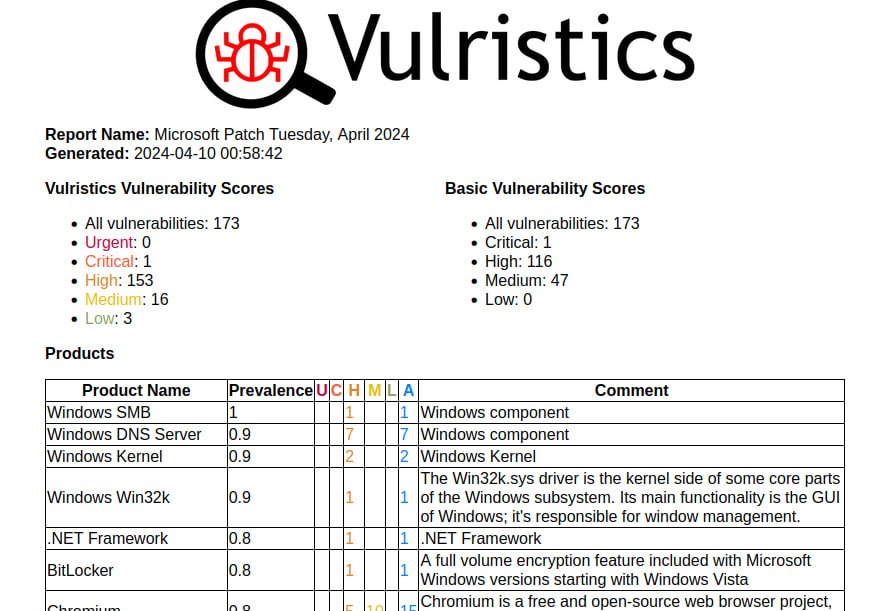
First impressions of the April Microsoft Patch Tuesday. I don't even know what to write. 🤪 Very strange! 173 vulnerabilities, of which 23 were added since the last Patch Tuesday.

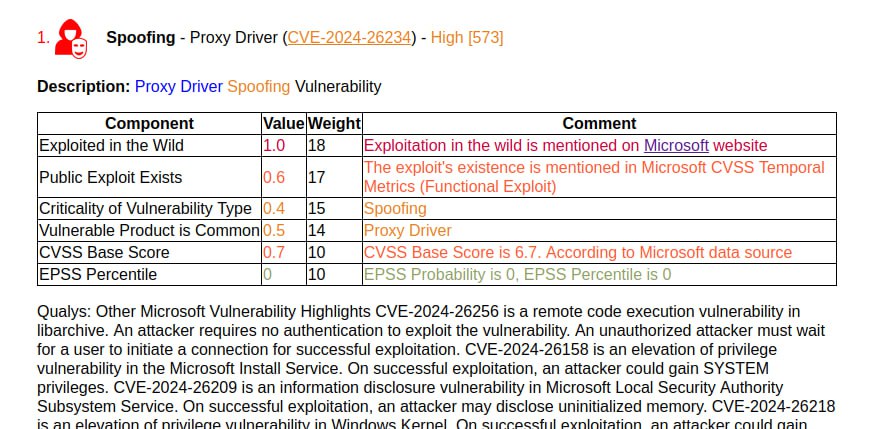
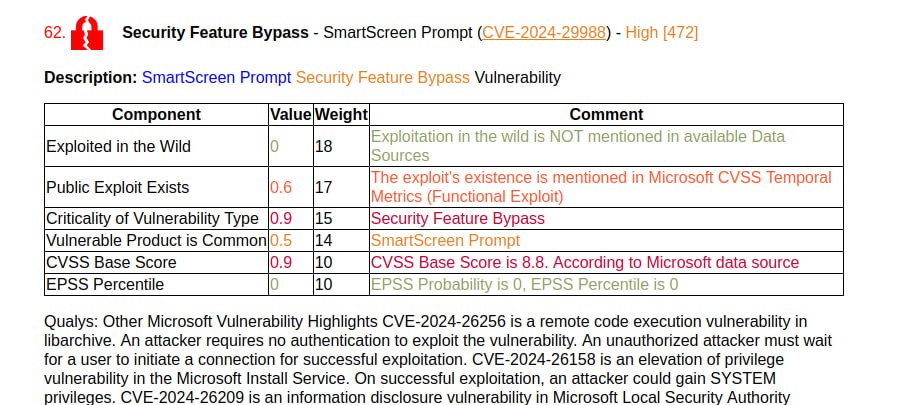
Microsoft flags one vulnerability as being exploited in the wild: Spoofing - Proxy Driver (CVE-2024-26234). And only Qualys briefly mentions it. Literally like this: "Microsoft has not disclosed any information about the vulnerability". 😅 ZDI also claims that Security Feature Bypass - SmartScreen Prompt (CVE-2024-29988) is being exploited in the wild, which is a Mark of the Web (MotW) bypass.

There are no exploits for anything yet. The following vulnerabilities can be highlighted:

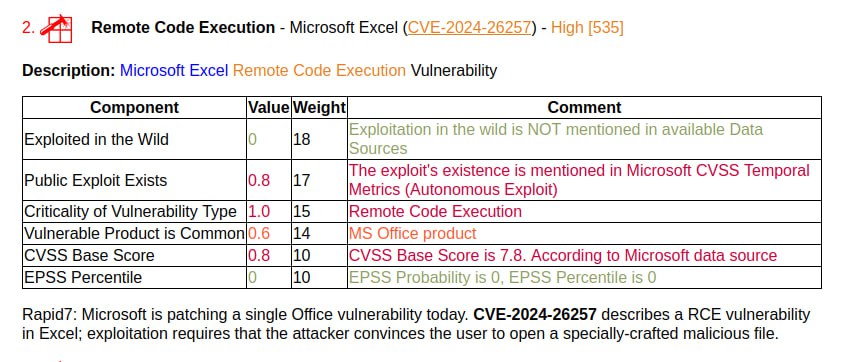
🔸 Remote Code Execution - Microsoft Excel (CVE-2024-26257). Can be exploited by an attacker when the victim opens a specially crafted file.
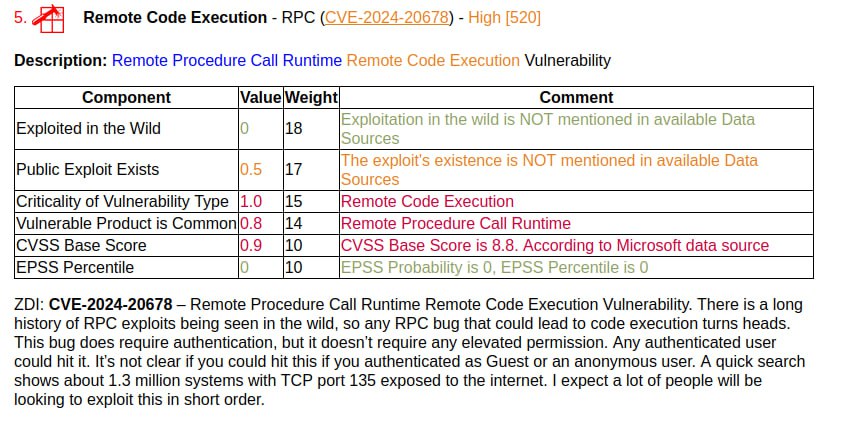
🔸 Remote Code Execution - RPC (CVE-2024-20678). It is highlighted by ZDI, which also claims 1.3 million exposed TCP 135 ports.
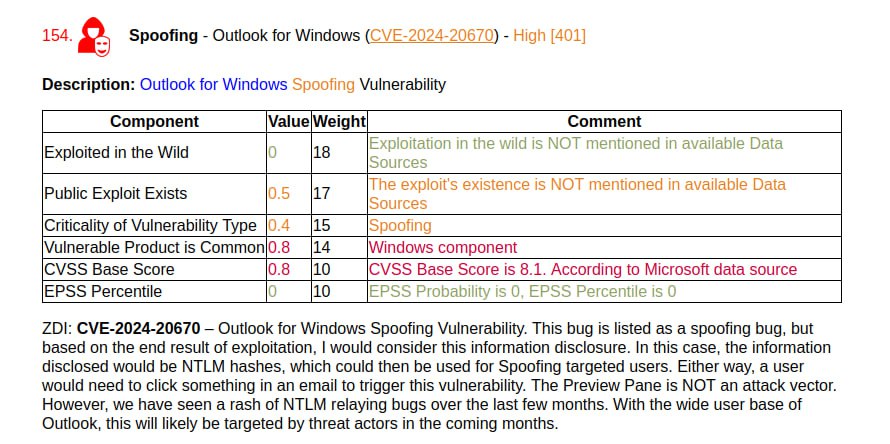
🔸 Spoofing - Outlook for Windows (CVE-2024-20670). ZDI writes that this is an Information Disclosure vulnerability that can be used in NTLM relay attacks.
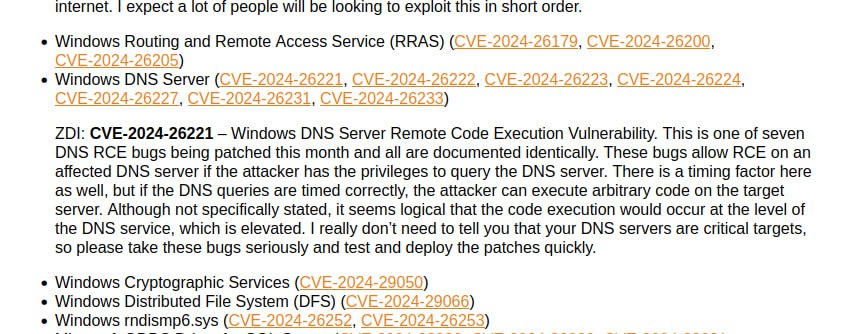
🔸 Remote Code Execution - Windows DNS Server (CVE-2024-26221, CVE-2024-26222, CVE-2024-26223, CVE-2024-26224, CVE-2024-26227, CVE-2024-26231, CVE-2024-26233). Maybe some of this will be exploited in the wild, ZDI particularly highlights CVE-2024-26221.
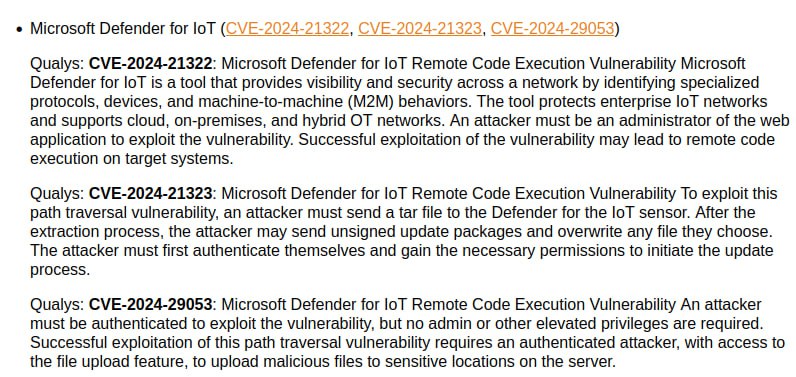
🔸 Remote Code Execution - Microsoft Defender for IoT (CVE-2024-21322, CVE-2024-21323, CVE-2024-29053). It is an IoT and ICS/OT security solution that can be deployed on-prem.

There are simply indecently massive fixes:

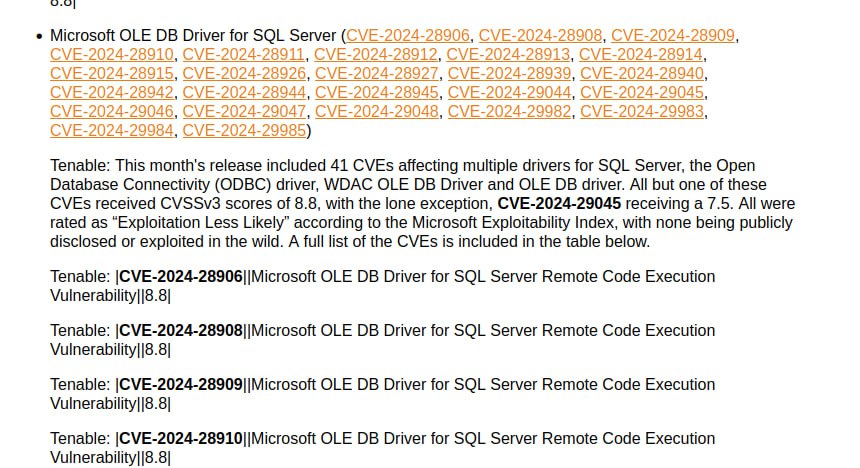
🔹 Remote Code Execution - Microsoft OLE DB Driver for SQL Server / Microsoft WDAC OLE DB Provider for SQL Server / Microsoft WDAC SQL Server ODBC Driver. 28 CVEs! I won’t even list everything here. 😨
🔹 Security Feature Bypass - Secure Boot. 23 CVEs!

🗒 Vulristics report

На русском

Upd. 10.04 I slightly tweaked the vulnerability type detection to increase the priority of the detection based on the Microsoft generated description compared to the detection based on CWE. In particular, the type of vulnerability for Spoofing - Proxy Driver (CVE-2024-26234) and Spoofing - Outlook for Windows (CVE-2024-20670) has changed.

September 2023: VM courses, Bahasa Indonesia, Russian Podcasts, Goodbye Tinkoff, MS Patch Tuesday, Qualys TOP 20, Linux, Forrester, GigaOm, R-Vision VM

September 2023: VM courses, Bahasa Indonesia, Russian Podcasts, Goodbye Tinkoff, MS Patch Tuesday, Qualys TOP 20, Linux, Forrester, GigaOm, R-Vision VM. Hello everyone! On the last day of September, I decided to record another retrospective episode on how my Vulnerability Management month went.

Alternative video link (for Russia): https://vk.com/video-149273431_456239136

September was quite a busy month for me.

Continue reading

Microsoft Patch Tuesday July 2023: Vulristics improvements, Office RCE, SFB SmartScreen and Outlook, EoP MSHTML and ERS, other RCEs

Microsoft Patch Tuesday July 2023: Vulristics improvements, Office RCE, SFB SmartScreen and Outlook, EoP MSHTML and ERS, other RCEs. Hello everyone! This episode will be about Microsoft Patch Tuesday for July 2023, including vulnerabilities that were added between June and July Patch Tuesdays.

Alternative video link (for Russia): https://vk.com/video-149273431_456239131

As usual, I use my open source Vulristics project to analyse and prioritize vulnerabilities.

Continue reading