Category Archives: Vulnerability

Today starts an online hackathon organized by the MaxPatrol VM Positive Technologies team

Today starts an online hackathon organized by the MaxPatrol VM Positive Technologies team

Today starts an online hackathon organized by the MaxPatrol VM Positive Technologies team. Participants will develop vulnerability detection rules. There were no restrictions on the participation of PT employees, so I also applied and will share my impressions in the Telegram channel. 😏 I am very exited. 🤩

IMHO, involving the community in the development of security content is exactly what will radically improve the completeness and quality of vulnerability/misconfiguration detection in VM products. And that is the very essence of these products.

На русском

Yesterday Qualys introduced CyberSecurity Asset Management 3.0

Yesterday Qualys introduced CyberSecurity Asset Management 3.0Yesterday Qualys introduced CyberSecurity Asset Management 3.0

Yesterday Qualys introduced CyberSecurity Asset Management 3.0. The product name contains “Asset Management”, but in the first sentence the solution is presented to us as “re-defining attack surface management” (EASM). Such a Gartner-style marketing mishmash. 🤷‍♂️ At the same time, Qualys does have quite unusual Asset Management and EASM. And it’s unusual how they came to this. These are solely my impressions as an outside observer; I do not have any insider information.

🔹 In 2020, Qualys introduced a Global AssetView solution. To put it simply, users could roll out Qualys cloud agents to hosts in the their infrastructure, deploy Qualys Passive Sensor to search for unknown assets in network traffic, and based on this get some basic understanding of their infrastructure (without detecting vulnerabilities). And most importantly, it’s all free! This is a Freemium offer that allowed the company to conveniently upsell the functionality of Vulnerability Management and Compliance Management. The move is very, very bold.

🔹 In 2021, as a development of Global AssetView, the CyberSecurity Asset Management product appeared. This was already a full-fledged Asset Management: two-way synchronization with ServiceNow CMDB, asset criticality assessment, analysis of installed software, attack surface analysis using Shodan (the last option was not particularly emphasized back then). As far as I can understand, the original purpose of CSAM was to deal with cases that affect the security of assets, but are not, strictly speaking, vulnerabilities: shadow IT, upcoming end-of-life (EoL)-of-support (EoS) hosts, hosts without installed EDR, risky ports accessible from the Internet, misconfigurations of software and services.

🔹 In 2022, Qualys released CyberSecurity Asset Management 2.0 with an integrated External Attack Surface Management (EASM) solution. The idea that EASM can be developed and delivered as part of an Asset Management solution is quite unusual. But there is logic in this. Reducing the attack surface is not about patching this or that vulnerable server. This is about the fact that there should not be any unnecessary junk (“if an externally facing asset or its configuration is not necessary for the business, then it should be shut down“). And from this point of view, EASM is really not so much a perimeter scanner. It is rather a cunning utility that lists non-obvious assets that are, with some probability, related to the company, and shows the risks associated with them. 🐇 🎩 Is this part of Аsset Management? Well, apparently so.

So, as far as I understand, Qualys now has VMDR (Vulnerability Management, Detection and Response), which includes CSAM (CyberSecurity Asset Management ), which in turn includes EASM (External Attack Surface Management). Something like a matryoshka. 🪆

What’s in CSAM 3.0?

🔻 Qualys removed mentions of Shodan. “CSAM 3.0 uses new attribution scoring and expands the use of open-source technology and a proprietary internet scanner to drive accurate discovery, attribution, and vulnerability assessment”. When attributing an asset, attribution scoring are displayed (you can filter by them).

🔻Cloud Agent Passive Sensing asset detection capabilities are now used (host agents that sniff traffic).

🔻Connectors for integration with asset data sources (connectors for Active Directory and BMC Helix announced). Apparently there was no integration with AD before.🤷‍♂️

На русском

Detection of known (CVE) vulnerabilities without authentication (in Pentest mode): overkill or necessity? There is an opinion that when detecting vulnerabilities in internal infrastructure, scanning without authentication is not necessary at all

Detection of known (CVE) vulnerabilities without authentication (in Pentest mode): overkill or necessity? There is an opinion that when detecting vulnerabilities in internal infrastructure, scanning without authentication is not necessary at all

Detection of known (CVE) vulnerabilities without authentication (in Pentest mode): overkill or necessity? There is an opinion that when detecting vulnerabilities in internal infrastructure, scanning without authentication is not necessary at all. That it is enough to install agents on the hosts. And those hosts where agents cannot be installed, for example network devices, just need to be scanned with authentication. They say scans without authentication are always less reliable than scans with authentication, and they are needed only for perimeter scanning or primary network inventory. In my opinion, this is not completely correct. Scanning without authentication for known vulnerabilities is mandatory, especially when the target is a host running a web application.

And this is due to the peculiarities of detecting vulnerabilities during scanning with authentication. Let’s take Linux hosts. Typically, VM vendors when scanning Linux hosts with authentication, limit themselves to detecting vulnerabilities in packages from the official Linux vendor repository. 🤷‍♂️ Simply because these vulnerabilities are described in publicly available security bulletins or even as formalized OVAL content. It’s convenient. If you have learned to work with such content, you can check the box that the Linux distribution is supported by the VM solution. What about vulnerabilities for software that is not in the official Linux vendor repository? This is where things get more complicated.

This software can be installed:

🔹 From a connected third-party Linux software repository
🔹 From a package (made by some vendor or selfbuilt) of the standard package system for this Linux distro (deb, rpm), brought to the host manually
🔹 From alternative packages for software distribution (snap, flatpak, appimage, etc.)
🔹 From module distribution tools (pip, conda, npm, etc.)
🔹 From a container image (docker, podman, etc.)
🔹 From software source codes; the software can be built directly on the target host or can be transferred there as binary files.

Ideally, no matter how the software is installed on a host, a vulnerability scanner should correctly detect that software installation, determine the version, and identify associated vulnerabilities based on the version. 🧙‍♂️ But in practice, due to the fact that there are many ways to install software, this is a very non-trivial task. 🧐

As a result, we get a situation: let’s say we have some kind of commercial or open source software on a Linux host (Zabbix, GitLab, Confluence, Jira). This software is not easy to reliably find simply by exploring the host from the inside via SSH. And when looking at the host from the outside, searching for this software is trivial: we scan the ports, find the web-GUI, often find the version directly on the main page and use it to detect vulnerabilities. At the same time, we are not at all dependent on the specific method of installing and running the software on the host. The main thing is that we see the web interface of the application itself. 🤩

Such “external” rules for detecting vulnerabilities are much easier to develop. You can also use ready-made expertise. Fingerprinting to obtain a CPE ID combined with a CPE lookup in NVD is, of course, a dirty path. But this allows you to add vulnerability detection rules in large quantities. 😏 And if you can tweak both the fingerprint and the CPE detection rules, then the number of errors can be reduced to an acceptable level. And if you also add validation of vulnerabilities with an exploitation attempt (for example, using nuclei), then a significant set of vulnerabilities can be detected more than reliably. 😉

So, scanning for known vulnerabilities without authentication (“pentest”) is a must have for internal infrastructure as well, especially for hosts with web applications.

На русском

On May 3, more than 826 new vulnerabilities were added to NVD (in just one day)

On May 3, more than 826 new vulnerabilities were added to NVD (in just one day)

On May 3, more than 826 new vulnerabilities were added to NVD (in just one day). Picture from the CVE.icu service, which visualizes NVD changes. There is also a list of these vulnerabilities. Most of them, 709, were added by ZDI. Why would they do that? 🤔

Last November I had a post (in Russian) that a number of trending vulnerabilities that were reported by ZDI are displayed in NVD as “CVE ID Not Found”. So, it seems the geniuses from Trend Micro ZDI finally noticed that their CVEs do not reach NVD and decided to fix this with such a massive import of problematic CVEs. 🤷‍♂️ At the same time, they clearly demonstrated the scale of the disaster. 🙂

Well, better late than never. But now it will be interesting to calculate the delay between the appearance of ZDI-CAN identifier and NVD CVE. 😏 For example, for RCE – WinRAR CVE-2023-40477, exploited in phishing attacks, it is 260 days. 🤠

PS: the final number for May 3rd is 847 CVE, but this is not that important.

На русском

4 RCEs in HPE Aruba Networking devices

4 RCEs in HPE Aruba Networking devices4 RCEs in HPE Aruba Networking devices4 RCEs in HPE Aruba Networking devices4 RCEs in HPE Aruba Networking devices4 RCEs in HPE Aruba Networking devices

4 RCEs in HPE Aruba Networking devices. All 4 vulnerabilities relate to buffer overflows in various ArubaOS services. ArubaOS is a network operating system for Aruba networking equipment, including switches, access points, and gateways. The company’s main focus is on wireless networks.

All 4 vulnerabilities are exploited via requests to the Process Application Programming Interface (PAPI), UDP port 8211, no authentication required. All have CVSS 9.8.

Vulnerable Products:

🔻 Mobility Conductor (formerly Mobility Master)
🔻 Mobility Controllers
🔻 Aruba Central manages WLAN Gateways and SD-WAN Gateways

Updates are available for minor versions of ArubaOS 8 and 10. Legacy versions of ArubaOS and SD-WAN are also vulnerable.

Now is the time to check if you have anything from HPE Aruba on your network before an exploit appears. 😉

На русском

I generated a Vulristics report on the April Linux Patch Wednesday

I generated a Vulristics report on the April Linux Patch Wednesday
I generated a Vulristics report on the April Linux Patch WednesdayI generated a Vulristics report on the April Linux Patch WednesdayI generated a Vulristics report on the April Linux Patch WednesdayI generated a Vulristics report on the April Linux Patch WednesdayI generated a Vulristics report on the April Linux Patch WednesdayI generated a Vulristics report on the April Linux Patch Wednesday

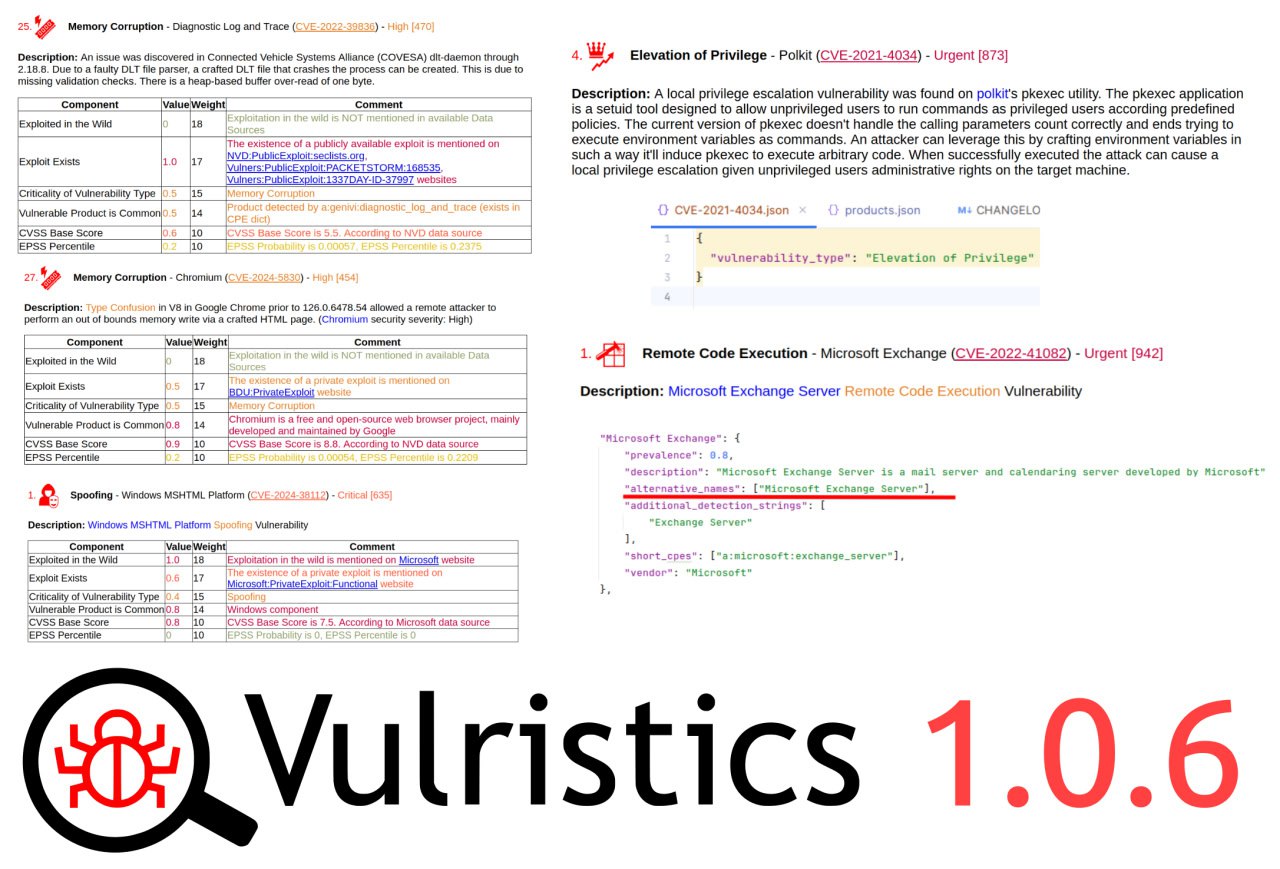
I generated a Vulristics report on the April Linux Patch Wednesday. Over the past month, Linux vendors have begun releasing patches for a record number of vulnerabilities – 348. There are signs of exploitation in the wild for 7 vulnerabilities (data on incidents from the FSTEC BDU). Another 165 have a link to an exploit or a sign of the existence of a public/private exploit.

Let’s start with 7 vulnerabilities with signs of exploitation in the wild and exploits:

🔻 The trending January vulnerability Authentication Bypass – Jenkins (CVE-2024-23897) unexpectedly appeared in the TOP. As far as I understand, Linux distributions usually do not include Jenkins packages in the official repositories and, accordingly, do not add Jenkins vulnerability detection rules to their OVAL content. Unlike the Russian Linux distribution RedOS. Therefore, RedOS has the earliest fix timestamp for this vulnerability.

🔻 2 RCE vulnerabilities. The most interesting of them is Remote Code Execution – Exim (CVE-2023-42118). When generating the report, I deliberately did not take into account the vulnerability description and product names from the BDU database (flags –bdu-use-product-names-flag, –bdu-use-vulnerability-descriptions-flag set to False). Otherwise, the report would be partly in English and partly in Russian. But it turned out that so far only BDU has an adequate description of this vulnerability. 🤷‍♂️ You need to take a closer look at this vulnerability because Exim is a fairly popular mail server. The second RCE vulnerability is in the web browser, Remote Code Execution – Safari (CVE-2023-42950).

🔻2 DoS vulnerabilities. Denial of Service – nghttp2/Apache HTTP Server (CVE-2024-27316) and Denial of Service – Apache Traffic Server (CVE-2024-31309). The second is classified in the report as Security Feature Bypass, but this is due to incorrect CWE in NVD (CWE-20 – Improper Input Validation)

🔻 2 browser vulnerabilities Security Feature Bypass – Chromium (CVE-2024-2628, CVE-2024-2630)

Among the vulnerabilities for which there are only signs of the existence of exploits so far, you can pay attention to the following:

🔸 A large number of RCE vulnerabilities (71). Most of them are in the gtkwave product. This is a viewer for VCD (Value Change Dump) files, which are typically created by digital circuit simulators. Also, the Remote Code Execution – Cacti (CVE-2023-49084, CVE-2023-49085) vulnerabilities look dangerous. Cacti is a solution for monitoring servers and network devices.

🔸 Security Feature Bypass – Sendmail (CVE-2023-51765). Allows an attacker to inject email messages with a spoofed MAIL FROM address.

🔸 A pack of Cross Site Scripting vulnerabilities in MediaWiki, Cacti, Grafana, Nextcloud.

There is a lot to explore this time. 🤩

🗒 April Linux Patch Wednesday

На русском

First impressions of the April Microsoft Patch Tuesday

First impressions of the April Microsoft Patch Tuesday
First impressions of the April Microsoft Patch TuesdayFirst impressions of the April Microsoft Patch TuesdayFirst impressions of the April Microsoft Patch TuesdayFirst impressions of the April Microsoft Patch TuesdayFirst impressions of the April Microsoft Patch TuesdayFirst impressions of the April Microsoft Patch TuesdayFirst impressions of the April Microsoft Patch TuesdayFirst impressions of the April Microsoft Patch TuesdayFirst impressions of the April Microsoft Patch Tuesday

First impressions of the April Microsoft Patch Tuesday. I don’t even know what to write. 🤪 Very strange! 173 vulnerabilities, of which 23 were added since the last Patch Tuesday.

Microsoft flags one vulnerability as being exploited in the wild: Spoofing – Proxy Driver (CVE-2024-26234). And only Qualys briefly mentions it. Literally like this: “Microsoft has not disclosed any information about the vulnerability”. 😅 ZDI also claims that Security Feature Bypass – SmartScreen Prompt (CVE-2024-29988) is being exploited in the wild, which is a Mark of the Web (MotW) bypass.

There are no exploits for anything yet. The following vulnerabilities can be highlighted:

🔸 Remote Code Execution – Microsoft Excel (CVE-2024-26257). Can be exploited by an attacker when the victim opens a specially crafted file.
🔸 Remote Code Execution – RPC (CVE-2024-20678). It is highlighted by ZDI, which also claims 1.3 million exposed TCP 135 ports.
🔸 Spoofing – Outlook for Windows (CVE-2024-20670). ZDI writes that this is an Information Disclosure vulnerability that can be used in NTLM relay attacks.
🔸 Remote Code Execution – Windows DNS Server (CVE-2024-26221, CVE-2024-26222, CVE-2024-26223, CVE-2024-26224, CVE-2024-26227, CVE-2024-26231, CVE-2024-26233). Maybe some of this will be exploited in the wild, ZDI particularly highlights CVE-2024-26221.
🔸 Remote Code Execution – Microsoft Defender for IoT (CVE-2024-21322, CVE-2024-21323, CVE-2024-29053). It is an IoT and ICS/OT security solution that can be deployed on-prem.

There are simply indecently massive fixes:

🔹 Remote Code Execution – Microsoft OLE DB Driver for SQL Server / Microsoft WDAC OLE DB Provider for SQL Server / Microsoft WDAC SQL Server ODBC Driver. 28 CVEs! I won’t even list everything here. 😨
🔹 Security Feature Bypass – Secure Boot. 23 CVEs!

🗒 Vulristics report

На русском

Upd. 10.04 I slightly tweaked the vulnerability type detection to increase the priority of the detection based on the Microsoft generated description compared to the detection based on CWE. In particular, the type of vulnerability for Spoofing – Proxy Driver (CVE-2024-26234) and Spoofing – Outlook for Windows (CVE-2024-20670) has changed.