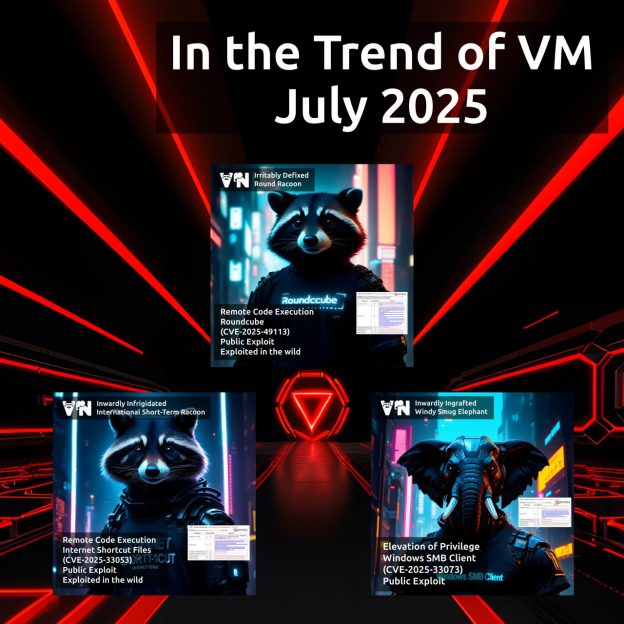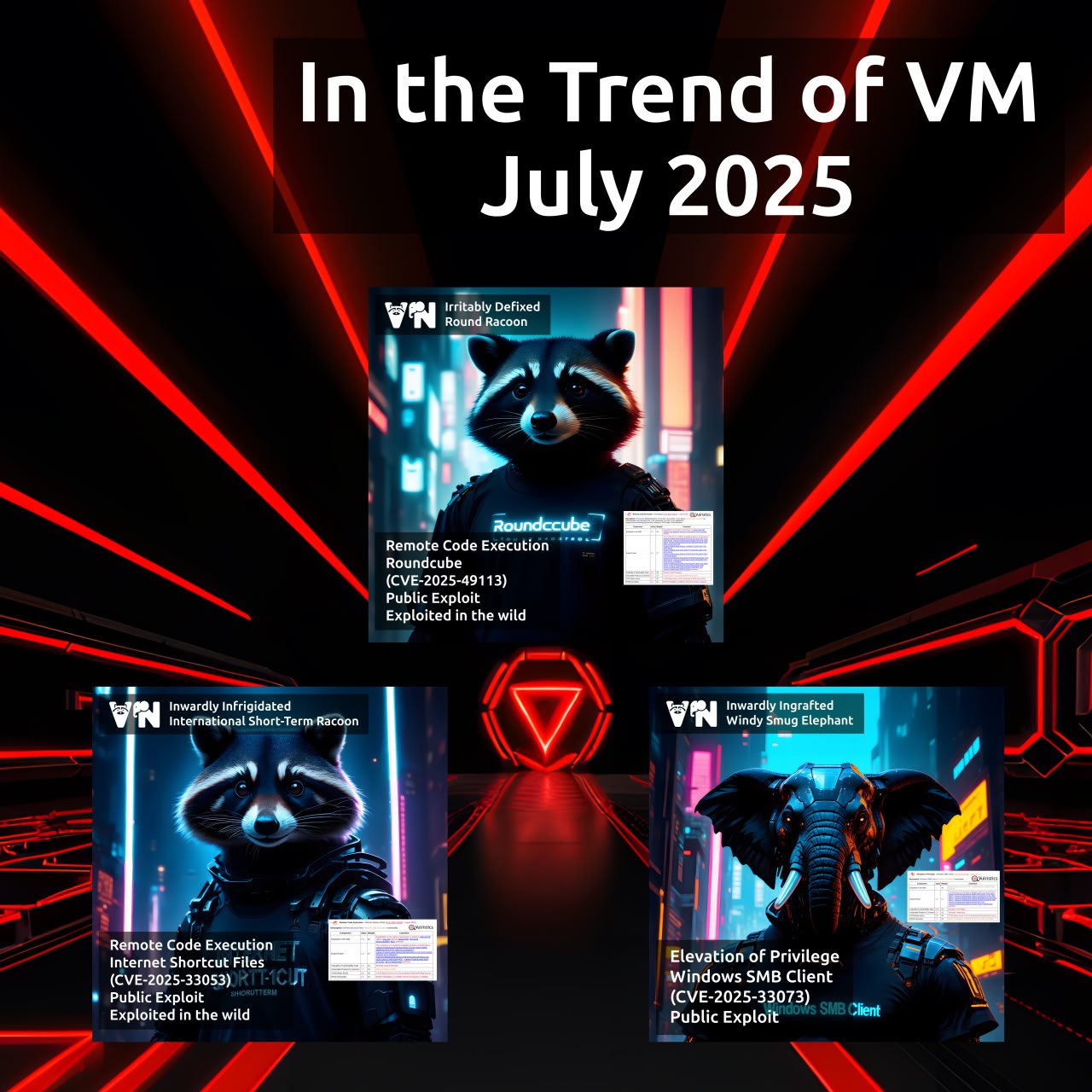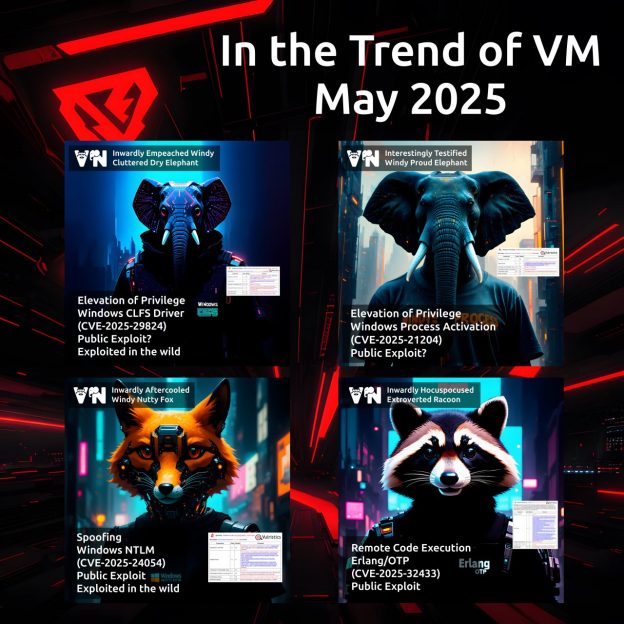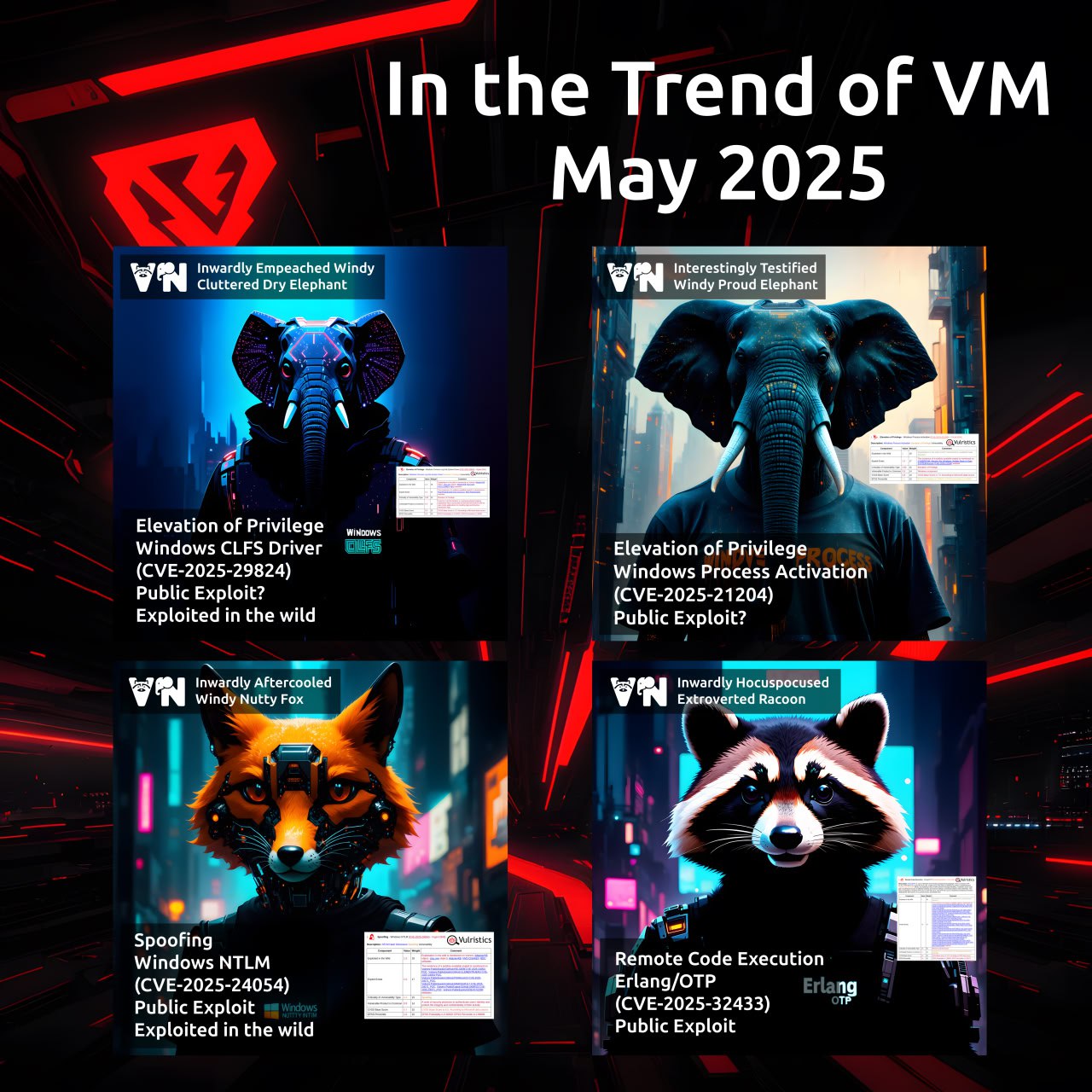
Tag Archives: TrendVulns

June "In the Trend of VM" (#16): vulnerabilities in Microsoft Windows, Apache HTTP Server, the web interfaces of MDaemon and Zimbra, and the 7-Zip archiver

June In the Trend of VM (#16): vulnerabilities in Microsoft Windows, Apache HTTP Server, the web interfaces of MDaemon and Zimbra, and the 7-Zip archiver

June "In the Trend of VM" (#16): vulnerabilities in Microsoft Windows, Apache HTTP Server, the web interfaces of MDaemon and Zimbra, and the 7-Zip archiver. A traditional monthly vulnerability roundup. 🙂

🗞 Post on Habr (rus)
🗒 Digest on the PT website (rus)

A total of 7 trending vulnerabilities:

🔻 Elevation of Privilege - Microsoft DWM Core Library (CVE-2025-30400)
🔻 Elevation of Privilege - Windows Common Log File System Driver (CVE-2025-32701, CVE-2025-32706)
🔻 Remote Code Execution & Arbitrary File Reading - Apache HTTP Server (CVE-2024-38475)
🔻 Cross Site Scripting - MDaemon Email Server (CVE-2024-11182)
🔻 Cross Site Scripting - Zimbra Collaboration (CVE-2024-27443)
🔻 Remote Code Execution - 7-Zip (BDU:2025-01793)

На русском

May "In the Trend of VM" (#15): vulnerabilities in Microsoft Windows and the Erlang/OTP framework

May In the Trend of VM (#15): vulnerabilities in Microsoft Windows and the Erlang/OTP framework

May "In the Trend of VM" (#15): vulnerabilities in Microsoft Windows and the Erlang/OTP framework. A traditional monthly vulnerability roundup. 🙂

🗞 Post on Habr (rus)
🗒 Digest on the PT website (rus)

A total of 4 trending vulnerabilities:

🔻 Elevation of Privilege - Windows Common Log File System Driver (CVE-2025-29824)
🔻 Elevation of Privilege - Windows Process Activation (CVE-2025-21204)
🔻 Spoofing - Windows NTLM (CVE-2025-24054)
🔻 Remote Code Execution - Erlang/OTP (CVE-2025-32433)

На русском

April "In the Trend of VM" (#14): vulnerabilities in Microsoft Windows, VMware products, Kubernetes, and Apache Tomcat

April In the Trend of VM (#14): vulnerabilities in Microsoft Windows, VMware products, Kubernetes, and Apache Tomcat

April "In the Trend of VM" (#14): vulnerabilities in Microsoft Windows, VMware products, Kubernetes, and Apache Tomcat. We decided to pause recording new videos, so for now only text. 🤷‍♂️🙂

🗞 Post on Habr (rus)
🗒 Digest on the PT website (rus)

A total of 11 trending vulnerabilities:

🔻 Elevation of Privilege - Windows Cloud Files Mini Filter Driver (CVE-2024-30085)
🔻 Spoofing - Windows File Explorer (CVE-2025-24071)
🔻 Four Windows vulnerabilities from March Microsoft Patch Tuesday were exploited in the wild (CVE-2025-24985, CVE-2025-24993, CVE-2025-26633, CVE-2025-24983)
🔻 Three VMware "ESXicape" Vulnerabilities (CVE-2025-22224, CVE-2025-22225, CVE-2025-22226)
🔻 Remote Code Execution - Apache Tomcat (CVE-2025-24813)
🔻 Remote Code Execution - Kubernetes (CVE-2025-1974)

На русском

March episode "In the Trend of VM" (#13): vulnerabilities of Microsoft, PAN-OS, СommuniGate and who should patch hosts with deployed application

March episode "In the Trend of VM" (#13): vulnerabilities of Microsoft, PAN-OS, СommuniGate and who should patch hosts with deployed application. I'm posting the translated video with a big delay, but it's better than never. 😉

📹 Video on YouTube and LinkedIn
🗞 Post on Habr (rus)
🗒 Digest on the PT website

Content:

🔻 00:00 Greetings
🔻 00:31 Elevation of Privilege - Windows Ancillary Function Driver for WinSock (CVE-2025-21418)
🔻 01:12 Elevation of Privilege - Windows Storage (CVE-2025-21391)
🔻 01:53 Authentication Bypass - PAN-OS (CVE-2025-0108)
🔻 03:09 Remote Code Execution - CommuniGate Pro (BDU:2025-01331)
🔻 04:27 The VM riddle: who should patch hosts with a deployed application?
🔻 07:11 About the digest of trending vulnerabilities

На русском

New episode "In the Trend of VM" (#12): 8 February CVEs & Why the Darknet Matters for VM Specialists

New episode "In the Trend of VM" (#12): 8 February CVEs & Why the Darknet Matters for VM Specialists. Now with a new design and new video editing. 😉

📹 Video on YouTube and LinkedIn
🗞 Post on Habr (rus)
🗒 Digest on the PT website

Content:

🔻 00:00 Greetings
🔻 00:23 Remote Code Execution - Windows Lightweight Directory Access Protocol (LDAP) (CVE-2024-49112)
🔻 01:35 Remote Code Execution - Microsoft Configuration Manager (CVE-2024-43468)
🔻 02:38 Remote Code Execution - Windows OLE (CVE-2025-21298)
🔻 03:55 Elevation of Privilege - Windows Hyper-V NT Kernel Integration VSP (CVE-2025-21333, CVE-2025-21334, CVE-2025-21335)
🔻 05:02 Authentication Bypass – FortiOS/FortiProxy (CVE-2024-55591)
🔻 06:16 Remote Code Execution - 7-Zip (CVE-2025-0411)
🔻 07:27 Should a VM specialist be aware of what is happening in the Darknet?
🔻 08:48 About the digest of trending vulnerabilities

На русском

New episode "In The Trend of VM" (#11): vulnerabilities that became trending in December and the final report on trending vulnerabilities for 2024

New episode "In The Trend of VM" (#11): vulnerabilities that became trending in December and the final report on trending vulnerabilities for 2024. I made this episode exclusively for the Telegram channel @avleonovcom "Vulnerability Management and More". 😉

📹 Video on YouTube, LinkedIn
🗞 Post on Habr (rus)
🗒 Digest on the PT website

Content:

🔻 00:00 Greetings
🔻 00:28 Elevation of Privilege - Windows Kernel Streaming WOW Thunk Service Driver (CVE-2024-38144)
🔻 01:30 Elevation of Privilege - Windows Common Log File System Driver (CVE-2024-49138)
🔻 02:37 Remote Code Execution - Apache Struts (CVE-2024-53677)
🔻 03:31 Authentication Bypass - Hunk Companion WordPress plugin (CVE-2024-11972)
🔻 04:44 Trending vulnerabilities for 2024

👾 08:10 Channel mascot 😅

На русском

I have finalized the list of trending vulnerabilities for 2024 according to Positive Technologies

I have finalized the list of trending vulnerabilities for 2024 according to Positive Technologies

I have finalized the list of trending vulnerabilities for 2024 according to Positive Technologies. Last year, 74 vulnerabilities were classified as trending (to compare the scale, just over 40,000 were added to NVD in 2024).

All trending vulnerabilities are found in Western commercial products and open source projects. This year, the vulnerabilities of domestic Russian products did not reach the level of criticality required to classify them as trending.

For 55 of all trending vulnerabilities there are currently signs of exploitation in attacks, for 17 there are public exploits (but no signs of exploitation) and for the remaining 2 there is only a possibility of future exploitation.

Vulnerabilities were often added to trending ones before signs of exploitation in the wild appeared. For example, the remote code execution vulnerability in VMware vCenter (CVE-2024-38812) was added to the list of trending vulnerabilities on September 20, 3 days after the vendor's security bulletin appeared. There were no signs of exploitation in the wild or public exploit for this vulnerability. Signs of exploitation appeared only 2 months later, on November 18.

Most of the vulnerabilities in the trending list are of the following types: Remote Code or Command Execution (24) and Elevation of Privilege (21).

4 vulnerabilities in Barracuda Email Security Gateway (CVE-2023-2868), MOVEit Transfer (CVE-2023-34362), papercut (CVE-2023-27350) and SugarCRM (CVE-2023-22952) were added in early January 2024. These vulnerabilities were massively exploited in the West in 2023, and attacks using these vulnerabilities could also tangentially affect those domestic Russian organizations where these products had not yet been taken out of service. The rest of the vulnerabilities became trending in 2024.

34 trending vulnerabilities affect Microsoft products (45%).

🔹 17 of them are Elevation of Privilege vulnerabilities in the Windows kernel and standard components.

🔹 1 Remote Code Execution vulnerability in Windows Remote Desktop Licensing Service (CVE-2024-38077).

2 trending Elevation of Privilege vulnerabilities affect Linux systems: one in nftables (CVE-2024-1086), and the second in needrestart (CVE-2024-48990).

Other groups of vulnerabilities

🔻 Phishing attacks: 19 (Windows components, Outlook, Exchange, Ghostscript, Roundcube)
🔻 Network security and entry points: 13 (Palo Alto, Fortinet, Juniper, Ivanti, Check Point, Zyxel)
🔻 Virtual infrastructure and backups: 7 (VMware, Veeam, Acronis)
🔻 Software development: 6 (GitLab, TeamCity, Jenkins, PHP, Fluent Bit, Apache Struts)
🔻 Collaboration tools: 3 (Atlassian Confluence, XWiki)
🔻 CMS WordPress plugins: 3 (LiteSpeed Cache, The Events Calendar, Hunk Companion)

🗒 Full Vulristics report

🟥 Article on the official website "Vulnerable software and hardware vs. security researchers" (rus)

На русском