Gartner’s view on Vulnerability Management market

Gartner’s view on Vulnerability Management market. Not so long time ago Gartner’s report “Vulnerability Management an essential piece of the security puzzle” has become publicly available. Now you can read it for free by filling out a questionnaire on F-Secure website.
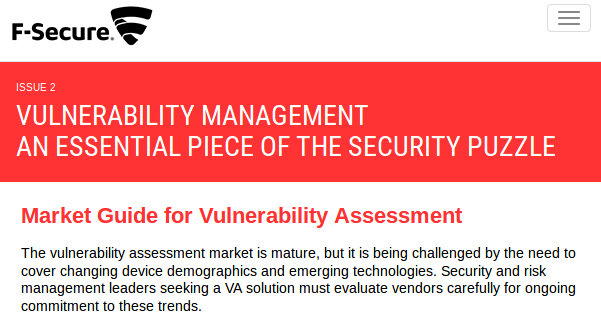
Gartner VM Market Guide

At the bottom of the document there is a reference to Gartner G00294756 from 05 December 2016. This document is quite fresh, especially for not very dynamic VM market ;-), and pretty expensive. Thanks for F-secure, we can read it now for free. If you are wondering why this anti-virus company is sponsoring Gartner VM reports: year ago they have bought Finnish VM vendor nScence, and I even did a small review of this product (F-Secure Radar Vulnerability Management solution, F-Secure Radar basic reporting, F-Secure Radar ticketing, F-Secure API for scanning).

Talking about the document, I would like, firstly, to thank Gartner. Do you know who writes most articles about VM? Of course, VM vendors. And we all understand that their main goal is to promote their own products. Reports of independent consulting firms, primarily IDC, Forrester and Gartner, allow us to get some balanced view from the side. It is very important.

Here I would like to comment some theses of the text.
Continue reading

Vulners.com and ranges of dates

Vulners.com and ranges of dates. I have already wrote earlier how to automatically retrieve data from the Vulners.com vulnerability database: if you need objects of some particular type, it’s better use Collection API, if you want to get different types of objects using advanced queries, your choice is Search API v.3.

But what if we want to get, not all the objects, but only new or modified ones in a some date range? How can we do it in Vulners?

Vulners.com date ranges

Search queries

Each object in Vulners (vulnerability, patch, bulletin, etc.) has a publication date, and modification date. You can see it if you open some Vulners object in json format, for example CVE-2017-6301:

        "published": "2017-02-23T23:59:00",
        "modified": "2017-02-24T14:45:17",

Continue reading

SikuliX: the last chance for automation

SikuliX: the last chance for automation. This post I will publish in the API section of my blog. However, it is about the situation when there application has no API. Let’s suppose that we have to use in our work some graphical application or web-service. And unfortunately we need constantly repeat some very routine and annoying operations in it. This often happens if the application developers have not thought enough about the real-life cases their end-users will deal with. What can we do in such scenario?

  • First of all, look maybe there is an open and documented API
  • If there is no API, and it is an installed application, maybe you can use it in a console mode
  • If it is a web-service, maybe you can figure out how it works and how to automate it using tools like Firebug

But sometimes it is impossible to do anything at all. And it is even more sad, if this routine task is really elementary and you can easily explain the logic: what menu to choose, what button to push, where you should enter text and so on.

At this point, you just spit on all and use your last resort – SikuliX.

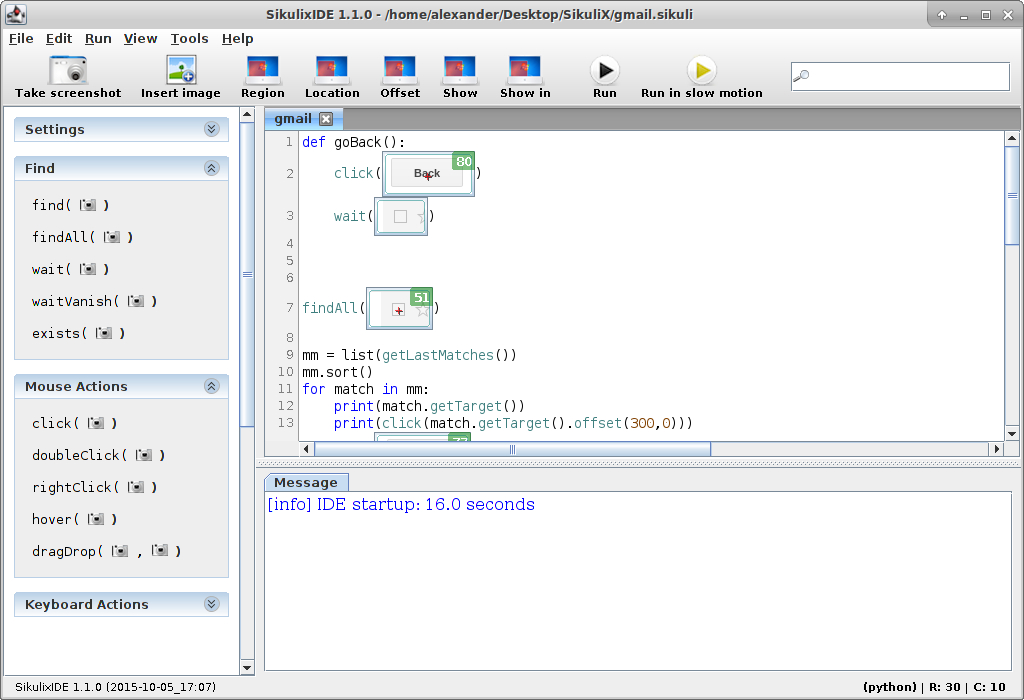
SikuliX Script window

With this tool, you can automate everything. It doesn’t matter if it is a web-service or a GUI application, what operating system it uses and so on. That’s all because SikuliX is working at the highest level. In fact, it just makes screenshots, analyses them as images, trying to find graphical elements that it should somehow use.

Continue reading

What’s actually new in Tenable.io VM application

What’s actually new in Tenable.io VM application. My last post was about the structure of a new Tenable.io cloud platform. Now, let’s see what is actually new in Tenable.io Vulnerability Management application.

Tenable.io VM is obviously based on Nessus Cloud, which in its turn had features similar to Nessus Manager briefly reviewed earlier. So, today I want to concentrate only on new features.

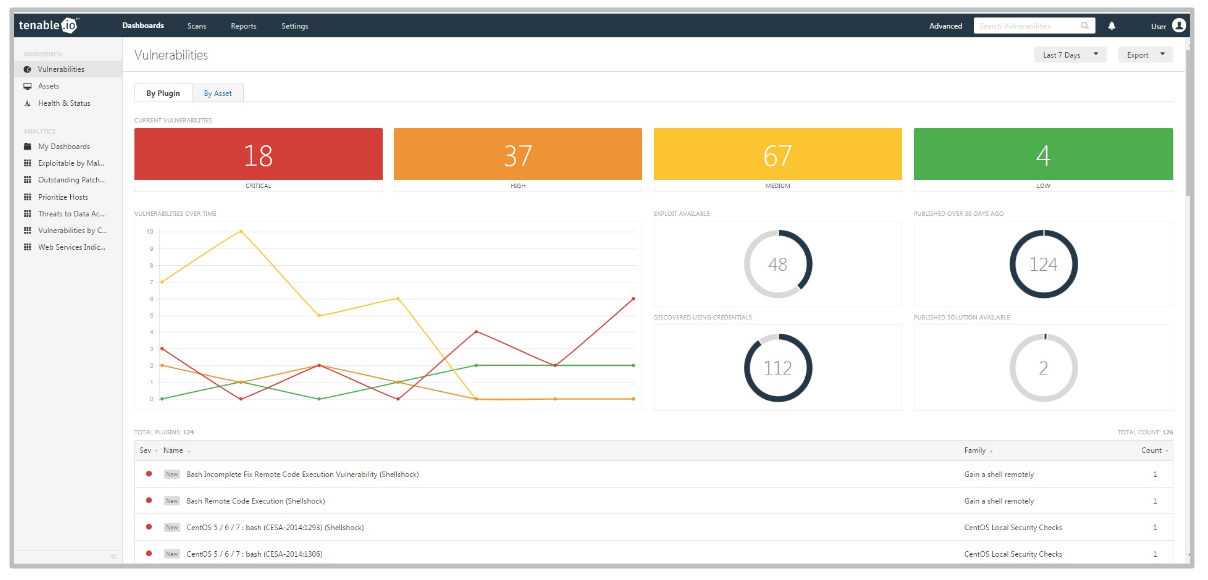
Tenable.io VM

According to the public interface screenshots and Tenable.io datasheets, it will have some new dashboards and reports, free integration with PVS and Nessus deployed on-premise, and something very new in asset management.

Continue reading

Bye-bye Nessus Cloud, hello Tenable.io

Bye-bye Nessus Cloud, hello Tenable.io. Tenable Network Security has announced today a new cloud platform – Tenable.io. Let’s see what it’s all about.

Applications

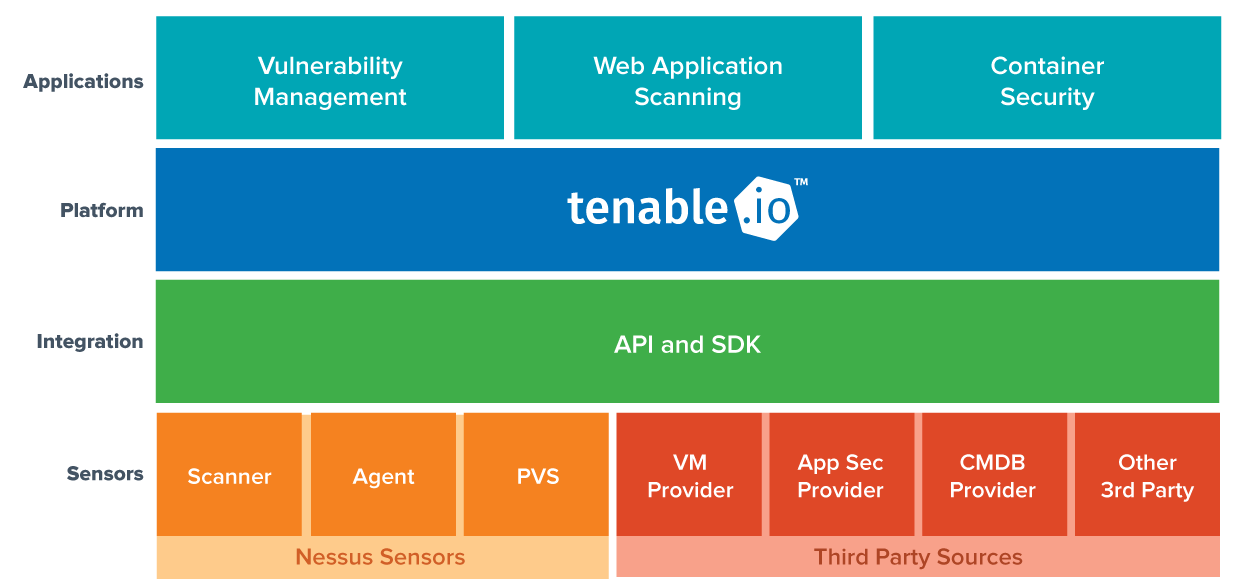
As you can see on this figure there will be three applications available for the platform: familiar Vulnerability Management (the new name of Nessus Cloud), new Container Security (Tenable bought FlawCheck service last October) and the long-awaited Web Application Security (not available yet).

It’s not clear yet how closely these services will be integrated with each other. But now even  trial versions of Container Security and Vulnerability Management should be requested separately.

Continue reading

Post-SIEM black boxes

Post-SIEM black boxes. Recently, I examined some automated Post-SIEM products, described with a lot of buzz words: UEBA, threat intelligence, machine learning, etc. I would like to share my opinion about all this, from the vendor, and from the consumer side.

What’s bad with traditional SIEMs?

Some information security experts [1,2,3] say, that SIEMs are very expansive and they don’t do their job properly. Traditional SIEMs usually unable to process huge amounts of mostly unnecessary logs and produce tonnes of false alarms. I’m not an expert in SIEM, but it seems to be true. Log data is useless when you just store it. And when you try to search something in it, you need to understand what exactly you are looking for and what threats are critical for your organization.

SIEM correlation features make this task much easier. But who will write the rules of this correlation? Even top SIEM vendors openly say that the most of out-of-the-box correlation rules are useless, can only be used as examples and users should develop their own rules. Of course, there are also some content and use case libraries: paid ones or free as SOC Prime Use Case Library. But in any case, the effective use of SIEM is a complex process.

Give me “real threats”

As a reaction on this, some vendors and security startups developed an easy way: solutions, that will detect only the “real threats”. Thats sounds great. Some wise application tells you what is going on in your network correlating various sources of security data, and you just work with this issues. Awesome! But how does this really work?

Continue reading

Automated task processing with JIRA API

Automated task processing with JIRA API. It’s no secret that task tracker is one of the most critical resources of any big organization. The whole working process can be represented as creating, processing and closing various tasks. Without task tracker there will be complete disaster, collapse and anarchy. So, it’s very important to work with this instrument efficiently. And when I write efficiently, I mean in automated way. It’s a blog about security automation after all. 😉

This post will be about Jira task tracker. I have already wrote how Jira can be used in VM Remediation process. That post was mainly about the main principles and how remediation tasks look in Jira WEB-GUI. Now, I will go further and show how to use it as a source of important information and easily deal with daily routine tasks using some trivial scripting. It is all possible because of advanced Jira Rest API.

Let’s say we have some regular tasks of some type. For example, to detect vulnerabilities on some hosts using Nessus and make a comment about founded vulnerabilities in the task. You can make a script that we will search for this kind of tasks in Jira, process them, add scan results to the comment and close the task. Of course it works the best when these tasks are also were created with in some automated way, in this case parsing will be much easier.

“Issue”, is the right name for the task in Jira; but I frequently use “issue”, “task” and “ticket” interchangeably. Sorry for this.

So, we need to take this steps:

  • Authorization
  • Search for existing Jira issues using some search request
  • View description, data and comments of the issue
  • Download files attached to the issue
  • Make some task processing
  • Add a new comment to the issue
  • Change status of the issue

Continue reading