Tag Archives: SAP

September “In the Trend of VM” (#19): vulnerabilities in the WinRAR and 7-Zip archivers, SAP NetWeaver, and TrueConf Server

September In the Trend of VM (#19): vulnerabilities in the WinRAR and 7-Zip archivers, SAP NetWeaver, and TrueConf Server

September “In the Trend of VM” (#19): vulnerabilities in the WinRAR and 7-Zip archivers, SAP NetWeaver, and TrueConf Server. A traditional monthly roundup – for the first time with NO Microsoft vulnerabilities! 😲🙂

🗞 Post on Habr (rus)
🗒 Digest on the PT website (rus)

A total of eight trending vulnerability IDs in four products:

🔻 Remote Code Execution – WinRAR (CVE-2025-6218, CVE-2025-8088). An exploitable RCE during archive extraction.
🔻 Remote Code Execution – SAP NetWeaver (CVE-2025-31324, CVE-2025-42999). An exploitable RCE in a component of a popular ERP system.
🔻 Remote Code Execution – 7-Zip (CVE-2025-55188). Mostly a Linux RCE during archive extraction – a public exploit is available.
🔻 Remote Code Execution – TrueConf Server (BDU:2025-10116, BDU:2025-10115, BDU:2025-10114). Critical flaws in Russian videoconferencing system.

На русском

About Remote Code Execution – SAP NetWeaver (CVE-2025-31324, CVE-2025-42999) vulnerability

About Remote Code Execution - SAP NetWeaver (CVE-2025-31324, CVE-2025-42999) vulnerability

About Remote Code Execution – SAP NetWeaver (CVE-2025-31324, CVE-2025-42999) vulnerability. SAP NetWeaver is the core SAP platform for running applications and integrating systems. Vulnerabilities were found in its Visual Composer component – a web tool for business app modeling. A lack of authorization checks (CVE-2025-31324) and insecure deserialization (CVE-2025-42999) allows unauthenticated attackers to perform remote code execution and compromise SAP systems, data, and processes.

🩹 The vulnerabilities were fixed by SAP in April and May 2025.

👾 On May 13, Onapsis researchers reported that CVE-2025-31324 had been exploited since February 10. The CVEs were added to CISA KEV on April 29 and May 15.

🛠 PoCs for CVE-2025-31324 began appearing on GitHub in late April. A public exploit combining CVE-2025-31324 and CVE-2025-42999 was reported by Onapsis on August 15.

📊 According to estimates, SAP products are still used by around 2,000 Russian organizations.

На русском

August 2023: GitHub PoCs, Vulristics, Qualys First-Party, Tenable ExposureAI, SC Awards and Rapid7, Anglo-Saxon list, MS Patch Tuesday, WinRAR, Juniper

August 2023: GitHub PoCs, Vulristics, Qualys First-Party, Tenable ExposureAI, SC Awards and Rapid7, Anglo-Saxon list, MS Patch Tuesday, WinRAR, Juniper. Hello everyone! This month I decided NOT to make an episode completely dedicated to Microsoft Patch Tuesday. Instead, this episode will be an answer to the question of how my Vulnerability Management month went. A retrospection of some kind.

Alternative video link (for Russia): https://vk.com/video-149273431_456239134

Continue reading

Vulnerability Management news and publications #1

Vulnerability Management news and publications #1. Hello everyone! In this episode, I will try to revive Security News with a focus on Vulnerability Management.

On the one hand, creating such reviews requires free time, which could be spent more wisely, for example, on open source projects or original research. On the other hand, there are arguments in favor of news reviews. Keeping track of the news is part of our job as vulnerability and security specialists. And preferably not only headlines.

Alternative video link (for Russia): https://vk.com/video-149273431_456239095

I usually follow the news using my automated telegram channel @avleonovnews. And it looks like this: I see something interesting in the channel, I copy it to Saved Messages so that I can read it later. Do I read it later? Well, usually not. Therefore, the creation of news reviews motivates to read and clear Saved Messages. Just like doing Microsoft Patch Tuesday reviews motivates me to watch what’s going on there. In general, it seems it makes sense to make a new attempt. Share in the comments what you think about it. Well, if you want to participate in the selection of news, I will be glad too.

I took 10 news items from Saved Messages and divided them into 5 categories:

  1. Active Vulnerabilities
  2. Data sources
  3. Analytics
  4. VM vendors write about Vulnerability Management
  5. de-Westernization of IT

Continue reading

Barapass, Tsunami scanner, vulnerabilities in Windows DNS Server and SAP products, weird attack on Twitter

Barapass, Tsunami scanner, vulnerabilities in Windows DNS Server and SAP products, weird attack on Twitter. This episode is based on posts from my Telegram channel avleonovcom, published in the last 2 weeks. So, if you use Telegram, please subscribe. I update it frequently.

Barapass, Tsunami scanner, vulnerabilities in Windows DNS Server and SAP products, weird attack on Twitter

Barapass update

I recently released an update to my password manager barapass. BTW, it seems to be my only pet project at the MVP stage, which I use every day.

What’s new:

  1. Now I am sure that it works on Windows 10 without WSL. And you can run it beautifully even with the icon. ? Read more about installation in Windows in this file.
  2. Not only “copy the next value to the clipboard” (or “revolver mode” ) is now possible in the search results section. You can also get the previous value or copy the same value one again if it was somehow erased in the clipboard. Previously, I had to retype the search request each time to do this, and it was quite annoying. By the way, I unexpectedly discovered that the user input history inside the application magically works in the Windows shell (using up and down arrows) without any additional coding. On Linux it does not.
  3. You can set a startup command, for example, to decrypt the container.
  4. The startup command and quick (favorite) commands are now in settings.json and not hard-coded.
  5. settings.json, container files and decrypted files are now in “files” directory. It became more convenient to update barapass, just change the scripts in the root directory and that’s it. I divided the scripts into several files, now it should be more clear how it works.

So, if you need a minimalistic console password manager in which you can easily use any encryption you like – welcome! You can read more about barapass in my previous post.

Continue reading

U.S. sanctions against Russian cybersecurity companies

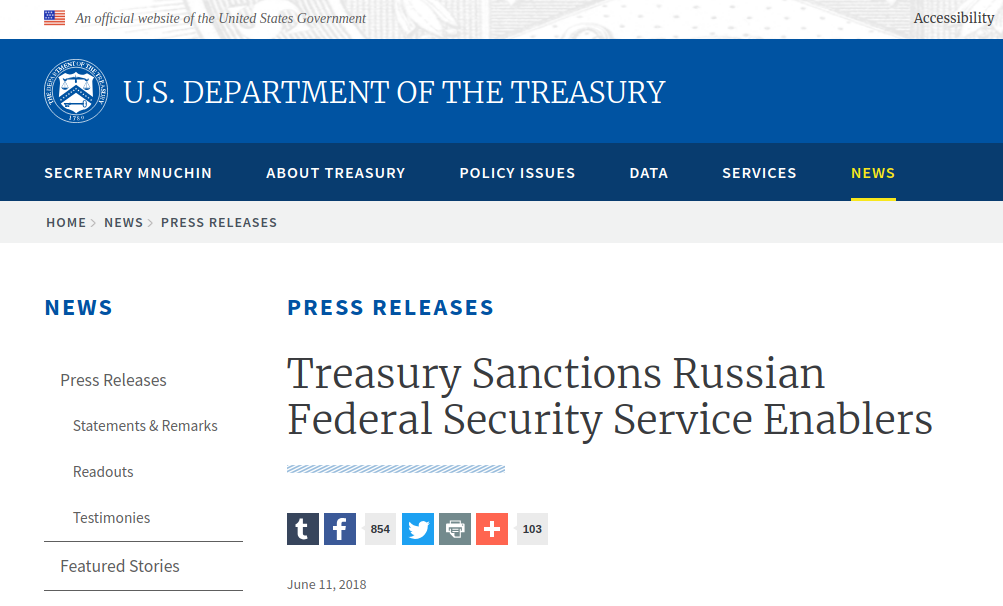
U.S. sanctions against Russian cybersecurity companies. I never thought that I will write here about state sanctions. Usually I try to ignore political topics. But now it’s necessary. Yesterday OFAC introduced sanctions against 5 Russian companies.

Treasury Sanctions Russian Federal Security Service Enablers

I would like to mention 3 of them:

Continue reading

Petya, M.E.Doc and the problem of trust

Petya, M.E.Doc and the problem of trust. I’ve already mentioned in “Petya the Great and why *they* don’t patch vulnerabilities“, that NotPetya ransomware seems trivial from Vulnerability Management point of view. It uses known Windows vulnerabilities, that were patched by Microsoft long time ago.

Despite of this, I was really interested in M.E.Doc (servers were confiscated by Ukrainian police and website is not operational) role in the initial phase of malware spreading. In my opinion, we have a pretty interesting example of an attack vector, that will be very hard to detect and mitigate. And moreover, it’s once again shows that protected perimeter won’t be a panacea anymore.

m.e.doc

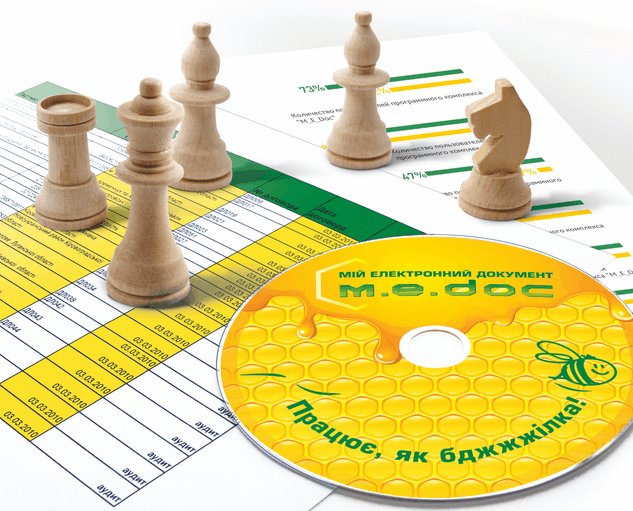
M.E.Doc – My Electronic Document Circulation System. “m.e.doc” sounds like the word, that mean “honey” in Russian and Ukrainian. That’s why all these bees in promo materials.

M.E.Doc is an Document Circulation System very popular in Ukraine. It makes possible to send reports to the government authorities in electronic form. It can be used in any organization. I can even imagine situation when usage of this kind of software may be even mandatory. Now the researchers [Eset, Dr.Web] say that M.E.Doc servers sent updates with backdoors  to the customers.

This backdoor has abilities:

  • Data collection for accessing mail servers
  • Arbitrary commands execution in the infected system
  • Running any executables
  • Downloading arbitrary files to the infected computer
  • Uploading arbitrary files to a remote server
  • Identify the exact organization using EDRPOU number.

I don’t really care about technical details about this backdoor. For me it’s enough that malicious code was on official server of the vendor and was spread to legitimate customers. Boom!

Continue reading