Category Archives: Vulnerability

June Microsoft Patch Tuesday

June Microsoft Patch Tuesday

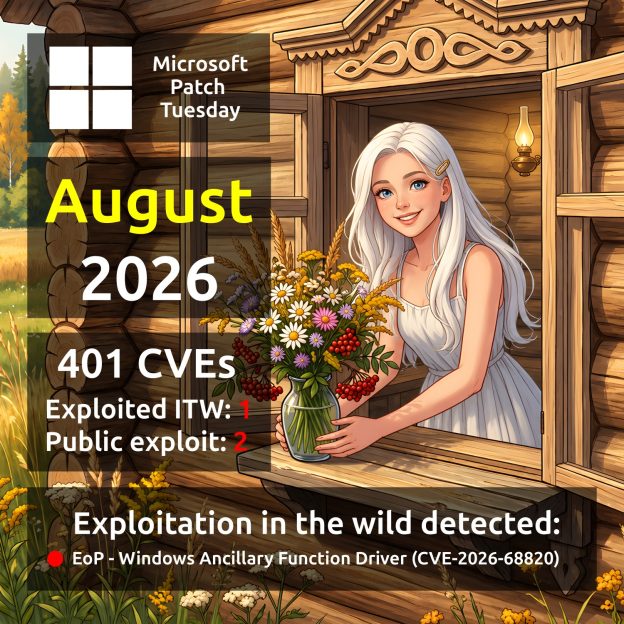
June Microsoft Patch Tuesday. Last week I was on vacation in Veliky Novgorod, so I'm publishing this overview only now. A total of 202 vulnerabilities were addressed, approximately twice as many as in May. There are currently no vulnerabilities marked as exploited in the wild. However, there are two vulnerabilities with publicly available exploits:

🔸 RCE - HTTP.sys (CVE-2026-47291). This critical vulnerability allows remote, unauthenticated attackers to execute arbitrary code on affected systems without user interaction. However, systems using the default MaxRequestBytes registry value in the Windows HTTP stack are not affected. If needed, you can change this registry setting to protect systems while testing and deploying the patch. Microsoft's security bulletin includes instructions and a PowerShell script for this workaround.

🔸 DoS - HTTP.sys (CVE-2026-49160). The same exploit is used as for the previous RCE vulnerability.

It is also worth paying attention to vulnerabilities that Microsoft has flagged as having a publicly available exploit:

🔹 SFB - Windows BitLocker (CVE-2026-50507). A successful attacker could bypass the BitLocker Device Encryption feature on the system storage device. An attacker with physical access to the target could exploit this vulnerability to gain access to encrypted data. According to Tenable, this is the "Bitskrieg" vulnerability discovered by the researcher known as Chaotic Eclipse/Nightmare Eclipse.

🔹 SFB - Secure Boot (CVE-2026-48570). An attacker who successfully exploited this vulnerability could bypass Secure Boot. This vulnerability was reported by Alon Leviev (STORM), who is known for previous research related to BootKitty and BlackLotus.

Among the remaining vulnerabilities, the following are worth highlighting:

🔹 RCE - Windows Kernel (CVE-2026-45657). This vulnerability allows remote, unauthenticated attackers to run code with SYSTEM privileges without any user interaction. In other words, it could be used to spread automatically between systems. The issue is caused by how the Windows kernel processes TCP/IP traffic. Microsoft rated this as "Exploitation Less Likely", but security researchers and exploit developers are already analyzing the patch and trying to build an exploit. Test and deploy this patch as soon as possible.

🔹 EoP - Windows Collaborative Translation Framework (CTFMON) (CVE-2026-45586). This vulnerability affects a component used for voice and handwriting recognition. If exploited, an attacker could gain SYSTEM privileges. Microsoft rates this vulnerability as "Exploitation More Likely".

🔹 RCE - Windows Remote Desktop Client (CVE-2026-42909, CVE-2026-42913, CVE-2026-42985, CVE-2026-42992, CVE-2026-42993, CVE-2026-44799, CVE-2026-44801, CVE-2026-47289, CVE-2026-47653, CVE-2026-47654, CVE-2026-48563). Successful exploitation would require a victim to connect to an attacker-controlled server using an affected version of the Remote Desktop Client. This action could trigger a heap-based buffer overflow, resulting in remote code execution.

🔹 RCE - DHCP Client Service (CVE-2026-44815). This vulnerability allows remote, unauthenticated attackers to execute code on affected systems without user interaction. Because the DHCP client is widely enabled across Windows systems, this vulnerability presents a broad attack surface. Organizations should prioritize testing and deploying the patch for this vulnerability as soon as possible.

🗒 Full Vulristics report

About Elevation of Privilege - Microsoft Defender "RedSun" (CVE-2026-41091) vulnerability

About Elevation of Privilege - Microsoft Defender RedSun (CVE-2026-41091) vulnerability

About Elevation of Privilege - Microsoft Defender "RedSun" (CVE-2026-41091) vulnerability. Microsoft Defender is a built-in security solution developed by Microsoft to protect the Windows operating system and user data from viruses, malware, and other cyber threats in real time. An improper link resolution vulnerability prior to file access ("link following", CWE-59) in Microsoft Defender, specifically within the Malware Protection Engine component, allows an authenticated local attacker to escalate privileges to SYSTEM level. As a result, an attacker could gain full control over the affected system, including unrestricted access to data, the ability to modify system settings, install software, manage user accounts, and disable security protections.

🛠 An exploit for the vulnerability was published on GitHub by security researcher Nightmare Eclipse on April 15, alongside exploits targeting other Windows component vulnerabilities. The account was later removed by GitHub administrators; however, this did not prevent the exploit code from spreading further.

⚙️ The security advisory and patches were released on May 19 outside Microsoft's regular Patch Tuesday schedule. Versions of Microsoft Malware Protection Engine from 1.1.26030.3008 through 1.1.26040.8 are affected. Systems with Microsoft Defender disabled are not vulnerable. By default, Microsoft Defender automatically updates Windows security components, antivirus definitions, and Microsoft Malware Protection Engine, so no additional user action is typically required. Malware Protection Engine is updated monthly or as new threats emerge, while antivirus definitions are updated several times per day. Update checks may run automatically anywhere from once to several times daily when an Internet connection is available. Manual update checks are also supported.

👾 According to Microsoft, the vulnerability is being exploited in the wild. The vulnerability was added to the CISA KEV catalog on May 20.

💡 Special attention should be paid to server and desktop Windows hosts where Microsoft Defender is not disabled, but Internet access is unavailable for regular updates.

About Remote Code Execution - PAN-OS (CVE-2026-0300) vulnerability

About Remote Code Execution - PAN-OS (CVE-2026-0300) vulnerability

About Remote Code Execution - PAN-OS (CVE-2026-0300) vulnerability. PAN-OS is an operating system for Palo Alto Networks firewalls and security platforms. User-ID™ Authentication Portal (also known as Captive Portal) is a non-default PAN-OS feature used to map IP addresses to usernames. By exploiting a buffer overflow vulnerability (CWE-787), an unauthenticated remote attacker can send specially crafted packets to a device with the Authentication Portal enabled, achieving arbitrary code execution with root privileges on the affected device. No authentication or user interaction is required. If the vulnerability is successfully exploited, the attacker gains full control over network traffic: they can intercept, modify, or block connections, access sensitive data, bypass security policies, hide traces of compromise, install backdoors, and use the device as a foothold for attacks on internal infrastructure.

⚙️ The vendor security advisory was published on May 6. PA-Series and VM-Series firewalls are affected. Prisma Access, Cloud NGFW, and Panorama appliances are not impacted by this vulnerability. Security updates for affected devices became available on May 13. As a workaround, the vendor recommended restricting User-ID™ Authentication Portal access to only trusted internal zones or disabling the User-ID™ Authentication Portal entirely if it is not required.

👾 On the same day, May 6, researchers from Palo Alto Networks Unit 42 published a report on active exploitation of the vulnerability in the wild. Post-exploitation activity includes deployment of publicly available tunneling tools (EarthWorm, ReverseSocks5), Active Directory enumeration using credentials likely obtained from the firewall, and systematic destruction of logs and other evidence of compromise. On the same day, the vulnerability was added to the CISA KEV catalog.

🛠 A public exploit was also published on GitHub on May 6.

🌐 PAN-OS is among the most widely deployed enterprise firewall operating systems in the world. As of June 5, Shodan identifies approximately 135,755 internet-facing PAN-OS instances, representing a significant attack surface.

May Linux Patch Wednesday

May Linux Patch Wednesday

May Linux Patch Wednesday. A total of 1,638 vulnerabilities (474 in the Linux kernel). For comparison, in April there were 1,035 vulnerabilities (a record!). And this time it turns out to be a record again, more than one and a half times higher! The acceleration is both impressive and alarming. But we will see what happens next. At some point it should stabilize. Although the number of critical vulnerabilities is already so high that reviewing all of them becomes quite problematic. For 7 vulnerabilities there are signs of exploitation in the wild. And for another 264 there are public exploits. Let’s start, as usual, with vulnerabilities being actively exploited according to CISA KEV and VulnCheck KEV data. Here, at the top, as expected, are two high-profile ways to get a root shell:

🔻 EoP - Linux Kernel "Copy Fail" (CVE-2026-31431)
🔻 EoP - Linux Kernel "Dirty Frag" (CVE-2026-43500)

Other vulnerabilities being exploited in the wild:

🔻 RCE - Apache ActiveMQ (CVE-2026-40466). Based on the description, this appears to be a bypass of the fix for CVE-2026-34197, which I already wrote about earlier.

🔻 AuthBypass - Rclone (CVE-2026-41176). Rclone ("rsync for cloud storage") is a command-line utility for synchronizing files and directories between various cloud storage services and local systems. Exploitation of the vulnerability can lead to unauthorized access to sensitive administrative functionality, including configuration and operational RC methods.

🔻 RCE - NGINX (CVE-2026-42945). The bug enables unauthenticated remote code execution against servers using rewrite and set directives.

🔻 DoS - PgBouncer (CVE-2026-6664). PgBouncer is a lightweight, open-source connection pooler for PostgreSQL databases. It reduces connection overhead by managing a pool of connections to one or more PostgreSQL servers, improving performance and resource efficiency for applications with frequent short-lived database connections. An integer overflow in the network packet parsing code in PgBouncer before 1.25.2 bypasses a boundary check and can lead to a crash.

🔻 XSS - Postorius (CVE-2026-44742). The Postorius Django app provides a web user interface to access GNU Mailman. Mailman is free software for managing electronic mail discussion and e-newsletter lists. The vulnerability is being exploited according to VulnCheck KEV; however, no public exploits has been observed yet.

From the remaining vulnerabilities with public exploits, but without any signs of exploitation in the wild so far, the following can be highlighted:

🔸 RCE - Apache HTTP Server (CVE-2026-23918). Double-free error in Apache httpd mod_http2 stream cleanup, leading to pre-auth RCE.

🔸 RCE - Apache Tomcat (CVE-2026-34486). Apache Tomcat Tribes cluster communication module fails to discard messages when EncryptInterceptor decryption fails, allowing unauthenticated attackers to trigger Remote Code Execution via Java deserialization on port 4000.

🔸 RCE - ProFTPD (CVE-2026-42167). The flaw exists in how mod_sql handles certain logging variables (like %U), allowing an unauthenticated attacker to inject SQL commands via the USER command.

🔸 EoP - Linux Kernel "DirtyDecrypt" (CVE-2026-31635). Linux local privilege escalation in the RxRPC/GSSAPI decryption path. A missing skb_cow_data() check in rxgk_decrypt_skb() allows an unprivileged local attacker to corrupt cache pages and overwrite in-memory contents of read-only files.

🔸 EoP - Linux Kernel "Fragnesia" (CVE-2026-46300). I also analyzed this vulnerability earlier. A bug in skb_try_coalesce() allowing page-cache write via fragmented ESP packets.

🔸 EoP - Linux Kernel (CVE-2026-46333). Local root privilege escalation and credential disclosure in the Linux kernel ptrace path, discovered by researchers at Qualys.

🔸 EoP - PackageKit "Pack2TheRoot" (CVE-2026-41651). PackageKit is a free and open-source suite of software applications designed to provide a consistent and high-level abstraction layer for a number of different package management systems. The vulnerability allows an attacker to escalate privileges, potentially gaining root access or compromising the system.

🔸 ComInj - Composer (CVE-2026-40261, CVE-2026-40176). Composer is a dependency manager for PHP. The vulnerability exists in the Perforce::generateP4Command() method. Due to insufficient sanitization of repository configuration parameters (such as url, p4user, or client) when constructing shell commands, an attacker who controls a composer.json file can execute arbitrary commands on the victim's system when composer install or composer update is executed.

🗒 Full Vulristics report

About Elevation of Privilege - Linux Kernel "Fragnesia" (CVE-2026-46300) vulnerability

About Elevation of Privilege - Linux Kernel Fragnesia (CVE-2026-46300) vulnerability

About Elevation of Privilege - Linux Kernel "Fragnesia" (CVE-2026-46300) vulnerability. The vulnerability was discovered by researcher William Bowling together with the V12 team. Fragnesia belongs to the class of Dirty Frag vulnerabilities. It is an error in the ESP/XFRM subsystem, distinct from Dirty Frag, which was addressed with a separate patch. It allows achieving arbitrary byte writes into the kernel page cache of read-only files, without requiring any race condition.

🛠 Technical details and exploit code were published on May 15. The public exploit modifies the contents of /usr/bin/su in the kernel page cache, and then executes /usr/bin/su, resulting in the user obtaining a root shell. The on-disk binary is never modified. A reboot or cache flush restores normal system behavior.

⚙️ Fragnesia affects the same kernel versions as Dirty Frag. Any distribution shipping a kernel without the May 13 patch is vulnerable. The vulnerability was confirmed on Ubuntu 6.8.0-111-generic (April 11, 2026 build). Monitor kernel package updates for your Linux distribution(s).

For systems where a kernel update is not possible, the same workaround as for Dirty Frag is effective (blacklisting modules). Systems where the Dirty Frag workaround has already been applied are already protected against Fragnesia. Systems that only received Dirty Frag updates without applying the workaround remain vulnerable and require new updates addressing Fragnesia.

May "In the Trend of VM" (#27): high-profile vulnerabilities in Linux, ActiveMQ, SharePoint, and Adobe Acrobat Reader

May In the Trend of VM (#27): high-profile vulnerabilities in Linux, ActiveMQ, SharePoint, and Adobe Acrobat Reader

May "In the Trend of VM" (#27): high-profile vulnerabilities in Linux, ActiveMQ, SharePoint, and Adobe Acrobat Reader. Presenting the traditional monthly roundup of trending vulnerabilities according to Positive Technologies. While the previous April edition featured only one vulnerability, this one includes four, covering different technologies and attack scenarios.

🗞 Post on Habr (rus)
🗒 Digest on the PT website (rus)

🔻 EoP - Linux Kernel "Copy Fail" (CVE-2026-31431). The vulnerability allows an attacker to gain root privileges.

🔻 RCE - Apache ActiveMQ (CVE-2026-34197). A vulnerability in a solution widely used in enterprise systems and integration platforms.

🔻 Spoofing - Microsoft SharePoint Server (CVE-2026-32201). A vulnerability in a Microsoft solution widely used in enterprise systems for collaboration, document management, and internal portal development.

🔻 RCE - Adobe Reader (CVE-2026-34621). A vulnerability in a widely used PDF document viewer; actively exploited in phishing attacks.

🟥 The full list of trending vulnerabilities is available on the portal

May Microsoft Patch Tuesday

May Microsoft Patch Tuesday

May Microsoft Patch Tuesday. A total of 119 vulnerabilities, approximately 1.5 times fewer than in April. There are currently no vulnerabilities marked as actively exploited in the wild. However, there is one vulnerability with a public exploit:

🔸 EoP - Windows Kernel (CVE-2026-40369). A detailed write-up and exploit for this vulnerability were published on May 14, two days after the May MSPT. The researcher describes exploitation of the vulnerability as follows: "A single syscall from any unprivileged process — including inside Chrome's renderer sandbox — can increment arbitrary kernel memory addresses. No race conditions. No heap spray. No special tokens. 100% deterministic privilege escalation to SYSTEM."

Among the remaining ones, the following stand out:

🔹 RCE - Windows DNS Client (CVE-2026-41096). A ZDI analyst commented on this vulnerability as follows: "This patch fixes a heap-based buffer overflow in the DNS Client triggered by a malicious DNS response. No authentication or user interaction needed, and since the DNS Client runs on virtually every Windows machine, the attack surface is enormous. An attacker with a position to influence DNS responses (MitM, rogue server) could achieve unauthenticated RCE across your enterprise."

🔹 RCE - Windows Netlogon (CVE-2026-41089). The vulnerability allows an unauthenticated remote attacker to execute arbitrary code on a domain controller by sending a specially crafted network request. Exploitation does not require credentials or user interaction, which classifies this vulnerability as wormable. Compromise of a domain controller means full compromise of the organization's entire domain. A Rapid7 analyst added in their commentary: "No privileges or user interaction are required, and attack complexity is low, which suggests that creation of a reliable exploit might not be especially difficult for anyone with knowledge of the specific mechanism. Microsoft assesses exploitation as less likely, but since those exploitability assessments are provided without an accompanying explanation, it's not clear how much reassurance defenders should take. Anyone who remembers the much-discussed CVE-2020-1472 (aka ZeroLogon) back in 2020 will note that CVE-2026-41089 offers an attacker more immediate control of a domain controller. Patches are available for all versions of Windows Server from 2012 onwards."

🔹 RCE - Windows TCP/IP (CVE-2026-40415). Commentary from a ZDI analyst: "This bug in the TCP/IP stack results from a use-after-free (UAF) and could allow a remote, unauthenticated threat actor to execute code without user interaction. That makes this another wormable bug. However, this one is much less likely to be exploited. The target needs to be under sustained low-memory (memory pressure) conditions, which is pretty rare."

🔹 RCE - Microsoft Word (CVE-2026-40361, CVE-2026-40364, CVE-2026-40366, CVE-2026-40367). An attacker can exploit these vulnerabilities through social engineering by sending a malicious file to a targeted victim. Successful exploitation would grant the attacker arbitrary code execution. Microsoft researchers note that the Preview Pane is an attack vector for each of these vulnerabilities.

🔹 RCE - Microsoft Office (CVE-2026-40363, CVE-2026-42831). A heap-based buffer overflow vulnerability in Microsoft Office may allow an unauthorized attacker to remotely execute arbitrary code.

🔹 RCE - Windows GDI (CVE-2026-35421). A heap-based buffer overflow vulnerability in the Windows GDI component may allow an unauthorized attacker to remotely execute arbitrary code.

🔹 RCE - Microsoft Dynamics 365 On-Premises (CVE-2026-42898). Commentary from a ZDI analyst: "It allows any authenticated user to execute code with a scope change, meaning exploitation can break out and affect resources beyond the vulnerable component itself. Scope changes are pretty rare, so if you're running Dynamics 365 On-Prem, definitely test and deploy this patch quickly."

🔹 EoP - Windows Kernel (CVE-2026-33841, CVE-2026-35420, CVE-2026-40369). CVE-2026-33841 and CVE-2026-40369 are rated "Exploitation More Likely". A local attacker can use these vulnerabilities to elevate privileges to SYSTEM level. In the case of CVE-2026-33841, the attacker can elevate privileges to Medium/High integrity level.

🗒 Full Vulristics report