Tag Archives: Microsoft

April Microsoft Patch Tuesday

April Microsoft Patch Tuesday

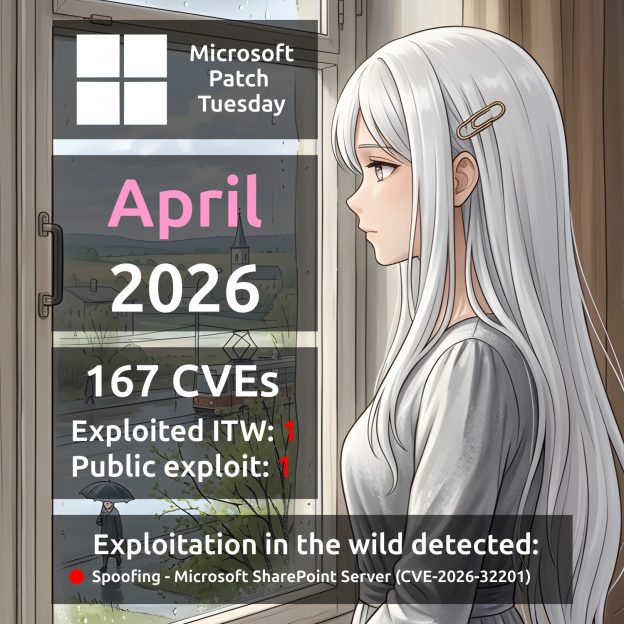
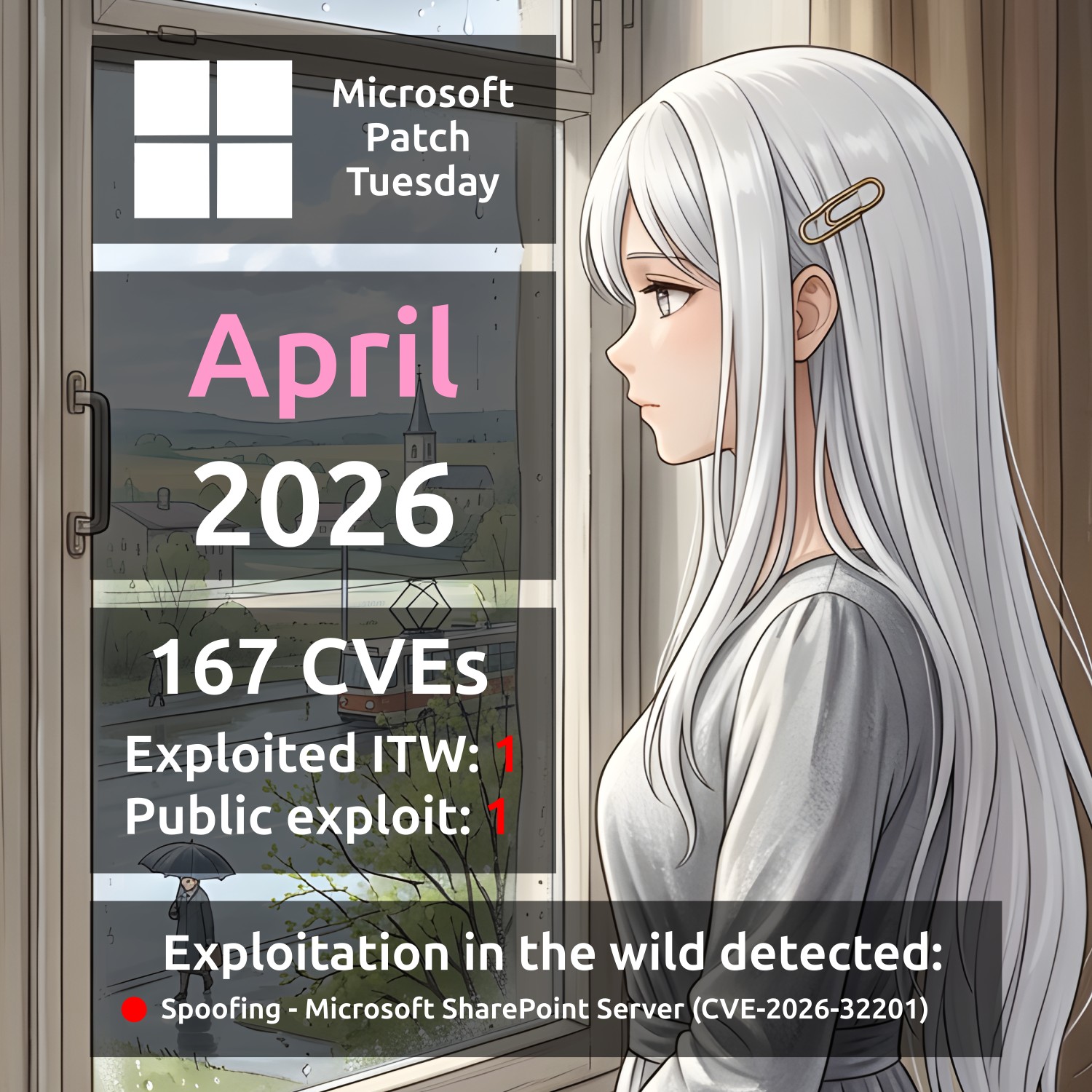
April Microsoft Patch Tuesday. A total of 167 vulnerabilities, about twice as many as in March. There is one vulnerability already being exploited in the wild:

🔻 Spoofing - Microsoft SharePoint Server (CVE-2026-32201). ZDI experts say "Spoofing bugs in SharePoint often manifest as cross-site scripting (XSS) bugs". "An attacker who successfully exploited the vulnerability could view some sensitive information (Confidentiality), make changes to disclosed information (Integrity), but cannot limit access to the resource (Availability)". There is no info yet about how widely it is being used in attacks, but you should not delay patching, especially if SharePoint is exposed to the Internet.

Formally, there are no public exploits yet. However, there are strong indications that a public exploit may already exist for one vulnerability.

🔸 EoP - Microsoft Defender (CVE-2026-33825). "Insufficient granularity of access control" in Microsoft Defender allows a logged-in attacker to gain higher privileges on a local system. Tenable and ZDI say the bug looks similar to the BlueHammer zero-day, for which a public exploit was released on GitHub on April 3. The researcher who published it, Chaotic Eclipse, criticized Microsoft’s disclosure process. ZDI says the exploit is real, but exploitation is unstable and not always reliable.

Other important issues:

🔹 RCE - Windows Active Directory (CVE-2026-33826). To exploit this, the attacker must have an account. The attacker sends a specially crafted RPC request to a vulnerable server, which can lead to code execution. Microsoft says the attacker must be in the same restricted Active Directory domain as the target system.

🔹 RCE - Windows Internet Key Exchange (IKE) Service Extensions (CVE-2026-33824). ZDI says this vulnerability is wormable, meaning it could allow malware to spread automatically between systems. It affects systems with IKE enabled, which creates a large attack surface. Microsoft recommends blocking UDP ports 500 and 4500 at the network edge. However, attackers inside the network can still use it for lateral movement. Patch quickly if you use IKE.

🔹 RCE - Windows TCP/IP (CVE-2026-33827). ZDI also says this may be wormable, especially on systems using IPv6 and IPSec. A race condition makes it harder to exploit, but similar bugs are often exploited at Pwn2Own, so you should not rely on that difficulty. If you use IPv6, test and deploy the patch quickly before exploits appear.

🔹 EoP - Windows Push Notifications (CVE-2026-26167). This Patch Tuesday includes several sandbox escape vulnerabilities, including in Push Notifications, AFD for Winsock, Windows Management Services, and User Interface Core. CVE-2026-26167 (Push Notifications) is the most important because it is the only one with low attack complexity. The others require winning a race condition (AC:H).

🔹 Spoofing - Remote Desktop (CVE-2026-26151). Weak warnings in the Remote Desktop interface allow a network attacker to trick a user into opening a specially crafted file, leading to spoofing. The issue was found by the UK National Cyber Security Centre (NCSC).

🗒 Full Vulristics report

About Remote Code Execution - Microsoft SharePoint (CVE-2026-20963) vulnerability

About Remote Code Execution - Microsoft SharePoint (CVE-2026-20963) vulnerability

About Remote Code Execution - Microsoft SharePoint (CVE-2026-20963) vulnerability. This vulnerability was fixed in the January MSPT. At the time of the MSPT release on January 13, VM vendors did not highlight this vulnerability in their reviews, and Microsoft reported no evidence of exploitation in the wild. The CVSS vector was initially rated as CVSS:3.1/AV:N/AC:L/PR:L/UI:N/S:U/C:H/I:H/A:H (8.8). The "PR:L" indicates that authentication was required to exploit the vulnerability. However, on March 17, Microsoft updated both the vulnerability description and its CVSS vector. The updated CVSS vector is CVSS:3.1/AV:N/AC:L/PR:N/UI:N/S:U/C:H/I:H/A:H (9.8). The "PR:N" indicates that authentication is not required for exploitation.

Current vulnerability description:

"Deserialization of untrusted data (CWE-502) in Microsoft Office SharePoint allows an unauthorized attacker to execute code over a network. In a network-based attack, an unauthenticated attacker could write arbitrary code to inject and execute code remotely on the SharePoint Server."

👾 On March 18, the vulnerability was added to the CISA KEV catalog. No detailed information about exploitation is available yet, and there are currently no public exploits. However, in terms of potential impact, this vulnerability may be comparable to last year's RCE "ToolShell" (CVE-2025-49704).

The situation surrounding this vulnerability demonstrates that the criticality of any vulnerability cannot be determined once and for all. Indicators of exploitation in the wild or public exploits may emerge at any time, and the vendor may also revise the vulnerability description and CVSS metrics for various reasons. Therefore, all vulnerabilities detected within an infrastructure must be continuously monitored (either internally or via a VM vendor), with their criticality regularly reassessed and remediation deadlines adjusted accordingly.

Given that the status of any specific vulnerability may change at any time, it is not advisable to dismiss vulnerabilities as definitively non-critical or non-exploitable. A responsible approach assumes that all detected vulnerabilities require remediation, prioritized according to their continuously updated risk levels.

March "In the Trend of VM" (#25): once again, vulnerabilities are only in Microsoft products

March In the Trend of VM (#25): once again, vulnerabilities are only in Microsoft products

March "In the Trend of VM" (#25): once again, vulnerabilities are only in Microsoft products. I present the traditional monthly roundup of trending vulnerabilities according to Positive Technologies. As in February, it turned out to be quite compact and focused on a single vendor.

🗞 Post on Habr (rus)
🗒 Digest on the PT website (rus)

All four vulnerabilities are from the February Microsoft Patch Tuesday, and all are actively being exploited in the wild:

🔻 RCE - Windows Shell (CVE-2026-21510)
🔻 RCE - Microsoft Word (CVE-2026-21514)

💬 Microsoft classified the two vulnerabilities above as Security Feature Bypass, but in fact, they are Remote Code Execution.

🔻 EoP - Windows Remote Desktop Services (CVE-2026-21533)
🔻 EoP - Desktop Window Manager (CVE-2026-21519)

🟥 The full list of trending vulnerabilities can be found on the portal

About Elevation of Privilege - Desktop Window Manager (CVE-2026-21519) vulnerability

About Elevation of Privilege - Desktop Window Manager (CVE-2026-21519) vulnerability

About Elevation of Privilege - Desktop Window Manager (CVE-2026-21519) vulnerability. The vulnerability is from the February Microsoft Patch Tuesday. Desktop Window Manager is a compositing window manager included in Windows starting with Windows Vista. A Type Confusion error (CWE-843) in Desktop Window Manager allows an authorized attacker to locally elevate privileges to the SYSTEM level. By fixing this vulnerability, Microsoft most likely attempted to counter the same attacker who exploited the January Information Disclosure vulnerability (CVE-2026-20805) in the same component. It is possible that the original fix did not fully resolve the issue.

👾 Microsoft reports that the vulnerability has been exploited in the wild. The vulnerability has been in the CISA KEV since February 10.

🛠 No public exploits are available yet.

На русском

About Elevation of Privilege - Windows RDS (CVE-2026-21533) vulnerability

About Elevation of Privilege - Windows RDS (CVE-2026-21533) vulnerability

About Elevation of Privilege - Windows RDS (CVE-2026-21533) vulnerability. The vulnerability is from the February Microsoft Patch Tuesday. Remote Desktop Services (RDS) is a component of Microsoft Windows that allows a user to initiate and control an interactive session on a remote computer or virtual machine over a network connection using the Remote Desktop Protocol (RDP). Improper Privilege Management (CWE-269) in Windows Remote Desktop allows a local attacker to gain SYSTEM privileges. According to CrowdStrike, the exploit binary modifies a service configuration key, allowing the attacker to elevate privileges and "add a new user to the Administrator group".

👾 Microsoft reports exploitation of the vulnerability in the wild. The vulnerability has been listed in the CISA KEV since February 10.

🛠 No public exploits are available yet, but there are reports of the exploit being advertised for sale for $220,000 on a dark forum.

На русском

March Microsoft Patch Tuesday

March Microsoft Patch Tuesday

March Microsoft Patch Tuesday. A total of 79 vulnerabilities, about one and a half times more than in February. What's truly unusual is that this time there were no vulnerabilities with signs of exploitation in the wild or a public exploit! 🤔 At least not yet. 😏

The following vulnerabilities can be highlighted:

🔹 RCE - Print Spooler (CVE-2026-23669), Office (CVE-2026-26110, CVE-2026-26113), Excel (CVE-2026-26107, CVE-2026-26108, CVE-2026-26109, CVE-2026-26112), SharePoint Server (CVE-2026-26106, CVE-2026-26114)
🔹 EoP - SQL Server (CVE-2026-21262, CVE-2026-26115, CVE-2026-26116), Windows Kernel (CVE-2026-24287, CVE-2026-24289, CVE-2026-26132), Windows Win32k (CVE-2026-24285), SMB Server (CVE-2026-24294, CVE-2026-26128), Windows Graphics Component (CVE-2026-23668), .NET (CVE-2026-26131)
🔹 DoS - .NET (CVE-2026-26127)

🗒 Full Vulristics report

На русском

About Remote Code Execution - Windows Shell (CVE-2026-21510) vulnerability

About Remote Code Execution - Windows Shell (CVE-2026-21510) vulnerability

About Remote Code Execution - Windows Shell (CVE-2026-21510) vulnerability. A vulnerability from the February Microsoft Patch Tuesday. The Windows Shell is the primary interface through which users interact with the Windows operating system. It includes visible elements such as the Desktop, Taskbar, and the Start Menu. Protection Mechanism Failure (CWE-693) allows an attacker to execute arbitrary code on the system by bypassing the Windows SmartScreen mechanism and Windows Shell warnings. To exploit the vulnerability, an attacker needs to convince a user to open a specially crafted shortcut file (.LNK) or follow a malicious link.

👾 Microsoft reports exploitation in the wild. The vulnerability has been listed in the CISA KEV since February 10.

💬 Microsoft classified the vulnerability as Security Feature Bypass, however it seems more appropriate to classify it as Remote Code Execution.

🛠 No public exploits are available yet.

На русском